Few rulers from the ancient world leave behind such a contradictory legacy as Ashurbanipal. He was one of history’s most accomplished conquerors, yet he is remembered just as readily for preserving knowledge as for destroying kingdoms. He hunted lions with almost theatrical confidence, crushed rebellions with astonishing brutality, and assembled what became the greatest library of the ancient Near East.
To modern historians, Ashurbanipal is fascinating precisely because he refuses to fit neatly into one category. He was both warrior and intellectual. His inscriptions boast of military victories with unapologetic pride, while the thousands of clay tablets collected during his reign preserved myths, scientific observations and literature that would otherwise have disappeared forever.
Without him, works such as the Epic of Gilgamesh might have remained buried beneath Mesopotamian soil indefinitely.
Who Was Ashurbanipal?
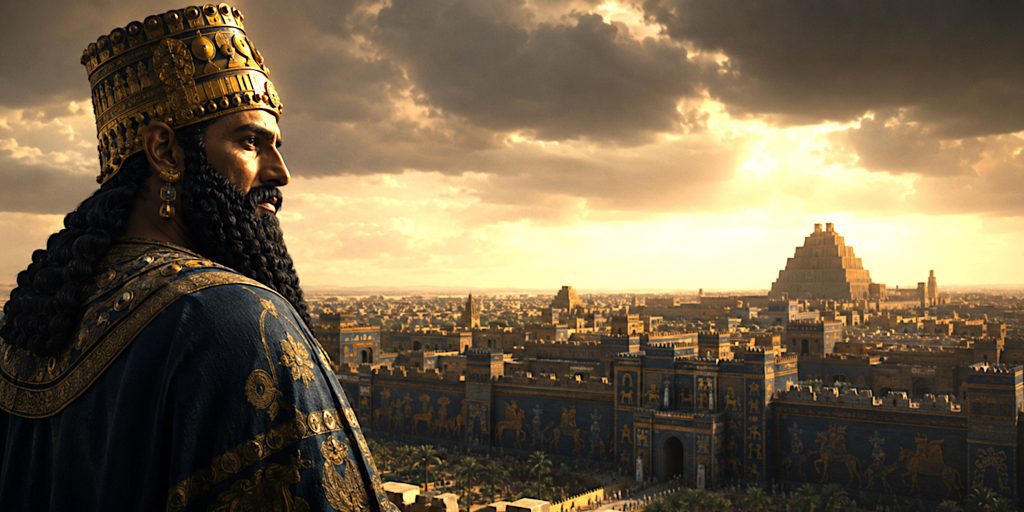
Ashurbanipal ruled the Neo-Assyrian Empire from approximately 669 BC until around 631 BC, although the exact year of his death remains uncertain.
He was the son of King Esarhaddon and grandson of the formidable Sennacherib. Unlike many royal heirs, Ashurbanipal was not originally expected to inherit the throne. His elder brother Shamash-shum-ukin became king of Babylon, while Ashurbanipal inherited Assyria itself.
This unusual arrangement was intended to maintain peace between Assyria and Babylon.
It did not.
Within two decades the brothers were locked in one of the bloodiest civil wars in Mesopotamian history.
By the time Ashurbanipal emerged victorious, he had become the undisputed ruler of the largest empire the world had yet seen.
Early Life and Education
Ashurbanipal received an education that set him apart from almost every other ancient monarch.
Royal inscriptions proudly state that he could read both Sumerian and Akkadian cuneiform. Whether this was entirely true or partly royal propaganda remains debated, but there is little doubt he possessed an unusually deep interest in literature and scholarship.
He described himself as someone who could:
Read difficult tablets from before the Flood.
This claim was undoubtedly exaggerated, yet it reflects his reputation as a learned king.
Unlike many rulers who delegated intellectual pursuits to scribes, Ashurbanipal appears to have taken a genuine interest in collecting and preserving knowledge.
The Neo-Assyrian Empire at Its Height
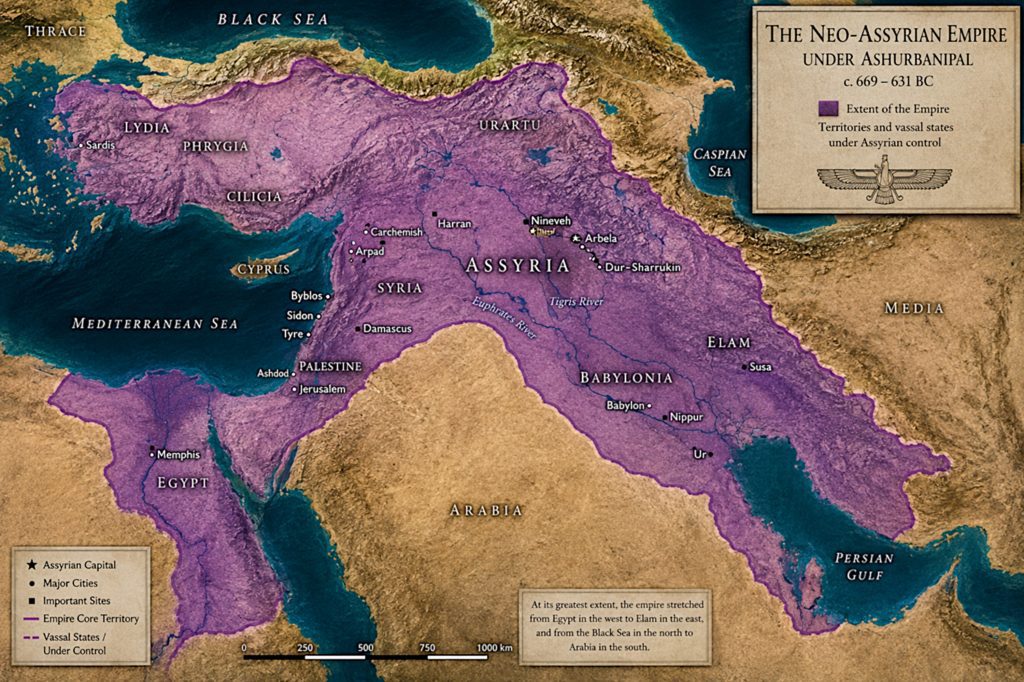
During Ashurbanipal’s reign, Assyria stretched across much of the Near East.
Its territories included:
- Mesopotamia
- Egypt, at least temporarily
- Syria
- Phoenicia
- Parts of Anatolia
- Elam
- Sections of Arabia
Maintaining such an enormous empire required constant military campaigning.
Unlike peaceful imperial administrations, Assyria survived through continuous displays of overwhelming force.
Every rebellion had to become an example.
Every defeated ruler served as a warning.
Harsh by modern standards? Absolutely.
Effective by ancient standards? Undeniably.
Battles and Military Acumen
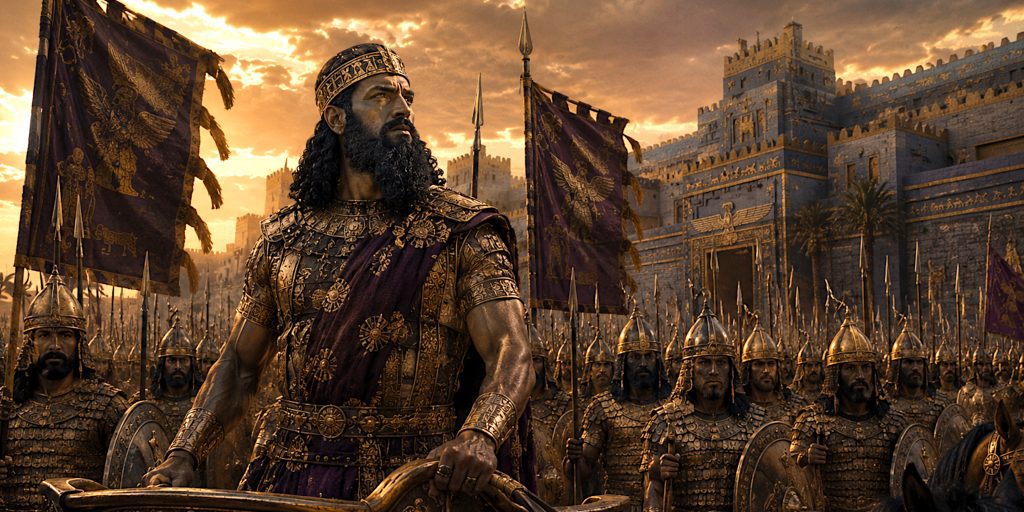
Ashurbanipal inherited one of history’s most sophisticated military machines and proved exceptionally capable of using it.
His strength did not necessarily lie in battlefield heroics but in strategy, logistics and relentless campaigning.
The Egyptian Campaigns
Although Egypt had first been conquered by his predecessors, Ashurbanipal spent much of his early reign suppressing revolts.
When Pharaoh Taharqa attempted to reclaim control, Assyrian armies marched south and restored imperial authority.
Later rebellions led by Psamtik I gradually weakened Assyrian influence, but Ashurbanipal initially maintained control through rapid intervention and overwhelming force.
The Civil War Against Babylon
Perhaps the defining conflict of his reign came when his own brother, Shamash-shum-ukin, rebelled.
Babylon attracted allies from across the region, including Elam and various Aramean tribes.
The war lasted several years.
Babylon eventually fell after a devastating siege.
Ancient accounts suggest famine became so severe that desperate acts of cannibalism occurred inside the city, although these reports probably contain deliberate exaggeration intended to glorify the Assyrian victory.
His brother likely died during the city’s destruction.
The Destruction of Elam
Ashurbanipal’s campaigns against Elam became legendary.
After repeated wars, Assyrian forces captured the Elamite capital of Susa.
Royal inscriptions proudly describe cities burned, temples destroyed and entire regions laid waste.
One inscription famously declares that the land was so completely devastated that even wild animals reclaimed it.
As historians, we must approach these claims carefully. Ancient kings routinely exaggerated their victories.
Even allowing for propaganda, archaeological evidence confirms widespread destruction.
Campaigns Against Arabian Tribes
Ashurbanipal also conducted campaigns deep into Arabia.
These expeditions demonstrated remarkable logistical organisation.
Marching armies across deserts required enormous planning, secure supply routes and experienced commanders.
Victories here protected Assyria’s lucrative trade connections.
Military Leadership
Ashurbanipal excelled in several areas.
Strategic Planning
He coordinated multiple campaigns across vast distances simultaneously.
Logistics
Supplying armies operating hundreds of miles from Assyria required exceptional administration.
Psychological Warfare
Public displays of punishment discouraged rebellion throughout the empire.
Siege Warfare
Assyrian engineers remained among the finest in the ancient world, using ramps, towers, battering rams and mining operations against fortified cities.
Arms and Armour
The Assyrian army represented one of the most advanced military forces of the Iron Age.
Swords
Elite warriors carried straight iron swords with double-edged blades.
These weapons proved highly effective in close combat following missile exchanges.
Officers often carried beautifully decorated ceremonial swords alongside practical battlefield weapons.
Spears
The spear remained the primary infantry weapon.
Long thrusting spears enabled disciplined formations capable of resisting enemy charges.
Bows
Perhaps Assyria’s greatest military advantage lay in its archers.
Composite bows produced remarkable power and range.
Archers frequently operated alongside large shield bearers who protected them while firing.
Armour
Elite soldiers wore scale armour made from overlapping bronze or iron plates sewn onto leather garments.
Helmets often featured pointed conical designs with neck protection.
Royal bodyguards received the finest equipment available.
Shields
Large wicker shields strengthened with leather protected infantry formations.
Archers commonly fought behind towering rectangular shields carried by assistants.
Cavalry and Chariots
Ashurbanipal’s reign marked the increasing importance of cavalry.
Horsemen gradually replaced traditional war chariots, although both remained in service.
Mounted archers and lancers provided flexibility across varied terrain.
The Famous Lion Hunts
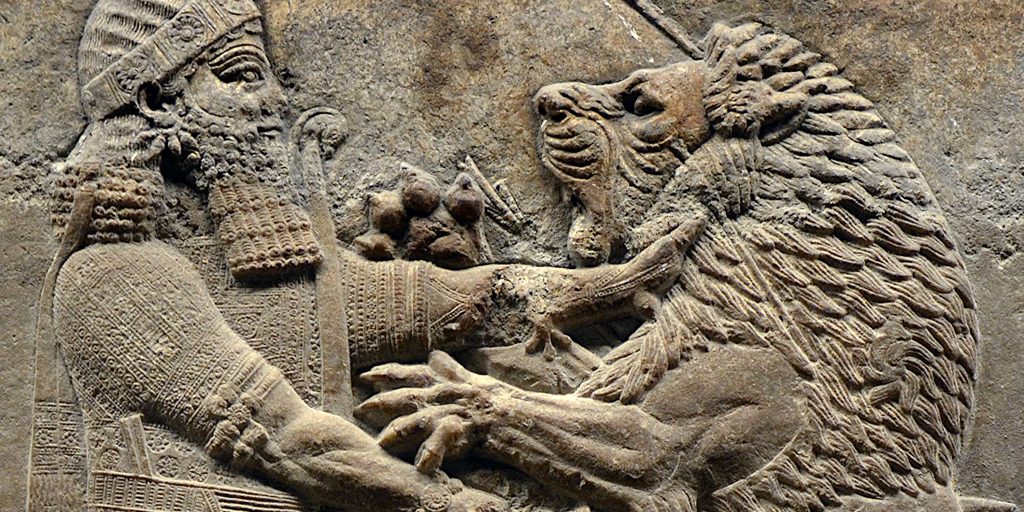
The lion hunt reliefs remain among the greatest artistic achievements of the ancient world.
They were never intended as sporting records.
Instead, they symbolised royal authority over chaos itself.
Ashurbanipal appears calm while lions leap toward him in dramatic scenes of extraordinary realism.
The animals are depicted with astonishing anatomical accuracy.
Even today they possess remarkable emotional power.
Standing before the originals is genuinely humbling. Ancient sculpture rarely feels this alive.
The Library of Ashurbanipal
Ashurbanipal’s greatest legacy may not be military at all.
His royal library at Nineveh contained more than 30,000 clay tablets.
Subjects included:
- Literature
- Medicine
- Astronomy
- Mathematics
- Law
- Religion
- Royal correspondence
- Dictionaries
- Omens
- Scientific observations
Many surviving copies of the Epic of Gilgamesh originate from this collection.
Ironically, the destruction of Nineveh helped preserve the library.
The intense heat from fires baked many clay tablets, making them durable enough to survive over two and a half millennia.
Government and Administration
Ashurbanipal maintained a highly organised imperial bureaucracy.
Governors reported directly to the king.
An extensive courier network carried information rapidly across the empire.
Taxation funded both military campaigns and monumental building projects.
Provincial rulers remained under close supervision, reducing opportunities for rebellion.
The system functioned remarkably well while strong leadership remained at its centre.
Art and Architecture
The royal palaces at Nineveh represented some of the finest buildings of the ancient Near East.
Stone reliefs covered entire walls.
Scenes depicted:
- Military victories
- Religious ceremonies
- Hunting expeditions
- Tribute from foreign rulers
- Construction projects
Their artistic quality remains extraordinary.
Unlike the static poses found in many ancient civilisations, Assyrian artists captured movement with remarkable confidence.
Personality
Ancient inscriptions portray Ashurbanipal as fearless, intelligent and divinely chosen.
Naturally, they were written to flatter the king.
Yet certain traits consistently emerge.
He appears genuinely curious.
He valued learning.
He enjoyed displaying power publicly.
He also possessed an uncompromising willingness to destroy anyone who threatened his authority.
It is tempting to imagine him as history’s first warrior scholar, although that phrase risks oversimplifying a far more complex individual.
Death and the Collapse of Assyria
Ashurbanipal likely died around 631 BC.
His final years remain poorly documented.
Within two decades, the mighty Assyrian Empire collapsed.
Babylonians and Medes captured Nineveh in 612 BC.
One of history’s greatest empires vanished with astonishing speed.
Ironically, its greatest king became its last truly effective ruler.
Archaeology and Recent Discoveries
Archaeology continues to reshape our understanding of Ashurbanipal’s reign.
Excavations at Nineveh have uncovered further sections of palace complexes, administrative buildings and fragments of sculptured reliefs that provide additional insight into royal life and imperial administration. Modern conservation work has also improved the reading of damaged inscriptions, allowing historians to refine translations and reconstruct missing passages from official records.
Advances in digital imaging and 3D scanning have transformed the study of the Library of Ashurbanipal. Tablets that were once considered unreadable due to fire damage or erosion can now be examined in far greater detail. Scholars continue to identify new joins between broken fragments scattered across museum collections, effectively reassembling texts that have been separated for more than 2,600 years.
Research has also revealed more about Assyrian urban planning at Nineveh. Geophysical surveys and satellite imaging have mapped extensive canals, aqueducts and defensive works that supported one of the largest cities of the ancient world. These engineering projects demonstrate that the empire’s strength rested not only on military power but also on sophisticated infrastructure.
Ongoing archaeological work in northern Iraq continues to uncover settlements, roads and provincial centres that were once administered under Ashurbanipal. Each discovery adds further detail to how the empire functioned beyond the walls of its royal capital.
Where to See Artefacts from Ashurbanipal’s Reign
Many of the finest surviving objects from Ashurbanipal’s reign are housed in museums around the world.
The British Museum in London holds the largest collection. Highlights include the celebrated Lion Hunt reliefs, palace sculptures from Nineveh and thousands of clay tablets from the royal library. These objects provide an unparalleled introduction to the art, administration and military culture of the Neo-Assyrian Empire.
The Iraq Museum in Baghdad preserves important Assyrian sculptures, inscriptions and archaeological finds from Nineveh and other major sites. Although access has varied over the years, it remains one of the most significant collections of Mesopotamian heritage.
The Louvre in Paris and the Vorderasiatisches Museum in Berlin also display impressive Assyrian reliefs, statues and inscriptions from the Neo-Assyrian period, helping visitors appreciate the artistic achievement of Ashurbanipal’s age.
For those interested in literature rather than warfare, nothing surpasses the surviving tablets from the royal library. Holding even a small clay tablet, covered in tiny cuneiform signs impressed over two and a half thousand years ago, offers a striking reminder that the voices of ancient Mesopotamia have endured because one king believed they were worth preserving.
Legacy
Ashurbanipal remains one of antiquity’s most remarkable rulers.
He expanded the Neo-Assyrian Empire to its greatest territorial extent, commanded armies that reshaped the political landscape of the Near East and presided over one of the finest artistic periods in Mesopotamian history.
Yet his most enduring achievement may be quieter than any battlefield victory.
Empires rise.
Empires fall.
Libraries have a habit of outliving both.
That may be the greatest irony of Ashurbanipal’s reign. A king remembered for conquest ultimately secured immortality by preserving words rather than wielding the sword.