The Viking raid on Hamburg in 845 rarely enjoys the same fame as the sack of Paris in the very same year, yet it deserves far more attention. If Paris became the symbol of Viking audacity, Hamburg demonstrated something equally significant. It showed that no frontier town, however ambitious or strategically important, could rely on walls alone.
Hamburg was not simply another settlement on the River Elbe. It had been chosen by the Carolingians as a missionary centre from which Christianity would spread into Scandinavia and among the pagan peoples beyond the empire’s borders. Destroying it carried military, economic and symbolic weight in equal measure.
From a historian’s perspective, this raid marks one of those moments where political ambition collided with brutal reality. The Carolingian vision for northern Europe was impressive on parchment. Unfortunately for its architects, the Vikings rarely read government plans before arriving with axes.
Background
During the reign of Emperor Louis the Pious and his successors, Hamburg developed into an important frontier fortress. In 831 it became the seat of the Archbishopric of Hamburg under Ansgar, the missionary later remembered as the “Apostle of the North.”
Its location made perfect sense from a Frankish perspective. Positioned along the lower Elbe, Hamburg controlled trade routes while acting as a launch point for Christian missions into Denmark and Sweden.
It also happened to lie within striking distance of experienced Viking fleets.
By the 840s, political instability had weakened Carolingian authority. Civil wars between the emperor’s sons diverted troops away from frontier defence, allowing Scandinavian raiders to penetrate deeper into Frankish territory than ever before.
Why Hamburg Was Targeted
Several factors made Hamburg an attractive objective.
- It was wealthy by regional standards.
- It held valuable church treasures.
- It served as a military outpost.
- It symbolised Frankish authority.
- It represented Christian expansion into pagan Scandinavia.
Unlike monasteries that offered quick plunder, Hamburg promised both riches and political prestige.
Destroying the archbishop’s headquarters also struck directly at Carolingian influence beyond the empire.
Forces
Precise numbers are unknown. Contemporary chroniclers focused on the destruction rather than battlefield statistics.
| Force | Estimated Strength | Composition |
|---|---|---|
| Viking Raiders | Approximately 500 to 2,000 warriors | Longships carrying professional raiders, experienced sailors and elite warriors |
| Hamburg Defenders | Unknown, probably a few hundred | Frankish garrison, local militia, church retainers and townspeople |
Most historians believe the Viking force arrived in several longships rather than as a massive invasion fleet.
Leaders
| Leader | Side | Role |
|---|---|---|
| Unknown Viking Chieftain | Vikings | Commander of the raiding force. His identity is not recorded. |
| Ansgar | Frankish | Archbishop of Hamburg. Escaped the destruction and later rebuilt his missionary work. |
| Local Frankish Commanders | Frankish | Oversaw the town’s defence, though little survives regarding their identities. |
The absence of named Viking leaders reminds us that medieval chroniclers often recorded kings and bishops while leaving successful raiders frustratingly anonymous.
Troop Composition
Viking Raiders
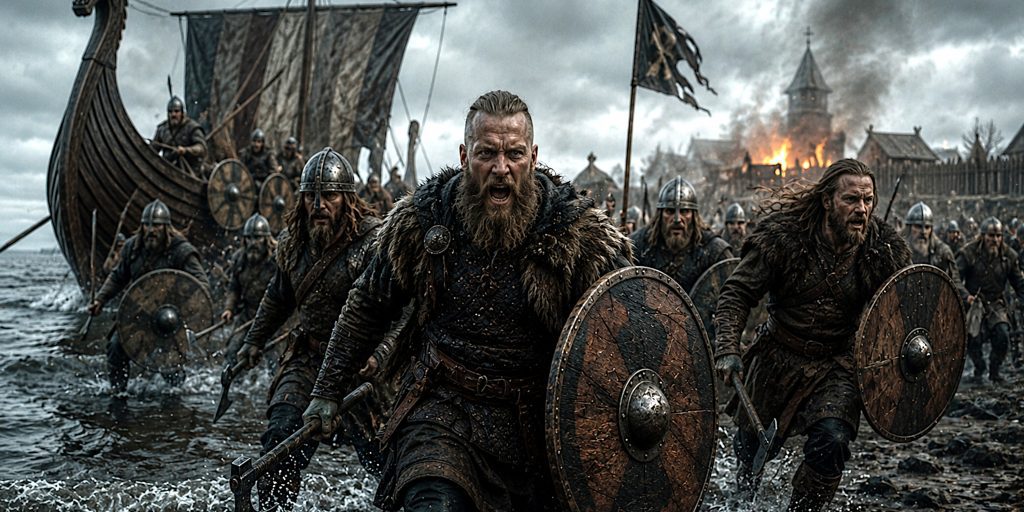
- Professional warriors
- Ship crews
- Experienced archers
- Spearmen
- Wealthier retainers armed with swords
- Possible berserkir traditions among elite fighters, although evidence remains debated
Frankish Defenders
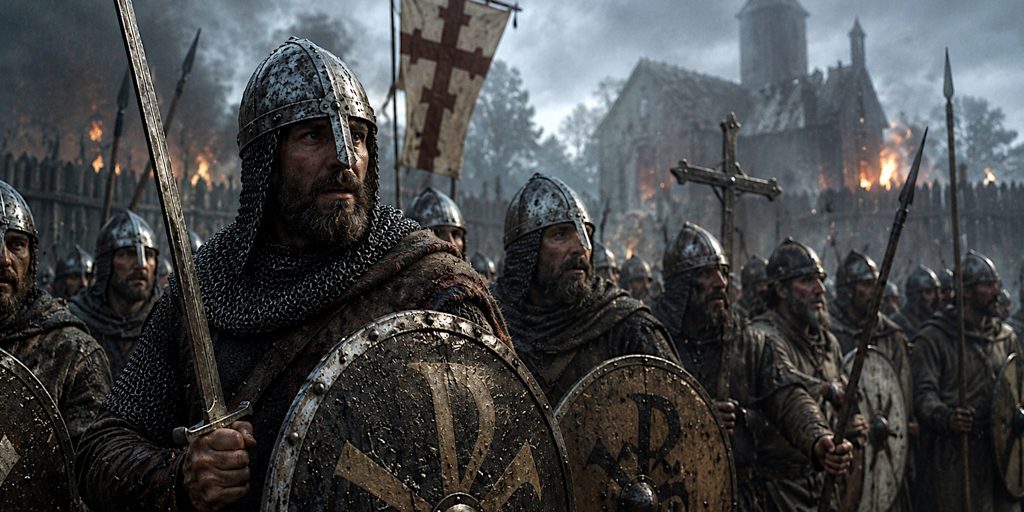
- Local garrison troops
- Noble retainers
- Town militia
- Clerical servants defending church property
- Armed civilians
The Frankish defenders were almost certainly outmatched by veterans who had spent years raiding along Europe’s coastlines.
Arms and Armour
The raid reflects the military equipment typical of the mid ninth century.
| Weapon | Viking Use | Frankish Use |
|---|---|---|
| Spears | Primary battlefield weapon | Standard infantry weapon |
| Axes | Extremely common | Used alongside other arms |
| Bows | Used before assaults | Defensive missile weapon |
| Seaxes | Widely carried | Common sidearm |
| Shields | Round wooden shields | Round and kite style transitional shields |
Viking Sword Types
Several forms of sword likely appeared during the raid.
- Petersen Type H
- Petersen Type K
- Petersen Type S
- Early Petersen Type X
- Carolingian pattern-welded swords acquired through trade or warfare
Many Viking swords were in fact Frankish-made blades. Carolingian workshops produced some of Europe’s finest steel, despite repeated attempts by Frankish rulers to prevent their export.
Frankish Swords
Frankish warriors commonly carried:
- Carolingian arming swords
- Pattern-welded double-edged swords
- High-status blades marked with famous smith names such as Ulfberht, although the widespread appearance of these swords belongs slightly later in the century.
Armour
Vikings
- Iron spectacle helmets
- Mail shirts owned by wealthier warriors
- Thick woollen tunics
- Leather belts and equipment
- Heavy cloaks for campaigning
Franks
- Mail hauberks
- Iron helmets with nasal protection
- Wooden shields
- Quilted garments beneath armour
- Spears and swords as primary arms
Mail remained expensive. Most combatants on both sides relied more upon skill and shield discipline than extensive armour.
Timeline of the Raid
| Date | Event |
|---|---|
| Early 845 | Viking fleet enters the lower Elbe region |
| Shortly afterwards | Hamburg is approached by Viking ships |
| Assault begins | Defensive positions collapse |
| Town captured | Churches, homes and administrative buildings are looted |
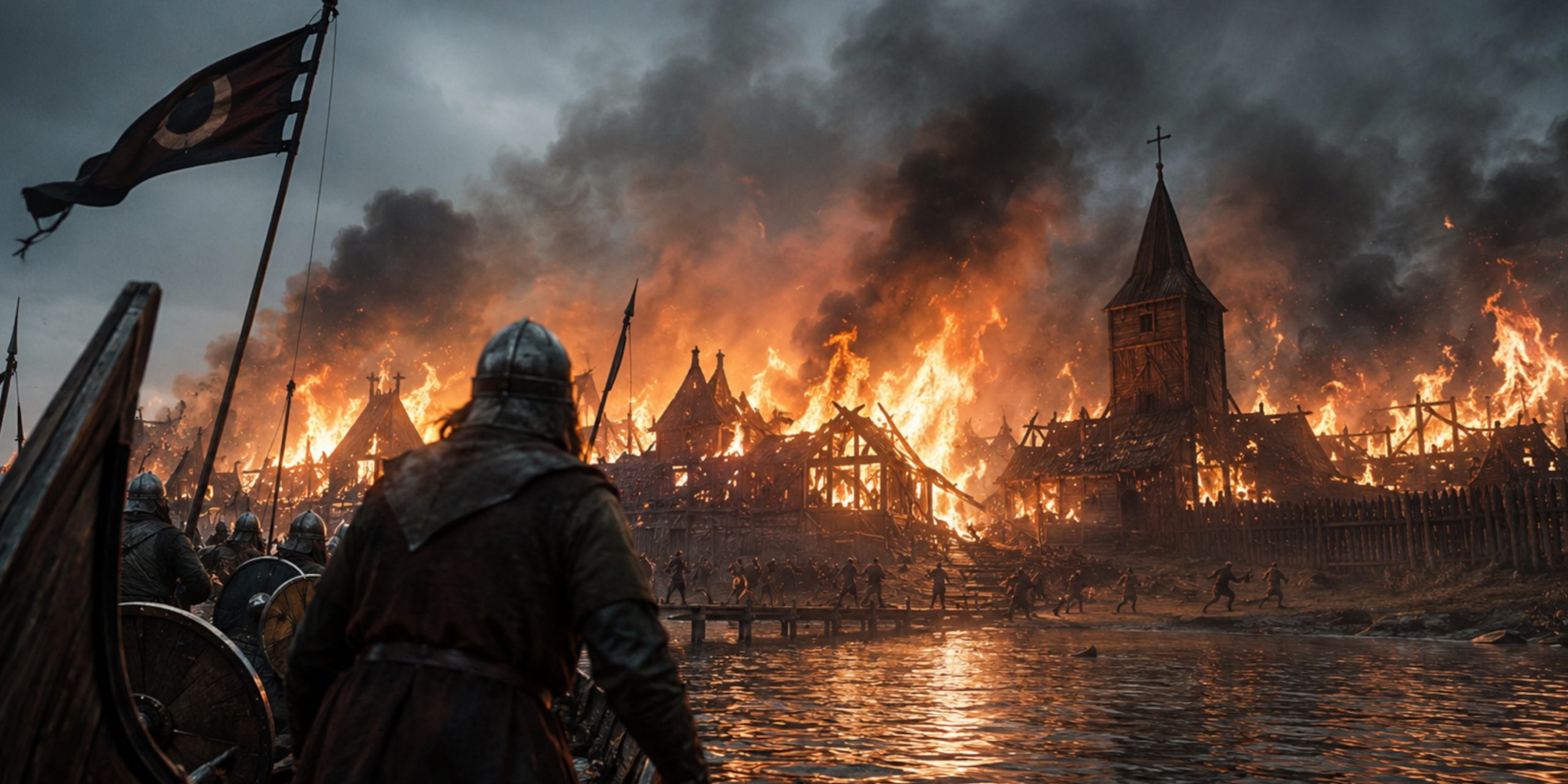
| Sack of Hamburg | Large parts of the settlement are burned |
| Aftermath | Archbishop Ansgar flees, later rebuilding his mission elsewhere |
The entire raid probably lasted only a short time. Viking operations depended upon speed rather than prolonged occupation.
The Destruction
Contemporary accounts describe widespread devastation.
Churches were stripped of valuables before being burned. Precious manuscripts disappeared. Relics were scattered or destroyed.
Hamburg’s importance as an ecclesiastical centre meant that much of its accumulated wealth consisted of liturgical treasures rather than commercial goods.
The physical destruction proved severe enough that the archbishopric temporarily lost much of its practical function.
Contemporary Accounts
The principal source comes from Rimbert, Ansgar’s successor.
Writing in the Vita Anskarii, he described the catastrophe:
“The city was utterly destroyed by the attack of the Northmen.”
He also records Ansgar escaping with only a handful of possessions, preserving a few sacred relics while losing much of the church’s accumulated wealth.
Although Rimbert naturally viewed events through a religious lens, his account remains invaluable.
The Annals of St Bertin likewise note renewed Viking attacks across the Frankish Empire during this turbulent period, placing the destruction of Hamburg within a much wider campaign of Scandinavian expansion.
Archaeology
Archaeological work in Hamburg has helped illuminate the ninth-century settlement despite extensive later urban development.
Excavations have uncovered:
- Burn layers consistent with destructive fires.
- Carolingian building remains.
- Timber fortifications.
- Imported trade goods.
- Iron tools and weapon fragments.
- Evidence of extensive rebuilding during the later ninth century.
Archaeologists cannot attribute every burned structure directly to the raid of 845, since medieval towns burned with unfortunate regularity. Fire and timber architecture made for an unhappy partnership throughout the Middle Ages.
Even so, the archaeological evidence broadly supports written accounts describing major destruction during this period.
Immediate Aftermath
Hamburg did not disappear permanently.
Ansgar continued his missionary work despite enormous setbacks. Eventually Hamburg was united with Bremen, creating the Archbishopric of Hamburg-Bremen.
Rather than ending Christian missions into Scandinavia, the raid delayed them.
Ironically, within two centuries many Viking kingdoms themselves had embraced Christianity.
History has an enduring habit of producing outcomes that would have baffled everyone involved.
Military Analysis
Several lessons emerge from the raid.
Viking Strengths
- Excellent operational mobility
- Surprise attacks
- Experienced professional warriors
- Flexible command structure
- Effective use of rivers
Frankish Weaknesses
- Limited frontier forces
- Political instability
- Slow mobilisation
- Vulnerable fixed settlements
- Overreliance on static defences
The attack demonstrated that fortified towns without nearby field armies remained vulnerable to determined Viking expeditions.
Historical Importance
Although overshadowed by the sack of Paris in 845, Hamburg’s destruction carried profound consequences.
It temporarily crippled the Carolingian missionary effort in northern Europe.
It exposed weaknesses in imperial frontier defence.
It encouraged further Scandinavian raids into Saxony and along the Elbe.
Perhaps most importantly, it reminded medieval rulers that economic centres, religious institutions and military strongholds were often one and the same. Lose one, and the others frequently followed.
Legacy
Today the raid stands as one of the defining Viking attacks against northern Germany.
It illustrates how relatively small but highly mobile forces could reshape political and religious history.
The destruction of Hamburg also highlights the resilience of medieval institutions. Despite catastrophe, the missionary movement recovered, Hamburg was rebuilt, and northern Europe gradually entered a new political and religious age.
The Vikings won the raid. The Carolingians eventually recovered their frontier. Neither side achieved quite the final victory they imagined, which is often how history prefers to leave things.
Further Reading
Primary sources include:
- Vita Anskarii by Rimbert
- Annals of St Bertin
- Royal Frankish Annals for earlier Carolingian context
Modern archaeological investigations in Hamburg continue to refine our understanding of the ninth-century settlement, revealing new evidence about the town that became one of the Viking Age’s most significant victims.