How one hot June afternoon on the banks of the Alle River changed Europe
The Battle of Friedland, fought on 14 June 1807, stands among Napoleon Bonaparte’s greatest battlefield victories. It was not merely another French success during the War of the Fourth Coalition. It was the engagement that forced Tsar Alexander I to negotiate, leading directly to the Treaties of Tilsit and the temporary reshaping of continental Europe.
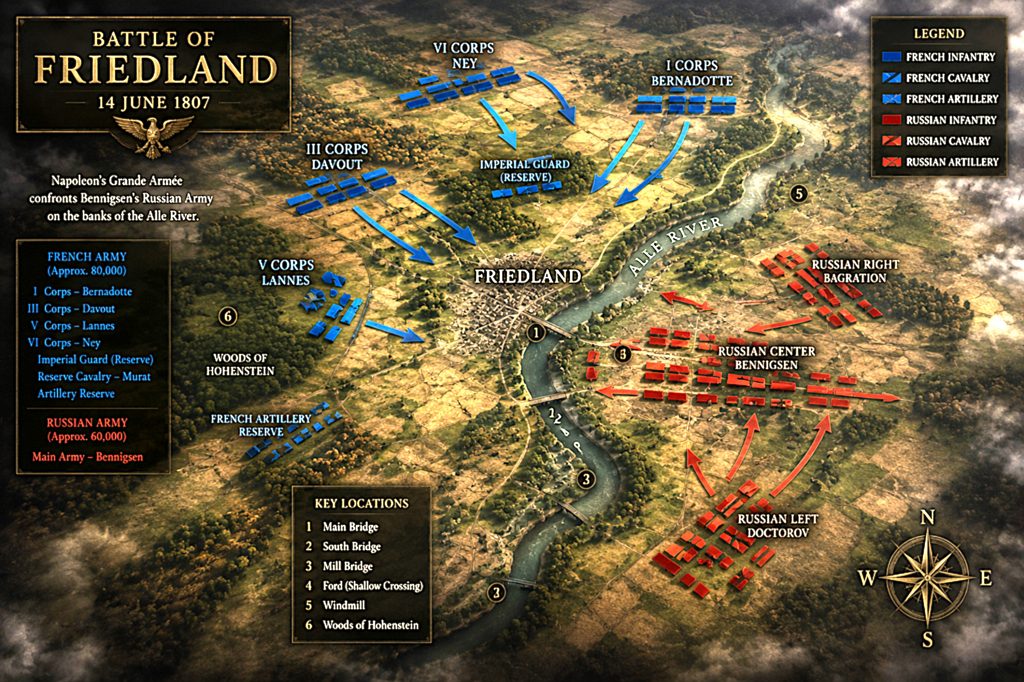
Napoleon had often spoken of destroying an enemy army before it could fully deploy. At Friedland he found precisely that opportunity. Russian commander General Levin August von Bennigsen crossed the Alle River believing he faced only part of the French army. Instead, he encountered Napoleon himself, who calmly allowed the Russians to commit the bulk of their forces before launching a devastating counterattack.
The battlefield offered the Russians almost no room for retreat. Behind them lay the river. Before them stood the Grande Armée at the height of its powers. It was the sort of tactical situation that military historians dream of analysing and generals desperately hope never to experience.
Battle Overview
| Detail | Information |
|---|---|
| Date | 14 June 1807 |
| Location | Friedland (modern Pravdinsk, Kaliningrad Oblast, Russia) |
| War | War of the Fourth Coalition |
| Result | Decisive French victory |
| French Commander | Napoleon Bonaparte |
| Russian Commander | General Levin August von Bennigsen |
| Estimated French Strength | About 80,000 men |
| Estimated Russian Strength | About 60,000 men |
| French Casualties | Approximately 8,000 to 10,000 |
| Russian Casualties | Approximately 20,000 to 30,000 |
Why the Battle Happened
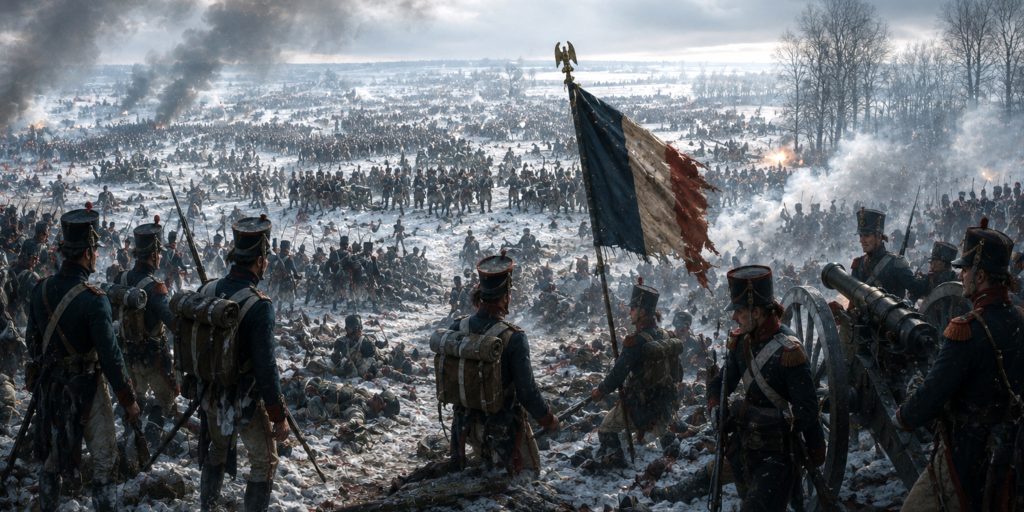
Following the bloody but indecisive Battle of Eylau earlier in 1807, both armies spent months rebuilding. Napoleon sought another opportunity to destroy the Russian field army before Prussian resistance could recover.
Bennigsen attempted to isolate and defeat Marshal Jean Lannes before the remainder of the French army could arrive. Initially this seemed a reasonable plan. Lannes deliberately fought a delaying action, buying precious hours while Napoleon concentrated his forces.
It proved a fatal miscalculation.
Instead of overwhelming an isolated French corps, Bennigsen found himself facing almost the entire Grande Armée while much of his own army was trapped with a major river to its rear.
Forces
French Army
| Formation | Commander | Approximate Strength |
|---|---|---|
| Imperial Guard | Napoleon Bonaparte | Elite reserve |
| I Corps | Jean-Baptiste Bernadotte | Around 20,000 |
| III Corps | Louis Davout | Around 20,000 |
| V Corps | Jean Lannes | Around 18,000 |
| VI Corps | Michel Ney | Around 17,000 |
| Reserve Cavalry | Joachim Murat | Around 10,000 cavalry |
| Artillery Reserve | Various | More than 100 guns |
French Strengths
- Exceptional operational mobility
- Highly experienced corps commanders
- Superior artillery concentration
- Flexible corps system
- Strong Imperial Guard reserve
Russian Army
| Formation | Commander | Approximate Strength |
|---|---|---|
| Main Army | Levin August von Bennigsen | Around 60,000 |
| Infantry Divisions | Various generals | Majority of army |
| Imperial Cavalry | Various commanders | Several thousand cavalry |
| Artillery | Various | Around 120 guns |
Russian Strengths
- Well-trained artillery
- Tough infantry with considerable combat experience
- Strong defensive tradition
- High morale despite recent campaigning
Russian Weaknesses
- Limited room to manoeuvre
- Poor battlefield communications
- Dangerous reliance on narrow bridges
- Inflexible deployment after crossing the river
Leaders
Napoleon Bonaparte
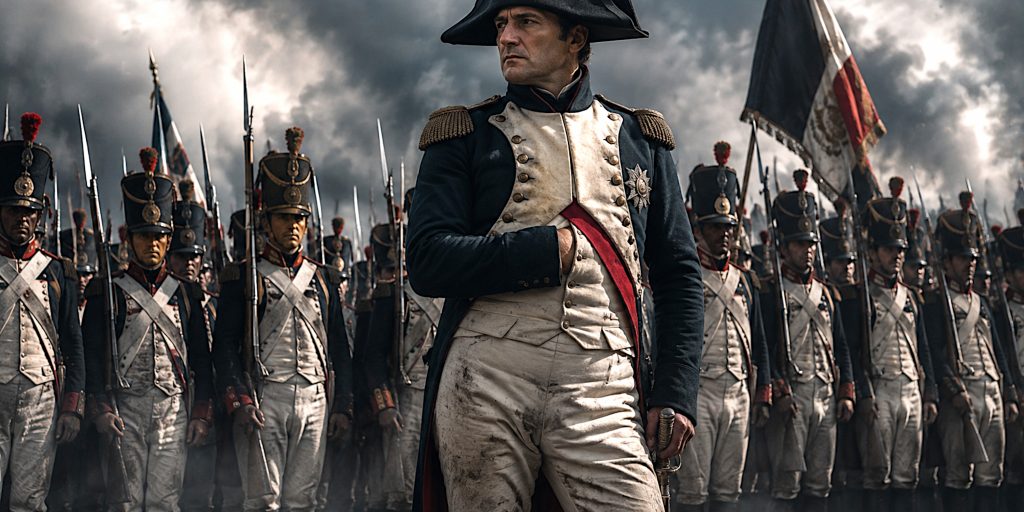
Napoleon displayed remarkable patience at Friedland. Rather than launching an immediate assault, he recognised the strategic opportunity developing before him. As more Russian troops crossed the Alle River, their position became increasingly precarious.
His timing remains one of the battle’s greatest lessons. Rather than attacking as soon as he arrived, he waited until the Russian army had effectively trapped itself.
Military history occasionally rewards patience more than brilliance. Friedland happened to provide both.
General Levin August von Bennigsen
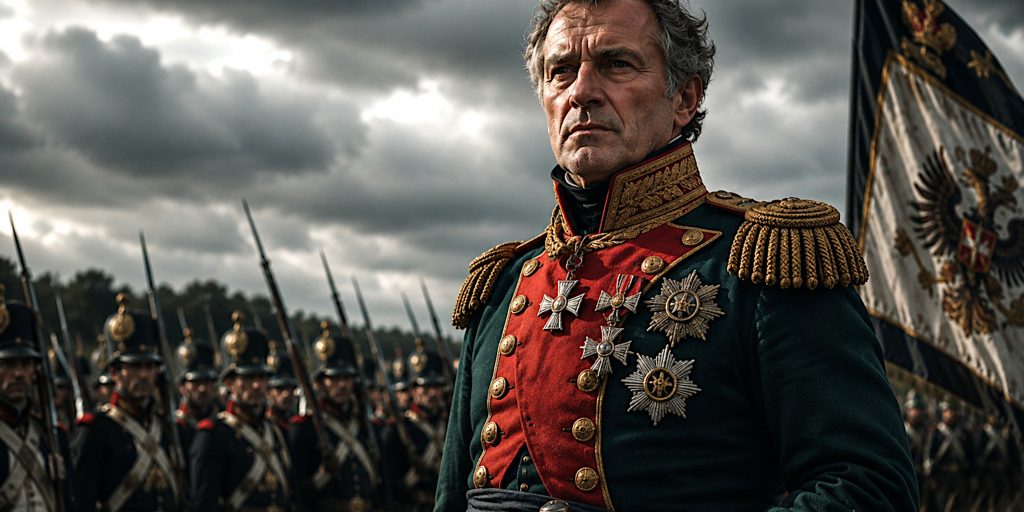
Bennigsen was an experienced officer who had performed reasonably well earlier in the campaign. At Friedland, however, he fundamentally misread French intentions.
Believing only a portion of Napoleon’s army stood before him, he continued feeding troops across the river. Once the French attack began, reversing the deployment became almost impossible.
Battle Timeline
| Time | Event |
|---|---|
| Early morning | Russian army crosses the Alle River near Friedland |
| Around 6:00 am | Marshal Lannes delays Russian advance |
| Mid-morning | Napoleon arrives with reinforcements |
| Noon | French army continues concentrating |
| Around 5:00 pm | Ney launches major assault against Russian left |
| Evening | French artillery devastates Russian formations |
| Late evening | Russian retreat becomes chaotic across the river |
| Night | French victory complete |
The Battle
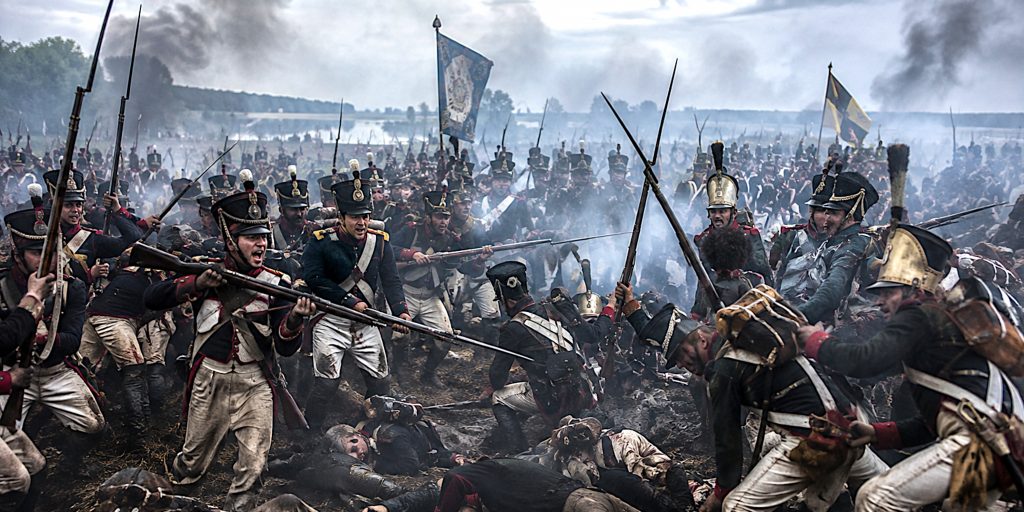
Opening Phase
Marshal Lannes deserves enormous credit for the French victory. His relatively small corps absorbed pressure for much of the morning while Napoleon gathered overwhelming strength.
Lannes understood his task perfectly. He was not expected to win. He merely had to avoid losing.
That distinction proved critical.
Ney’s Assault
The decisive moment came when Marshal Michel Ney attacked the Russian left.
Supported by massed artillery, Ney’s infantry advanced aggressively toward Friedland itself. Fierce fighting erupted around the town, with French troops gradually forcing the Russians backwards.
As pressure increased, the Russian army found itself compressed against the Alle River.
French Artillery Dominance
Napoleon concentrated his artillery with devastating effect.
French batteries poured shot and shell into increasingly crowded Russian formations. The confined terrain magnified every salvo.
The Russian artillery fought stubbornly, but it could not compensate for the deteriorating tactical position.
Collapse of the Russian Position
As French infantry and cavalry pressed forward, Russian formations began retreating toward the river crossings.
Many bridges became clogged.
Others collapsed under the weight of retreating soldiers, horses and artillery.
Large numbers of Russian troops drowned attempting to escape across the Alle.
By nightfall, Bennigsen’s army had ceased to function as an organised fighting force.
Arms and Armour
The Napoleonic Wars saw firearms dominate the battlefield, yet edged weapons remained essential during close combat and cavalry charges.
French Weapons
| Weapon | Primary Users |
|---|---|
| AN XI Infantry Briquet Sword | Grenadiers and elite infantry |
| AN IX Heavy Cavalry Sabre | Cuirassiers |
| AN XI Light Cavalry Sabre | Hussars and chasseurs à cheval |
| Infantry Musket (Charleville pattern) | Line infantry |
| Bayonet | Universal infantry weapon |
Russian Weapons
| Weapon | Primary Users |
|---|---|
| 1798 Russian Infantry Hanger | Infantry officers and NCOs |
| Heavy Cavalry Broadsword | Cuirassiers |
| Curved Light Cavalry Sabre | Hussars and Cossacks |
| Flintlock Musket | Line infantry |
| Socket Bayonet | Infantry |
Armour
Although full medieval armour had disappeared, heavy cavalry still retained significant protective equipment.
French cuirassiers wore:
- Steel breastplates
- Backplates
- Brass helmets with horsehair crests
Russian cuirassiers wore similar cuirasses alongside metal helmets.
These protections remained highly effective against sword cuts and some pistol fire, although artillery largely ignored such niceties.
Battlefield Tactics
Napoleon demonstrated several principles still studied in military academies today.
- Delaying action by advance corps
- Concentration of superior force
- Centralised artillery support
- Flexible corps manoeuvre
- Sequential commitment of reserves
- Exploitation of restricted enemy retreat routes
The Russians, meanwhile, committed the classic operational error of fighting with a major river immediately behind their army.
History rarely forgives that particular mistake.
Casualties
| Army | Estimated Casualties |
|---|---|
| French | 8,000 to 10,000 |
| Russian | 20,000 to 30,000 |
Russian losses included:
- Killed
- Wounded
- Captured
- Soldiers drowned during retreat
- Large quantities of artillery abandoned
Archaeology
The battlefield around modern Pravdinsk has yielded numerous discoveries.
Recovered artefacts include:
- Musket balls
- Canister shot
- French and Russian uniform buttons
- Belt fittings
- Bayonets
- Cavalry sabre fragments
- Horse equipment
- Coins
- Artillery fragments
Distribution studies of these finds have helped historians reconstruct troop movements, artillery positions and the location of the fiercest fighting.
Modern archaeological surveys continue to improve understanding of battlefield geography, particularly where later development has altered the landscape.
Contemporary Accounts
Napoleon reportedly reflected after the battle:
“The battle of Friedland is worthy to rank with Marengo, Austerlitz and Jena.”
Marshal Lannes praised the fighting qualities of the Russian infantry despite their defeat, noting their stubborn resistance under intense pressure.
General Bennigsen acknowledged that the French concentration of force had overwhelmed his army before an orderly withdrawal could be organised.
These accounts underline an important point. Friedland was not won because the Russians lacked courage. They fought with determination throughout the day. Their defeat stemmed from an increasingly impossible tactical position.
Legacy
Friedland transformed European politics.
Within weeks:
- Russia sought peace.
- The Treaties of Tilsit were signed.
- Prussia suffered severe territorial losses.
- Napoleon reached the height of his influence over continental Europe.
- France appeared virtually unstoppable.
Many historians consider Friedland the true conclusion of the War of the Fourth Coalition.
Ironically, Napoleon’s greatest victories often planted the seeds of later challenges. The confidence generated by campaigns such as Friedland arguably contributed to increasingly ambitious strategic decisions in the years that followed.
Visiting the Battlefield
The battlefield lies around modern Pravdinsk in Russia’s Kaliningrad Oblast.
Visitors can still identify elements of the original terrain, including the course of the Alle River, although urban development has altered sections of the landscape.
Local memorials commemorate those who fought during one of the Napoleonic Wars’ most decisive engagements.
Frequently Asked Questions
When was the Battle of Friedland fought?
The battle took place on 14 June 1807.
Why was Friedland important?
It forced Russia into peace negotiations that resulted in the Treaties of Tilsit and established Napoleon’s dominance over continental Europe.
Who won the Battle of Friedland?
Napoleon’s French Grande Armée achieved a decisive victory over Bennigsen’s Russian army.
How many soldiers fought?
Approximately 140,000 soldiers participated, with around 80,000 French and 60,000 Russians.
Why did the Russians lose?
They committed most of their army across the Alle River before realising Napoleon had concentrated his full force. Once the French attacked, escape routes became dangerously restricted.