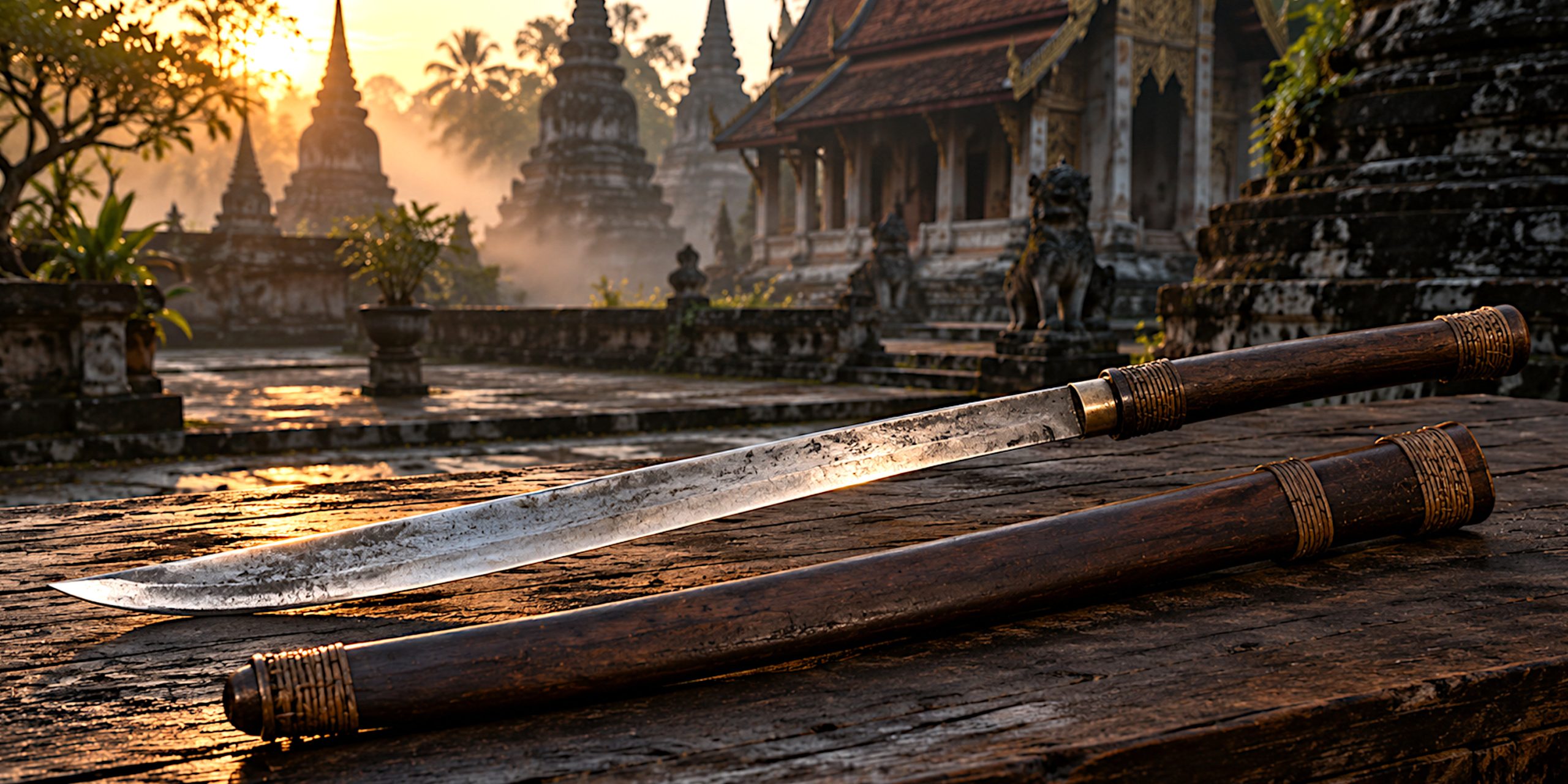
Thai swordsmanship has a particular economy of movement: a turn of the body, a change of angle, then a blade arriving where the opponent would rather it did not. The weapons associated with Krabi-Krabong belong within that practical tradition, although their history requires more care than the familiar image of a warrior carrying two swords might suggest.
Krabi-Krabong is a Thai weapons-based martial art, rather than the name of one standard sword. Its repertoire includes swords, staffs, polearms and shields. Understanding the weapons means distinguishing the martial system from the individual objects used within it.
For collectors, that distinction matters. A nineteenth-century Thai daab, a decorated performance weapon and a modern training sword may share a recognisable outline while having very different purposes and values.
What Are Krabi and Daab?
Terminology varies between translations, martial arts schools and auction catalogues. These are useful distinctions rather than rigid rules.
| Term | Meaning and context |
|---|---|
| Krabi-Krabong | The Thai martial art encompassing several weapon categories |
| Krabi | Commonly translated as sabre; also used within broader classifications of shorter weapons |
| Daab, dap or darb | Alternative transliterations for a Thai sword, commonly single-edged |
| Dha or dah | A term frequently used in English-language collecting for related mainland Southeast Asian swords |
| Daab song mue | Paired-sword practice, with a sword held in each hand |
The Thai Sports Association lists krabi and daab separately within the art’s equipment. Its description also includes staffs, halberds, shields and short wooden weapons. Reducing the entire tradition to double swords leaves rather a lot of equipment outside the discussion.
Specification and Construction
There is no universal specification for a “Krabi-Krabong sword”. Historical swords vary by period, region, workshop and purpose. Training equipment introduces further differences.
The following features describe many daab or dha-style swords associated with the wider tradition.
| Feature | Description |
|---|---|
| Blade | Commonly single-edged, straight to gently curved |
| Point | Varies in profile; suitability for thrusting depends on the example |
| Hilt | Often an elongated wooden grip, sometimes bound with rattan or cord |
| Hand protection | Frequently little or no substantial guard |
| Fittings | Plain functional mounts or more elaborate decorative metalwork |
| Scabbard | Commonly wooden, sometimes bound or fitted with metal mounts |
| Dimensions | Variable; measurements should come from the individual weapon |
| Weight | No reliable single standard across historical and modern examples |
| Training construction | Rattan, wood or other materials selected for the school and exercise |
A useful measured example appeared at Golding Young in June 2026. Catalogued cautiously as a Burmese or Thai dha, it had a 59 cm blade and an overall sword length of 81 cm. Those dimensions describe that particular lot, not a prescribed Thai military pattern.
A sword’s handling also depends on blade thickness, taper and balance. Length alone tells us surprisingly little about how readily it changes direction.
History and Evolution
Early swords and the limits of the evidence
Sword use in the territory of modern Thailand predates the surviving literary references to Krabi-Krabong. The Metropolitan Museum of Art, for example, catalogues a sword from Tak Province as fourteenth century or earlier. It has an iron blade, a bronze handle and an overall length of 42.9 cm.
That object establishes an early sword tradition. It does not establish that its owner practised the same forms taught in a modern Krabi-Krabong school.
This is a distinction worth preserving. An old weapon and an old martial tradition can be connected without every intervening century being neatly documented.
From military skills to a documented martial art
Krabi-Krabong draws upon Thailand’s armed fighting heritage, but its exact beginnings remain uncertain. The Thailand Foundation identifies literary references in the early Rattanakosin period, including works associated with the reigns of Rama II and Rama III.
Royal support helped popularise the art under Rama IV and Rama V. Later, education became central to its survival: teacher Nak Thephasadin Na Ayudhya introduced a school class in 1935, and the art entered the national physical education curriculum in 1975. Thailand Foundation
| Period | Development | Historical caution |
|---|---|---|
| Fourteenth century or earlier | Surviving sword from Tak Province | Evidence for swords, not a named Krabi-Krabong syllabus |
| Ayutthaya period, 1351–1767 | Important context for Siamese armed warfare | Claims about particular surviving techniques need separate evidence |
| Early nineteenth century | Literary references identified by the Thailand Foundation | Firmer evidence for the named tradition |
| Mid to late nineteenth century | Royal encouragement and public performances | Martial practice and performance increasingly overlap |
| Twentieth century onwards | Preservation through teaching and education | Modern instruction reflects choices made by successive teachers |
How the Swords Are Used
Krabi-Krabong places weapons within a wider practice of movement, timing, ritual and paired interaction. A sword cannot be understood entirely by placing it beside a ruler.
Sword work may involve:
- A single sword used with a defensive implement.
- Paired swords, requiring coordination between both hands.
- Changes of angle to avoid meeting an attack directly.
- Controlled exercises that develop distance and timing.
- Formal demonstrations incorporating weapon dances.
The Thai Sports Association distinguishes equipment for dancing, contact exercises and real weapons. A beautifully decorated performance sword and a working steel blade should therefore be assessed according to their intended roles.
Paired swords are visually impressive, but carrying two blades does not automatically double effectiveness. It also doubles the number of objects the practitioner must keep under control.
Advantages and Disadvantages
The following are practical observations about common daab-style construction. Individual swords can behave quite differently.
| Aspect | Advantage | Limitation |
|---|---|---|
| Single-edged blade | Supports a cutting-focused design with a substantial spine | Edge alignment remains essential |
| Elongated grip | Can provide leverage and handling options | A long hilt may become awkward in confined movement |
| Minimal guard | Leaves the grip relatively unobstructed | Offers limited protection for the fingers |
| Moderate overall length | Can be manageable during changes of direction | Usually concedes reach to a spear or long staff |
| Paired use | Allows one weapon to cover while the other threatens | Demands considerable coordination and training |
| Wooden scabbard and grip | Practical materials that can be worked and repaired | Vulnerable to splitting, insects and poor storage |
Advantages
- Adaptable to several forms of sword practice.
- Often relatively uncluttered in construction.
- Suitable for cuts delivered from changing angles.
- Capable of combining functional simplicity with accomplished craftsmanship.
Disadvantages
- Exposed hands require careful defensive technique.
- Cutting performance cannot be judged from appearance alone.
- Broad cuts need space.
- Condition, heat treatment and hilt security vary substantially between surviving examples.
No sword should be credited with reliable armour-cutting ability simply because it has a curved edge. Armour was generally designed to discourage exactly that sort of optimism.
Comparison with Similar Weapons
These are broad comparisons between weapon families, rather than a ranking.
| Weapon | Typical characteristics | Useful distinction |
|---|---|---|
| Thai daab | Single-edged blade, frequently an elongated grip and limited guard | Closely associated with Thai sword traditions |
| Burmese dha | Diverse blade forms, often with long grips and minimal guards | Closely related regional family; attribution can be difficult |
| Japanese katana | Curved single-edged blade, usually a two-handed grip and tsuba | A distinct construction and mounting tradition |
| Indian talwar | Commonly curved, with a characteristic disc pommel and quillons | More enclosed hilt geometry than many daab |
| European military sabre | Curved blade with military patterns often providing substantial hand protection | Frequently easier to identify by regulated pattern |
The daab and dha deserve particular care. Auction descriptions such as “Burmese or Thai” reflect genuine uncertainty, rather than necessarily poor cataloguing. Regional exchange and overlapping forms make modern national labels less tidy than collectors might prefer.
Legacy
Krabi-Krabong survives through teaching, performance and the transmission of movement between generations. Its cultural setting includes respect for teachers and formal rituals alongside physical skill.
The Thailand Foundation describes the opening wai khru, weapon dances and concluding gestures of reconciliation as parts of the practice. These give the art a social and ethical framework as well as a technical one.
The sword remains important within that inheritance, but its significance extends beyond the blade. The practitioner’s footwork, judgement and relationship with a teacher are considerably harder to put in a display cabinet.
Where to See Thai Swords and Swordsmanship
| Institution or setting | What it offers | Visiting or research advice |
|---|---|---|
| Bangkok National Museum | Thai historical collections and educational material on paired-sword fighting | Ask about current arms displays and demonstrations before travelling |
| Metropolitan Museum of Art, New York | Online record for the early Tak Province sword, accession 1991.383.2 | The object is currently listed as not on view |
| British Museum, London | Online collection records for swords acquired in Thailand and related regional weapons | Collection ownership does not guarantee public display |
| Krabi-Krabong demonstrations and schools | An opportunity to observe movement, ritual and weapon handling | Establish whether the session presents performance, instruction or both |
Bangkok National Museum publishes material specifically concerning paired-sword fighting. The British Museum’s catalogue also provides Thai-associated sword records, making it useful for comparative research.
Collector’s Guide
Establish what the object actually is
Before discussing age or price, decide whether the sword is:
- A historical functional weapon.
- A ceremonial or presentation piece.
- A performance implement.
- A modern training sword.
- A decorative souvenir.
Decoration alone proves very little. An elaborate scabbard may accompany a relatively ordinary blade, while an unadorned sword may preserve excellent workmanship.
What to examine
| Area | Questions to ask |
|---|---|
| Blade | Are there cracks, deep corrosion, major reshaping or signs of aggressive grinding? |
| Hilt | Is it secure, and does its wear correspond with the blade? |
| Fittings | Are they original, repaired or recently added? |
| Scabbard | Does it fit properly, and are its materials consistent with the sword? |
| Attribution | What supports the proposed Thai, Burmese or other regional origin? |
| Provenance | Are there dated photographs, invoices, collection labels or earlier catalogue entries? |
Treat claims of royal ownership or battlefield use as claims requiring evidence. A seller’s confidence is not provenance, even when delivered at impressive volume.
Recorded auction prices
Published results provide firmer reference points than unsupported estimates.
| Auction record | Catalogue description | Published result |
|---|---|---|
| Golding Young, 3 June 2026, lot 26 | Burmese or Thai dha with scabbard; 59 cm blade, 81 cm overall | £85 |
| Golding Young, archived sale, lot 559 | Burmese or Thai dha with rope-bound grip | £100 |
| Lawsons, 29 June 2012, lot 139 | Thai dha sword | A$150 |
These are the amounts reported by the auction houses. Check the individual sale terms before assuming buyer’s premium, taxes or delivery are included. The older Lawsons result is historical context, not a current valuation. bid.goldingyoung.com
These examples demonstrate that broadly attributed swords can sell for modest sums. They do not establish the value of securely dated antiques, exceptional metalwork or documented presentation weapons.
The best purchase is an accurately described sword with sound condition and credible provenance. Paying extra for an impressive story is easy. Recovering that money can be less straightforward.