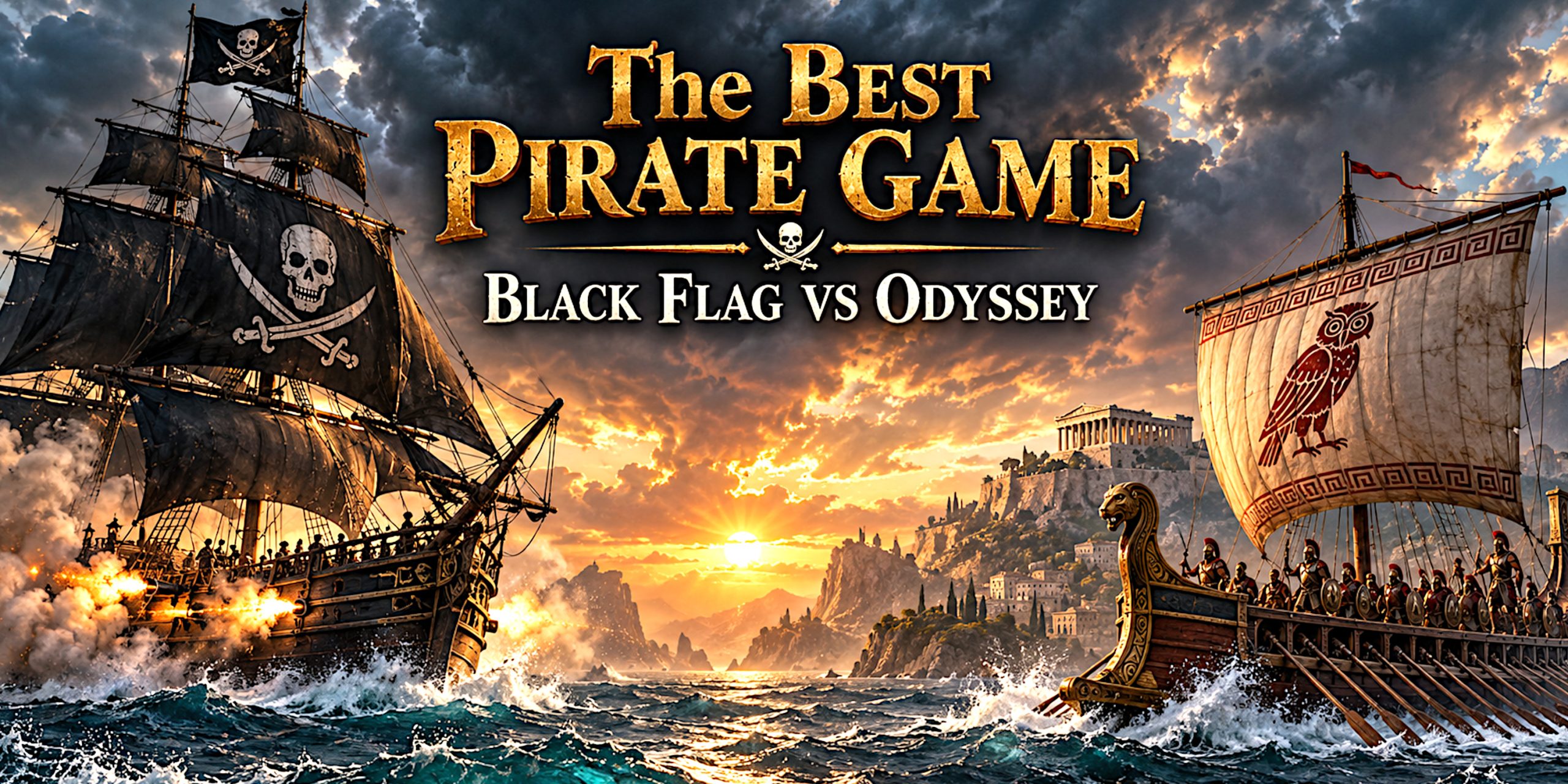
Assassin’s Creed IV: Black Flag is the better pirate game. Its ship battles, plunder and story all feed the same ambition: becoming a feared captain in the Caribbean. Odyssey offers excellent seafaring within a much broader Greek adventure, but piracy is something you can do rather than the identity holding everything together.
That does not make this a pointless contest. Both games understand the appeal of spotting land on the horizon, changing course and allowing your original objective to become somebody else’s problem.
The interesting question is how those shared ideas feel in practice. Do you want the life of a pirate, or the freedom of an adventurer who happens to own a warship?
This comparison covers the original 2013 Black Flag and Assassin’s Creed Odyssey.
Black Flag vs Odyssey at a Glance
| Category | Black Flag | Odyssey | Our pick |
|---|---|---|---|
| Pirate atmosphere | Caribbean ports, outlaw captains and sea shanties | Greek islands, mercenary work and ancient warfare | Black Flag |
| Naval combat | Cannon broadsides, mortars and boarding | Arrows, javelins, fire attacks and ramming | Black Flag |
| Crew development | Recruitment supports boarding | Recruitable lieutenants with gameplay bonuses | Odyssey |
| Character combat | Counters, dual swords and pistols | Weapon variety, abilities and character builds | Odyssey |
| Exploration | A concentrated Caribbean playground | A sprawling Greek world | Depends on your priorities |
| Story | Edward Kenway’s defined character arc | A branching family adventure | Black Flag for a pirate story |
| Overall pirate experience | The main attraction | Part of a larger RPG | Black Flag |
These are editorial judgements rather than a points system. Better melee combat does not automatically make a game better at being a pirate adventure.
Setting and Atmosphere: Who Makes You Feel Like a Pirate?
Black Flag has the obvious advantage here, but its success goes beyond owning the appropriate hats.
Its Caribbean brings together crowded ports, isolated beaches, fortified coastlines and ships carrying goods you would very much like to acquire. Edward Kenway moves among figures including Blackbeard, Anne Bonny and Charles Vane. Piracy shapes the people you meet and the future they imagine for themselves.
There is a lovely tension between the beauty of the setting and the instability of life within it. The sea looks inviting. The men promising you freedom are often unreliable. Edward himself is hardly a model of sensible financial planning.
Odyssey creates a different mood. You play Kassandra or Alexios, a mercenary travelling through a Greece divided by war. Your journey involves family, competing loyalties and a much larger mystery.
Piracy existed in the ancient Mediterranean. The distinction is about what these games emphasise, rather than whether a Greek setting can support a pirate story.
For me, Black Flag wins because its atmosphere survives the quiet moments. Sailing with the crew singing can feel like the point of the evening, even before anything explodes.
Winner: Black Flag.
Naval Combat: Cannons Against Rams
Black Flag gives its ship battles a satisfying rhythm. You assess an opponent, manoeuvre the Jackdaw into position, fire a broadside and brace for the response. Different weapons reward thinking about distance and angle, while dangerous opponents make upgrades matter.
The best encounters turn a calm stretch of water into a noisy sequence of decisions. A target you thought would be easy has company. Your hull needs attention. Boarding might save the situation, assuming you survive long enough to do it.
Odyssey builds its battles around different tools. Arrows and javelins replace cannon fire, while ramming makes closing the distance especially important. Fire attacks add another way to pressure an enemy.
It is an energetic system. Driving the Adrestia into a vulnerable ship has a wonderfully unsubtle appeal. Sometimes the correct response really is to hit the other boat with yours.
Still, Black Flag gives me the more compelling naval contest. Ranged firepower, positioning and the move into boarding create a stronger sense of commanding a fighting ship.
Neither is a naval simulator. Black Flag’s advantage comes from accessible spectacle and a rewarding combat rhythm, rather than strict historical realism.
Winner: Black Flag, although Odyssey’s ramming deserves respect.
Boarding and Plunder: Where Black Flag Pulls Ahead
Boarding is available in both games. The difference is how naturally it fits the rest of the experience.
In Black Flag, raiding ships supplies resources for improving the Jackdaw. A stronger Jackdaw makes tougher targets more manageable, encouraging you to return to sea and test your growing confidence.
That gives a passing ship immediate meaning. You are looking at an opportunity, a risk and potentially the materials for your next upgrade.
Boarding also changes the scale of the action. One moment you are directing a ship; the next you are fighting through a crowded deck. The transition gives piracy a physical quality that a reward screen could never provide.
Odyssey also rewards naval aggression. You can board disabled vessels or finish vulnerable ships by ramming and cleaving them. Ubisoft’s own guide even suggests swimming down to collect treasure before the wreck disappears. Admirable dedication to checking the pockets.
Its on-deck fighting benefits from a broader combat system. Yet naval plunder competes with equipment, quests, mercenaries and numerous other routes to progress.
Black Flag’s boarding can become repetitive, especially when you are collecting resources rather than chasing a memorable encounter. Even so, the reason to do it usually feels closely connected to being a captain.
Winner: Black Flag.
Your Ship and Crew: Jackdaw or Adrestia?
The Jackdaw has a strong claim to being Black Flag’s most important relationship. You invest in it, learn its limits and gradually trust it against enemies that once looked absurdly intimidating.
It is your means of travel, your weapon and the focus of much of your ambition. That concentration gives its upgrades emotional weight as well as practical value.
The Adrestia has its own strengths. Barnabas brings warmth to the voyage, and recruiting lieutenants connects your adventures on land with your capabilities at sea. A formidable opponent can become a useful addition if you take them down without killing them.
That makes Odyssey’s recruitment more interesting as a development system. Meeting someone and considering whether they might improve your crew creates a pleasing connection between otherwise separate activities.
I prefer the Jackdaw as the centre of a pirate adventure, but Odyssey offers more engaging choices about the people serving aboard your vessel.
Winner: Black Flag for attachment to the ship; Odyssey for recruitment.
Exploration: Caribbean Treasure or Greek Island Hopping?
Black Flag’s world feels arranged around the temptation to make one more stop. A beach, wreck, fort or small island can interrupt a journey without turning it into an entirely different sort of game.
That is useful when you want an evening of piracy rather than an extended commitment to clearing a region. Its smaller destinations help keep the sea at the centre of your attention.
Odyssey’s Greece offers broader possibilities. An island can become a substantial adventure, with local disputes, settlements and quests pulling you away from the shore. Inland exploration matters far more to the overall experience.
I find Odyssey more tempting when I want to wander with no particular concern for how long anything will take. Black Flag is more tempting when I specifically want to sail, find trouble and return with somebody else’s cargo.
Both games can suffer when curiosity becomes checklist work. Collectibles lose their charm if every map icon starts feeling like an unpaid obligation.
Winner: Black Flag for sea-focused exploration; Odyssey for a broader world.
Combat on Land: Odyssey Has More to Offer
Black Flag’s sword fighting is quick, theatrical and well suited to boarding. Edward’s pistols help sell the fantasy, and chaining successful attacks can look excellent.
Its limitations become clearer during extended play. Counters and familiar attack patterns can make encounters feel routine once you understand the system. The spectacle often lasts longer than the challenge.
Odyssey provides more room to experiment. Different weapons, equipment choices and active abilities let you shape how you fight. Dodging, parrying and managing abilities give encounters more moving parts.
There is a cost to that flexibility. Equipment management can become fussy, and the level system can make an apparently ordinary opponent surprisingly durable. Sometimes you want a duel, and the game wants to discuss your numbers.
Even with those frustrations, Odyssey offers the stronger combat system for players who enjoy developing a build and trying different approaches.
Winner: Odyssey.
Story and Characters: Edward Gives Piracy a Purpose
Without spoiling the major turns, Edward’s story examines the gap between wanting freedom and knowing what to do with it.
His confidence makes him entertaining company, but the game gradually asks harder questions about ambition, loyalty and the price other people pay for his decisions. The pirate setting supports that development rather than merely decorating it.
That is why Black Flag’s story works particularly well for this comparison. Its emotional direction grows out of the life it invites you to enjoy.
Odyssey tells a broader family story, with dialogue choices and different possible outcomes. Its structure gives players more say in how particular relationships unfold.
That freedom is appealing, although the scale makes it easier for the main story to lose momentum between other activities.
My preference is Edward’s more tightly defined arc. Odyssey gives you more decisions, but Black Flag makes a clearer argument about the adventurer at its centre.
Winner: Black Flag for the stronger pirate narrative.
What Might Put You Off Each Game?
Black Flag’s weakest moments often arrive when it pulls you away from the freedom of sailing. Tailing missions and restrictive objectives interrupt the pace, while older movement and combat systems sometimes show their age. Repeated boarding objectives can also wear thin during an upgrade hunt.
Odyssey’s main risk is fatigue. Its scale, equipment systems and level-based progression can make a promising adventure feel crowded with things demanding attention. If you mainly want naval action, substantial portions of the game will take you elsewhere.
Someone irritated by repetition may struggle with Black Flag’s resource gathering. Someone tired of sprawling RPGs may find Odyssey difficult to finish.
Which Game Should You Choose?
Choose Black Flag if your priorities are:
- Commanding a pirate ship in the Caribbean.
- Cannon battles, boarding and plunder.
- A story about ambition and the consequences of pirate life.
- Less emphasis on character builds and equipment statistics.
Choose Odyssey if your priorities are:
- Exploring ancient Greece by land and sea.
- Experimenting with weapons and abilities.
- Dialogue choices and crew recruitment.
- Naval warfare within a much larger RPG.
If you are choosing purely on the promise of being a pirate, Black Flag is the more direct recommendation. If Greece and role-playing systems interest you more than piracy itself, Odyssey could easily be your favourite overall.
The Verdict: Black Flag Is the Better Pirate Game
Black Flag wins because its best systems keep bringing you back to the same life. You sail to find targets, take risks for plunder, improve the Jackdaw and grow attached to a crew whose songs become part of the journey.
Odyssey deserves credit for its naval game. The Adrestia is enjoyable to command, recruitment adds depth, and its islands offer plenty of reasons to stay at sea. It also has the stronger case for players who value flexible combat and role-playing choices.
But when I picture the better pirate evening, I picture the Jackdaw turning towards a ship I probably should have left alone. The crew are singing. The cannons are ready. My judgement is questionable.
Black Flag understands the appeal of that combination extremely well.
Frequently Asked Questions
Is Assassin’s Creed Odyssey a pirate game?
Odyssey lets you attack ships, board enemies and take loot, but it is primarily an action RPG about a mercenary in ancient Greece. Piracy is an available activity rather than its main theme.
Does Odyssey have ship boarding like Black Flag?
Yes. You can board disabled enemy ships and fight their crews. You can also finish vulnerable vessels by ramming and cleaving them.
Which has better naval combat?
Our pick is Black Flag for its cannon battles, ship weapons and integration of combat with plunder. Odyssey offers an enjoyable alternative built around arrows, javelins, fire and ramming.
Is Odyssey better than Black Flag overall?
It depends on what you value. Odyssey offers more elaborate character progression and broader role-playing choices. Black Flag provides a more focused pirate adventure.