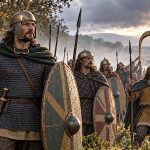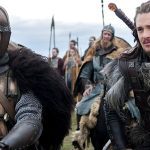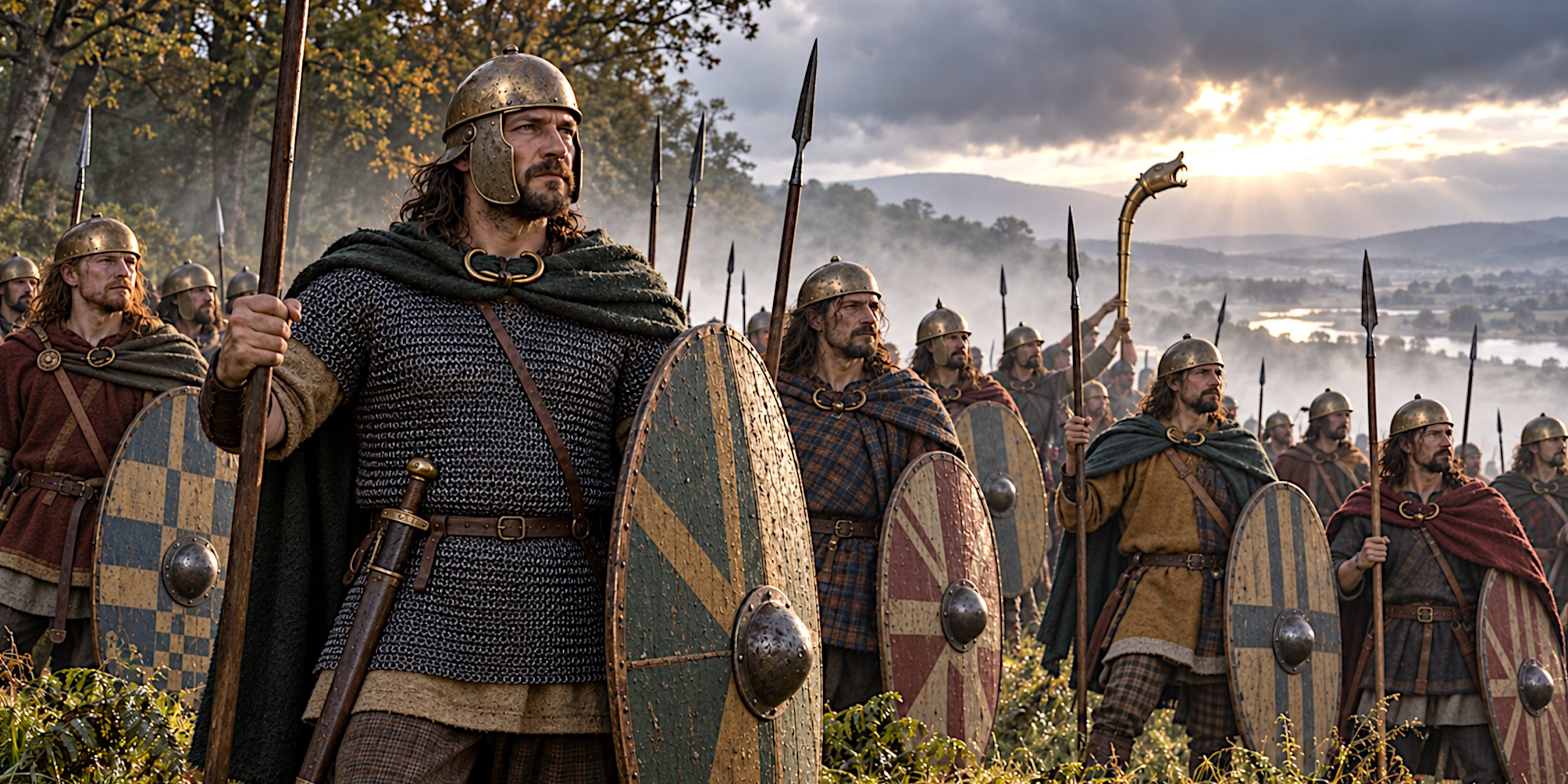
A Celtic warband could be a noble’s armed following, a body of hired fighters or one contingent within a much larger army. Its members might defend their community, raid a neighbour or travel considerable distances in search of service and reward. There was no single organisation shared by every people we now describe as Celtic.
That variety matters. The familiar image of a bare-chested swordsman charging towards a Roman shield wall catches one part of the evidence and leaves a great deal behind. These societies also produced accomplished horsemen, carefully made weapons and leaders capable of organising difficult campaigns.
What interests me most is the relationship between those fighters and the communities that sustained them. Behind the polished scabbard stood a smith, a household and someone expected to provide supper when the campaigning was over.
What Was a Celtic Warband?
“Warband” is a useful modern description, rather than the name of a standard ancient military unit. It usually suggests a group bound to a leader through personal loyalty, kinship, obligation or the expectation of reward.
It becomes less useful when applied indiscriminately to an entire army. A coalition assembled from several peoples could contain personal followings alongside broader levies and specialist troops.
Nor does “Celtic” describe a single ancient nation. Language, material culture and the names used by Greek and Roman writers overlap imperfectly. Gauls, Britons and Galatians belonged to different political settings, even where they shared elements of language or military equipment.
This article concentrates on the later Iron Age, especially the centuries before Roman conquest in Gaul and Britain. Early medieval Irish warrior bands belong to a different historical discussion. A similar label does not make them the same institution.
How Were Celtic Warbands Organised?
In late Iron Age Gaul, influential nobles maintained networks of dependants and armed supporters. Wealth helped attract followers; followers helped a noble defend that wealth and increase his influence.
Caesar describes this relationship in The Gallic War, Book VI, chapter 15:
“according to the importance of each of them in birth and resources”
He connects that standing with the number of followers surrounding each noble. This is contemporary evidence for the society Caesar encountered, although his Roman categories and political interests shape the account.
A personal following could provide a dependable core within a larger force. We should not assume that every dependant was a permanently maintained professional soldier.
| Element | Likely role | Main qualification |
|---|---|---|
| Leader and close companions | Direction, personal protection and an experienced fighting core | Arrangements varied between communities |
| Wider following | Additional manpower through social and political obligations | Dependency did not necessarily mean full-time service |
| Community contingents | Defence and larger campaigns | Mobilisation depended on local circumstances |
| Hired fighters | Reinforcement and service abroad | One part of Celtic warfare, rather than its universal basis |
| Mounted warriors | Scouting, skirmishing, pursuit and battlefield combat | Horses required resources and training |
We cannot recover a universal establishment, recruitment age or standard number of men. It is tempting to imagine a neat hierarchy beneath every chief. The surviving evidence is much less obliging.
Why Did Celtic Warriors Fight?
Defence, political rivalry, plunder and paid service all provided reasons to take up arms. These motives often overlapped. A campaign presented as defending allies might also offer opportunities to seize livestock, captives and prestige.
Successful leadership could bring rewards to followers and strengthen a patron’s position. Failure could destroy the relationships on which his authority depended.
The Gaesatae illustrate the importance of hired military service. Polybius describes them joining the coalition defeated by Rome at Telamon in 225 BCE. They were a distinct contingent, not a name for every Celtic warrior.
Raiding and warfare also imposed costs on ordinary people. Crops were destroyed, households displaced and captives enslaved. The attractive metalwork in museum cases should not make the violence behind it seem picturesque.
Arms and Armour
Equipment varied with date, region and wealth. A sword, helmet and mail shirt should never be treated as the compulsory uniform of a Celtic fighter.
Spears, javelins and shields
Spears were important weapons for both foot soldiers and mounted men. Their surviving iron heads differ considerably in shape and size, reflecting a range of designs rather than one standard “Celtic spear”.
Throwing weapons allowed warriors to disrupt or injure opponents before close combat. Shields provided essential protection, commonly using wooden bodies with fittings that might include an iron boss and reinforced grip.
Oval and elongated shields are familiar, but there was no universal outline. Organic components survive unevenly, so archaeological collections can make an army look more metallic than it actually was.
Specific sword types used
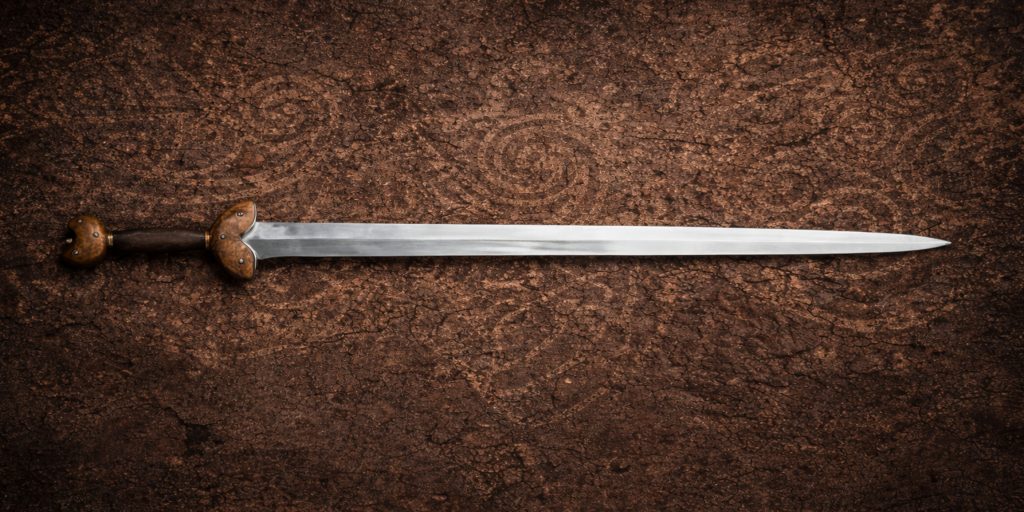
Ancient swords rarely come with the convenient model names of later military equipment. Archaeologists distinguish them through blade form, hilt, scabbard and chronology.
| Sword type or tradition | Broad context | Characteristics and cautions |
|---|---|---|
| Early La Tène swords, often described as La Tène I | Earlier part of the La Tène period, beginning around the fifth century BCE | Many have pronounced points and a median ridge. They undermine the claim that Celtic swords could only cut |
| Middle La Tène swords, broadly La Tène C | Principally the third and second centuries BCE | Includes longer, straight, double-edged blades associated with metal scabbards and elaborate suspension fittings |
| Late La Tène swords, broadly La Tène D | Principally the later second and first centuries BCE | Includes long blades suited to cutting, with considerable variation in points and proportions |
| Anthropoid or anthropomorphic-hilt swords | Examples occur across several regions and dates | Hilts suggest a human figure. These form a distinctive hilt tradition, rather than evidence for a separate warrior caste |
These are broad archaeological groupings, not four weapons issued successively across Europe. Regional chronologies differ, and the older I–III terminology does not map neatly onto every modern scheme.
The British Museum’s catalogue notes the sharp points characteristic of many early La Tène swords. A particularly useful example from Isleham has a blade measuring 53.8 cm, tapering to a sharp point.
The Metropolitan Museum’s anthropomorphic sword, dated around 60 BCE, measures only 49.8 cm overall. Its finely worked human-shaped hilt makes it a striking example of the overlap between weaponry, craftsmanship and personal display. “Celtic sword” plainly does not mean one enormous chopping blade.
Polybius criticises swords used by particular Gallic opponents, including their tendency to bend. His account deserves attention, but it cannot establish the quality of every blade made across several centuries. Shape, metallurgy and condition must be examined separately.
Helmets and body armour
Some warriors wore helmets of iron or copper alloy. Mail was also available, although its labour-intensive manufacture made it a substantial investment. The Iron Age mail remains from Kirkburn provide firm archaeological evidence for its use in Britain.
Other fighters probably relied chiefly on shields and ordinary clothing. We cannot turn the survival of a few wealthy burials into a reliable percentage of armoured troops.
The horned Waterloo Helmet is an exceptional object. It is a poor foundation for equipping an entire reconstructed army. Ancient craftsmen were quite capable of making something remarkable without intending everyone else to wear one.
How Did Celtic Warbands Fight?
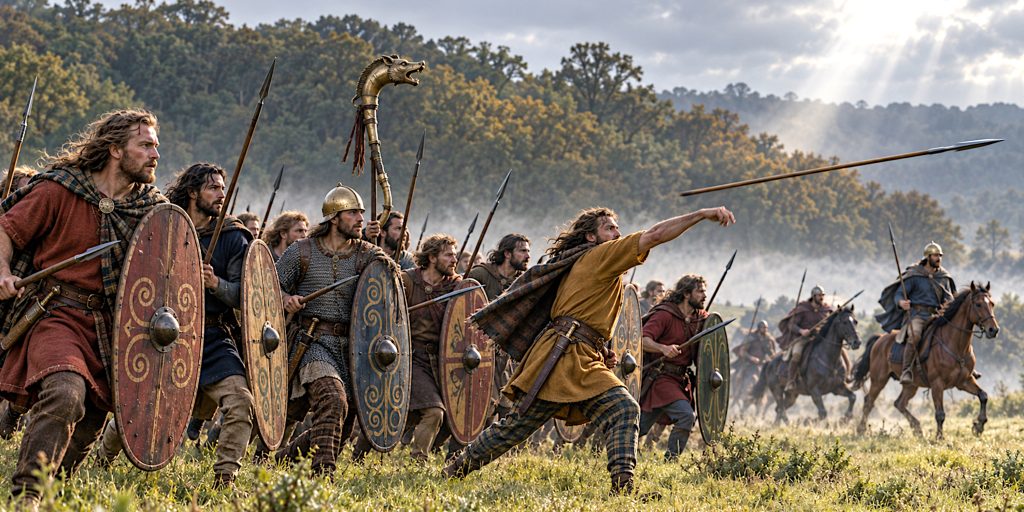
There was no single Celtic battle drill. Depending on circumstances, fighting could involve missile exchanges, close infantry combat, mounted action, ambushes or attacks on vulnerable supply parties.
The charge mattered, but “they charged” is a description of movement, not a complete explanation of tactics.
At Telamon, Polybius describes a Celtic army deploying to face Roman forces approaching from two directions. He also records prolonged resistance after the initial missile fighting. That is difficult to reconcile with the idea that Celtic troops invariably became helpless when their first rush failed.
Noise and display could contribute to intimidation and cohesion. Trumpets, shouted cries, conspicuous ornaments and standards helped make a force visible and audible. How precisely particular signals worked is much harder to recover.
Cavalry and British chariots
Cavalry played an important role in late Iron Age warfare. British chariot fighting provides an especially striking example of trained cooperation.
Caesar describes warriors throwing missiles from chariots and then dismounting:
“they leap down from the chariots and fight on foot.”
The Gallic War, Book IV, chapter 33.
The drivers remained available to carry them away. In the same campaign, Caesar describes an ambush on Roman troops gathering grain. Such episodes show attention to timing, terrain and supply, alongside the more theatrical elements of battle.
Running along a chariot pole might impress an audience. Attacking soldiers when they had put down their weapons to harvest corn was rather more immediately useful.
Did Celtic Warriors Really Fight Naked?
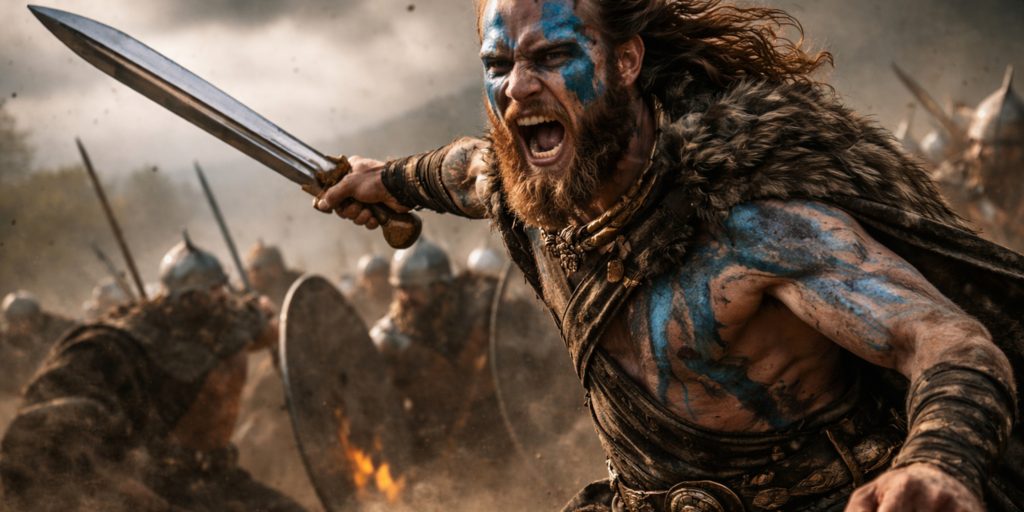
Some did, according to ancient accounts. The mistake is to make an exceptional practice the defining feature of an entire military tradition.
At Telamon, Polybius distinguishes the naked Gaesatae from the clothed Insubres and Boii. His own narrative therefore resists the stereotype that all Celtic fighters discarded their clothing.
Writing in the second century BCE about a battle fought in 225 BCE, he was not an eyewitness. His account remains important, but it is a later reconstruction.
On the noise of the army, he writes:
“there were innumerable horn-blowers and trumpeters”
Histories, Book II, chapter 29.
That description is evocative; it is not a recording. Literary effects, inherited stereotypes and historical observation can occupy the same passage.
I would be equally cautious about giving every warrior blue paint. Ancient descriptions of British body colouring do not establish a universal Celtic battlefield appearance.
Archaeology: What Survives?
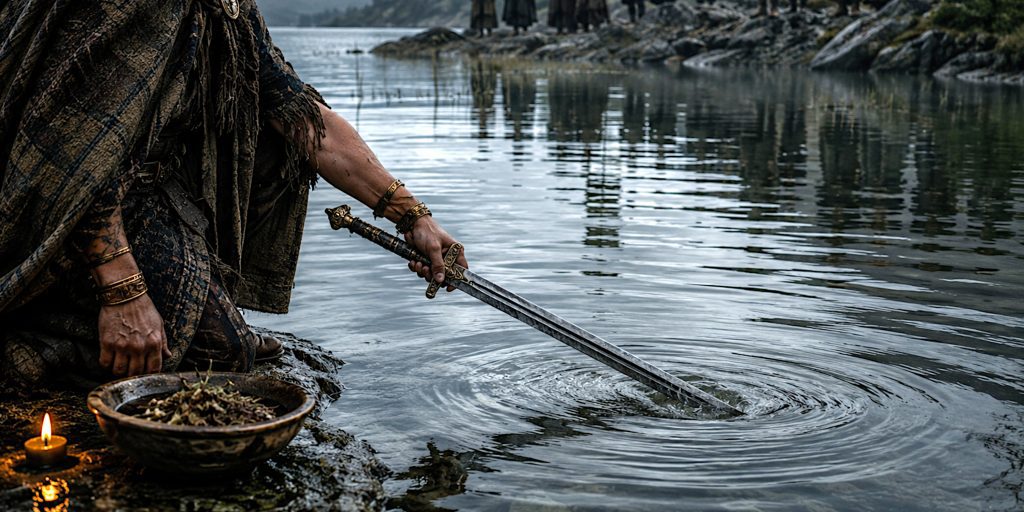
Archaeology gives us evidence independent of Roman victory narratives, but it comes with its own distortions. Burial customs, ritual offerings, corrosion and modern discovery all influence what survives.
| Site or discovery | Evidence | What it helps us understand |
|---|---|---|
| La Tène, Switzerland | Weapons and other material from the site that gave the period its name | Sword and scabbard development, deposition and metalworking |
| Gournay-sur-Aronde, France | Sanctuary deposits containing weapons and animal remains | The treatment of arms within religious practice |
| Tintignac, France | A deposited assemblage including weapons, helmets and carnyces | Connections between martial display and ritual |
| Kirkburn, East Yorkshire | A richly equipped burial including a sword and mail remains | Access to expensive equipment in Iron Age Britain |
| Battersea, London | Decorated copper-alloy shield facing recovered from the Thames | Elite craftsmanship and watery deposition |
At Gournay, weapons entered a sanctuary rather than an ordinary battlefield rubbish heap. Some were deliberately damaged. Their condition therefore cannot automatically be read as evidence of failure in combat. The archaeological treatment of weapon deposits is essential to interpreting them properly.
The Battersea Shield is particularly instructive. What survives is a decorated metal facing, rather than a complete shield. Its workmanship tells us a great deal about display and resources; it does not tell us what the average warrior carried.
These distinctions matter. An offering selected for a sacred place and an object chosen for a prestigious burial are both evidence, but neither is a random sample of military kit.
Religion, Display and the Carnyx
The carnyx, a long trumpet with an animal-shaped head, is among the most distinctive objects associated with Iron Age martial culture. Its appearance alone must have contributed to the spectacle of an assembled force.
The surviving bronze head from Deskford in north-east Scotland belongs to a later context than many continental examples. National Museums Scotland dates the original instrument to approximately 80–200 CE. Its modern reconstruction combines archaeological study with practical investigation of how the instrument could sound.
Weapons could also pass out of practical use through religious dedication. Caesar describes Gaulish practices of gathering captured goods after victory and dedicating spoils to a war deity whom he identifies as Mars. That name reflects his Roman interpretation of local religion.
It would be unwise to make every broken sword an offering or every river find a sacrifice. Context does the important work.
Contemporary Accounts and Their Limits
Caesar is a contemporary participant in the campaigns he describes. He is also a commander explaining and justifying his actions to a Roman audience.
Polybius is an ancient historian writing closer to these events than we are, but his account of Telamon was composed generations after the battle. It should not be labelled eyewitness testimony.
Most importantly, we lack a comparable surviving narrative written by the ordinary fighters themselves. We hear far more about Celtic warriors from their enemies than from their own mouths.
Speeches attributed to ancient leaders require particular care. They may express what a historian thought suited the occasion, rather than preserve words spoken and recorded at the time. A stirring quotation is not improved by pretending someone took shorthand beneath the standards.
Strengths and Vulnerabilities
Personal connections could make a following cohesive. Experienced companions, local knowledge and skilled mounted troops offered real advantages. The ability to assemble a wider coalition could increase military strength considerably.
The same political relationships could complicate command. Leaders might have competing interests, and keeping a large force supplied required cooperation beyond the battlefield.
Equipment was uneven, but Roman victories cannot be reduced to a simple contest between good and bad swords. Campaign endurance, siege capabilities, manpower, intelligence and alliances all mattered.
Nor did Celtic-speaking peoples invariably fight Rome. They also served as allies and soldiers within Roman forces. Conquest changed military institutions and opportunities; it did not instantly remove the people who possessed those skills.
What We Still Do Not Know
We cannot establish a standard warband size, a universal training programme or the exact boundary between a noble’s household following and a wider mobilisation.
We also struggle to identify particular social roles from weapons alone. A rich grave can indicate status, but it cannot provide a complete service record. A distinctive sword does not identify the language spoken by its owner.
My own preference is to leave those gaps visible. A carefully qualified reconstruction is more useful than a confident imaginary army.
The most convincing Celtic warband is a group rooted in a particular place and period: men with different resources, relationships and levels of experience, brought together for a purpose. Their weapons could be beautiful, their warfare skilful and their violence devastating. None of those things requires a legend about an entire people being born with a sword in hand.