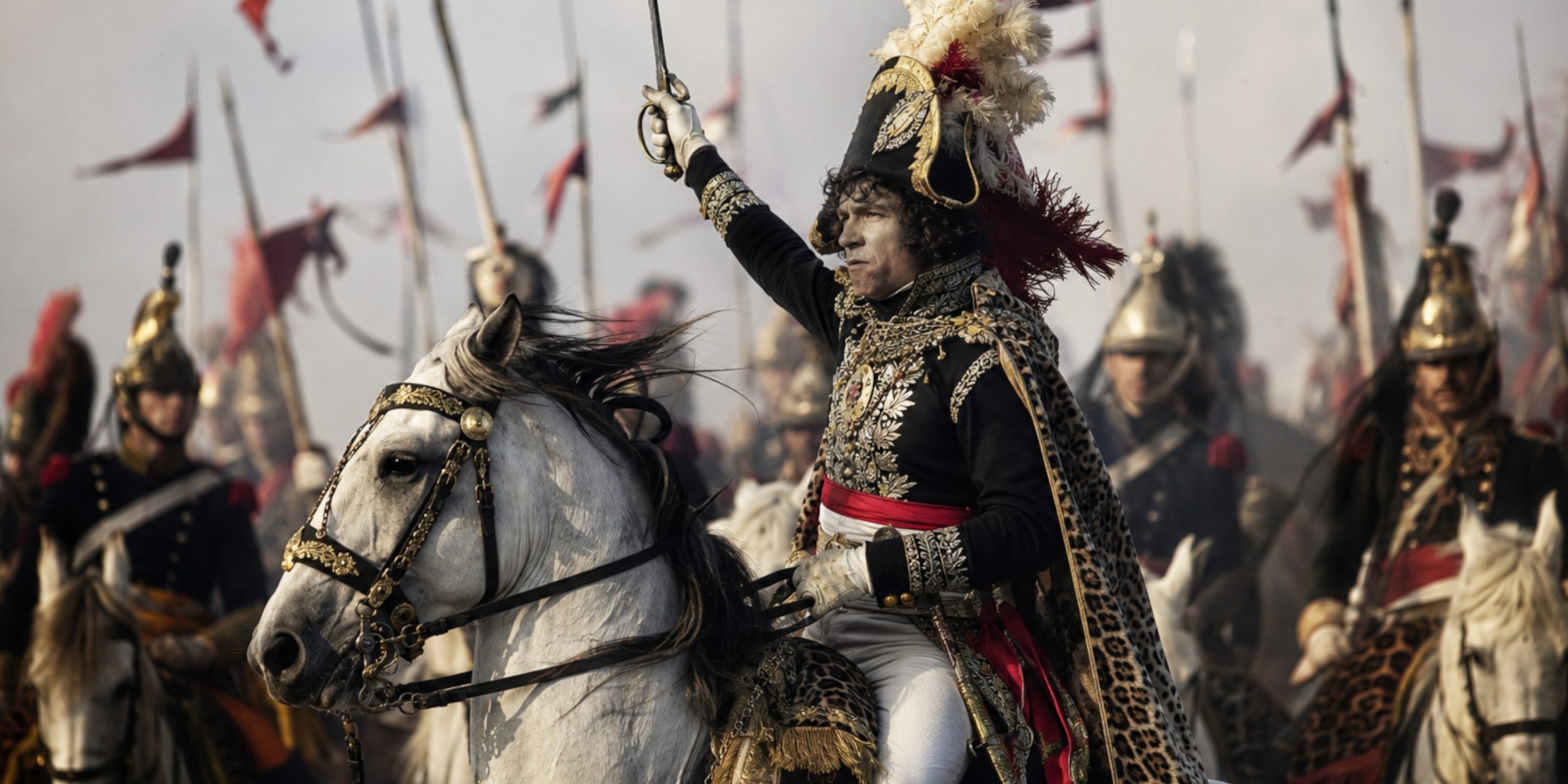
Few figures from the Napoleonic era command attention quite like Joachim Murat. He looked as though he had stepped out of a painter’s imagination rather than a military camp. Covered in gold lace, towering plumes, exotic furs and jewels, Murat seemed determined to ensure that every soldier on the battlefield could spot him from several miles away.
Yet behind the extravagant appearance stood one of the finest cavalry commanders Europe has ever produced.
Murat’s reputation has often been trapped beneath his flamboyant image. Historians sometimes focus on the feathers and costumes while overlooking the reality that Napoleon repeatedly entrusted him with the most dangerous cavalry operations in Europe. He led charges that shattered armies, pursued retreating enemies across continents, and inspired fierce loyalty among his horsemen.
His story is one of extraordinary rise, spectacular success, political ambition, and a tragic ending before a firing squad in 1815.
Early Life and Rise to Power
Joachim Murat was born on 25 March 1767 in La Bastide-Fortunière, in southern France.
His father was an innkeeper and postmaster. Murat was originally intended for a religious career and spent part of his youth studying for the priesthood. History occasionally enjoys a good joke, and the image of Murat quietly serving as a village priest is one of its better ones.
Instead, he joined the cavalry.
The French Revolution transformed his prospects. Like many talented officers of humble origins, he benefited from the collapse of the old aristocratic military system. Promotion suddenly depended more upon ability than noble birth.
His career accelerated dramatically after meeting Napoleon Bonaparte.
In 1795, Murat played a crucial role during the suppression of the royalist uprising in Paris by securing artillery that Napoleon used to crush the rebellion. This helped establish a lifelong connection between the two men.
By the end of the decade, Murat had become one of Napoleon’s most trusted cavalry leaders.
Physical Appearance and Personality
Contemporaries consistently described Murat as strikingly handsome.
He was tall, athletic, charismatic and possessed immense personal confidence. Soldiers admired him because he shared their dangers. He regularly led charges from the front and appeared almost indifferent to enemy fire.
His vanity became legendary.
Murat often designed his own uniforms, combining military practicality with theatrical extravagance. Bright colours, leopard skins, ostrich feathers and elaborate embroidery became his trademarks.
Many foreign observers initially dismissed him as a peacock.
Most changed their minds after seeing him lead cavalry into battle.
Marriage to Caroline Bonaparte
In 1800 Murat married Caroline Bonaparte, Napoleon’s younger sister.
The marriage elevated his political position and strengthened his connection to the Bonaparte dynasty.
Together they formed one of Europe’s most powerful couples during the Napoleonic period.
Napoleon rewarded Murat with titles, wealth and influence. Eventually, in 1808, he became King of Naples.
The transformation was remarkable.
A provincial innkeeper’s son had become a king.
Arms and Armour
Murat belonged to the age when cavalry still dominated large sections of the battlefield.
His equipment reflected both practical military requirements and his love of spectacle.
Typical Weapons Used by Murat
| Weapon | Purpose |
|---|---|
| Heavy Cavalry Sabre | Primary combat weapon |
| Light Cavalry Sabre | Fast cutting attacks |
| Flintlock Pistols | Close-range engagements |
| Cavalry Carbine | Mounted firearm |
| Dress Sword | Ceremonial and command use |
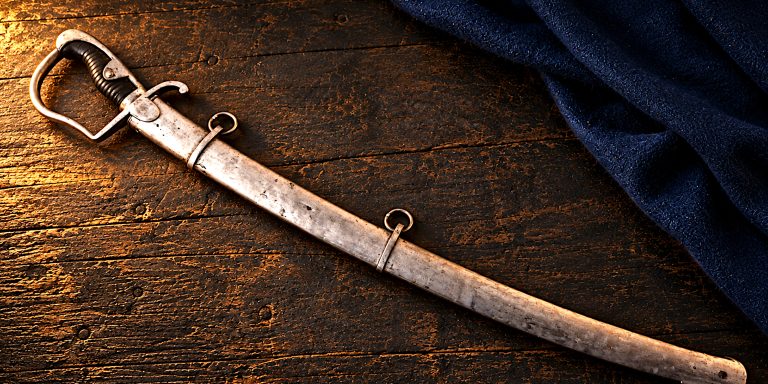
The cavalry sabre remained Murat’s signature weapon.
Contemporary paintings often show him wielding curved sabres while leading charges directly into enemy formations.
Armour and Uniform
By Murat’s era, traditional armour had largely disappeared from European battlefields.
However, some heavy cavalry still wore:
- Steel cuirasses
- Brass helmets
- Iron-reinforced breastplates
- Leather riding boots
- Heavy gauntlets
Murat frequently appeared wearing:
- Magnificent hussar uniforms
- Gold embroidered jackets
- Fur pelisses
- Feathered hats
- Jewel-encrusted decorations
His appearance was so distinctive that enemy officers often identified him instantly.
From a modern military perspective, wearing enough gold braid to be visible from orbit may seem questionable. Murat somehow survived countless battles regardless.
Battles and Military Acumen
What Made Murat Special?
Napoleon considered Murat one of the finest cavalry leaders in Europe.
His greatest strengths included:
- Exceptional battlefield courage
- Rapid decision making
- Aggressive pursuit operations
- Inspirational leadership
- Outstanding understanding of cavalry manoeuvre
His weakness was strategic judgement.
Napoleon frequently noted that Murat excelled when executing orders but struggled when operating independently.
Battle of Aboukir (1799)
Murat distinguished himself during the Egyptian campaign.
His cavalry attack helped secure a decisive French victory and further strengthened Napoleon’s confidence in him.
Battle of Marengo (1800)
Murat played a major role in the campaign that restored Napoleon’s fortunes in Italy.
His cavalry operations helped exploit French success following the dramatic reversal of the battle.
Battle of Austerlitz (1805)
Often regarded as Napoleon’s masterpiece, Austerlitz showcased Murat’s ability to coordinate large cavalry formations.
His forces helped secure French dominance across the battlefield.
Battle of Jena-Auerstedt (1806)
Murat’s pursuit after the battle became legendary.
French cavalry relentlessly chased retreating Prussian forces, contributing significantly to the collapse of the Prussian military system.
Battle of Eylau (1807)
Perhaps his most famous moment.
During one of the bloodiest battles of the Napoleonic Wars, Murat led a massive cavalry charge involving thousands of horsemen.
The attack smashed through Russian formations and helped prevent a potentially disastrous French defeat.
Many historians consider it one of the greatest cavalry charges ever executed.
Russian Campaign (1812)
Murat commanded much of Napoleon’s cavalry during the invasion of Russia.
His performance remained energetic despite immense losses among horses and men.
After Napoleon left Russia, Murat briefly commanded remnants of the Grande Armée during its desperate retreat.
Leipzig (1813)
Murat continued to fight skillfully but France’s military position had deteriorated significantly.
The Battle of Leipzig marked the beginning of the end for Napoleonic dominance in Europe.
King of Naples
As King of Naples, Murat attempted to modernise administration and strengthen the kingdom.
He was not merely a decorative monarch.
His government introduced reforms and sought to balance local interests with French influence.
Over time, however, Murat’s relationship with Napoleon deteriorated.
As French fortunes declined, he became increasingly concerned with preserving his own throne.
This ultimately led him to abandon Napoleon during the final stages of the empire.
It remains one of the most controversial decisions of his career.
The Hundred Days and Final Gamble
When Napoleon escaped from Elba in 1815, Murat made a desperate attempt to regain influence.
He launched a campaign aimed at uniting Italy under his leadership.
The effort failed.
Defeated by Austrian forces, Murat fled and attempted one final return to power later that year.
The venture ended in catastrophe.
Captured after landing in Calabria, he was sentenced to death.
On 13 October 1815, he faced a firing squad with remarkable composure.
According to several accounts, his final words included instructions to the soldiers:
“Aim at my heart. Spare my face.”
It was a fittingly dramatic end for one of history’s most theatrical warriors.
Artefacts and Objects Associated with Murat
Several museums preserve items connected with Murat and the Napoleonic era.
Notable collections can be found in:
- The Musée de l’Armée in Paris
- The Palace of Caserta near Naples
- The National Museum of San Martino in Naples
- Regional museums in Calabria connected with his final campaign
Visitors can see:
- Portraits commissioned during his reign
- Military decorations
- Royal documents
- Uniform fragments
- Napoleonic cavalry equipment
- Contemporary weapons and horse furniture
Original Murat uniforms are exceptionally rare and highly prized.
Archaeology and Recent Discoveries
Unlike Roman emperors or medieval kings, Murat lived during a period with abundant written documentation. Archaeological discoveries therefore tend to focus on battlefields associated with his campaigns.
Recent research across Napoleonic battlefields has uncovered:
- Musket balls
- Cavalry sabre fragments
- Uniform buttons
- Horse equipment
- Artillery remains
- Personal military items
Excavations connected with battlefields such as Eylau, Leipzig and Waterloo continue to improve understanding of cavalry combat during the Napoleonic Wars.
Modern battlefield archaeology has also revealed the enormous logistical challenges faced by cavalry armies, particularly during the Russian campaign.
Studies of horse remains, camp sites and military debris continue to provide new evidence regarding the scale of losses suffered during Napoleon’s campaigns.
No major new archaeological discovery directly linked to Murat himself has emerged in recent years, but ongoing Napoleonic battlefield investigations continue to shed light on the world in which he operated.
Legacy
Joachim Murat remains one of the most fascinating figures of the Napoleonic age.
As a king, he was capable but inconsistent.
As a politician, he was often impulsive.
As a strategist, he could be unreliable.
As a cavalry commander, however, he was exceptional.
When reading contemporary accounts, one gets the sense that Murat embodied a fading age of warfare. He belonged to the final generation in which personal bravery, horsemanship and sheer battlefield presence could still shape the outcome of major battles.
There is something almost cinematic about him. A man covered in feathers and gold should not have survived dozens of campaigns against Europe’s greatest armies. Yet Murat repeatedly rode into danger and emerged victorious.
Napoleon once remarked that Murat was the bravest man he had ever seen.
Considering the company Napoleon kept, that is no small compliment.