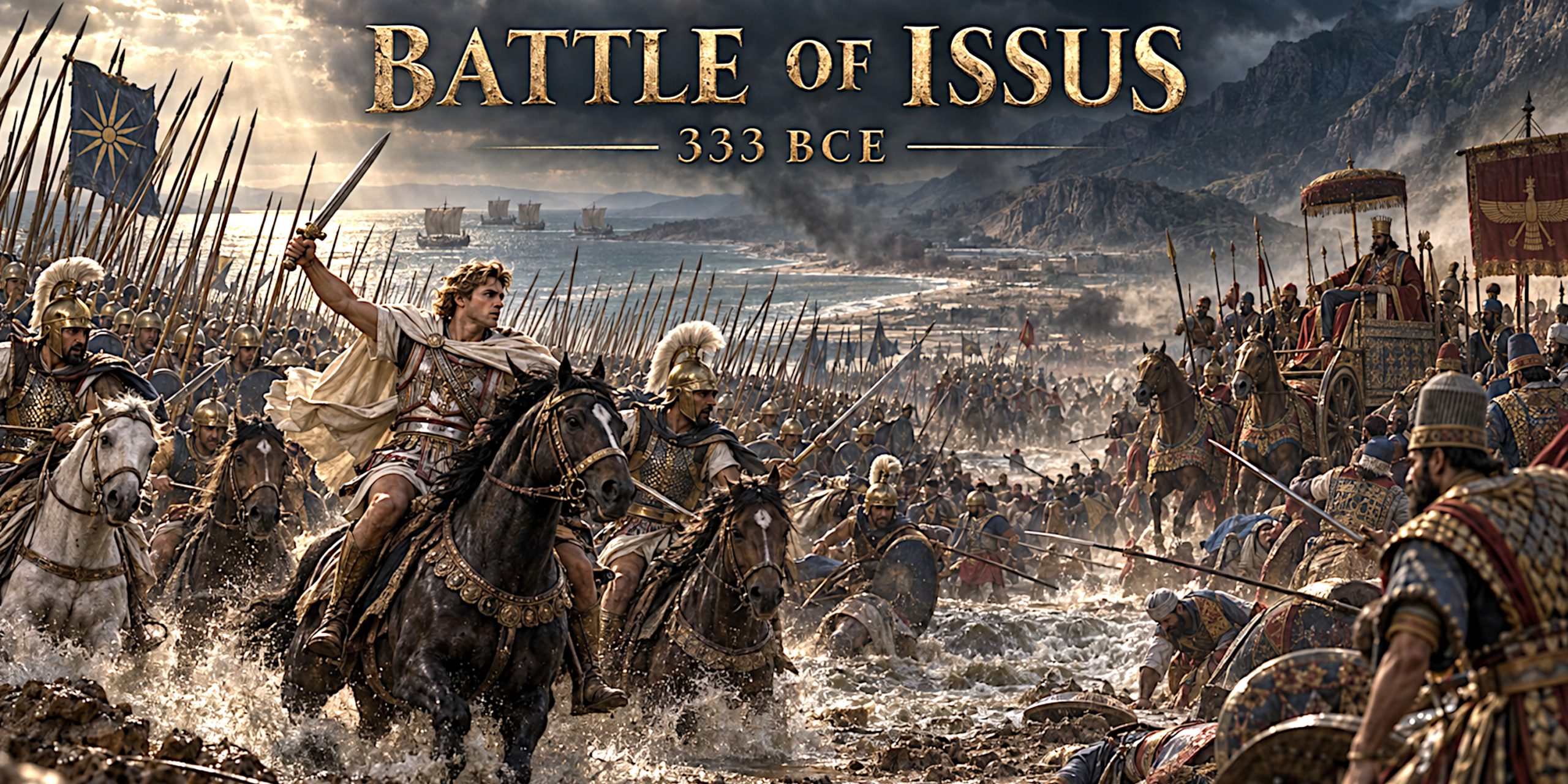
The Battle of Issus brought Alexander the Great and Darius III face to face for the first time. Fought in southern Anatolia in 333 BCE, it was a violent, compressed battle in which geography mattered almost as much as numbers. The Macedonian king forced a crossing under pressure, struck through the Persian left and threatened Darius in the centre. When the Persian king withdrew, resistance unravelled.
Issus is sometimes presented as a simple triumph of tactical genius over an enormous horde. The truth is more interesting. Alexander took serious risks, his phalanx briefly lost cohesion and Parmenion’s left wing came under severe pressure. Darius did not merely sit in a chariot waiting to flee either. His deployment exploited the river line and came close to creating a very different afternoon.
| Battle fact | Detail |
|---|---|
| Date | November 333 BCE, traditionally dated to 5 or 6 November |
| Location | Near Issus in Cilicia, southern Anatolia |
| Belligerents | Macedonian-led Hellenic army and the Achaemenid Persian Empire |
| Commanders | Alexander III of Macedon and Darius III |
| Outcome | Decisive Macedonian victory |
| Strategic effect | Darius retreated east; Alexander gained control of the eastern Mediterranean approaches |
Why Was the Battle of Issus Fought?
Alexander crossed into Asia in 334 BCE and defeated the Persian satraps at the River Granicus. During the following campaigning season he moved through western and central Anatolia, dismantling Achaemenid control town by town. Darius now took personal command of the imperial response.
The approach to Issus became an extraordinary reversal. Alexander moved south through the narrow Cilician Gates and then along the coast towards Syria. Darius crossed the Amanus Mountains behind him, entered Issus and cut the Macedonian line of communication. Alexander initially refused to believe the report. One can sympathise. Discovering that the enemy’s royal army has appeared in your rear is the sort of intelligence update that encourages a second opinion.
Alexander turned north. Darius, rather than following him into the open Syrian plain where Persian cavalry could operate freely, remained near the river that Greek and Roman writers call the Pinarus. The precise identification of that watercourse remains disputed, although the Payas River is a strong modern candidate.
The battlefield was a narrow coastal strip between the Mediterranean and the foothills. This restricted the Persian frontage and limited the value of superior numbers. It did not make the Persian army harmless. The riverbank formed a defensive obstacle, Greek mercenaries strengthened the centre and Persian cavalry massed where the coastal ground was most favourable.
Forces at Issus
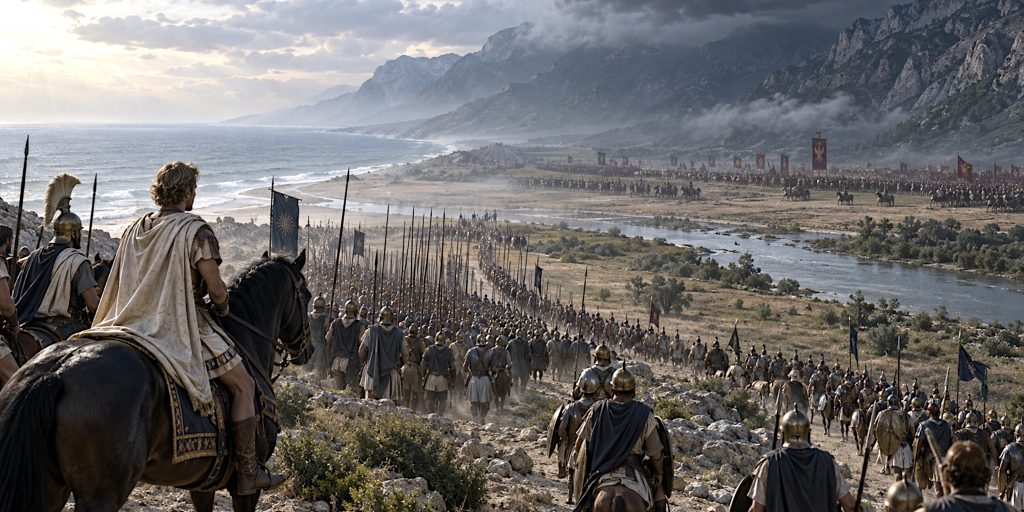
Ancient authors give spectacular figures for the Persian army, sometimes reaching 600,000 men. Such totals belong to the literature of conquest rather than a dependable order of battle. Feeding and deploying an army of that size in the Issus corridor would have been a logistical fantasy.
Alexander probably fielded roughly 30,000 to 40,000 infantry and around 5,000 to 7,000 cavalry. The Persian force was likely larger, but no modern estimate can be treated as settled fact. A cautious range of roughly 50,000 to 100,000 is often proposed, with the lower part of that range easier to reconcile with the ground.
| Army | Plausible strength | Main components | Principal advantage |
|---|---|---|---|
| Macedonian-led army | About 35,000 to 47,000 | Phalanx, hypaspists, Companion cavalry, Thessalian cavalry, allied Greek infantry and light troops | Cohesion, experienced command and combined-arms tactics |
| Achaemenid army | Possibly 50,000 to 100,000 | Persian and allied infantry, Greek mercenaries, royal guards, archers and strong cavalry | Numerical depth, defensible river line and cavalry strength |
These remain estimates. The Macedonian figure is the firmer of the two, while Persian totals should be handled with care.
Leaders and Troop Composition
Macedonian Command
| Leader | Position | Role at Issus |
|---|---|---|
| Alexander III | Right wing | Led the Companion cavalry and the decisive assault towards Darius |
| Parmenion | Left wing | Held the coastal sector against powerful Persian cavalry attacks |
| Nicanor | Right-centre | Commanded the hypaspists beside the phalanx |
| Coenus, Perdiccas, Meleager, Ptolemy and Amyntas | Centre | Commanded the taxeis of the Macedonian phalanx |
| Philotas | Right wing | Commanded the Companion cavalry under Alexander |
The Macedonian-led force included:
- Six battalions of pezhetairoi, the Foot Companions who formed the sarissa phalanx
- Hypaspists, flexible elite infantry positioned between phalanx and cavalry
- Companion cavalry, Alexander’s hard-hitting mounted arm
- Thessalian cavalry on the left, among the best horsemen in the Greek world
- Allied Greek and mercenary hoplites
- Agrianian javelin men, Cretan archers and other light infantry
- Thracian and Paeonian cavalry
Persian Command
| Leader | Position | Role at Issus |
|---|---|---|
| Darius III | Centre | Directed the army from a royal chariot behind the main infantry line |
| Nabarzanes | Persian right | Commonly associated with the cavalry attack against Parmenion |
| Aristomedes of Pherae | Centre | Commanded or helped lead the Greek mercenaries |
| Atizyes, Sabaces and Reomithres | Near the centre | Senior Persian commanders who fought and died during the battle |
The Achaemenid force included:
- Greek mercenary heavy infantry in the centre
- Kardakes, whose precise status and equipment remain debated
- Persian cavalry concentrated heavily on the coastal right
- Royal guards and aristocratic retainers around Darius
- Archers, spearmen and javelin troops drawn from several imperial regions
- Light infantry placed forward and along broken ground
The army was diverse because the empire was diverse. That did not automatically make it disorganised. Achaemenid forces could combine regional specialisms effectively, although command became harder once the centre was threatened and the king moved from the field.
Arms and Armour
Macedonian Weapons
| Weapon or equipment | Users | Battlefield purpose |
|---|---|---|
| Sarissa | Foot Companions | Pike roughly 4.5 to 5.5 metres long, used in deep formation |
| Xyston | Companion and Thessalian cavalry | Long thrusting lance used in mounted charges |
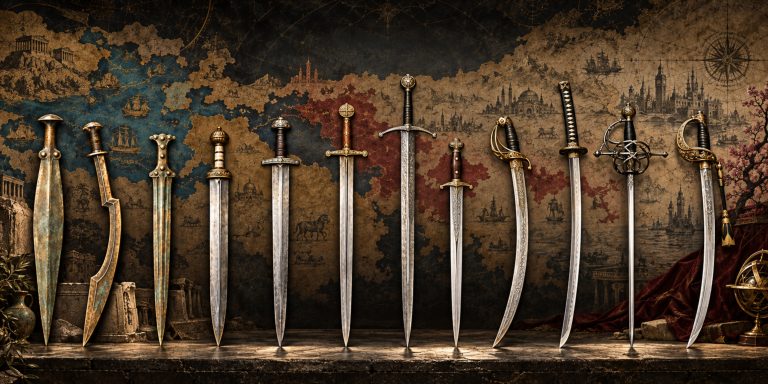
| Xiphos | Infantry and officers | Straight, double-edged sword for close combat after the spear or pike became unusable |
| Kopis or machaira | Cavalry and some infantry | Forward-curving cutting sword effective from horseback |
| Dory | Hoplites and some allied infantry | One-handed thrusting spear used with a shield |
| Aspis and smaller shields | Greek infantry, hypaspists and light troops | Protection varied according to role and formation |
Macedonian armour was not uniform. Wealthier soldiers and officers might wear bronze muscle cuirasses, while linen or composite body armour and metal helmets were more common. Phrygian, Thracian and Chalcidian helmet forms appear in the wider material record. Greaves were worn by some troops, though probably not by every phalangite.
The phalanx was formidable from the front but depended upon alignment. At Issus, the river crossing opened gaps between battalions. Persian Greek mercenaries exploited them, proving that a sarissa wall was a system rather than a spell.
Persian Weapons
| Weapon or equipment | Users | Battlefield purpose |
|---|---|---|
| Palta and other spears | Infantry and cavalry | Thrusting or throwing, with forms varying among contingents |
| Composite bow | Persian and allied archers, some cavalry | Long-range missile fire from a compact recurved bow |
| Akinakes | Persian nobles, guards and cavalry | Short, straight sidearm carried at the belt |
| Kopis or machaira-type swords | Greek mercenaries and troops within the western empire | Heavy cutting weapon suited to close fighting |
| Xiphos | Greek mercenaries | Double-edged secondary sword used with hoplite equipment |
| Wicker or hide-covered shield | Various infantry | Light protection suited to missile troops and spearmen |
Persian armour ranged from textile protection to bronze or iron scale corselets. Elite cavalry and guards could be well protected, while many missile troops relied on mobility and shields. Greek mercenaries in Persian service fought with the familiar hoplite combination of spear, aspis, helmet and body armour.
The akinakes deserves a little restraint. It was an important emblem of rank and a practical short weapon, but it was not the universal sword of every Persian soldier. Ancient armies stubbornly refuse to organise themselves for modern weapon glossaries.
How the Battle Unfolded
Alexander approached from the south in a broad formation, carefully extending his right to avoid being outflanked in the foothills. He initially placed the Thessalian cavalry on the right, then transferred it behind the line to reinforce Parmenion on the left once the scale of the Persian cavalry concentration became clear.
Darius deployed north of the river. His Greek mercenaries occupied the centre opposite the Macedonian phalanx. Persian infantry extended beside them, while the strongest cavalry force stood on the coastal right. The king remained in the centre, visible in his chariot and surrounded by guards.
Alexander Attacks on the Right
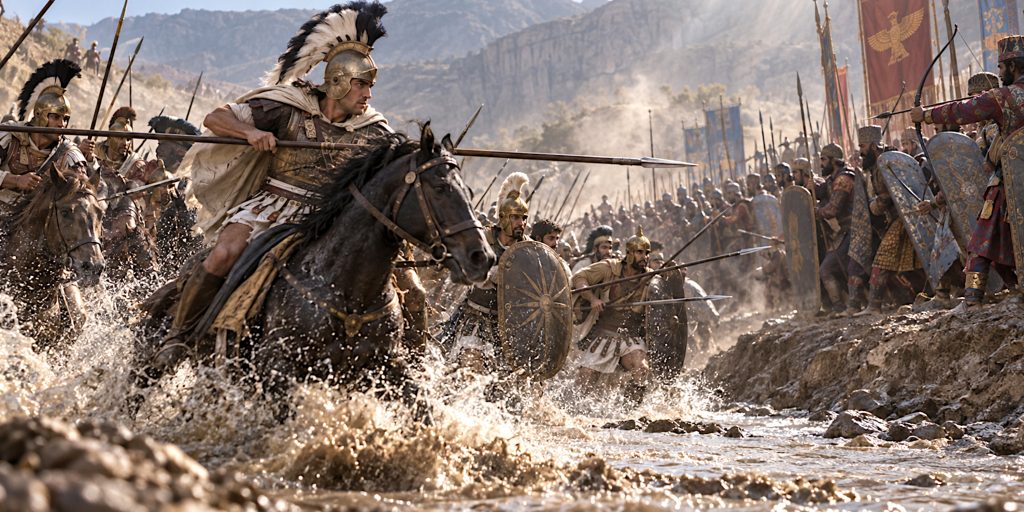
Alexander advanced obliquely with the hypaspists and Companion cavalry. Missile troops helped clear Persian skirmishers from the foothills, after which the Macedonian right crossed the water and struck the Persian left. The angle and violence of the attack disrupted the defenders and opened a route towards the royal centre.
The Phalanx Runs Into Trouble
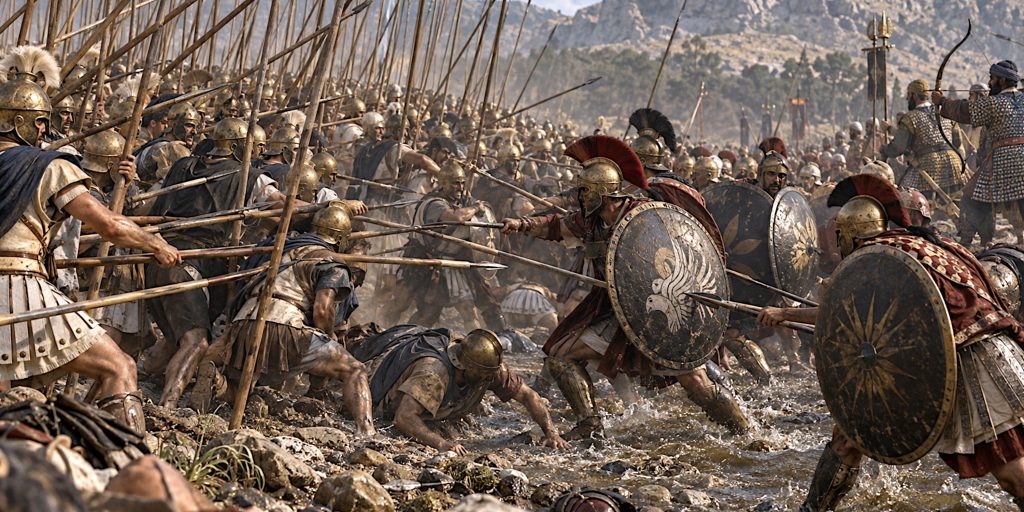
The centre did not advance as one neat wall. The uneven riverbank and speed of Alexander’s right created gaps in the Macedonian line. Greek mercenaries serving Darius attacked into these openings and inflicted serious losses. Ptolemy son of Seleucus, a phalanx commander rather than the later ruler of Egypt, was killed.
This was the battle’s dangerous hinge. Had the Persian centre broken the phalanx before Alexander turned inward, Macedonian victory would have been far from certain.
Parmenion Holds the Coast
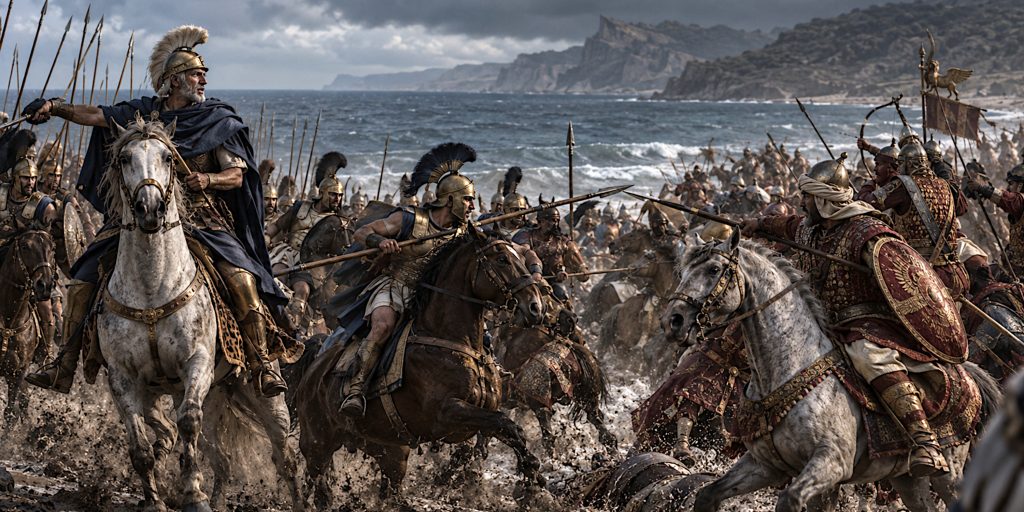
On the left, Persian cavalry crossed or pressed across the river and engaged the Thessalians. Parmenion’s command was heavily tested. The Thessalians fought defensively and prevented the Persian horse from rolling up the Macedonian line.
Parmenion is often reduced to the older subordinate who needed rescuing, partly because later Alexander traditions found him convenient to diminish. At Issus, his wing performed the essential and thoroughly unglamorous task of not collapsing.
The Drive Towards Darius
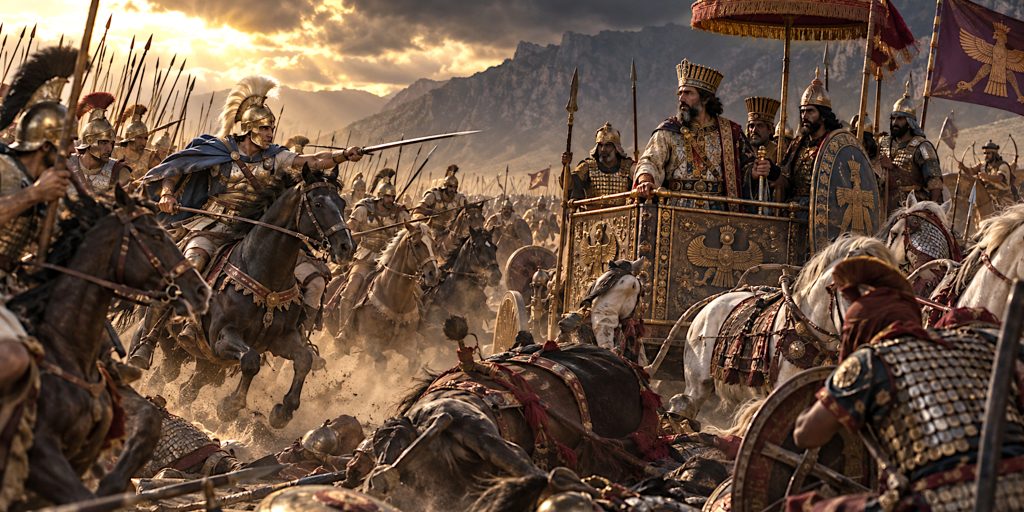
With the Persian left giving way, Alexander wheeled towards the centre and drove at Darius. Ancient accounts describe fierce fighting around the royal chariot and name several Persian nobles who died defending the king. Darius eventually withdrew, abandoning the chariot and later taking a horse to escape.
His departure was militarily disastrous, but it should not be read simply as personal cowardice. The Achaemenid king was the political and command centre of the army. Capture or death could end the dynasty in a single moment. Even so, a royal retreat visible to thousands was unlikely to improve morale.
Alexander then turned upon the Greek mercenaries, while Persian cavalry on the coast withdrew after learning that the centre had broken. The retreat became a rout through confined ground, producing heavy casualties.
Battle Timeline
| Stage | What happened |
|---|---|
| Before dawn | Alexander’s army prepared south of the Persian position after reversing its march towards Issus |
| Morning approach | Macedonian units advanced gradually and expanded from marching column into battle order |
| Initial deployment | Darius placed Greek mercenaries in the centre and massed cavalry near the coast |
| Opening action | Skirmishers engaged as Alexander extended and strengthened his right wing |
| River assault | Alexander led the hypaspists and Companion cavalry across the Pinarus against the Persian left |
| Crisis in the centre | Gaps opened in the Macedonian phalanx and Persian Greek mercenaries attacked through them |
| Cavalry struggle | Persian horse pressed Parmenion and the Thessalians on the coastal wing |
| Decisive movement | Alexander turned inward towards Darius and the Persian royal position |
| Royal withdrawal | Darius left the field as the centre became threatened |
| Rout | Persian units fled north and east; Macedonian troops pursued in difficult, crowded terrain |
| After nightfall | Alexander returned from the pursuit and secured the Persian camp and royal family |
Precise clock times cannot be reconstructed. The sequence is much firmer than the hour-by-hour schedule sometimes offered online.
Casualties
Ancient casualty figures are unreliable. Arrian reports 10,000 Persian cavalry and 100,000 infantry killed, totals that cannot be accepted literally. Curtius gives different but still enormous numbers. Such figures served to magnify the victory and the scale of Darius’ defeat.
Macedonian losses were much lower, although the hard fighting in the centre was costly by Alexander’s standards. Arrian gives 150 Macedonian infantry and 32 prominent men or cavalry dead, but this probably omits allied and lower-status losses. The safest conclusion is that Persian casualties were severe during the congested retreat, while the Macedonians also suffered meaningful losses, particularly among the phalanx.
The Capture of Darius’ Family
The Persian royal camp fell into Macedonian hands. Among the captives were Darius’ mother Sisygambis, his wife Stateira, his children and other court women. Ancient writers praise Alexander for treating them with respect and protecting their status.
This behaviour was humane by the standards of ancient conquest, but it was political as well. Possession of the royal household gave Alexander prestige and leverage. He was beginning to act less like a raider and more like a rival king of Asia.
Plutarch relates the famous story that Sisygambis mistakenly bowed to Hephaestion because he appeared taller and more imposing. Alexander supposedly reassured her that Hephaestion was “Alexander too”. It is a splendid line, although Plutarch wrote centuries later and enjoyed a morally revealing anecdote almost as much as Alexander enjoyed a dramatic entrance.
Ancient Quotes and What They Can Tell Us
No surviving account was written by an eyewitness whose complete work has reached us. Arrian, Plutarch, Diodorus and Curtius wrote centuries after 333 BCE, drawing on earlier histories now lost. They are ancient sources, not contemporary testimony.
Arrian describes the critical moment succinctly:
“The Persians were already giving way where Alexander was.”
In Plutarch’s account, Alexander’s treatment of Sisygambis produced the reassurance:
“For he too is Alexander.”
These passages are useful, but neither should be read as a verbatim battlefield transcript. Arrian wrote in the second century CE and Plutarch around the late first and early second century CE. Both shaped their material around Alexander’s character and achievement.
Archaeology and the Search for the Battlefield
Issus has not produced the kind of securely mapped battlefield archaeology available for some later conflicts. There is no agreed concentration of weapons, burials or camp remains that fixes every phase of the fighting. The humid coastal environment, river movement, later settlement and modern development all complicate the search.
The principal archaeological and topographical questions include:
- The identity of the Pinarus River, traditionally linked with the Deli Çay but also strongly argued to be the Payas River
- The width of the ancient coastal plain and changes caused by silting and shifting watercourses
- The route used by Darius across the Amanus Mountains
- The position of the Greek mercenaries and Macedonian crossing points
- The extent to which modern roads, agriculture and industry have disturbed the landscape
Material culture from the wider Macedonian and Achaemenid worlds helps reconstruct equipment, but objects without secure battlefield provenance cannot simply be assigned to Issus. Claims that excavated sarissas or akinakai have confirmed exact troop positions should therefore be treated cautiously.
The most famous visual object associated with the battle is the Alexander Mosaic from the House of the Faun at Pompeii, probably copied from an earlier Hellenistic painting. It shows Alexander driving towards Darius amid collapsing spears, wounded horses and terrified faces. The mosaic is not a photographic record of Issus, naturally, but it preserves a sophisticated ancient interpretation of the encounter and its royal drama.
Why Alexander Won
Alexander’s victory came from several advantages working together:
- He recognised that the decisive point was the Persian left and royal centre
- His experienced army could change formation while approaching the enemy
- Light troops protected the cavalry attack near the foothills
- The Companion cavalry delivered concentrated shock at the chosen point
- Parmenion and the Thessalians held under intense pressure on the opposite wing
- Darius’ position became untenable once Alexander threatened the royal centre
- The narrow battlefield limited the Persians’ ability to exploit their full frontage and cavalry strength
Luck mattered too. The gaps in the phalanx could have become fatal. Alexander’s method relied upon speed, personal leadership and the ability of other commanders to survive while he created the decision elsewhere. It worked magnificently at Issus, but it was not a tidy victory.
Outcome and Legacy
Issus destroyed Darius’ first royal army but did not end the Achaemenid Empire. Darius escaped, raised another force and fought Alexander again at Gaugamela in 331 BCE. In the meantime, Alexander moved south through Phoenicia, took Tyre after a gruelling siege and entered Egypt.
The victory transformed the political character of the campaign. Alexander had defeated the Great King in person, captured his family and seized a rich royal camp. Greek cities, Persian officials and regional rulers now had to consider that the Macedonian invasion might be permanent.
For Darius, Issus was a grave defeat rather than immediate ruin. He retained the empire’s eastern resources and tried diplomacy as well as military reconstruction. Alexander rejected settlement. By then, Asia itself had become the prize.
Issus endures because it captures Alexander’s strengths and dangers in one battle. He read the ground quickly, accepted frightening risk and led from the front. Yet the victory also depended upon soldiers holding elsewhere while their king pursued the decisive blow. Great commanders rarely win alone, however vigorously later art places them in the centre of the picture.
Frequently Asked Questions
When was the Battle of Issus fought?
The battle was fought in 333 BCE, probably in November. Traditional reconstructions often suggest 5 or 6 November, but the exact date is not absolutely secure.
Where was the Battle of Issus?
It took place on the narrow coastal plain of Cilicia in modern southern Turkey, near a river called the Pinarus by ancient writers. The modern identity of that river remains debated.
How many soldiers fought at Issus?
Alexander probably commanded around 35,000 to 47,000 troops. Darius had the larger army, perhaps 50,000 to 100,000 men, but ancient Persian totals are exaggerated and no precise modern figure is possible.
Why did Darius flee?
Alexander’s attack broke the Persian left and threatened Darius in the centre. The king withdrew to avoid death or capture, but his visible departure contributed to the collapse of the army.
What swords were used at Issus?
Macedonian and Greek troops used straight xiphoi and curved kopides or machairai as secondary weapons. Persian nobles and guards carried the short akinakes, while Greek mercenaries in Persian service used Greek-style swords alongside their spears.
Was the Alexander Mosaic found at Issus?
No. It was discovered in the House of the Faun at Pompeii. It probably reproduces a lost Hellenistic painting and is widely interpreted as showing Issus, though other identifications have been proposed.
Sources and Further Reading
- Arrian, Anabasis of Alexander, Book II
- Plutarch, Life of Alexander
- Diodorus Siculus, Library of History, Book XVII
- Quintus Curtius Rufus, History of Alexander, Book III
- A. B. Bosworth, Conquest and Empire: The Reign of Alexander the Great
- Peter Green, Alexander of Macedon, 356 to 323 BCE
- Nicholas G. L. Hammond, “Alexander’s Charge at the Battle of Issus in 333 BCE”, Historia
- Waldemar Heckel, The Conquests of Alexander the Great