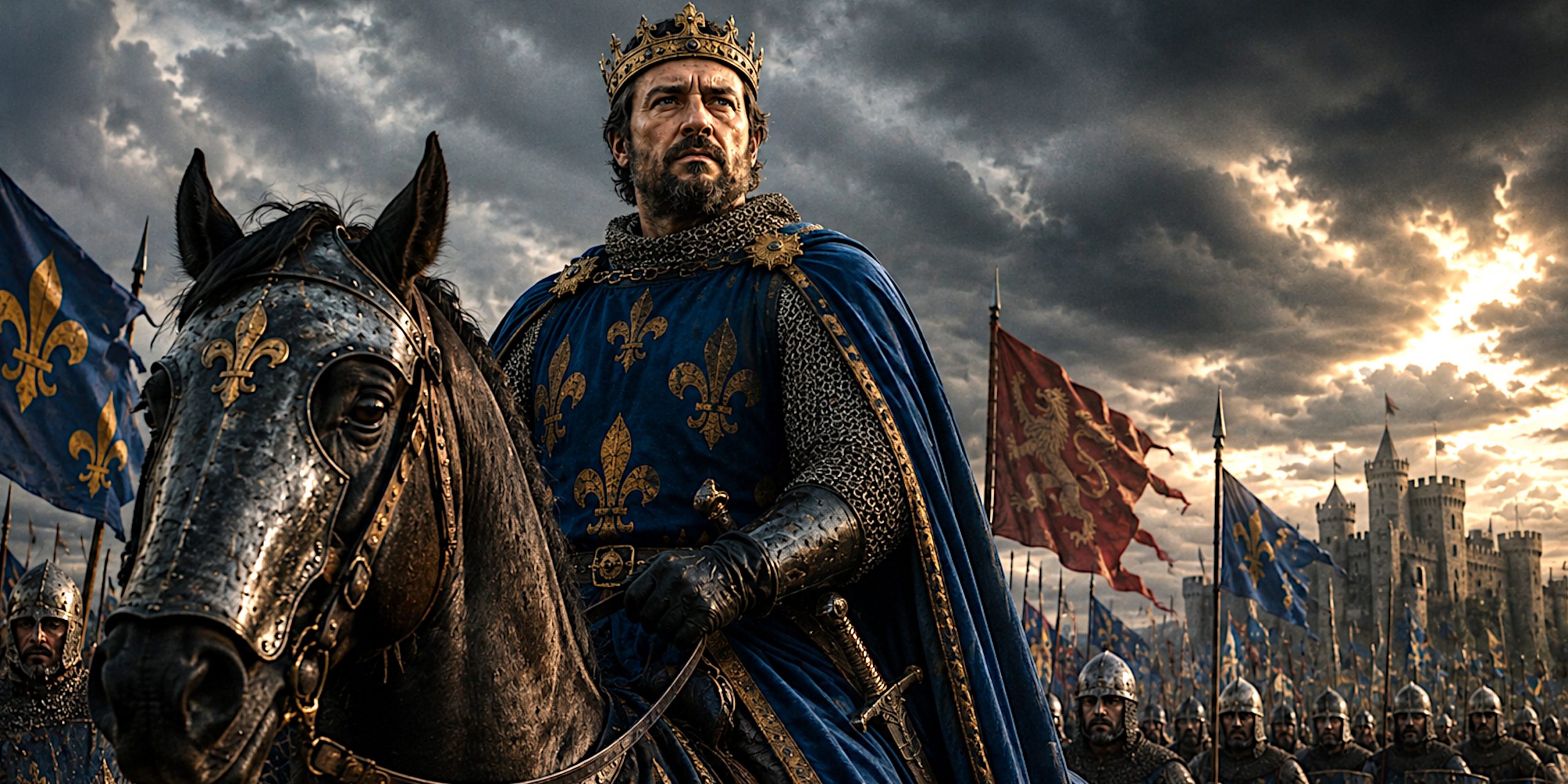
Philip II of France inherited a kingdom in which the king of France was, rather awkwardly, less powerful across much of France than one of his own nominal vassals.
By the time Philip died in 1223, that situation had been transformed.
Known to history as Philip Augustus, Philip II ruled France from 1180 until 1223. During those forty-three years he broke much of the Plantagenet empire in France, conquered Normandy, strengthened royal administration, fortified Paris and won one of the defining battles of the Middle Ages at Bouvines.
He was not the romantic warrior-king that Richard the Lionheart became in popular memory. Philip was something considerably more dangerous: patient.
He understood law, money, castles, logistics, political division and the useful medieval habit of allowing one’s enemies to quarrel amongst themselves before attacking them.
As a historian, I find Philip fascinating precisely because he does not fit comfortably into the heroic mould. Richard makes the better statue. Philip probably makes the better king.
Philip II at a Glance
| Detail | Philip II of France |
|---|---|
| Born | 21 August 1165 |
| Reigned | 1180–1223 |
| Dynasty | Capetian |
| Father | Louis VII of France |
| Mother | Adela of Champagne |
| Coronation | 1 November 1179 |
| Principal rivals | Henry II, Richard I, John of England, Otto IV |
| Major campaigns | Third Crusade, Normandy, Anjou, Flanders |
| Greatest victory | Battle of Bouvines, 1214 |
| Died | 14 July 1223 |
| Burial | Basilica of Saint-Denis |
| Successor | Louis VIII |
Philip was crowned during his father’s lifetime in 1179 and became sole king after Louis VII died the following year.
He was only fifteen.
The France he inherited was not yet France in the modern political sense. The Capetian king possessed an important royal domain centred on Paris and Orléans, but enormous territories were controlled by powerful dukes and counts.
Most threatening of all were the Plantagenets.
The France Philip Inherited
Henry II of England controlled England as well as Normandy, Anjou and extensive territories in western France through the extraordinary accumulation of lands associated with the Angevin or Plantagenet dynasty.
Through Eleanor of Aquitaine, the Plantagenet sphere also extended across much of south-western France.
The absurdity was obvious. Henry was technically Philip’s vassal for his French possessions, yet he controlled considerably more territory than his supposed feudal superior.
Philip spent much of his reign correcting this.
He rarely attempted it through simple frontal conquest. Instead, he exploited divisions inside the Plantagenet family, supported rebellious sons against fathers, used feudal courts against recalcitrant vassals and attacked when circumstances favoured him.
There is something almost unnervingly modern about it. Philip treated warfare as part of statecraft rather than statecraft as something temporarily suspended whenever somebody produced a sword.
Philip Against Henry II
Philip’s early reign coincided with the final years of Henry II.
Relations within Henry’s family were notoriously poisonous. Henry’s sons competed for territory, inheritance and power, while Philip was perfectly willing to encourage them.
He developed particularly useful relationships with Richard, the future Richard I.
In 1189 Richard and Philip combined against Henry II. The ageing English king was forced into submission shortly before his death at Chinon.
Richard inherited the Plantagenet possessions.
Philip had helped remove one formidable opponent.
Unfortunately for him, the replacement was Richard the Lionheart.
Philip II and Richard the Lionheart
Philip and Richard are sometimes portrayed as straightforward rivals, but their relationship was considerably more complicated.
They had cooperated against Henry II and then travelled east as fellow crusading monarchs during the Third Crusade. Yet their interests in France made a lasting friendship almost impossible.
Richard was an exceptionally dangerous military commander. Philip appears to have understood this perfectly well.
Their rivalry would become one of the great political contests of the late twelfth century.
Philip II and the Third Crusade
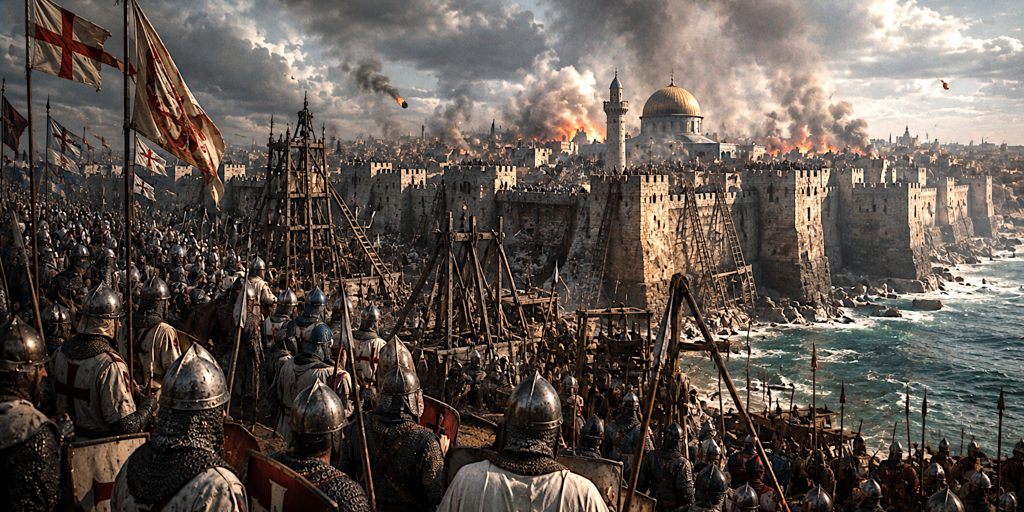
The fall of Jerusalem to Saladin in 1187 produced an enormous reaction across western Christendom.
Philip and Richard both took the cross.
They eventually travelled to the Holy Land and joined the prolonged Siege of Acre, one of the major operations of the Third Crusade.
Philip arrived in 1191 and participated actively in siege operations. Acre surrendered in July.
Shortly afterwards Philip returned to France.
Illness was certainly a factor, although relations with Richard and political opportunities in Europe were hardly irrelevant. His departure was criticised, particularly when compared with Richard’s subsequent campaigning against Saladin.
Yet judging Philip purely by crusading ideals rather misses the man.
His priority was France.
Richard remained in the east and was later captured while returning to Europe. Philip immediately recognised the opportunity.
Exploiting Richard’s Captivity
Richard’s capture by Leopold V of Austria in 1192 was an extraordinary gift to Philip.
Philip cooperated with Richard’s brother John and attacked Plantagenet possessions in France.
Richard was eventually released in 1194 and returned with considerable enthusiasm for settling accounts.
The resulting campaigns demonstrated why Philip had good reason to prefer fighting Richard when Richard was somewhere else.
Richard recovered territory and repeatedly placed Philip under military pressure. The construction of Château Gaillard above the Seine became the most spectacular expression of Richard’s determination to defend Normandy.
Then, in 1199, Richard was struck by a crossbow bolt while besieging Châlus-Chabrol.
He died from the wound.
The strategic balance changed almost overnight.
Philip II Against King John
John inherited the English throne but lacked Richard’s military reputation and political authority.
Philip exploited both weaknesses.
The crisis surrounding John’s treatment of Arthur of Brittany gave Philip a powerful political weapon. As overlord of John’s French territories, Philip summoned him before the royal court.
John failed to appear.
Philip declared his French lands forfeit.
This is one of the most revealing episodes of the reign. Philip did not simply invade his rival’s territory and invent a justification afterwards. He used the developing machinery of Capetian kingship to present conquest as the enforcement of feudal law.
Very convenient law, admittedly.
The Conquest of Normandy
Philip launched his decisive offensive against Normandy in 1202.
Rather than relying upon one spectacular field battle, he systematically attacked the defensive network protecting the duchy.
The greatest obstacle was Château Gaillard.
The Siege of Château Gaillard
Richard had constructed Château Gaillard between 1196 and 1198 overlooking a bend of the Seine at Les Andelys.
Its position protected the approaches towards Rouen and Paris.
Philip besieged the fortress in 1203.
The operation demonstrated several characteristics of his military style:
- patience rather than reckless assault
- careful investment of fortified positions
- control of surrounding territory
- use of siege engineering
- willingness to sustain operations over months
- exploitation of weaknesses in supposedly formidable defences
The castle fell in March 1204.
Once Château Gaillard was lost, the defence of Normandy rapidly deteriorated.
Rouen surrendered in June.
Normandy, held by the descendants of William the Conqueror since 1066, had effectively been absorbed into the Capetian royal domain.
That was an extraordinary reversal of fortune.
The Expansion of the Royal Domain
Philip’s victories brought enormous territories under direct or increased royal control.
Among the major gains were:
| Territory | Importance |
|---|---|
| Normandy | Rich, strategically vital and previously central to Plantagenet power |
| Anjou | Weakened the geographical core of the Angevin dynasty |
| Maine | Connected expanding Capetian possessions |
| Touraine | Further reduced Plantagenet influence in central France |
| Parts of Poitou | Extended Capetian influence towards the south-west |
France did not suddenly become a completely centralised monarchy. Powerful nobles remained, and many regions retained distinct political identities.
But the geographical balance of power had changed dramatically.
Arms and Armour During Philip II’s Reign
Philip’s reign sits in a particularly interesting period for medieval military equipment.
The knight of 1180 was recognisably related to the Norman-style warrior of the previous century. By the early thirteenth century, equipment was moving towards the more enclosed protection associated with the classic medieval knight.
Armour
The principal defence remained mail.
A wealthy knight could wear a long mail hauberk extending towards the knees, with sleeves protecting the arms. Mail chausses increasingly protected the legs.
Beneath the mail was a padded textile garment that helped absorb impacts and prevented the metal rings from resting directly against the body.
Mail was extremely effective against cuts, though powerful thrusts and blunt trauma remained dangerous.
Helmets
Philip’s reign witnessed considerable development in helmet design.
Earlier nasal helmets remained in use, but increasingly enclosed helmets appeared among elite warriors.
By the early thirteenth century the development towards the great helm was clearly underway. At Bouvines in 1214, heavily equipped knights could therefore present a substantially more enclosed appearance than warriors from the beginning of Philip’s reign.
Shields
Large kite-shaped shields gradually became shorter during the period.
This contributed to the emergence of the heater-shaped shield, particularly suitable for mounted combat.
Heraldry was becoming increasingly important, allowing shields and surcoats to communicate identity amid the dust and confusion of battle.
At Bouvines, identifying important nobles was not merely decorative pageantry. Capturing the right man could make someone extremely rich.
Swords
The characteristic knightly sword remained the single-handed arming sword.
Typical swords of Philip’s period had:
- straight double-edged blades
- cruciform guards
- single-handed grips
- wheel, disc or related pommel forms
- blades suited to both cutting and thrusting
In the Oakeshott typology, swords broadly corresponding to Types XI, XII and related transitional forms are particularly relevant to the late twelfth and early thirteenth centuries.
The sword was an important sidearm and potent symbol of knightly status, but it should not be imagined as the primary weapon of every mounted engagement.
That honour usually belonged to the lance.
Lances and Spears
The couched lance allowed mounted knights to combine the mass of horse and rider into a concentrated impact.
Infantry spears remained among the simplest and most important weapons on the battlefield.
Crossbows
Crossbows played an increasingly prominent role in warfare.
Their power and relatively straightforward aiming process made them valuable during sieges and field operations. Richard I himself famously died from a crossbow wound.
Philip’s armies operated in a military environment in which crossbowmen were becoming an increasingly significant specialist element.
What Would Philip II Have Worn in Battle?
No complete surviving armour can securely be identified as Philip’s personal equipment.
Any reconstruction therefore needs to remain cautious.
As a king campaigning around 1200–1214, Philip could plausibly have worn:
| Equipment | Likely form |
|---|---|
| Body defence | Mail hauberk over padded textile armour |
| Leg protection | Mail chausses |
| Head protection | Mail coif with increasingly enclosed helmet |
| Shield | Reduced kite or early heater form |
| Primary mounted weapon | Lance |
| Sidearm | One-handed arming sword |
| Additional weapon | Dagger or knife |
| Identification | Heraldic shield, banner and possibly decorated surcoat |
Royal equipment would naturally have been of extremely high quality.
It was still functional equipment. Bouvines provides rather convincing evidence that Philip was close enough to the fighting for this to matter.
Major Battles and Campaigns
| Date | Campaign or battle | Result |
|---|---|---|
| 1189 | Campaign against Henry II | Capetian and Richardian success |
| 1191 | Siege of Acre | Crusader victory |
| 1193–1194 | Campaigns during Richard’s captivity | Initial French gains |
| 1194–1199 | Wars against Richard I | Mixed, increasingly difficult for Philip |
| 1203–1204 | Siege of Château Gaillard | French victory |
| 1204 | Conquest of Normandy | Major French victory |
| 1206 | Campaign against John | Consolidation of Capetian gains |
| 1214 | Campaign against Anglo-Imperial coalition | Decisive French victory |
| 27 July 1214 | Battle of Bouvines | Philip’s greatest battlefield success |
Battle of Bouvines
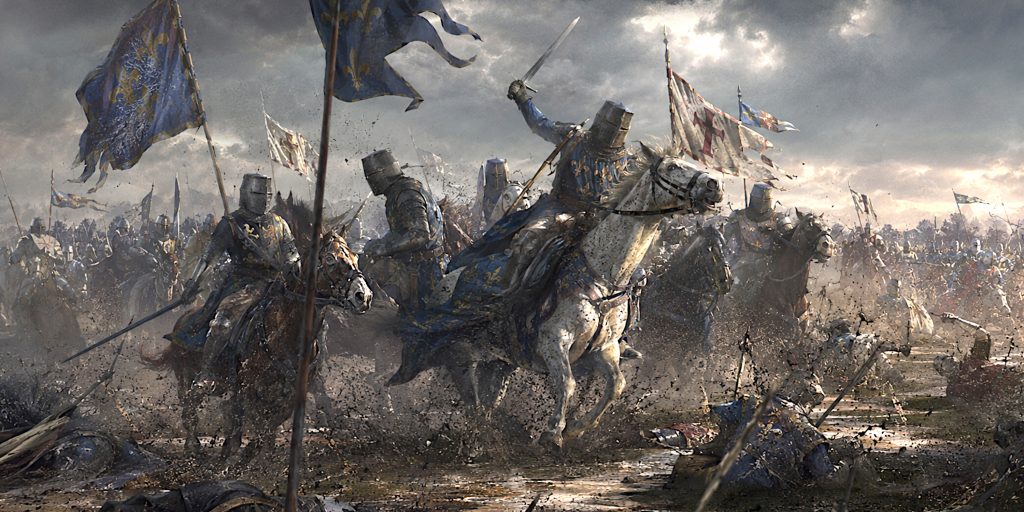
Everything in Philip’s career seems to lead towards 27 July 1214.
His enemies had assembled a formidable coalition involving Emperor Otto IV, Count Ferdinand of Flanders, Renaud of Boulogne and other opponents of the Capetian monarchy.
King John attacked from the south-west while the main coalition threatened Philip from the north-east.
Philip’s son Louis confronted John’s forces and helped force him back.
Philip faced the coalition army near Bouvines.
The battle that followed became one of the defining confrontations of medieval France.
Philip in the Fighting at Bouvines
Bouvines was not a battle directed safely from a distant command post.
Philip was personally exposed.
During the fighting he was reportedly pulled from his horse and placed in serious danger. His armour protected him while members of his household and surrounding knights fought to save him.
The episode matters because medieval kingship remained intensely personal.
If Philip had been killed or captured, the political consequences could have been enormous.
Instead, the French army recovered its position.
The allied forces eventually broke.
Emperor Otto escaped, but several major nobles were captured, including Ferdinand of Flanders and Renaud of Boulogne.
Bouvines became Philip’s defining triumph.
Why Bouvines Mattered
The consequences extended far beyond the battlefield.
For Philip, victory secured the territorial transformation he had spent decades constructing.
For Otto IV, defeat fatally damaged his political position.
For John of England, the failure of the continental strategy further weakened his authority.
Less than a year later, John was forced to accept Magna Carta at Runnymede.
Bouvines did not directly create Magna Carta, but John’s costly failure to recover his French territories formed an important part of the political crisis surrounding his rule.
A battle in northern France therefore helped shape political developments on both sides of the Channel.
Philip’s Military Acumen
Philip should not be judged purely as a battlefield tactician.
He lost campaigns. Richard I frequently outperformed him operationally during the 1190s.
What makes Philip impressive is his ability to learn, persist and combine different forms of power.
Siege Warfare
Philip understood that medieval territory was controlled through fortified places.
Rather than constantly seeking decisive pitched battles, he captured castles, towns and river crossings.
The conquest of Normandy was essentially a demonstration of strategic siege warfare.
Logistics
Long campaigns required food, money, transport, horses and secure communications.
Philip’s expanding administrative system improved his ability to sustain military operations.
Diplomacy
He repeatedly divided enemy coalitions and exploited disputes among rival nobles.
Feudal Law
Philip used his position as feudal overlord against John.
Legal condemnation became a weapon of territorial expansion.
Fortification
He invested heavily in castles and urban defences.
This was not glamorous warfare, but walls tend to remain useful considerably longer than heroic speeches.
Philip II and the Transformation of the French Monarchy
Military victory alone does not explain Philip’s success.
His reign witnessed substantial growth in royal administration.
Royal officials increasingly supervised territories on the king’s behalf. Among the most important were baillis, officials who exercised administrative and judicial responsibilities.
Philip also relied upon prévôts for local royal administration.
These systems were not a modern bureaucracy, but they allowed the monarchy to exercise considerably greater control over its enlarged domain.
Records, revenues and officials became increasingly important instruments of royal power.
The Capetian monarchy was acquiring institutional muscle.
Philip and Paris
Philip’s relationship with Paris deserves far more attention than it usually receives.
Under his reign the city was substantially fortified and developed.
He ordered construction of a major defensive wall around Paris, work beginning around the end of the twelfth century.
The fortifications incorporated:
- substantial masonry walls
- towers at intervals
- fortified gates
- control of approaches to the Seine
- defensive structures protecting strategically important areas
The circuit eventually enclosed both the Right and Left Banks.
Parts survive today.
Walking beside one of those surviving stretches is one of the rare occasions when medieval royal policy becomes physically obvious. This was not an abstract kingdom drawn on a textbook map. Philip was enclosing his capital in stone.
The Medieval Louvre
One of Philip’s most enduring structures lies beneath one of the world’s most famous museums.
Around 1190 he ordered construction of the fortress that became the Louvre.
The original complex was not the elegant royal palace later generations would recognise.
It was a military fortress.
A roughly quadrangular enclosure surrounded a powerful central cylindrical keep known as the Grosse Tour. The position guarded the western approach to Paris and strengthened the city’s defences against threats arriving along the Seine.
The Louvre would later be rebuilt and transformed repeatedly.
Its beginnings, however, belong firmly to Philip’s military programme.
Philip’s Character
Recovering the personality of a medieval monarch is difficult because the surviving sources are neither neutral nor psychologically interested in the modern sense.
Philip could be calculating, opportunistic and ruthless.
He was also capable of remarkable patience.
His troubled marital history, particularly his treatment of Ingeborg of Denmark, presents a much less admirable aspect of his reign. Philip attempted to repudiate her almost immediately after their marriage in 1193. The resulting dispute with the papacy lasted for years and eventually contributed to an interdict being imposed on France.
It is a useful reminder not to turn successful medieval rulers into comfortable modern heroes.
Philip was effective.
That is not quite the same thing as being pleasant.
Philip II and the Church
Relations with the Church were complicated.
Philip participated in the Third Crusade and presented himself within the expected framework of Christian kingship, but his marital dispute brought him into serious conflict with Pope Innocent III.
His reign also coincided with the beginning of the Albigensian Crusade against the Cathars of southern France.
Philip himself was relatively cautious about direct royal involvement, although his son Louis later participated.
The crusade would ultimately contribute to the expansion of Capetian influence in southern France, particularly under Philip’s successors.
The Death of Philip Augustus
Philip died at Mantes on 14 July 1223, aged fifty-seven.
He had ruled for more than four decades.
His body was taken to the royal necropolis at the Basilica of Saint-Denis.
His son succeeded him as Louis VIII.
The kingdom Louis inherited was fundamentally stronger than the one Philip had received in 1180.
Where to See Artefacts and Remains from Philip II’s Reign
Objects unquestionably owned by Philip are rare, but several places preserve physical evidence closely associated with his reign.
The Louvre, Paris
The most important surviving monument is beneath the modern Louvre.
Visitors can see sections of the foundations, moat and walls of Philip’s medieval fortress in the Medieval Louvre beneath the Cour Carrée.
It is probably the single best place to appreciate the scale of his building programme.
Philip Augustus’ Wall, Paris
Fragments of the defensive circuit survive at several locations across Paris.
Sections can be found around areas including Rue Charlemagne and parts of the Latin Quarter.
Some remains have been incorporated directly into later buildings.
Musée Carnavalet
The museum’s archaeological and historical collections document medieval Paris and the development of Philip’s fortifications.
Its collections also preserve drawings and photographs recording sections of the wall uncovered during later building work.
Basilica of Saint-Denis
Philip was buried at Saint-Denis alongside generations of French monarchs.
The revolutionary destruction of royal tombs means visitors should be cautious about assuming that surviving funerary monuments remain untouched medieval burials. Nevertheless, Saint-Denis remains essential for understanding Capetian kingship and royal burial culture.
Bouvines
The battlefield can still be visited near the modern village.
The Church of Saint-Pierre at Bouvines contains later stained-glass windows commemorating the battle.
They are not medieval eyewitness artefacts, but they provide fascinating evidence for the way Bouvines became embedded in French historical memory.
Bibliothèque nationale de France
The BnF preserves medieval manuscripts, chronicles and documentary material relating to Capetian France.
Manuscript imagery is particularly useful when studying clothing, heraldry, warfare and royal representation, although later illustrations should never automatically be treated as accurate depictions of Philip’s own equipment.
Philip’s Royal Seals
Surviving impressions of royal seals provide some of the most direct material evidence for how Philip’s monarchy represented itself.
A particularly interesting regency seal is known from impressions dating to 1190 and 1191, when Philip was absent on crusade.
Seals are easily overlooked beside swords and armour, but politically they are arguably more revealing. A sword tells us how a knight might fight. A royal seal tells us how authority travelled hundreds of miles without the king being present.
Archaeology and Recent Research
There is an important distinction to make here.
Many popular accounts describe the remains beneath the Louvre as a “recent archaeological discovery”. They are not.
The foundations of Philip’s fortress have been known and investigated through the redevelopment of the Louvre, and they are now incorporated into the museum itself.
What remains active is the archaeological and architectural study of Philip’s Paris.
The Wall of Philip Augustus
Construction and redevelopment in Paris have repeatedly exposed sections of the medieval enceinte.
Historic excavations documented towers and curtain walls that had disappeared inside later buildings. Modern archaeological work continues to refine understanding of how medieval Paris expanded around and absorbed these fortifications.
The surviving sections are particularly useful because the wall was not simply a military structure. Its course tells archaeologists about the changing limits, streets and economic geography of medieval Paris.
Archaeology Beneath Modern Paris
Parisian archaeological projects continue to reveal medieval occupation layers alongside Roman and later material.
These discoveries do not necessarily produce objects carrying Philip’s name. Archaeology is rarely that obliging.
Instead, ceramics, building foundations, streets, rubbish deposits and modifications to the urban landscape help reconstruct the city that Philip governed.
The Louvre Fortress
The preserved foundations remain the clearest archaeological expression of Philip’s defensive strategy.
The fortress begun around 1190 consisted of a roughly rectangular fortified enclosure protected by a moat and dominated by a large cylindrical central keep.
Its position is especially revealing. The Louvre was originally a fortress at the edge of Paris, not a palace sitting comfortably in its centre.
The city eventually swallowed it.
Few monuments illustrate the expansion of medieval Paris quite so neatly.
What Archaeology Still Cannot Tell Us
No archaeological discovery has securely produced Philip’s personal battlefield sword, armour or helmet.
Claims that ordinary late twelfth or early thirteenth-century military objects belonged personally to him should therefore be treated cautiously.
This absence is hardly surprising. Medieval kings did not thoughtfully label their campaign equipment for future museum curators.
Philip II’s Legacy
Philip Augustus deserves to rank among the most consequential monarchs of medieval Europe.
He did not create France by himself, nor did he establish anything resembling a modern centralised state.
What he did was change the balance.
When he became king, Plantagenet rulers dominated enormous areas of western France. When he died, Normandy and much of the former Angevin heartland had been brought under Capetian control.
Paris was stronger.
Royal administration was deeper.
Royal revenues and territorial resources were greater.
The monarchy possessed an authority that Philip’s predecessors would have struggled to exercise.
Bouvines provided the spectacular finale, but concentrating entirely on that battle rather misses his achievement.
Philip’s real weapon was persistence.
Richard the Lionheart was probably the superior battlefield commander. John could occasionally recover from his political disasters. Otto IV commanded a formidable coalition.
Philip outlasted them.
There is something wonderfully unromantic about that.
Medieval history likes its kings charging across battlefields with swords raised. Philip Augustus certainly experienced the brutal reality of battle, especially at Bouvines, but his greatest victories were constructed through courts, castles, taxation, alliances, sieges and the patient accumulation of power.
By 1223, the king of France was no longer merely the man with the grandest title in France.
He was becoming its master.