Few figures in British history provoke debate quite like Oliver Cromwell. To some, he was the defender of Parliament, religious reform and constitutional change. To others, he became a military dictator whose rule replaced one form of absolute power with another. His reputation is especially controversial in Ireland, where his campaigns remain associated with destruction and brutality.
Born in Huntingdon on 25 April 1599, Cromwell began life as a relatively minor member of the English gentry. He was not raised as a professional soldier, did not inherit great wealth and spent much of his early adulthood managing land and local affairs. Yet by the time of his death in 1658, he had helped defeat a king, reshape the English army, conquer across Britain and Ireland, and rule as Lord Protector of the Commonwealth.
That transformation remains one of history’s stranger career changes. Going from country gentleman to the man who effectively ran England is a rather ambitious midlife adjustment.
Early Life and Background
Oliver Cromwell was born into a family connected to the Tudor political world. His great-great-grandfather’s sister had married Thomas Cromwell, the powerful minister of Henry VIII. Although the family name carried influence, Oliver’s branch had declined financially.
He studied briefly at Sidney Sussex College, Cambridge, a strongly Puritan institution, before returning home after his father’s death. His religious beliefs became central to his worldview. Cromwell developed a deep Puritan faith, believing that political and military events reflected divine judgement.
Before the Civil War, he served as:
- Member of Parliament for Huntingdon in 1628
- MP for Cambridge in the Long Parliament of 1640
- A local organiser for Parliamentarian interests
At this stage, few would have predicted he would become one of Europe’s most effective cavalry commanders.
The Road to Civil War
Tension between King Charles I and Parliament grew throughout the 1630s and early 1640s. The main disputes involved:
- Royal authority and taxation
- Religious reforms
- Control of the army
- The power balance between monarchy and Parliament
When the English Civil War began in 1642, Cromwell sided with Parliament. Unlike many aristocratic commanders, he believed motivation and discipline mattered more than social status.
His famous observation reflected his approach:
“I had rather have a plain russet-coated captain that knows what he fights for, and loves what he knows, than that which you call a gentleman and is nothing else.”
The idea was simple, but revolutionary for the time. An army based on ability rather than birth was a serious threat to traditional military culture.
Arms and Armour of Oliver Cromwell’s Era
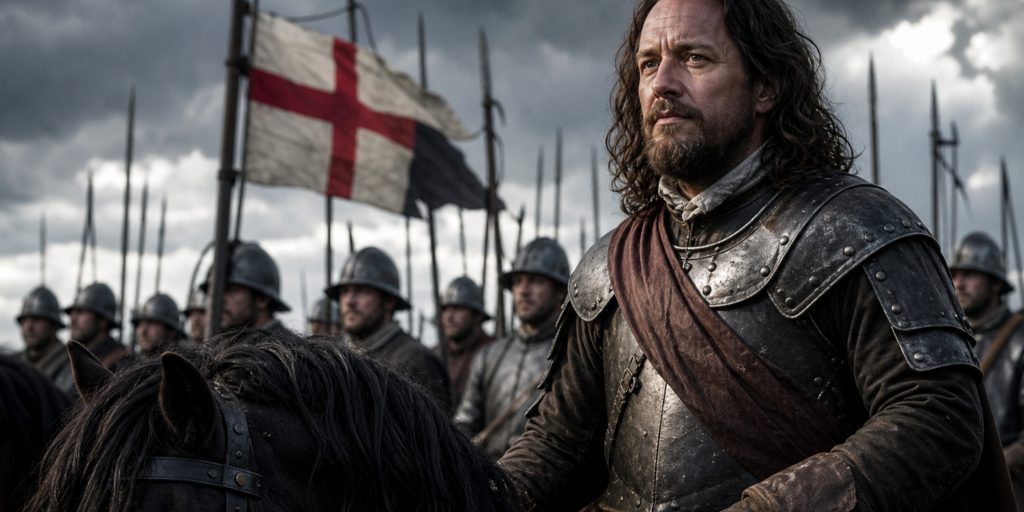
The English Civil War occurred during a transitional period of warfare. Medieval battlefield traditions had largely disappeared, but swords, armour and cavalry charges still remained important.
Cromwell’s Personal Arms and Equipment
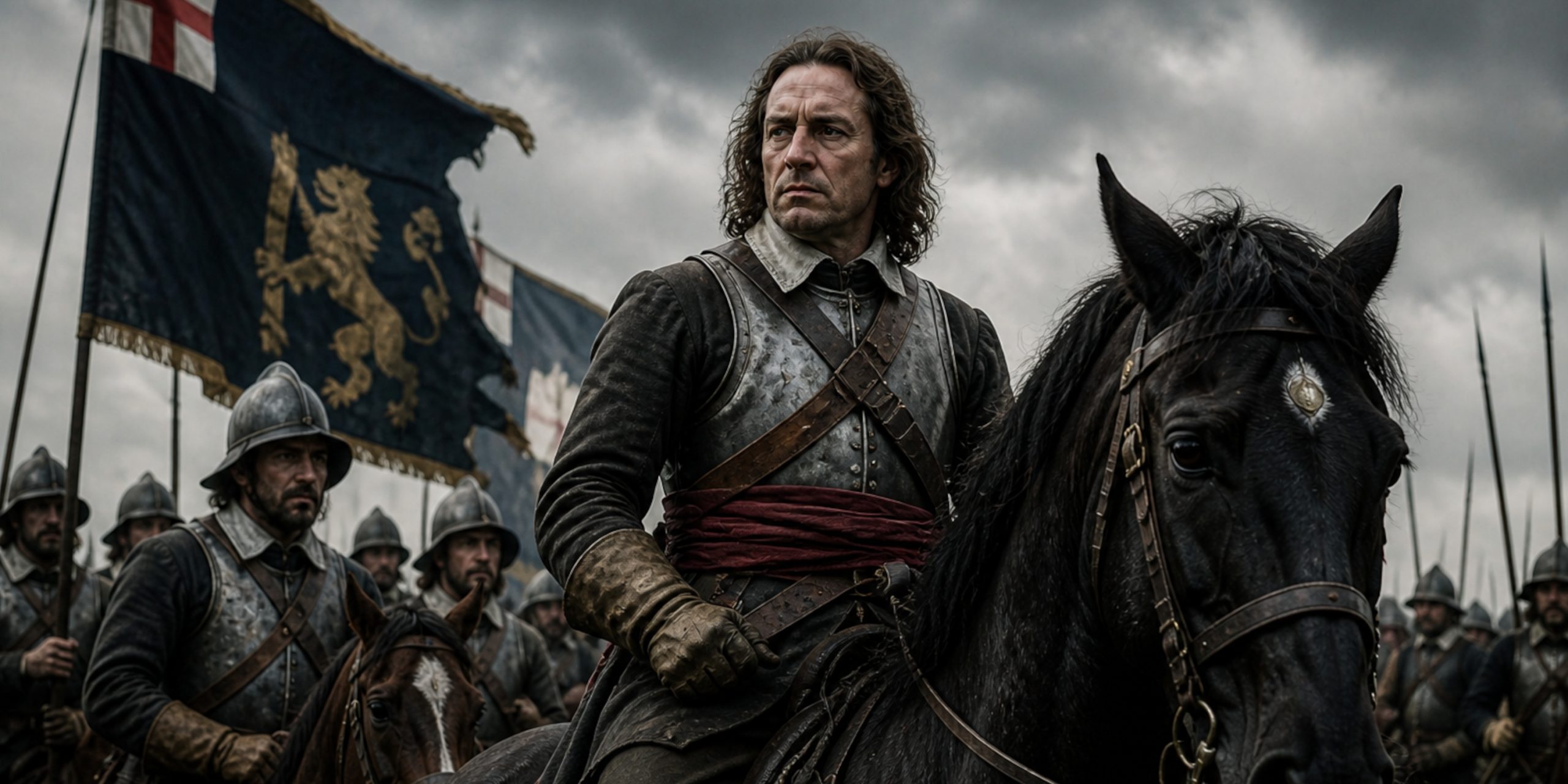
As a cavalry officer, Cromwell would typically have used equipment associated with a heavy cavalryman or “Ironside”.
Likely equipment included:
| Item | Details |
|---|---|
| Sword | Cavalry backsword or mortuary-hilt sword |
| Pistols | Wheellock or early flintlock cavalry pistols |
| Armour | Breastplate and backplate cuirass |
| Helmet | Lobster-tailed pot helmet |
| Clothing | Buff coat made from thick treated leather |
| Horse equipment | Military saddle, pistols, sword hangers |
The mortuary sword is often associated with Civil War commanders. Despite the name sometimes being linked romantically with Charles I’s death, the style existed before the execution and was simply a practical cavalry weapon.
The Ironsides
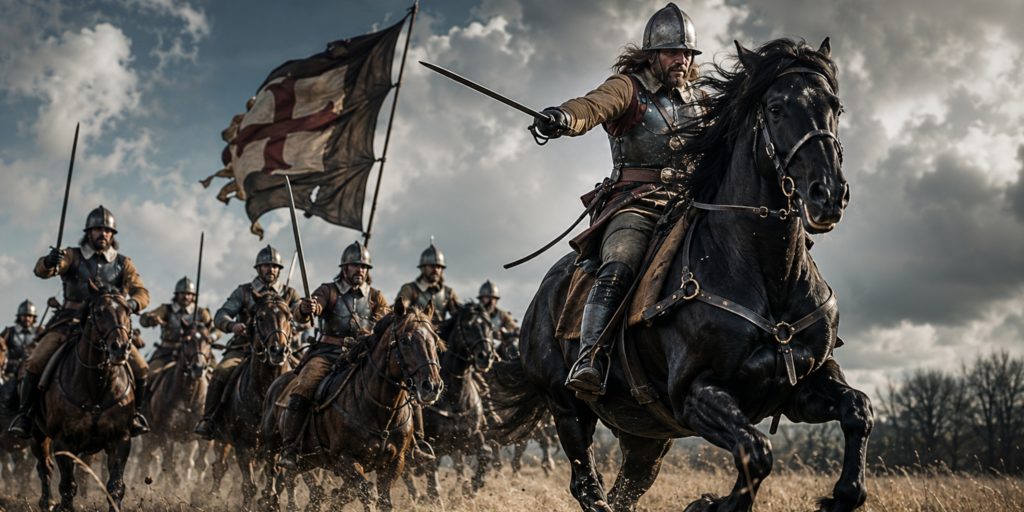
Cromwell’s cavalry gained the nickname “Ironsides”, a term traditionally linked to their discipline and battlefield toughness.
Their success came from:
- Maintaining formation after charging
- Avoiding uncontrolled pursuit
- Rapid regrouping
- Strong religious and ideological motivation
Royalist cavalry often broke opponents in spectacular charges, but Cromwell’s men were better at returning to finish the battle.
Battles and Military Acumen
Cromwell was not a formally trained commander, which makes his rise even more unusual. His strength was not complex battlefield theory but leadership, organisation and understanding morale.
He recognised a truth many commanders ignored: a disciplined average soldier often beats an undisciplined brilliant one.
Battle of Marston Moor (1644)
Conflict: First English Civil War
Role: Parliamentarian cavalry commander
Result: Parliamentarian victory
Marston Moor was one of the largest battles fought on British soil. Cromwell commanded cavalry on the Parliamentarian left wing.
His cavalry defeated Prince Rupert’s Royalist horsemen and returned to attack the exposed Royalist infantry. This ability to control cavalry after the initial charge became Cromwell’s battlefield signature.
The victory effectively ended Royalist dominance in northern England.
Battle of Naseby (1645)
Conflict: First English Civil War
Role: Commander of Parliamentarian cavalry
Result: Decisive Parliamentarian victory
Naseby destroyed Charles I’s main field army.
Cromwell’s cavalry again showed superior discipline. While some Royalist cavalry chased fleeing enemies away from the battlefield, Cromwell regrouped and attacked the Royalist centre.
The battle proved the effectiveness of the New Model Army.
Battle of Preston (1648)
Conflict: Second English Civil War
Role: Parliamentarian commander
Result: Parliamentarian victory
At Preston, Cromwell defeated a Scottish Royalist invasion despite difficult conditions.
The campaign demonstrated his ability beyond cavalry command. He coordinated movement, logistics and aggressive attacks against a larger enemy force.
Campaign in Ireland (1649 to 1650)
Cromwell’s Irish campaign remains the darkest and most controversial part of his career.
After arriving with the New Model Army, he captured Drogheda and Wexford. Both assaults resulted in large-scale killings of defenders and civilians, although historians continue to debate exact numbers, intent and how these events compared with contemporary siege warfare.
Cromwell viewed his actions through a combination of military necessity, revenge for earlier violence against Protestants and religious conviction. Modern assessments are far more critical, particularly regarding civilian suffering and the long-term impact of the conquest.
Any honest study of Cromwell has to hold two ideas together: he was an exceptional military organiser, and his victories often came with severe human consequences.
Battle of Dunbar (1650)
Conflict: Third English Civil War
Opponent: Scottish Covenanter army
Result: Cromwell victory
Dunbar is often considered one of his finest military achievements.
Facing a larger Scottish army, Cromwell exploited a tactical mistake when his opponents moved from a strong defensive position. His dawn attack shattered the Scottish forces.
Battle of Worcester (1651)
Conflict: Third English Civil War
Opponent: Charles II and Royalists
Result: Parliamentarian victory
Cromwell described Worcester as his “crowning mercy”.
The victory ended major Royalist resistance and forced Charles II into exile. It confirmed Cromwell as the dominant political and military figure in Britain.
Leadership Style and Military Strengths
Cromwell’s success came from several qualities:
- Choosing capable officers regardless of background
- Encouraging professional standards
- Understanding cavalry discipline
- Inspiring loyalty among soldiers
- Moving quickly and aggressively during campaigns
He was not flawless. His confidence could become stubbornness, and his belief that he served a divine mission made compromise difficult.
Yet as a battlefield commander, his record was extraordinary. Few leaders enter war with almost no professional experience and become one of their country’s most successful generals.
Lord Protector and Rule of the Commonwealth
After the execution of Charles I in 1649, England became a republic. Political instability eventually led Cromwell to become Lord Protector in 1653.
His government included:
- Attempts at legal reform
- Greater religious tolerance for some Protestant groups
- Continued restrictions against Catholics and some traditions
- Military administration through Major-Generals
- Expansion of English naval power
He refused the crown when offered it in 1657, but his rule increasingly resembled the authority he had fought against.
History enjoys irony, and Cromwell’s career provides plenty of it.
Death and the Restoration
Cromwell died on 3 September 1658. His son Richard briefly succeeded him but lacked political and military support.
In 1660, the monarchy was restored under Charles II.
Cromwell’s body was removed from Westminster Abbey, symbolically executed, and his head was displayed on a spike at Westminster Hall. It was a brutal piece of political theatre, even by 17th-century standards.
Where to See Artefacts Connected to Cromwell
Several important collections preserve objects linked to Cromwell and the Civil War.
Cromwell Museum, Huntingdon
The museum holds one of the most significant Cromwell collections, including:
- Personal objects associated with Cromwell
- Portraits
- Military items
- Documents
- Coins and medals
Royal Armouries, Leeds
The Royal Armouries displays Civil War weapons and armour including:
- Mortuary swords
- Cavalry armour
- Helmets
- Firearms
- Polearms
These collections provide valuable insight into the equipment used by Cromwell’s soldiers.
Museum of London and British Museum Collections
Relevant Civil War material includes:
- Coins from the Commonwealth period
- Political medals
- Printed propaganda
- Everyday objects from 17th-century England
Archaeology and Recent Research
Archaeology has transformed understanding of the Civil War period.
Important areas of study include:
Battlefield Archaeology
Investigations at Civil War sites such as Naseby have uncovered:
- Musket balls
- Artillery evidence
- Battlefield movement patterns
- Weapon fragments
These discoveries help reconstruct how battles unfolded rather than relying entirely on written accounts.
Drogheda and Wexford Studies
Archaeological and historical research continues into Cromwell’s Irish campaigns. These studies examine siege conditions, urban destruction and the experience of ordinary civilians caught between armies.
Civil War Landscapes
Modern surveys using metal detecting, mapping technology and landscape archaeology have revealed how mobile and chaotic 17th-century warfare could be.
Legacy: Hero, Villain or Something More Complicated?
Oliver Cromwell refuses to sit comfortably in one historical category.
He challenged royal absolutism but ruled with extraordinary personal authority. He promoted some forms of religious liberty while violently suppressing others. He helped modernise the army yet left behind memories of conquest and trauma.
As a historian, Cromwell is fascinating because he exposes the danger of simple labels. Calling him only a champion of freedom ignores his authoritarian rule. Calling him only a tyrant ignores his military reforms and the political changes he helped create.
He was ambitious, brilliant, ruthless and deeply convinced of his own cause. Whether admired or condemned, Cromwell remains one of the few figures who genuinely altered the direction of British history.