Thomas Cromwell remains one of the most fascinating, contradictory and misunderstood figures of Tudor England. To some he was a political genius who dragged England into the modern age. To others he was an ambitious fixer who could smile politely while arranging your destruction before supper.
He rose from remarkably humble beginnings, became the most powerful man in England after Henry VIII, broke the power of the monasteries, transformed royal government and helped change the course of English history. Then, with almost theatrical Tudor cruelty, he lost everything in a matter of weeks.
His life reads less like a conventional biography and more like a warning. In Henry VIII’s court, there was no such thing as being indispensable. There was only being useful until the king decided otherwise.
Who Was Thomas Cromwell?
Thomas Cromwell was born around 1485 in Putney, then a village outside London. He served as chief minister to Henry VIII from the early 1530s until his execution in 1540.
He was not born into the nobility. His father, Walter Cromwell, was a blacksmith, brewer, cloth merchant and, judging by surviving records, a man who managed to quarrel with almost everyone in Putney. It was not an auspicious beginning for a future statesman.
Unlike most Tudor ministers, Cromwell did not inherit power or status. He built it himself.
By the late 1530s he had become:
- Henry VIII’s principal secretary and chief minister
- Master of the Jewel House
- Lord Privy Seal
- Earl of Essex
- One of the richest and most influential men in England
He was, in effect, the architect of the Tudor state.
Thomas Cromwell’s Early Life
Very little is known for certain about Cromwell’s childhood, but contemporary accounts suggest he had a turbulent youth.
The sixteenth-century writer George Cavendish claimed Cromwell was a troublesome boy who left England while still young and travelled across Europe. According to tradition, he fought as a mercenary in Italy, worked for merchants in the Low Countries and later entered the service of a Florentine banking family.
Whether every detail is true is impossible to prove. Tudor biographies had a habit of improving a story if it sounded sufficiently dramatic. Even so, Cromwell almost certainly spent time abroad and learned languages, commerce, law and diplomacy.
That experience shaped him. Unlike many English nobles, Cromwell understood European finance and administration. He could speak to merchants, bankers and foreign ambassadors with an ease that made many traditional courtiers look as if they had wandered into the wrong room.
By the 1510s he had returned to England and entered the household of Cardinal Wolsey.
Cromwell and Cardinal Wolsey
Cromwell’s political career truly began under Cardinal Thomas Wolsey, Henry VIII’s chief minister.
Wolsey recognised Cromwell’s intelligence and gave him important work, particularly involving legal matters and the management of church property. Cromwell quickly proved himself efficient, loyal and extraordinarily hard-working.
When Wolsey fell from power in 1529 after failing to secure Henry VIII’s divorce from Catherine of Aragon, most of his servants abandoned him as quickly as rats leaving a leaking ship.
Cromwell did not.
He remained loyal to Wolsey until the cardinal’s death in 1530. That loyalty impressed many people, including the king.
It also taught Cromwell a lesson he never forgot. In Tudor politics, favour could vanish overnight.
Rise to Power Under Henry VIII
After Wolsey’s death, Cromwell entered royal service directly. Within a few years he became Henry VIII’s most trusted adviser.
His rise was astonishingly rapid.
Between 1532 and 1536, Cromwell gained office after office and became the driving force behind Henry’s break with Rome.
The king wanted an annulment from Catherine of Aragon so he could marry Anne Boleyn. When the Pope refused, Cromwell helped devise a radical solution: England would reject papal authority altogether.
Through a series of parliamentary acts, Cromwell helped create a new political and religious order.
These included:
- The Act in Restraint of Appeals
- The Act of Supremacy
- The declaration of Henry VIII as Supreme Head of the Church of England
Cromwell understood that Parliament could be used as an instrument of royal power. Before his time, kings often ruled through custom and personal authority. Cromwell instead used legislation, bureaucracy and written record.
It was a quieter form of revolution, though no less dramatic.
Thomas Cromwell and the English Reformation
Cromwell played a central role in the English Reformation.
Although historians still debate the depth of his personal religious beliefs, he appears to have supported reform and sympathised with Protestant ideas.
He encouraged the translation of the Bible into English and supported the spread of reformist preaching.
In 1538 every parish church in England was ordered to obtain an English Bible.
For many ordinary people, this was the first time scripture became accessible in their own language. For others, it was deeply unsettling. Tudor England was not famous for embracing change calmly.
Cromwell also oversaw the dissolution of the monasteries.
The Dissolution of the Monasteries
Between 1536 and 1540, Cromwell organised one of the greatest transfers of wealth in English history.
The monasteries were investigated, accused of corruption and gradually closed. Their lands, money and treasures passed to the Crown.
Officially, the monasteries were portrayed as morally decayed and financially wasteful. Some certainly were. Others were perfectly respectable institutions that happened to own desirable land.
The suppression of the monasteries transformed England:
- More than 800 religious houses were dissolved
- Vast estates were seized by the Crown
- Monastic libraries and buildings were destroyed
- Wealthy nobles and gentry acquired former church lands
The policy made Henry VIII richer and more powerful. It also created lasting resentment.
Many monasteries had provided charity, education and medical care. Their destruction left a gap that the Tudor state had no immediate interest in filling.
The sight of monastic buildings being stripped of lead, bells and stone must have been extraordinary. It was as if centuries of English religious life were being dismantled brick by brick.
The Pilgrimage of Grace
In 1536 northern England erupted in rebellion.
The uprising, known as the Pilgrimage of Grace, was partly a protest against the dissolution of the monasteries and partly an expression of anger towards Cromwell.
To many rebels, Cromwell represented everything they hated about the new government: centralisation, taxation, religious change and the rise of clever men from humble origins.
One rebel described him as:
“the false flattering traitor Cromwell”
The rebellion involved tens of thousands of people and briefly threatened royal authority in the north.
Henry VIII eventually crushed it. Cromwell helped organise the government response and showed little mercy.
The leaders of the rebellion were executed. The monasteries continued to close.
Cromwell had survived one of the greatest crises of Henry’s reign, though he had also made himself many enemies.
What Was Thomas Cromwell Like?
Contemporary descriptions of Cromwell are mixed.
Supporters admired his intelligence, discipline and energy. Enemies saw him as cold, ruthless and dangerously ambitious.
The French ambassador described him as:
“a man of low origin, who by his wit and industry has risen to such power”
Another observer wrote that he was:
“ever open to the poor”
This is one of the more surprising details about Cromwell. He could be generous and practical. He patronised scholars, helped servants and often intervened on behalf of people who asked for his assistance.
Yet he was also capable of extraordinary severity.
He played a role in the destruction of Anne Boleyn, helped bring down opponents at court and used accusations of treason with alarming efficiency. Tudor politics was rarely a gentle profession, but Cromwell practised it with the enthusiasm of a man who had discovered a particular talent.
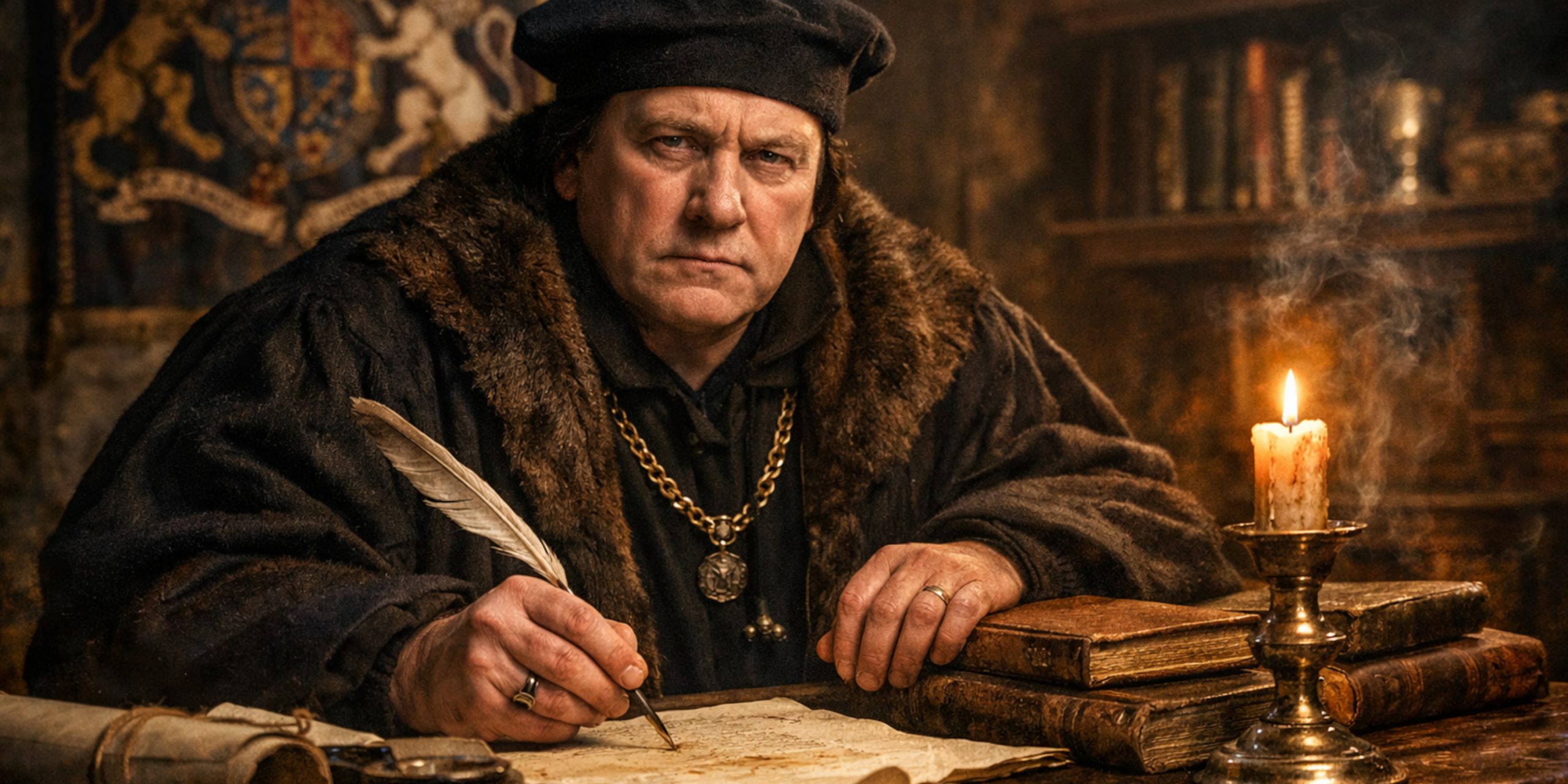
Physically, Cromwell was described as stocky, broad-faced and not especially handsome. He lacked the glamour of noble courtiers.
He probably did not care. Cromwell understood that power mattered more than appearance. Although, given the portraits, one suspects he would have appreciated a slightly kinder painter.
Thomas Cromwell and Anne Boleyn
Cromwell initially worked closely with Anne Boleyn. Both supported reform and both wanted England freed from papal authority.
Their alliance eventually collapsed.
By 1536 Cromwell and Anne disagreed over foreign policy and over what should happen to the wealth taken from the monasteries. Anne wanted more of it directed towards education and charity. Cromwell wanted it under royal control.
At the same time, Henry VIII had become dissatisfied with Anne.
Cromwell helped organise the investigation that led to Anne’s arrest on charges of adultery and treason. She was executed in May 1536.
Whether Cromwell believed the charges is doubtful. He probably understood, as most people at court did, that Henry wanted rid of his queen and expected his ministers to make it happen.
One contemporary later observed:
“Master Cromwell hath now made himself master of all men”
For a brief period after Anne’s fall, that looked entirely true.
Government Reformer and Political Genius
Cromwell’s greatest achievement may have been administrative rather than religious.
He reorganised royal government into a more efficient system.
Under Cromwell:
- Government departments became more specialised
- Financial administration improved
- Royal records were kept more systematically
- Parliament was used more regularly and effectively
- The Crown gained greater control over Wales and northern England
Many historians see Cromwell as one of the founders of the modern English state.
Before Cromwell, government often depended on the king’s household and personal relationships. After Cromwell, it relied increasingly on offices, paperwork and institutions.
It was not glamorous work. There are few grand paintings of men enthusiastically reorganising treasury records. Yet this was the foundation of Tudor power.
The Marriage to Anne of Cleves
Cromwell’s downfall began with a marriage.
In 1540 he arranged Henry VIII’s marriage to Anne of Cleves as part of a diplomatic alliance with the German Protestant states.
The match was a disaster.
Henry disliked Anne almost immediately. He famously complained that she did not match the flattering portrait painted by Hans Holbein.
Whether Henry was being fair is another matter. The king was ageing, increasingly irritable and no longer the athletic prince of his youth. One suspects Anne of Cleves may have had her own reservations.
The marriage was never consummated and was annulled after only a few months.
Cromwell’s enemies seized their chance.
The Fall and Execution of Thomas Cromwell
On 10 June 1540, Cromwell was arrested during a meeting of the Privy Council.
According to one account, the Duke of Norfolk tore the Order of the Garter from Cromwell’s neck while accusing him of treason.
It was a brutal and theatrical moment, perfectly suited to the Tudor court.
Cromwell was imprisoned in the Tower of London.
He was accused of treason and heresy, though the charges were vague and politically convenient. Parliament condemned him without a proper trial.
From the Tower he wrote desperately to Henry VIII:
“Most gracious prince, I cry for mercy, mercy, mercy.”
Henry did not answer.
Thomas Cromwell was executed on 28 July 1540.
The execution was badly carried out. Contemporary accounts suggest the executioner struggled to kill him cleanly, which feels horribly appropriate for the end of a man who had spent years arranging the destruction of others.
On the same day, Henry VIII married Catherine Howard.
Tudor England did have a talent for timing.
Contemporary Quotes About Thomas Cromwell
“I trust in no man alive, for this man hath told me that he trusted in me, and yet hath deceived me.”
Henry VIII, reportedly speaking after Cromwell’s fall
“He was such a servant in my judgement as for wisdom, diligence, faithfulness and experience, no prince in this realm ever had.”
Henry VIII, later regretting Cromwell’s execution
“The king is entirely governed by Cromwell.”
Imperial ambassador Eustace Chapuys
“He that was yesterday in the highest prosperity, is today brought to the lowest misery.”
Edward Hall
Did Henry VIII Regret Executing Cromwell?
There is strong evidence that Henry later regretted Cromwell’s death.
The king reportedly blamed his ministers for encouraging him to destroy “the most faithful servant” he had ever possessed.
Henry also seems to have realised that the Anne of Cleves marriage had not been entirely Cromwell’s fault.
By then, however, it was too late.
Cromwell’s enemies had triumphed, and one of the most capable men of the Tudor age was gone.
Henry VIII rarely admitted mistakes. The fact that he appears to have regretted Cromwell’s execution says a great deal.
Thomas Cromwell’s Legacy
Thomas Cromwell changed England more profoundly than almost any other minister in British history.
He helped:
- Break England from the Roman Catholic Church
- Create the Church of England
- Expand the power of Parliament
- Strengthen royal government
- Destroy the monasteries
- Build the foundations of a more modern state
Without Cromwell, Henry VIII’s reign would have looked very different.
He remains controversial because his achievements came at a terrible cost. The dissolution of the monasteries destroyed ancient institutions. His political methods could be ruthless. His rise and fall showed how dangerous power could be in Tudor England.
Yet he was also brilliant, resilient and, in many ways, ahead of his time.
Thomas Cromwell was not born to greatness. He forced his way into it.
Then Tudor politics, with its usual delicacy and restraint, swallowed him whole.