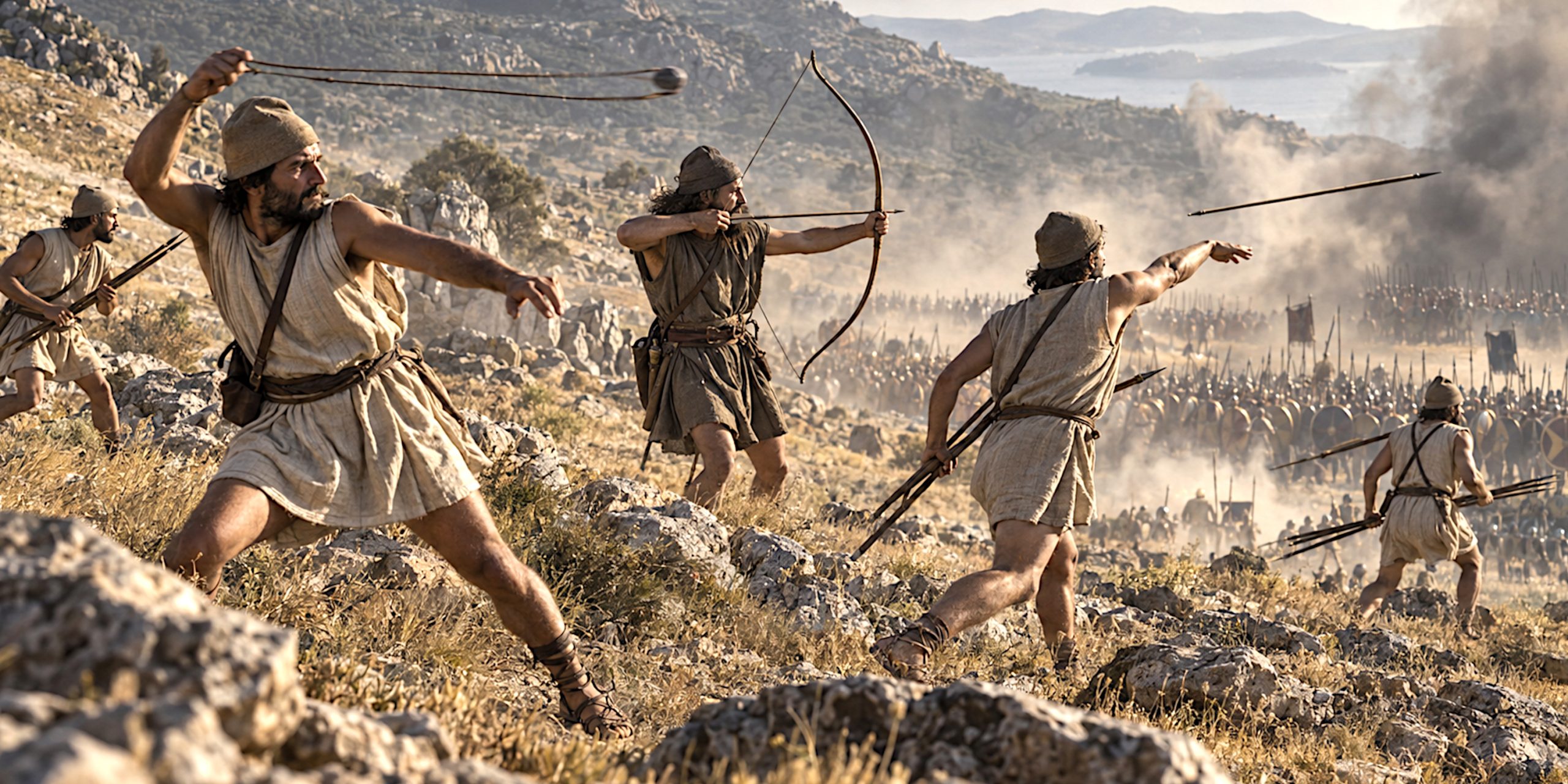
The psiloi were the lightly armed skirmishers of Greek and Byzantine warfare. They carried bows, slings, javelins or little more than a bag of stones, operating ahead of the battle line to harass the enemy, protect the flanks and make heavily equipped soldiers thoroughly miserable.
They rarely received the attention given to hoplites. Bronze armour and painted shields naturally make better monuments. Yet a phalanx without light infantry was vulnerable to missiles, rough terrain and opponents sensible enough not to attack it from the front.
Psiloi were not a single regiment, tribe or precisely defined troop type. The term covered several kinds of lightly equipped soldier over more than a thousand years. Their weapons and status changed, but their essential purpose remained recognisable: move quickly, strike from a distance and avoid being caught by anyone carrying more armour.
Psiloi at a Glance
| Category | Details |
|---|---|
| Name | Psiloi, singular psilos |
| Meaning | Bare, stripped or lightly equipped |
| Period | Archaic Greece to the Byzantine period |
| Primary role | Skirmishing and missile support |
| Typical weapons | Sling, bow, javelin and stones |
| Secondary weapons | Knife, xiphos, kopis or machaira |
| Armour | Usually none |
| Shields | Often absent, though equipment varied |
| Formation | Loose order |
| Recruitment | Citizens, poorer freemen, subject peoples and mercenaries |
| Strengths | Speed, range, flexibility and low cost |
| Weaknesses | Limited protection and poor performance in close combat |
What Does Psiloi Mean?
The Greek word psiloi broadly means the bare or stripped ones. In a military context, it described troops without the heavy shield and body armour associated with hoplites.
Ancient writers did not always use military terms with modern precision. Psiloi could include:
- Archers
- Slingers
- Javelin throwers
- Stone throwers
- Light spearmen
- Poorly equipped levies
- Servants pressed into battlefield service
- Specialist missile troops operating in loose formation
The defining feature was not a particular weapon. It was the absence of heavy equipment.
A Rhodian slinger, a Cretan archer and an Aetolian javelinman could all function as psiloi, even though their methods were quite different. It is therefore safer to think of the word as a battlefield category rather than a formal unit title.
Origins and Early Development
Light troops must have accompanied Greek armies long before historians began describing them. Hunting weapons such as bows, slings and javelins required relatively little expensive material, making them accessible to people who could not afford a bronze panoply.
In the Archaic period, aristocratic poetry and art placed enormous emphasis on close combat. This has sometimes created the impression that early Greek warfare consisted almost entirely of hoplites. It did not. Missile troops appear in literature, vase painting and archaeological finds, although elite authors generally found armoured spearmen more worthy of praise.
The Homeric poems preserve a world in which warriors throw spears, shoot arrows and hurl stones as well as fight with swords. These epics are not straightforward military reports, but they remind us that Greek combat was never as tidy as two walls of shields politely colliding.
By the fifth century BCE, psiloi were a normal component of many Greek forces. Some armies deployed them in substantial numbers, while others recruited specialists from regions known for particular weapons.
Who Became a Psilos?
Many psiloi came from the less wealthy parts of society. A hoplite was usually expected to provide his own shield, helmet, spear and armour. Men without the money for that equipment could still serve with a sling, bow or bundle of javelins.
This economic distinction should not be mistaken for a complete lack of skill. Effective slinging and archery required years of practice. Regional specialists could become highly valued mercenaries.
Well-known light troops included:
- Rhodian slingers, renowned for their range and accuracy
- Cretan archers, employed across the Greek and Hellenistic worlds
- Aetolian javelinmen, particularly effective in broken country
- Acarnanian slingers and light infantry
- Thracian missile troops, often associated with javelins and peltast warfare
- Balearic slingers, who served in Hellenistic and later Roman armies
Other psiloi were far less specialised. They might be attendants, labourers or poorer levies temporarily armed with whatever missile weapons were available.
Herodotus claimed that the Spartan force at Plataea in 479 BCE was accompanied by thousands of lightly armed helots. The exact figures are debated, but the passage shows that servants and dependent populations could form a substantial part of a Greek army’s light contingent.
The Battlefield Role of Psiloi
Psiloi fought in open order rather than in the dense ranks of a phalanx. Space allowed them to run, aim and withdraw without becoming entangled with one another.
Their main tasks included:
- Screening an army during its advance
- Driving away enemy skirmishers
- Weakening heavy infantry before contact
- Attacking exposed flanks and rears
- Protecting hoplites from missile troops
- Fighting in hills, woodland and broken ground
- Supporting cavalry
- Defending walls and field fortifications
- Pursuing defeated troops
- Disrupting elephants and other specialist forces
A good skirmisher tried to remain close enough to inflict damage but far enough away to escape a charge. This sounds simple until someone begins running towards you with a spear. The work demanded judgement, stamina and a keen awareness of terrain.
How Psiloi Fought
Psiloi generally advanced ahead of the main formation. They released missiles, withdrew when threatened and returned once the pursuing enemy had lost momentum.
Against heavily armoured infantry, their aim was not necessarily to kill large numbers immediately. Repeated attacks could tire the enemy, damage morale and disrupt formation. Even a missile stopped by a shield forced its bearer to react.
Skirmishers were most effective when they could attack from several directions. A hoplite’s large shield protected his left side and much of his front, but offered little help against missiles arriving from behind or from the unshielded right.
Terrain mattered enormously. On flat ground, cavalry could scatter exposed psiloi. In hills, ravines and woodland, light troops could evade pursuit and attack from positions inaccessible to a coherent phalanx.
Arms and Armour
There was no universal psiloi equipment set. Their weapons reflected local traditions, wealth and battlefield purpose.
| Equipment | Use |
|---|---|
| Sling | Long-range harassment using stone, clay or lead ammunition |
| Bow | Sustained missile fire against troops and horses |
| Javelin | Shorter-ranged but powerful throwing weapon |
| Stones | Simple missiles gathered locally or carried into battle |
| Knife | Utility tool and weapon of last resort |
| Sword | Emergency protection during close combat |
| Light clothing | Allowed rapid movement in difficult terrain |
| Cap or simple helmet | Occasional head protection |
| Small shield | Used by some light troops, but not typical of psiloi in the strict sense |
Slings
The sling was one of the cheapest military weapons and one of the most underestimated. It consisted of a pouch attached to two cords. A trained user could project a stone or lead bullet at dangerous speed and considerable range.
Ammunition included:
- Rounded stones
- Shaped clay projectiles
- Cast lead bullets
- Almond-shaped lead glandes
- Inscribed projectiles bearing names, symbols or insults
Lead bullets were compact and dense. Their small size made them difficult to see in flight, while consistent moulded forms helped trained slingers achieve reliable performance.
Bows
Greek archers used self bows or composite bows, depending on region and cultural influence. Cretan archers became particularly respected and served as mercenaries across the Mediterranean.
Archers could maintain fire at ranges beyond most javelinmen, but they needed space and protection. Their effectiveness depended on bow strength, ammunition, weather and the armour worn by their targets.
Javelins
Light javelins could be carried in groups and thrown in rapid succession. Some used throwing loops or thongs to increase rotation and distance.
Javelinmen operated at closer range than archers or specialist slingers. Their missiles were heavier, however, and potentially more effective against shields, exposed limbs and lightly armoured opponents.
Stones
Thucydides refers to stone throwers serving alongside other light troops. A stone gathered from the ground might look primitive beside a bronze-tipped spear, but a well-thrown rock could injure an unprotected face, hand or leg.
Simple weapons are still weapons. The human skull has never been particularly interested in military prestige.
The Swords Used by Psiloi
Swords were secondary weapons for psiloi rather than their principal means of fighting. Many lightly equipped soldiers may not have carried one at all. Those who did would have used forms common in their region and period.
Xiphos
The xiphos was a straight, double-edged Greek sword. It was compact enough to carry without seriously restricting movement and could be used for cutting or thrusting.
A psilos equipped with a xiphos gained some protection if caught at close quarters. He did not thereby become a hoplite. Without a large shield and armour, prolonged sword fighting against heavy infantry remained a remarkably poor career choice.
Kopis
The kopis had a single-edged blade with a forward-weighted cutting profile. It was capable of delivering forceful blows and was used by infantry and cavalry.
A light soldier might carry a short kopis as a sidearm, although direct evidence linking specific surviving examples to psiloi is rarely possible.
Machaira
Ancient authors sometimes used machaira broadly for a single-edged blade or large knife. The distinction between a machaira and kopis is not always consistent in ancient or modern usage.
For light infantry, such a weapon could serve as both a practical camp tool and an emergency fighting blade.
Akinakes and Regional Blades
Troops recruited from Persian, Scythian or Anatolian traditions might carry an akinakes or another short regional sword. Greek armies, especially during the Hellenistic period, regularly included soldiers from beyond mainland Greece.
We should resist presenting every psilos as a neatly standardised Greek figure. Ancient armies were often visually untidy, which tends to be how real armies behave once they leave the illustrator’s desk.
Did Psiloi Carry Shields?
Strictly speaking, psiloi were usually distinguished by their lack of heavy defensive equipment. Many probably carried no shield at all.
This separated them from peltasts, who were named after the pelta, a light shield traditionally associated with Thrace. In practice, the categories could overlap. Some light javelinmen carried small shields, and ancient writers did not always maintain a rigid distinction.
A useful general division is:
| Troop type | Typical protection | Main role |
|---|---|---|
| Psiloi | Little or no armour, often no shield | Missile skirmishing |
| Peltasts | Light shield, limited armour | Aggressive skirmishing and flexible infantry combat |
| Hoplites | Large shield, helmet and body armour | Close-order spear fighting |
By the fourth century BCE, some peltasts were capable of sustained close combat. Psiloi remained more dependent on distance and mobility.
Psiloi Against Hoplites
A lone psilos was at a severe disadvantage against an armoured hoplite at close range. Groups of psiloi operating in suitable terrain were a different matter.
Their methods exploited the weaknesses of heavy infantry:
- Hoplite formations were slower
- Large shields restricted visibility and movement
- Armour increased fatigue
- Dense ranks struggled on uneven ground
- Spears were awkward against dispersed targets
- Pursuit could break formation
- Exposed flanks remained vulnerable to missiles
Psiloi could shower a formation with missiles, retreat from a charge and resume attacking once the hoplites stopped. If the heavy troops pursued too far, they risked isolation and exhaustion.
The danger was particularly serious when psiloi worked with cavalry or heavier infantry. The hoplites could not chase the skirmishers freely without opening their formation to another attack.
The Aetolian Disaster
The Athenian campaign in Aetolia in 426 BCE provides one of the clearest demonstrations of effective light infantry.
The Athenian commander Demosthenes advanced with hoplites and allied troops but failed to secure sufficient Locrian javelinmen. The Aetolians assembled quickly and attacked from the surrounding hills.
According to Thucydides, the Aetolians were lightly armed and highly mobile. They threw javelins, withdrew whenever the Athenians advanced and returned when the pursuit ended.
Athenian archers initially kept them at a distance. Once the commander of the archers was killed and the ammunition began to fail, the Athenian force collapsed. Heavy infantry that might have been formidable on open ground became trapped, exhausted and vulnerable.
This was not a freak accident. It was a lesson in combined arms, terrain and the unpleasant consequences of assuming armour solves every problem.
Psiloi at Sphacteria
At Sphacteria in 425 BCE, Athenian light troops helped defeat a force of Spartan hoplites stranded on the island.
The Athenians landed archers, peltasts and other lightly armed men alongside their hoplites. Rather than offering the Spartans the close battle they wanted, these troops attacked with missiles and retreated whenever the Spartans attempted to close.
Dust, heat, smoke and repeated missile attacks wore down the Spartan force. The Spartans could neither catch their attackers nor remain indefinitely under fire. Eventually, the survivors surrendered.
The event shocked the Greek world. Spartan hoplites were expected to die rather than submit. Light troops had helped expose that reputation as an ideal rather than a law of nature.
Rhodian Slingers with the Ten Thousand
During the retreat of the Ten Thousand in 401 BCE, Xenophon’s Greek mercenaries were repeatedly harassed by Persian cavalry and missile troops.
The Greeks initially lacked sufficient long-range support. Xenophon responded by organising Rhodians within the army as slingers. He observed that they could use lead bullets and outrange Persian slingers who relied on larger stones.
The episode shows that psiloi were not always permanent units. Skilled men could be identified within an army and reorganised to meet a particular tactical problem.
It also reminds us that ammunition mattered. A sling was simple, but the projectile influenced range, consistency and impact.
Psiloi in Hellenistic Armies
The conquests of Alexander and the wars of his successors produced increasingly diverse armies. Pikemen remained central, but they operated alongside cavalry, elephants, archers, slingers and several classes of light infantry.
Hellenistic psiloi performed essential tasks:
- Screening pike formations
- Guarding elephants from enemy skirmishers
- Attacking enemy elephants and their crews
- Supporting cavalry on the wings
- Contesting riverbanks and passes
- Participating in sieges
- Protecting camps and baggage trains
Professional and mercenary specialists became particularly important. Cretan archers and Rhodian slingers appear repeatedly in the armies of the period.
A Macedonian pike phalanx was powerful from the front but vulnerable on difficult ground and at its flanks. Light troops helped prevent an enemy from exploiting those weaknesses, assuming commanders remembered to use them.
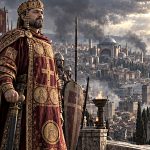
Psiloi in Byzantine Warfare
The word psiloi survived into the Byzantine military vocabulary, although its meaning shifted with changing organisation and equipment.
Byzantine writers used it for lightly armed infantry, especially missile troops such as archers and javelinmen. These soldiers operated alongside heavier infantry commonly described as skoutatoi, named after their shields.
Byzantine psiloi could:
- Shoot from behind heavy infantry
- Skirmish ahead of the main line
- Support cavalry operations
- Defend fortifications
- Fight in ambushes
- Occupy rough or elevated ground
- Harass enemy formations during a withdrawal
Some Byzantine tactical arrangements placed archers within or behind formations of shielded infantry. This gave missile troops protection while allowing them to shoot over or through controlled gaps.
The Byzantine psilos was therefore not identical to his Classical predecessor. Armour, formations and military institutions evolved considerably. The underlying distinction between lighter missile troops and shield-bearing heavy infantry nevertheless remained useful.
Contemporary Descriptions
Ancient accounts were written from the perspective of literate elites, commanders and political historians. Their words remain invaluable, but they do not offer an uncomplicated view of the ordinary soldiers doing the throwing.
Thucydides on the Aetolians
In his account of the Aetolian campaign, Thucydides describes warriors who repeatedly attacked with javelins and retreated when pursued:
“They ran down from all sides from the hills, hurling their javelins.”
His account captures the central rhythm of effective skirmishing. Attack, withdraw and return before the enemy can recover.
Thucydides on Sphacteria
Thucydides records the Spartans’ inability to reach the lightly armed troops attacking them:
“Their enemy was too nimble for them.”
The wording varies between translations, but the point is wonderfully clear. Spartan training offered few answers to an opponent who declined to stand still.
Xenophon on Rhodian Slingers
Xenophon explains why Rhodian slingers proved valuable during the retreat of the Ten Thousand:
“The Rhodians could sling twice as far as the Persians.”
The precise claim may contain some authorial pride, but Xenophon directly links their greater range to the use of lead ammunition and practised skill.
Homer on Archery
In the Iliad, archers are sometimes treated with suspicion by heroic warriors, yet their arrows repeatedly wound prominent fighters. One rebuke dismisses Paris as:
“A bowman, a braggart.”
The insult tells us more about aristocratic ideas of courage than it does about the bow’s effectiveness. Warriors tend to dislike weapons that allow someone else to hurt them from a safe distance.
Archaeological Evidence
Light infantry often leave a faint archaeological signature. Bows, slings and wooden javelin shafts decay, while stones are difficult to identify as weapons unless found in a clear military context.
Missile points and lead sling bullets provide stronger evidence.
Sling Bullets
Cast lead sling bullets have been recovered from battlefields, settlements and siege sites across the Greek and Hellenistic worlds. Their almond-shaped forms could be produced in moulds and carried in quantity.
Some bear:
- Personal names
- Unit or commander names
- City names
- Religious symbols
- Thunderbolts and scorpions
- Short insults or commands
A sling bullet in the British Museum bears a winged thunderbolt and the word dexai, meaning “catch” or “take that”. Ancient military humour was not always subtle, particularly when delivered at high speed.
Olynthus
Excavations at Olynthus uncovered large numbers of sling bullets and arrowheads associated with the city’s destruction by Philip II of Macedon in 348 BCE.
The distribution of projectiles around the defensive areas helps archaeologists reconstruct directions of attack and zones of intense fighting. Some sling bullets carry names or abbreviations connected with opposing forces.
Such finds show that missile troops were not peripheral spectators during sieges. They maintained fire against walls, defenders and assault parties.
Arrowheads
Bronze and iron arrowheads survive at settlements, sanctuaries and battle sites. Their shapes vary by date and cultural tradition. Socketed, tanged and trilobate forms all appear within the wider Greek world.
An individual arrowhead cannot usually identify the status or ethnicity of the archer who shot it. Armies reused captured equipment, employed mercenaries and acquired weapons through trade. Archaeology gives us the weapon more readily than the person.
Javelin Heads
Small spearheads may have belonged to javelins, thrusting spears or multipurpose weapons. Context, size and weight can suggest a function, but certainty is often impossible.
This is an important limitation. A neat museum label may imply a confidence that the object itself does not possess.
Art and Painted Pottery
Greek pottery depicts archers, Scythian figures, slingers and other lightly equipped warriors. These images help reconstruct clothing and weapon use, although artists were not producing technical manuals.
Typical visual features include:
- Short tunics
- Soft caps
- Quivers
- Bow cases
- Slings
- Bundles of javelins
- Limited or absent armour
Artistic evidence should be compared with texts and surviving objects rather than treated as a battlefield photograph.
Advantages of Psiloi
Mobility
Without heavy shields and armour, psiloi could cross broken ground, climb slopes and reposition quickly.
Range
Their missiles allowed them to attack without entering spear reach. Specialist slingers and archers could force an enemy to respond from considerable distance.
Flexibility
Psiloi could screen, scout, harass, pursue or defend. They were useful in pitched battles, raids and sieges.
Low Equipment Cost
A sling or javelin required far less metal than a hoplite panoply. Cities could therefore field light troops from citizens and subjects unable to equip themselves as heavy infantry.
Effectiveness in Difficult Terrain
Hills, woods and narrow routes weakened dense formations while giving skirmishers cover and escape routes.
Psychological Pressure
Repeated missile attacks could be deeply unsettling. Soldiers unable to reach their attackers might lose cohesion or charge recklessly.
Disadvantages of Psiloi
Limited Protection
Most psiloi were vulnerable to arrows, javelins, cavalry and close combat.
Dependence on Space
Skirmishers needed room to withdraw. If trapped against a river, wall or steep slope, their mobility could disappear very quickly.
Vulnerability to Cavalry
Fast cavalry could overtake light infantry on open ground. Psiloi needed friendly cavalry, difficult terrain or supporting heavy troops for protection.
Limited Close-Combat Power
Once their ammunition was exhausted, many psiloi had little ability to fight formed infantry.
Variable Quality
The category included both highly trained specialists and hastily assembled levies. Their performance could vary enormously.
Ammunition Supply
Arrows, javelins and lead bullets had to be transported or replaced. Stones were more readily available, though not every battlefield offered convenient ammunition in the desired size.
Psiloi, Peltasts and Toxotai
Ancient troop terminology often overlaps, but the following distinctions are useful.
| Term | General meaning | Typical weapon |
|---|---|---|
| Psiloi | Broad category of lightly equipped troops | Sling, bow, javelin or stones |
| Peltasts | Light infantry carrying a pelta shield | Javelins |
| Toxotai | Archers | Bow |
| Sphendonētai | Slingers | Sling |
| Akontistai | Javelin throwers | Javelin |
A toxotes or sphendonetes could also be described as a psilos because an archer or slinger belonged to the wider category of light infantry.
Peltasts occupied a more complicated position. Early peltasts were clearly light skirmishers, but later versions sometimes carried stronger shields, helmets and longer weapons. By then, they could operate somewhere between psiloi and hoplites.
How Important Were Psiloi?
Psiloi rarely won wars by themselves, but that is not a sensible measure of their value. Hoplites also needed scouts, cavalry, food, transport and allies. Ancient armies functioned as systems, even if contemporary literature preferred to celebrate individual courage.
Light troops were particularly important when:
- The battlefield was broken or mountainous
- An army faced cavalry
- Enemy missile troops were present
- A siege required sustained projectile fire
- A heavy formation needed its flanks protected
- Pursuit or retreat became necessary
- The enemy relied too heavily on slow infantry
The defeats at Aetolia and Sphacteria demonstrated what happened when heavily armed troops could neither catch their opponents nor escape their missiles.
By the Hellenistic and Byzantine periods, commanders increasingly integrated missile infantry with cavalry and heavier foot soldiers. This was not the disappearance of the psiloi. It was recognition that light troops worked best as part of a coordinated army.
Appearance and Clothing
A typical psilos may have worn a simple tunic, cloak and sandals, although clothing varied by climate, region and period.
Possible equipment included:
- Wool or linen tunic
- Simple belt
- Cloak
- Sandals or boots
- Soft cap
- Quiver or ammunition bag
- Sling wrapped around the head or waist
- Small knife
- Water flask and food pouch
Reconstructions sometimes make light infantry look almost naked to emphasise the contrast with hoplites. The Greek term referred primarily to their lack of military protection, not necessarily a heroic disregard for weather.
Legacy
The psiloi represent one of the less glamorous but more persistent truths of warfare: mobility and range can make expensive armour feel painfully inadequate.
Greek light infantry influenced the broader development of Mediterranean warfare. Their methods appeared in Hellenistic armies and found close parallels among Roman velites, auxiliary archers and slingers. Byzantine commanders continued to rely on lightly equipped missile infantry centuries later.
They also expose the social structure behind Greek warfare. The hoplite ideal celebrated citizens wealthy enough to own substantial equipment. Psiloi reveal the presence of poorer freemen, subject populations, mercenaries and specialists whose contribution was essential but less often honoured.
I find them more interesting for precisely that reason. The psiloi stood at the edge of the heroic picture, usually without bronze armour, noble ancestry or a poet arranging their reputation. Yet when the ground became steep and the javelins began arriving, everyone noticed them.
Frequently Asked Questions
Were psiloi slaves?
Some were. Helots and other dependent populations served as light troops, but many psiloi were free citizens, allied soldiers or paid mercenaries.
Did psiloi use swords?
Some carried a xiphos, kopis, machaira or regional short sword. The sword was a secondary weapon and many poorer troops may not have owned one.
Were psiloi the same as peltasts?
Not exactly. Psiloi were generally unarmoured missile troops, often without shields. Peltasts normally carried a light pelta shield and could engage more aggressively at closer range.
Could psiloi defeat hoplites?
Yes, under favourable conditions. They were most effective in broken terrain or when hoplites lacked cavalry and missile support. At close range on open ground, the advantage shifted heavily towards the hoplites.
What weapons did psiloi use?
Their principal weapons were slings, bows, javelins and stones. Equipment depended on region, period and individual wealth.
Were psiloi used by the Byzantines?
Yes. Byzantine sources continued to use the term for lightly equipped infantry, particularly archers and other missile troops operating alongside heavier shield-bearing soldiers.