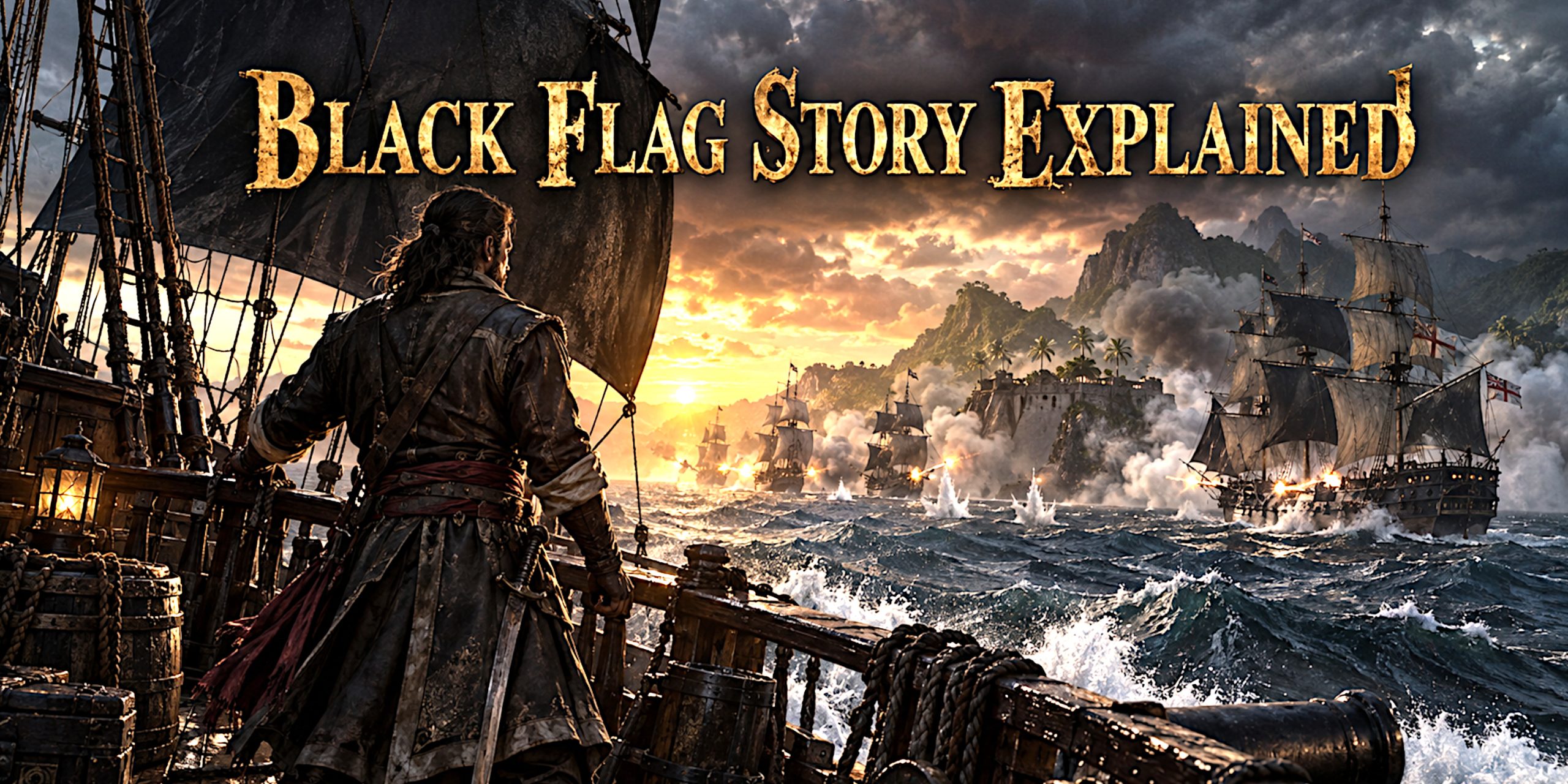
Full story summary, character guide, ending breakdown and explanation of the Observatory.
This article contains major spoilers for Assassin’s Creed IV: Black Flag.
Assassin’s Creed IV: Black Flag begins as a pirate adventure and quietly develops into one of the most personal stories in the Assassin’s Creed series. Edward Kenway spends much of the game chasing money, status and an early retirement. Instead, he loses nearly everyone who matters to him and discovers that freedom without responsibility is a rather elegant way of ruining your life.
The Assassin and Templar conflict is important, but it is not the emotional centre of the story. This is really about a selfish man learning, painfully and very slowly, that independence means little if there is nobody left beside you.
Here is the complete story of Black Flag, including the modern-day plot, the Observatory, the Sage and the meaning of the ending.
Who is Edward Kenway?
Edward Kenway is a Welsh privateer turned pirate operating during the final years of the Golden Age of Piracy. He is the grandfather of Assassin’s Creed III protagonist Connor Kenway and the father of Haytham Kenway, the charmingly dangerous Templar introduced in that game.
Before travelling to the Caribbean, Edward married Caroline Scott. He loved her, but he was also restless, proud and convinced that one great fortune would solve every problem. Caroline wanted a stable life. Edward wanted glory, wealth and proof that he was meant for something greater.
He sailed for the West Indies promising to return as a rich man. As promises go, it was sincere. His plan for keeping it was considerably less impressive.
Edward is not an Assassin at the beginning of Black Flag. He has no philosophical commitment to liberty beyond wanting to do whatever he likes. He steals an Assassin’s robes, impersonates him and wanders into a conflict he barely understands.
That distinction matters. Edward looks like an Assassin long before he behaves like one.
The story begins with a shipwreck
The main story opens in 1715 during a naval battle in the Caribbean. Edward is serving aboard a privateering vessel when the ship is destroyed in a storm.
He washes ashore alongside Duncan Walpole, a rogue member of the Assassin Brotherhood. Walpole has betrayed the Assassins and plans to sell information to the Templar Order in Havana.
Edward notices Walpole’s valuable-looking robes and assumes there must be money involved. After chasing and killing him, Edward takes his clothing, weapons and documents. He then decides to impersonate the dead man and complete the meeting himself.
This impulsive theft drags Edward into a struggle involving the Assassins, the Templars and an ancient First Civilisation device capable of observing people almost anywhere in the world.
To Edward, however, it initially looks like a profitable business opportunity.
Edward meets the Templars in Havana
Edward travels to Havana with the merchant Stede Bonnet, one of the game’s more endearing characters. Stede is polite, curious and spectacularly unsuited to piracy, which naturally means he eventually becomes a pirate.
Posing as Duncan Walpole, Edward meets several senior Templars:
- Laureano de Torres y Ayala, Governor of Cuba and Grand Master of the West Indies Templars
- Woodes Rogers, a privateer who later becomes governor of the Bahamas
- Julien du Casse, a French arms dealer and Templar
- El Tiburón, Torres’s heavily armoured enforcer
The Templars explain that they are searching for the Observatory, an ancient chamber built by the Isu, also known as the First Civilisation. It can locate and watch any living person if supplied with a sample of their blood.
The only person capable of guiding them to it is a mysterious man called Bartholomew Roberts.
Edward immediately recognises the Observatory’s financial value. Whoever controls such a device could spy on monarchs, merchants, soldiers and political enemies. Secrets have always been valuable, and the Observatory could industrialise the entire business.
The Templars also present a captive Assassin named Ah Tabai and several members of the Caribbean Brotherhood. Edward’s disguise is eventually exposed, and he is taken prisoner.
How Edward gets the Jackdaw
Edward escapes captivity with Adéwalé, a Trinidadian man who had been enslaved before joining a pirate crew. Together they free other prisoners and capture a brig.
Edward names the ship the Jackdaw and makes Adéwalé his quartermaster.
The Jackdaw becomes Edward’s base throughout the game. It begins as a modest vessel but can be upgraded with stronger armour, heavier cannon, mortars and other weapons. More importantly, it gives Edward the freedom he has been chasing.
Adéwalé quickly proves to be more thoughtful and principled than his captain. He remains loyal to Edward, but he is never blind to his faults. Their friendship provides one of the clearest measures of Edward’s development. When Adéwalé criticises him, he is usually saying what the player has already begun to suspect.
Edward may call himself free, but he is becoming a servant to his own greed.
Nassau and the pirate republic
Edward joins a loose community of pirates based in Nassau. Its leading figures include:
- Edward “Blackbeard” Thatch
- Benjamin Hornigold
- Charles Vane
- Calico Jack Rackham
- Mary Read
- Anne Bonny
- Stede Bonnet
They dream of creating an independent pirate republic, free from kings, governors and wealthy trading companies. Nassau represents the most idealistic side of piracy in Black Flag. It is chaotic and violent, but it also offers sailors a form of equality rarely available aboard merchant or naval vessels.
Crews can vote out captains. Plunder is divided according to agreed shares. Men who would possess little power in European society can help govern their own ships.
The dream is fragile from the beginning. Nassau lacks reliable supplies, medicine, political unity and long-term leadership. Its inhabitants are very good at capturing ships and rather less gifted at running a functioning state.
Blackbeard attempts to secure medicine during a disease outbreak, while Hornigold becomes frustrated with the disorder. The British government then offers pardons to pirates willing to surrender.
The group begins to fracture.
James Kidd is really Mary Read
Edward meets a young pirate named James Kidd, who appears to understand the Assassins and their methods unusually well.
James eventually reveals that she is Mary Read, a member of the Assassin Brotherhood who has been living publicly as a man. She introduces Edward to the Assassins’ base at Tulum and encourages him to take their cause seriously.
Mary sees potential in Edward, but she also sees through him. He talks about freedom, yet he regularly sells information, manipulates allies and pursues wealth regardless of the consequences.
Through Mary, Edward learns more about the Assassin philosophy. The famous maxim, “Nothing is true, everything is permitted”, does not mean that nothing matters and everyone may behave however they please. It asks Assassins to question imposed certainties while accepting responsibility for their own choices.
Edward embraces the first half with great enthusiasm. The responsibility takes a little longer.
Who is Bartholomew Roberts?
Bartholomew Roberts is one of the most important characters in Black Flag. He is both a historical pirate and a fictional Sage.
A Sage is a human reincarnation of Aita, the husband of the Isu scientist Juno. Aita participated in Juno’s experiments before the destruction of the First Civilisation. His genetic memories continue to reappear in certain humans across history.
Every Sage has a similar face and carries fragments of Aita’s personality and memories. Roberts therefore possesses knowledge that ordinary humans cannot access, including the location of the Observatory.
The Templars want to control him. The Assassins want to keep the Observatory from being exploited. Edward wants to find the Observatory first and sell its secrets.
Roberts does not truly serve either side. He recognises Edward’s ambition and uses it.
What is the Observatory?
The Observatory is an Isu surveillance facility hidden beneath the island of Long Bay, Jamaica.
At its centre is a crystal skull. When blood belonging to a particular person is placed inside the device, the user can see and hear through that person’s senses, even across a great distance.
The device offers something more dangerous than ordinary military intelligence. It can expose private conversations, secret negotiations and personal weaknesses. A ruler with access to enough blood samples could monitor rivals without armies, informants or physical surveillance.
Torres believes the Templars could use it to enforce order. That fits their wider philosophy. The Templars seek peace through control, while the Assassins defend freedom even when freedom produces uncertainty and disorder.
Edward understands neither side fully at first. He simply knows that powerful people will pay for powerful secrets.
The game’s point is not subtle, but it remains effective. A machine capable of watching anyone becomes terrifying regardless of who claims they will use it responsibly.
Edward and Roberts find the Observatory
Edward eventually forms an alliance with Roberts and helps him reach the Observatory.
Inside, Roberts demonstrates the power of the crystal skull. Edward finally sees what everyone has been fighting over, but his triumph does not last. Roberts betrays him, takes the device and leaves him injured.
This betrayal should not be surprising. Edward has spent years treating alliances as temporary arrangements and trust as a commodity. Roberts merely applies the same rules more efficiently.
Edward later hunts Roberts to Príncipe, where he kills him and recovers the crystal skull. As he dies, Roberts asks Edward to preserve his body so that the Templars cannot obtain his blood and study his nature as a Sage.
Even in death, Roberts remains connected to a conflict stretching far beyond the pirate world.
The fall of Nassau
While Edward pursues the Observatory, the pirate republic collapses.
Woodes Rogers arrives as the new royal governor of the Bahamas and offers the King’s Pardon. Pirates who surrender will be forgiven. Those who refuse will be hunted.
Benjamin Hornigold accepts the pardon and eventually works with the Templars. From his perspective, Nassau has failed and continued resistance will only produce more death. Edward sees the decision as betrayal.
Charles Vane rejects British authority but becomes increasingly unstable. After Calico Jack Rackham mutinies and abandons Vane and Edward on an island, Vane descends into paranoia and violence. Edward is eventually forced to defeat him.
Blackbeard attempts to retire but is killed during a British attack at Ocracoke. His death is one of the story’s defining moments. He dies fighting on the deck of his ship while Edward watches another part of the pirate dream disappear.
Stede Bonnet is later captured and executed. Calico Jack is arrested. Hornigold is killed by Edward. Vane is imprisoned.
The friendships that made piracy feel romantic are stripped away one by one. Edward continues chasing the Observatory while his world collapses behind him.
Blackbeard’s death changes everything
Blackbeard is presented as theatrical, intimidating and surprisingly reflective. His fearsome image is partly a weapon. Smoke, burning fuses and dramatic behaviour help him terrify enemies before a fight begins.
He also understands that piracy cannot continue forever. He wants enough money to retire, which places him closer to Edward than either man may admit.
His death exposes the weakness beneath Edward’s ambition. Wealth cannot protect his friends. Freedom cannot stop governments from reclaiming control. Reputation cannot replace a future.
Edward still does not change immediately. Black Flag allows him to remain stubborn because people rarely receive one meaningful lesson and instantly become better. Usually they ignore several warnings, make matters worse and then act surprised by the consistency of consequences.
Mary Read and Anne Bonny are imprisoned
Mary Read and Anne Bonny are captured and imprisoned in Jamaica. Both are pregnant, which temporarily delays their executions.
Edward infiltrates the prison to rescue them. Anne survives, but Mary is gravely ill after childbirth. Edward carries her out of the prison, but she dies before they can escape.
Mary’s death breaks through the excuses Edward has built around himself. She believed he could become something better, yet he repeatedly placed his obsession with wealth above the people trying to guide him.
Her death also mirrors the collapse of Edward’s personal world. Nearly every pirate companion who shared his early adventures is dead, imprisoned, defeated or working for the enemy.
For the first time, Edward must consider that he is not merely unlucky. His own choices helped bring him here.
Edward’s drunken vision explained
After Mary’s death, Edward falls into despair and drinks heavily. He experiences a vision in which he sees his lost friends gathered around a table.
The scene is not a supernatural reunion. It is Edward confronting his guilt, grief and isolation. He chased a fortune because he believed it would earn him respect and happiness. Instead, he has wealth but almost nobody left with whom to share it.
Adéwalé has also left the Jackdaw to join the Assassins. He no longer believes Edward’s private ambitions justify the damage caused along the way.
Anne Bonny remains with Edward and later serves as his quartermaster, but she is also grieving. Their friendship is quieter than Edward’s earlier pirate alliances. Both understand that the age they knew is ending.
This section marks Edward’s true turning point. His growth does not begin when he puts on Assassin robes. It begins when he accepts responsibility for what wearing them should mean.
Why Edward joins the Assassins
Edward returns the crystal skull to the Assassin Brotherhood and commits himself to their cause.
He does not suddenly become a perfectly disciplined Assassin. What changes is his understanding of freedom. Earlier, freedom meant escaping all obligations. By the end, he recognises that liberty survives only when people are willing to defend it for others.
Ah Tabai accepts Edward because he has finally shown humility and purpose. Mary believed he could become an Assassin, and Edward chooses to honour that faith.
His decision also gives him a chance to repair some of the damage caused by Duncan Walpole’s betrayal and his own reckless search for the Observatory.
The stolen robes have finally become more than a costume.
Edward’s final battle with the Templars
Edward begins dismantling the remaining Templar leadership.
He kills Benjamin Hornigold after pursuing him to an island. Hornigold defends his decision to accept British authority, arguing that the pirate republic was doomed. He is not entirely wrong, which makes the confrontation more interesting than a simple battle between hero and traitor.
Edward later infiltrates a party to attack Woodes Rogers. He wounds Rogers and believes he has killed him, although historical records and later game material establish that Rogers survives.
The final target is Laureano de Torres. Edward initially kills a decoy before discovering that Torres has gone to the Observatory.
Inside the facility, Torres uses the Observatory’s defences against him. Edward overcomes them and assassinates the Templar Grand Master, ending the immediate threat to the site.
Edward then entrusts the Observatory to the Assassins. He could have sold it and gained the fortune he always wanted. Choosing not to use it completes his transformation.
What happens to Edward at the end?
After Torres is defeated, Edward prepares to leave the Caribbean.
He learns that Caroline has died and that they had a daughter, Jennifer Scott. Jennifer travels to meet him, and Edward welcomes her into his life. Their first conversation is slightly awkward, as one might expect when meeting the daughter whose existence you only recently discovered.
Edward leaves for England with Jennifer. Before departing, he gives his Caribbean property to the Assassins, providing them with a new base.
Anne Bonny sings “The Parting Glass” while Edward remembers the friends he has lost. The scene gathers the emotional weight of the entire story into one quiet farewell. Edward looks toward an empty table and imagines Blackbeard, Mary, Stede and the others sitting together.
He cannot bring them back, but he can finally stop running from what their deaths taught him.
Who is the boy in the final scene?
The epilogue takes place several years later at a London theatre.
Edward sits with Jennifer and his young son, Haytham Kenway. They are watching a performance of The Beggar’s Opera. Haytham is the same character who later becomes a leading Templar and the father of Connor in Assassin’s Creed III.
Edward asks Haytham whether he would like to see the Jackdaw one day. The moment connects the pirate adventure directly to the Kenway family tragedy.
Edward raises Haytham in London and trains him in combat, but he does not live long enough to guide him into adulthood. In the wider Assassin’s Creed lore, Edward is murdered in 1735 after his home is attacked. Haytham is subsequently manipulated by the Templar Reginald Birch and eventually joins the Templar Order.
There is a grim irony here. Edward spends years discovering the value of the Assassin cause, only for his son to become one of its most formidable enemies.
The modern-day story explained
Black Flag is the first main game set after the death of Desmond Miles in Assassin’s Creed III.
The player controls an unnamed research analyst employed by Abstergo Entertainment in Montreal. Abstergo presents itself as a video game and media company, but it is controlled by the modern Templar Order.
The analyst explores Edward Kenway’s memories to gather material for a pirate-themed entertainment product. Behind the cheerful corporate language, Abstergo is searching for information about the Observatory and the Sages.
The analyst is contacted by John Standish, an Abstergo IT employee who encourages them to hack company systems and pass information to Shaun Hastings and Rebecca Crane, members of the modern Assassin Brotherhood.
John appears to be helping the Assassins, but his real objective is much stranger.
Who is John Standish?
John Standish is a modern Sage and therefore another reincarnation of Aita.
He wants to help Juno gain a physical body. Juno’s consciousness survived within digital systems after Desmond released her at the end of Assassin’s Creed III.
John manipulates the analyst into accessing restricted systems and approaching Juno’s digital presence. He hopes she can possess the analyst, but Juno is not yet strong enough to complete the process.
When the plan fails, John attacks the analyst. Abstergo security shoots and kills him.
His death does not end the Sage storyline. The repeated reappearance of Aita’s genetic identity shows that the conflict involving Juno and the Isu has moved beyond a single historical period or individual body.
Why the modern plot mirrors Edward’s story
Both storylines involve powerful organisations turning human memories into property.
In the eighteenth-century story, the Templars seek a machine capable of observing anyone through their blood. In the modern story, Abstergo extracts private ancestral memories and packages them as entertainment.
The technology has changed, but the underlying ambition remains familiar. Personal experience becomes data, data becomes power and power is given a friendly corporate presentation.
Edward eventually understands the danger of treating every secret as something that can be sold. The modern analyst is working inside a company built upon exactly that idea.
It is one of Black Flag’s sharper observations, even if the office sections are less exciting than firing a broadside into a Spanish man-of-war. Most things are.
What is Black Flag really about?
Black Flag is about the difference between freedom and selfishness.
Edward initially believes that freedom means answering to nobody. His pirate companions share some of this belief, but their attempt to build Nassau reveals the problem. A society cannot survive on resistance alone. People must also decide what they owe one another.
The Assassins understand freedom as a responsibility. They oppose systems of absolute control, but they also accept that their choices carry consequences.
Edward’s tragedy is that he learns this after losing many of the people who could have shared his future. His eventual redemption matters because it cannot erase those losses. He becomes a better man, but the story refuses to pretend that personal growth repairs every wound.
That gives the ending its force. Edward wins, returns home and becomes a father, yet his victory is filled with absences.
Is Edward Kenway a hero?
By the end of the game, yes, although Black Flag makes him work for the title.
Edward begins as a charismatic opportunist. He lies, steals identities, exploits the Assassin and Templar conflict and repeatedly prioritises profit over loyalty. His charm makes him likeable, but it does not make his behaviour noble.
What saves him as a character is his ability to change. He eventually confronts the consequences of his choices, rejects the fortune offered by the Observatory and commits himself to protecting others.
His redemption feels convincing because it is neither quick nor clean. Edward does not discover a secret heroic nature. He builds one from the wreckage of his mistakes.
Where Black Flag fits in the Assassin’s Creed timeline
Most of the historical story takes place between 1715 and 1722. This places it before the events of Assassin’s Creed III and after the main story of Assassin’s Creed Revelations.
The Kenway family connection runs through three generations:
- Edward Kenway becomes an Assassin
- His son, Haytham Kenway, becomes a Templar
- Haytham’s son, Ratonhnhaké:ton, also known as Connor, becomes an Assassin
Black Flag therefore serves as the beginning of the Kenway family story, even though it was released after Assassin’s Creed III.
Its ending becomes more poignant when we know what happens next. Edward escapes the Caribbean and attempts to build a stable family life, but the Assassin and Templar conflict follows his descendants long after the Jackdaw sails out of sight.
Black Flag’s ending in simple terms
Edward defeats Torres, gives the Observatory to the Assassins and abandons his pursuit of wealth at any cost.
He leaves the Caribbean after learning that Caroline has died and that he has a daughter named Jennifer. He returns to England with her, later remarries and has a son named Haytham.
The ending shows that Edward has finally found a purpose beyond treasure and reputation. His real reward is the chance to become a father and live according to the lessons he learned too late to save many of his friends.
The final theatre scene connects Black Flag to Assassin’s Creed III, while the modern story establishes that the Sages, Juno and the struggle over Isu technology remain active.
The pirate fantasy ends with treasure, betrayal and several excellent hats. The story endures because Edward’s greatest discovery is much less glamorous: your choices matter, and eventually the bill arrives.
Frequently asked questions
Was Edward Kenway always an Assassin?
No. Edward steals Duncan Walpole’s Assassin robes at the beginning of the game. He only joins the Brotherhood properly near the end of the story.
Why did Bartholomew Roberts betray Edward?
Roberts viewed Edward as a useful means of reaching the Observatory. Once Edward had served that purpose, Roberts had no reason to share its power or profits with him.
Is James Kidd a real person?
James Kidd is the identity used by Mary Read. Mary Read was a real pirate who sailed during the early eighteenth century, although Black Flag fictionalises many details of her life.
What happened to Caroline Scott?
Caroline returned to her family while Edward was in the Caribbean. She gave birth to their daughter, Jennifer, and later died before Edward returned to England.
Does Woodes Rogers die in Black Flag?
No. Edward seriously wounds Rogers but does not kill him. Rogers survived historically and later returned to the Bahamas as governor.
Why can only Roberts locate the Observatory?
Roberts is a Sage carrying the recurring genetic identity and memories of the Isu Aita. Those inherited memories give him knowledge of the Observatory and its operation.
What happens to the Jackdaw?
The game does not provide a definitive final fate for the Jackdaw. Edward returns to England and later owns other property, but the ultimate fate of his famous ship remains uncertain.
Is Black Flag connected to Assassin’s Creed III?
Yes. Edward is Haytham Kenway’s father and Connor Kenway’s grandfather. The final scene introduces the young Haytham and establishes the next generation of the Kenway story.