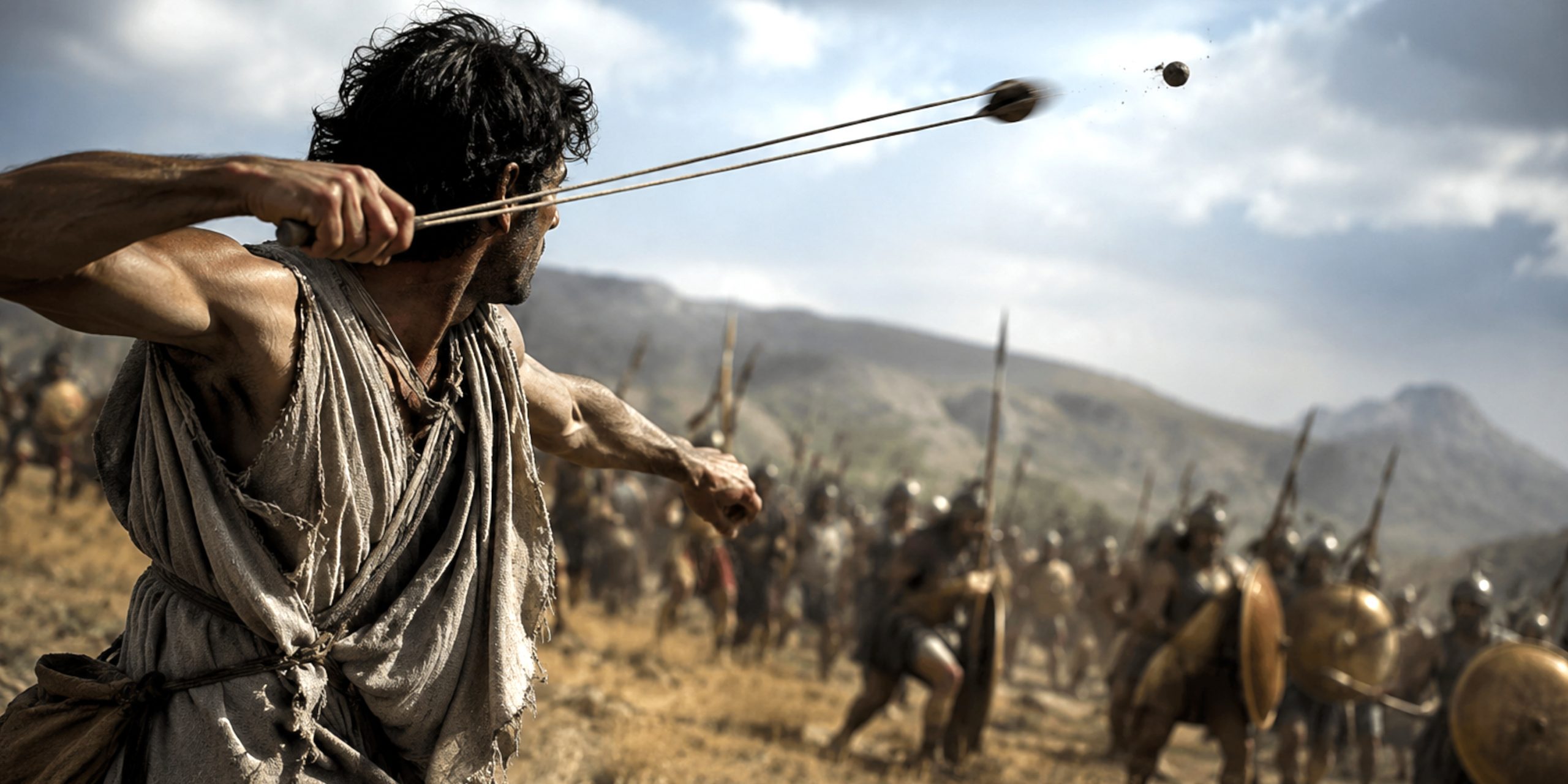
The Rhodian slingers were among the most highly regarded missile troops of the ancient Greek world. Armed with little more elaborate than a sling, a pouch of ammunition and years of acquired skill, they could harass formations from distances at which conventional infantry could do very little except endure the experience.
Their reputation was established by at least the late fifth century BC. Thucydides records hundreds of Rhodian slingers serving in the disastrous Athenian expedition to Sicily, while Xenophon gives us the most revealing description of them during the retreat of the Ten Thousand from Persia in 401 BC.
What makes the Rhodians particularly interesting is that Xenophon does not simply tell us that they were good. He explains why they were useful. Their ability to employ small lead projectiles gave them greater effective range than enemy slingers using large stones, transforming the tactical situation almost immediately.
There is something pleasingly economical about the whole business. Hoplites required shields, helmets, armour and spears. A Rhodian needed a length of carefully made cordage and something unpleasant to put in it.
Who Were the Rhodian Slingers?
Rhodian slingers were light infantry associated with the island of Rhodes in the south-eastern Aegean. By the Classical period, Rhodes and its inhabitants had acquired a considerable reputation for expertise with the sling.
This was not necessarily a permanently constituted national regiment in the modern sense. Rhodians appear serving as mercenaries and auxiliary specialists in the armies of other Greek states and commanders.
Their reputation was already well established by 415 BC. During preparations for the Athenian expedition against Sicily, Thucydides records a contingent that included:
“seven hundred Rhodian slingers”
The number is significant. These were not a handful of colourful specialists attached as an afterthought. Missile troops formed an important part of the expeditionary force.
A few years later, Xenophon provides even stronger evidence. During the retreat of the Ten Thousand, Rhodians who had apparently not originally been recruited specifically as slingers could be reorganised into an effective missile force.
This suggests that proficiency with the sling may have been relatively widespread among Rhodian soldiers, although we should resist turning that observation into a romantic picture in which every Rhodian child spent his youth terrorising seabirds with lead ammunition.
Why Rhodes Produced Famous Slingers
Exactly why Rhodes became so closely associated with slinging is less certain than the reputation itself.
The sling was inexpensive, portable and well suited to communities where familiarity with hunting, herding or informal missile practice could develop considerable skill. It was also a weapon requiring practice rather than expensive equipment.
Rhodes occupied an important position between the Aegean and eastern Mediterranean worlds. Rhodian soldiers consequently had plenty of opportunities to find employment abroad.
The island eventually became famous for rather more than slingers. Hellenistic Rhodes possessed considerable naval power, commercial influence and military expertise. The slinger therefore belongs to a broader martial culture rather than representing the entirety of Rhodian warfare.
The evidence nevertheless shows that contemporaries considered Rhodian sling skill distinctive enough to mention by name.
The Rhodian Sling
The sling was deceptively simple.
A typical weapon consisted of:
- two cords
- a central pouch or widened cradle
- a retention loop or knot
- a release cord
- fibres such as flax, wool, sinew or other suitable material
The projectile was placed in the pouch. One cord remained secured while the other was released at the appropriate moment, sending the missile towards its target.
Xenophon specifically describes new slings being plaited during the retreat of the Ten Thousand. This is useful evidence because the physical survival of ancient organic slings is understandably poor.
A sling could be carried almost anywhere, weighed very little and required minimal logistical support compared with bows.
The catch was training.
Giving someone a sling did not make him a slinger any more than giving someone a violin makes him tolerable at weddings.
Lead Sling Bullets
The weapon became considerably more formidable when used with purpose-made lead ammunition.
Greek sling bullets, commonly called glandes in modern archaeological terminology from the Latin word for an acorn, were frequently shaped into compact oval or almond-like forms.
Lead offered several advantages:
| Feature | Military advantage |
|---|---|
| High density | Considerable mass from a small projectile |
| Small dimensions | Reduced aerodynamic drag compared with a large stone |
| Regular manufacture | More consistent ammunition |
| Compact storage | Large quantities could be carried |
| Malleability | Bullets could be cast in moulds |
| Inscribable surface | Names, symbols and messages could be added |
The projectile’s small size is especially important when considering Xenophon’s account of Rhodian range.
He contrasts the Rhodians with Persian slingers using stones described as approximately hand-sized. The Rhodians could employ much smaller lead missiles.
The result was considerably greater range.
How Far Could Rhodian Slingers Shoot?
Exact modern figures should be treated cautiously.
Sling performance depends upon the length and construction of the sling, projectile mass and shape, release technique, wind conditions and, above all, the ability of the person using it.
Xenophon nevertheless provides unusually clear comparative evidence.
During the retreat of the Ten Thousand, the Greeks were being harassed by Persian missile troops. Xenophon proposed recruiting Rhodians already present in the army because:
“their missile carries no less than twice as far as those from the Persian slings.”
He explains that the Persians were using large stones while:
“the Rhodians, however, are versed also in the art of slinging leaden bullets.”
The claim should not be converted too literally into a precise range table, but the tactical result is unmistakable. Xenophon subsequently reports that the Rhodian slingers could outrange both Persian slingers and Persian archers.
Experimental slinging demonstrates that ranges exceeding 100 metres are entirely plausible in trained hands, while considerably greater distances can be achieved under favourable conditions. Effective battlefield accuracy at those ranges is another matter.
The important point is comparative rather than absolute. The Rhodians could engage enemies who had previously believed themselves safely outside Greek missile range.
That was enough to change the battle.
Xenophon and the Retreat of the Ten Thousand
The most revealing episode involving Rhodian slingers occurred during one of antiquity’s great military retreats.
After Cyrus the Younger was killed at Cunaxa in 401 BC, the Greek mercenary army that had supported him found itself deep inside Persian territory. Its commanders were subsequently killed or captured, leaving the Greeks to fight their way northwards.
Persian forces quickly discovered that they could harass the marching Greeks from a distance.
The Greeks possessed Cretan archers and javelin troops, but Xenophon recognised that their opponents could operate beyond their effective reach.
His solution was practical.
He discovered that numerous Rhodians among the Greeks already knew how to use slings. Xenophon proposed buying existing slings, paying men to manufacture new ones and rewarding volunteers who joined a dedicated slinging unit.
The response was remarkably rapid.
“That very night there came forward slingers to the number of two hundred.”
A force of approximately 200 slingers was therefore created almost immediately.
This episode tells us something important about Rhodian military culture. These men did not require months of instruction before becoming useful. The necessary skills were already present.
The Rhodians Turn the Tables
The newly organised slingers quickly justified Xenophon’s decision.
When the Persian forces of Tissaphernes attempted to resume their harassment, the Greeks responded with Rhodian slingers and archers.
Xenophon writes:
“the Rhodian slingers carried farther with their missiles than the Persians, farther even than the Persian bowmen.”
The Persian troops consequently had to withdraw beyond the Rhodians’ range.
The significance went beyond casualties.
The Persians had previously controlled the space surrounding the Greek column. They could approach, shoot and withdraw while remaining largely beyond retaliation.
The Rhodians removed that advantage.
Once Persian missile troops could themselves be struck, skirmishing became considerably more dangerous. Xenophon says that the enemy subsequently “had the worst of it” during the exchange.
This is light infantry doing precisely what good light infantry should do: denying the enemy freedom of movement rather than attempting to win the entire battle by itself.
Battlefield Tactics
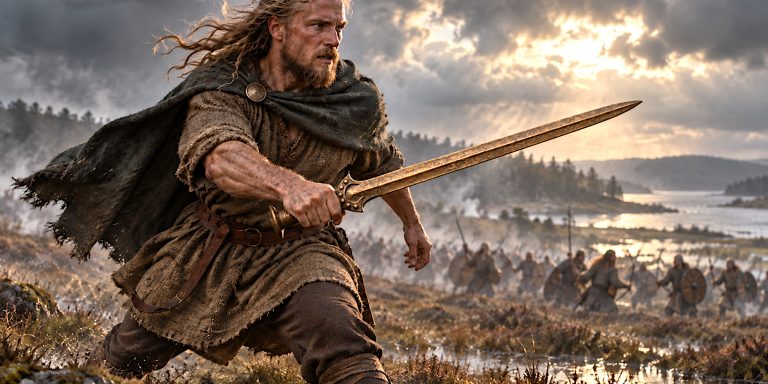
Rhodian slingers were principally skirmishers.
They could operate ahead of a formation, along its flanks or from gaps within a larger body of troops.
Their battlefield roles probably included:
- disrupting enemy formations
- driving away hostile skirmishers
- attacking exposed officers and specialists
- screening heavier infantry
- protecting marching columns
- harassing cavalry
- supporting assaults against defensive positions
- forcing enemy missile troops to remain at greater distances
Xenophon describes the Rhodians being distributed at intervals among the Greek force when responding to Persian harassment.
This flexibility mattered.
A dense hoplite phalanx was extraordinarily dangerous when an opponent obligingly stood in front of it. It was considerably less impressive when horsemen and missile troops remained fifty or a hundred metres away and refused to cooperate.
Slingers helped solve that problem.
Accuracy and Rate of Fire
Ancient sources praise expert slingers for accuracy, but calculating their battlefield rate of fire is difficult.
A trained slinger could potentially discharge several missiles per minute. Sustained shooting would depend upon ammunition access, formation, distance and the need to observe targets.
Unlike the bow, the sling required substantial clear space around the user’s arm and weapon. Closely packed slingers could interfere with one another, so formations needed room.
Accuracy was also affected by range.
At long distances, slingers could fire collectively against formations rather than selecting individual soldiers. At closer ranges, skilled operators could potentially target individuals with considerably greater precision.
Xenophon is strikingly complimentary when describing the exchange with Tissaphernes:
“not a man among them missed his mark”
This is probably rhetorical exaggeration rather than an ancient statistical report, but it reflects his confidence in their effectiveness.
Arms and Armour
Rhodian slingers belonged to the lightly equipped end of Greek warfare.
Their effectiveness depended upon mobility rather than protection.
Typical equipment
| Equipment | Likely use |
| Sling | Primary missile weapon |
| Lead bullets | Preferred long-range ammunition when available |
| Stones | Readily available alternative ammunition |
| Ammunition pouch | Carrying prepared missiles |
| Light clothing | Maximised mobility |
| Cloak | General campaign equipment |
| Knife or dagger | Utility and emergency defence |
| Sword | Possible secondary weapon, particularly among mercenary soldiers |
| Light helmet | Plausible in some contexts, but not universal |
| Small shield | Possible for some light troops, but not essential to the Rhodian slinger’s role |
We should be careful with reconstructions showing every Rhodian slinger wearing identical armour and carrying an identical sword. Ancient light infantry equipment was rarely that obligingly uniform.
What swords might Rhodian slingers have carried?
There is no secure evidence for a special “Rhodian slinger sword”.
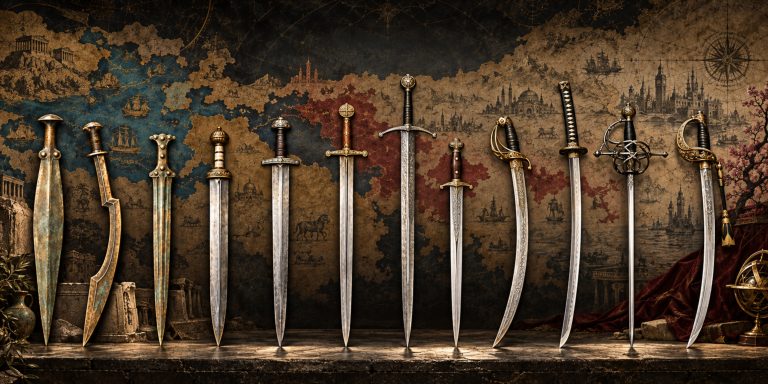
If equipped with a sidearm, the most plausible Greek sword types included the xiphos and kopis.
The xiphos was the conventional straight, double-edged Greek sword and would have been perfectly suitable as a compact secondary weapon.
The kopis, with its forward-weighted cutting blade, was another established Greek weapon and is particularly associated in artistic evidence with cavalry and warriors favouring powerful cuts.
Neither should automatically be assigned to every Rhodian slinger.
Their real protection lay in distance. If a lightly equipped slinger had reached the point where he needed to duel a heavily armoured infantryman with his sword, the tactical plan had already become rather less elegant.
What Could a Sling Bullet Do to Armour?
Sling bullets should not be imagined as miniature armour-piercing rounds.
Their effect came from kinetic impact.
Against an unprotected target, a high-velocity stone or lead projectile could inflict severe blunt trauma, fractures and potentially fatal head injuries.
Helmets, shields and body armour provided substantial protection, but protection did not make the wearer invulnerable. A projectile did not necessarily have to penetrate armour to injure the person underneath it.
The most vulnerable areas remained:
- face
- throat
- limbs
- hands
- joints
- lower legs
Missile fire also had psychological effects. Soldiers under sustained bombardment might close ranks, raise shields or alter formation, creating opportunities for other troops.
The sling therefore worked particularly well as part of combined-arms warfare.
Rhodian Slingers and Cretan Archers
The comparison between Rhodian slingers and Cretan archers is particularly useful because both became famous specialist troops.
| Rhodian Slingers | Cretan Archers |
| Sling as primary weapon | Composite or self bow |
| Lead or stone ammunition | Arrows |
| Exceptional potential range | Excellent accuracy and versatility |
| Ammunition comparatively cheap | Arrows more complex to manufacture |
| Very light equipment | Often somewhat more extensively equipped |
| Required extensive practice | Required extensive practice |
| Excellent counter-skirmish troops | Excellent general missile troops |
Xenophon’s Ten Thousand employed both.
This is perhaps the best answer to the inevitable question of which was “better”. Ancient commanders with sufficient money generally preferred not to choose.
The Rhodians could provide exceptional range. Cretan archers offered a different trajectory, ammunition system and tactical capability.
Together they were considerably more troublesome.
Rhodian Slingers in the Sicilian Expedition
Rhodians appear in one of the most famous campaigns of the Peloponnesian War.
When Athens launched its expedition against Sicily in 415 BC, Thucydides records 700 Rhodian slingers among the troops assembled for the campaign.
Their presence shows that Rhodian expertise was recognised decades before Xenophon’s expedition.
The Sicilian campaign ultimately ended catastrophically for Athens, but that should not be taken as a judgement upon its slingers. The Athenians managed to create an impressively varied expeditionary army and then proceeded to make strategic decisions capable of overcoming many of its advantages.
Rhodian slingers could solve the problem of enemy skirmishers. They could not solve Athenian politics.
Rhodian Slingers in Hellenistic Warfare
Rhodian slingers continued to appear within the broader world of Greek and Hellenistic military specialisation.
By this period armies had become increasingly diverse. Macedonian-style phalangites fought alongside cavalry, archers, javelin troops and other light infantry.
Specialist slingers remained valuable because they could:
- screen formations
- contest broken ground
- support sieges
- harass elephants and cavalry
- attack enemy missile troops
- operate where heavy infantry formations struggled
Rhodes itself became an important Hellenistic naval and commercial power.
Yet references to “Rhodian slingers” should not always be interpreted as evidence for a single continuous elite corps lasting unchanged for centuries. Ancient authors frequently identified specialist troops by ethnic or regional reputation.
“Rhodian” therefore functioned partly as a geographical description and partly as a military label associated with recognised skill.
Archaeology of Ancient Sling Warfare
Archaeology provides a useful counterpart to the literary evidence.
Lead sling bullets survive extremely well and have been discovered at numerous Greek and Hellenistic military sites. Finds from places such as Olynthus demonstrate the extensive battlefield use of cast lead ammunition during Classical warfare. Oxford’s overview of ancient slinging notes both the long archaeological history of sling ammunition and the evidence for large numbers of lead bullets associated with Philip II’s attack on Olynthus in 348 BC.
The sling itself presents a more difficult problem.
Organic materials such as wool, flax, leather and sinew rarely survive normal Mediterranean archaeological conditions. Consequently, ammunition is far more common in the archaeological record than the weapon that launched it.
Lead bullets can sometimes preserve:
- inscriptions
- personal names
- unit identifiers
- symbols
- abbreviated messages
- decorative motifs
These inscriptions are one of the more entertaining corners of ancient military archaeology. Some Greek and Roman sling bullets carried taunts or commands intended for their recipients.
Ancient warfare apparently discovered personalised messaging long before social media did.
Care is needed, however, when connecting individual archaeological bullets directly with Rhodian troops. A lead sling bullet found on a battlefield demonstrates the presence of slinging ammunition, but not automatically the presence of Rhodians.
Context, inscription, chronology and distribution all matter.
What Did Rhodian Sling Bullets Look Like?
Lead bullets were commonly compact and elongated, often described as almond-shaped or biconical.
The aerodynamic advantage of this shape has sometimes been overstated. Ancient ammunition varied considerably, and not every surviving projectile conforms to one standard.
Weights also vary substantially.
A smaller projectile offered greater potential velocity and range, while heavier ammunition could deliver greater momentum at shorter distances. Slingers could therefore potentially select ammunition according to circumstances.
Xenophon’s account strongly suggests that the Rhodian advantage in his campaign came partly from using relatively small lead projectiles instead of the large stones employed by Persian slingers.
That distinction is one of the rare occasions when an ancient author gives us something approaching an explanation of weapons performance rather than merely announcing who won.
Were Rhodian Slingers Mercenaries?
Frequently, yes, although the label requires qualification.
Rhodians appear serving outside Rhodes, sometimes as hired specialists or within allied contingents.
The Classical and Hellenistic Mediterranean supported an extensive military labour market. Cretan archers, Thracian peltasts, Greek hoplites and other specialists could find employment far from home.
A reputation for expertise was economically valuable.
For a Rhodian capable of professional-level slinging, the weapon required little capital investment compared with the equipment of a hoplite. Skill itself became the valuable commodity.
This helped make specialist light infantry attractive to commanders building mixed armies.
Rhodian Slingers Versus Balearic Slingers
The other great name in ancient slinging is that of the Balearic Islanders.
Balearic slingers became especially prominent in Carthaginian and Roman warfare, while Rhodians are particularly visible in Greek sources of the Classical period.
Comparisons are tempting but difficult.
| Rhodians | Balearic Islanders |
| Particularly prominent in Greek warfare | Particularly prominent in Carthaginian and Roman warfare |
| Strongly associated with lead ammunition | Famous for extensive sling training |
| Praised by Xenophon | Praised by several Greek and Roman writers |
| Active especially in eastern Mediterranean contexts | Active especially in western Mediterranean contexts |
| Known for exceptional range | Known for skill and battlefield effectiveness |
There is no meaningful ancient championship result telling us which group was superior.
Both reputations probably emerged because repeated military experience demonstrated that recruiting these men was worthwhile.
The Balearic tradition eventually became more famous in Roman literature, but Xenophon’s account gives the Rhodians one of the clearest descriptions of successful slinging anywhere in ancient military literature.
Contemporary Accounts
Our understanding of the Rhodian slinger rests heavily upon ancient literary testimony.
Thucydides
Writing about the Sicilian Expedition, Thucydides records:
“seven hundred Rhodian slingers”
The reference demonstrates that Rhodian specialists were already being recruited in substantial numbers during the late fifth century BC.
Xenophon
Xenophon provides the most important evidence:
“most of them understand the use of the sling”
More significantly, he explains their technological advantage:
“the Rhodians, however, are versed also in the art of slinging leaden bullets.”
Later he describes the practical consequence:
“the Rhodian slingers carried farther with their missiles than the Persians.”
These passages make the Rhodians unusually well documented among ancient specialist missile troops.
Legacy
Rhodian slingers occupy an important place in the history of ancient missile warfare because the surviving evidence allows us to see more than their reputation.
Xenophon explains their ammunition, comparative range, recruitment and tactical effect. Few ancient specialist troops receive such a neat case study.
Their success also exposes the limitations of the traditional image of Greek warfare as essentially a contest between armoured hoplites.
Real Greek armies could be remarkably flexible.
Slingers, archers, peltasts and cavalry shaped battles before heavy infantry ever reached spear range. On difficult campaigns, they could be the difference between maintaining a formation and being slowly dismantled by an enemy who refused to fight on convenient terms.
The Rhodian slinger represents this less glamorous but extremely important side of ancient warfare.
No bronze breastplate. No enormous shield. No heroic spear thrust immortalised on a vase.
Just a sling, a piece of lead and the deeply unpleasant ability to deliver it from further away than the other fellow expected.
Rhodian Slingers: Quick Facts
| Category | Detail |
| Origin | Rhodes, south-eastern Aegean |
| Period of fame | Classical and Hellenistic Greek warfare |
| Primary weapon | Sling |
| Preferred ammunition | Lead bullets, with stones also usable |
| Battlefield role | Light infantry and long-range skirmishing |
| Famous campaign | Retreat of the Ten Thousand, 401 BC onwards |
| Recorded Xenophontic unit | Approximately 200 slingers |
| Earlier major contingent | 700 with the Athenian Sicilian Expedition |
| Notable advantage | Exceptional range using compact lead ammunition |
| Secondary weapons | Potentially xiphos, kopis, knife or dagger |
| Armour | Generally light or minimal |
| Major sources | Thucydides and Xenophon |
| Archaeological evidence | Lead sling bullets and related battlefield finds |