Few pirates have left such a disproportionate mark on history as Thomas Tew. Unlike the flamboyant figures who followed him, Tew’s career was remarkably brief. Yet his extraordinary success demonstrated that immense fortunes could be seized from the lucrative shipping lanes of the Indian Ocean. In doing so, he effectively helped write the blueprint for what historians now call the Golden Age of Piracy.
He was neither the first pirate nor the most notorious. He certainly lacked the theatrical reputation of Blackbeard or the ruthless legend of Henry Every. Nevertheless, many of those later captains followed the route that Thomas Tew had already charted.
For a man whose career lasted only a few years, that is quite the achievement.
Who Was Thomas Tew?
Thomas Tew was probably born around 1649, although his exact birthplace remains uncertain. Some historians suggest England, while others argue he was born in the American colonies before settling in Rhode Island.
By the early 1690s he had established himself in Newport, one of Britain’s busiest Atlantic ports. Newport thrived on commerce, privateering and maritime trade, making it an ideal environment for an ambitious seaman.
Like many captains of the period, Tew appears to have begun his career as a privateer. The distinction between privateer and pirate could be surprisingly thin. One operated with official permission, the other without it. Sometimes the only difference was whether the paperwork remained politically convenient.
The Political World That Created Pirates
The late seventeenth century was a turbulent period.
European powers fought expensive colonial wars across the Atlantic and Indian Oceans. Merchant fleets carried silver, silk, spices, ivory, coffee and precious stones worth fortunes. Governments frequently issued letters of marque authorising private captains to attack enemy shipping.
Once peace returned, many experienced sailors suddenly found themselves unemployed.
Some accepted retirement.
Others discovered piracy paid considerably better.
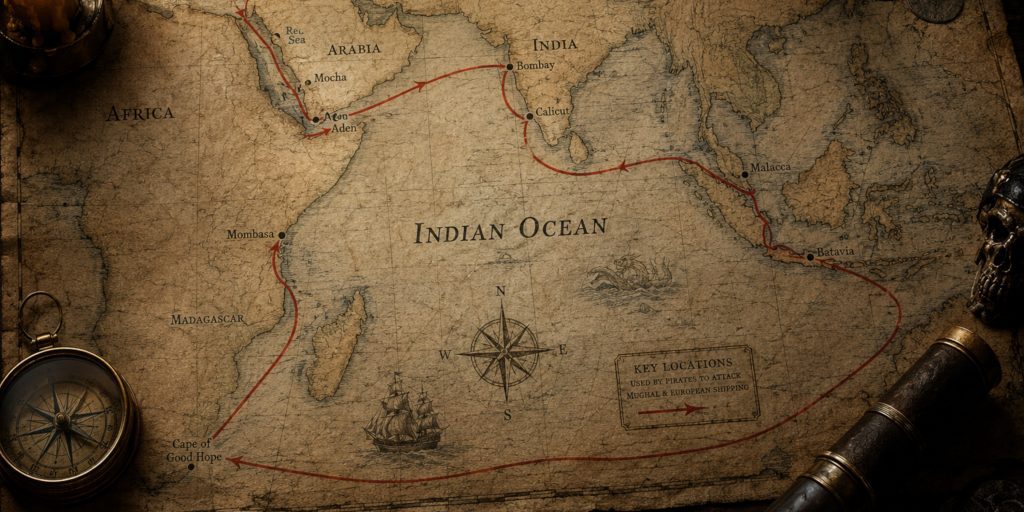
The Red Sea and Indian Ocean became particularly attractive because Mughal treasure fleets transported enormous wealth between Arabia and India. These ships were heavily armed but often carried cargoes whose value dwarfed anything crossing the Atlantic.
Thomas Tew’s First Pirate Voyage
Around 1692, Tew reportedly sailed from Bermuda with what may have begun as a privateering commission against French interests.
Instead of heading towards the Caribbean, he steered south around the Cape of Good Hope into the Indian Ocean.
It proved an inspired decision.
Operating near the entrance to the Red Sea, Tew intercepted a large Mughal vessel carrying gold, silver and valuable trade goods. Contemporary accounts differ on the exact value of the prize, but estimates suggest the haul exceeded £100,000, an astronomical sum in the seventeenth century.
Each member of his crew reportedly received around £3,000.
That amount could make an ordinary sailor independently wealthy for life.
The Famous Capture
Although records vary, one of Tew’s greatest successes involved attacking a large Indian merchant vessel travelling from the Red Sea.
Rather than relying on overwhelming firepower, Tew preferred speed, surprise and intimidation. His relatively small crew boarded the merchantman after a brief engagement.
The enormous prize instantly transformed his reputation.
News spread quickly through colonial ports.
If one relatively modest pirate vessel could seize such wealth, others were eager to try.
In many respects, this single voyage encouraged an entire generation of pirates to abandon the Caribbean and head east.
Thomas Tew’s Ship
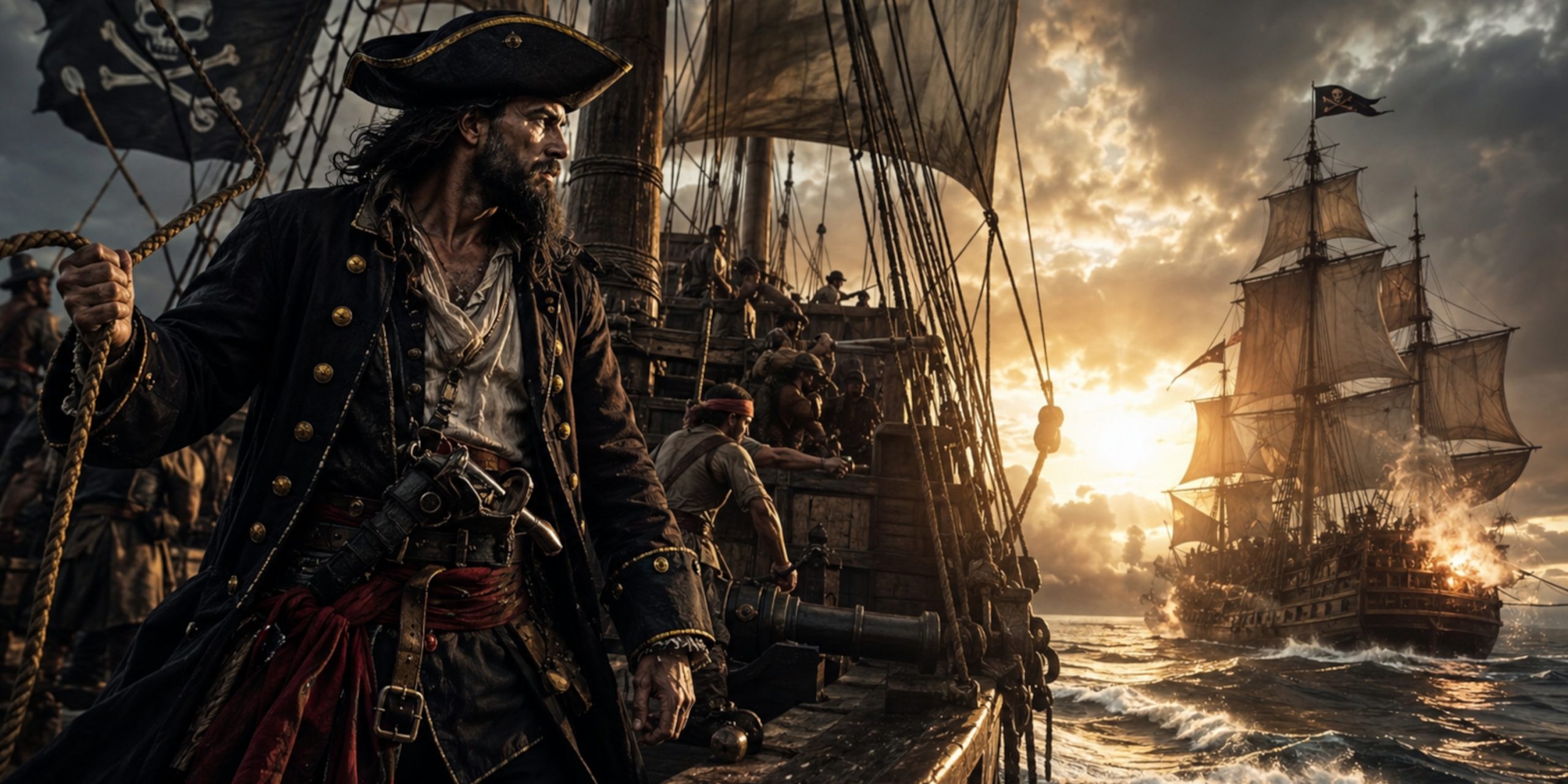
The ship most commonly associated with Thomas Tew was the Amity.
Compared with the vast East Indiamen he pursued, she was relatively small and lightly armed.
Known Characteristics
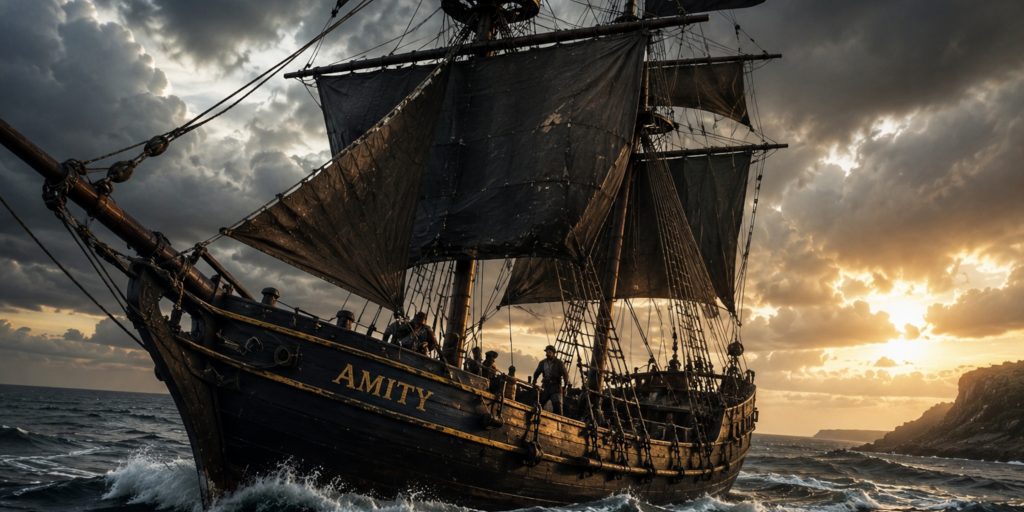
| Feature | Details |
|---|---|
| Name | Amity |
| Type | Sloop |
| Crew | Approximately 70 men |
| Armament | Around 8 guns |
| Strengths | Speed, manoeuvrability and surprise |
Tew understood that outrunning larger warships often mattered more than carrying additional cannon.
It is an early example of pirates choosing mobility over brute force, a lesson later embraced by captains across the Atlantic.
Weapons Used by Thomas Tew and His Crew
Pirate combat revolved around boarding actions rather than prolonged artillery duels.
Common Weapons
| Weapon | Purpose |
| Cutlass | Close combat aboard ships |
| Flintlock pistols | Short range fighting |
| Boarding axes | Breaking through doors and rigging |
| Muskets | Initial volleys before boarding |
| Daggers | Personal defence |
| Grenades | Occasionally thrown during assaults |
The cutlass became the defining weapon of pirate warfare because its short, curved blade was ideal in cramped conditions below deck.
Long swords might have looked impressive but were considerably less useful when surrounded by ropes, masts and panicked sailors.
Thomas Tew’s Second Voyage
Success encouraged another expedition.
In 1695, Tew joined a growing collection of pirate vessels heading once again towards the Red Sea.
This voyage proved dramatically different.
During an attack on another large Mughal ship, Tew stood exposed on deck directing the assault.
A cannonball struck him in the abdomen.
According to later accounts, he was almost cut in half.
His death instantly shattered the crew’s morale.
Without their captain, the pirates abandoned the attack and fled.
It was a violent end befitting an occupation with exceptionally poor retirement prospects.
Contemporary Quotes
Few direct quotations from Thomas Tew survive, but several contemporary writers described his activities and their consequences.
From Captain Charles Johnson’s A General History of the Pyrates:
“Captain Tew had acquired a vast deal of Wealth.”
English merchant correspondence complained of pirates operating in the Red Sea:
“The seas are much infested with pirates.”
Officials representing the Mughal Empire protested repeatedly to the English East India Company after attacks by Tew, Henry Every and others, blaming English subjects for disrupting vital trade.
These complaints eventually forced Britain to take piracy far more seriously than it had previously.
Reputation Among Fellow Pirates
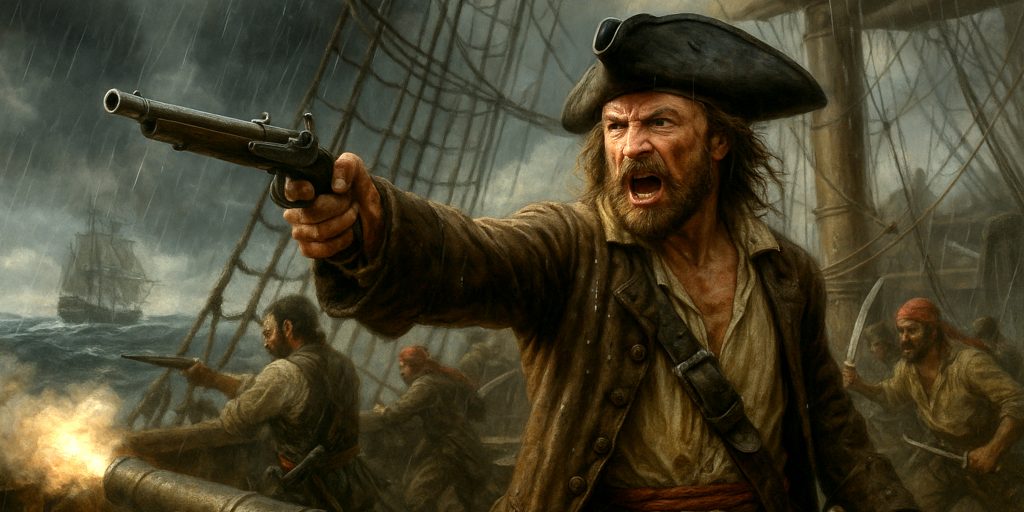
Thomas Tew earned enormous respect because he achieved something remarkably difficult.
He became rich.
Many pirates died penniless, were captured, or simply disappeared into the sea. Tew returned from his first expedition with extraordinary wealth, distributed generous shares among his crew and established a reputation as a successful leader.
This made recruitment much easier.
Success has always been an effective advertisement.
The Legacy of Thomas Tew
Although overshadowed by later pirate legends, Tew occupies a pivotal place in maritime history.
His achievements influenced captains including:
- Henry Every
- William Kidd
- John Bowen
- Thomas Howard
His Indian Ocean route became known among historians as the Pirate Round, connecting the Atlantic with the rich shipping lanes of the East.
Without Tew demonstrating its profitability, the explosion of piracy during the 1690s may have looked very different.
Archaeology and Historical Evidence
Unlike famous naval battles, pirate archaeology rarely produces spectacular discoveries linked to individual captains.
No confirmed wreck of Amity has ever been identified.
Historians instead reconstruct Tew’s career using:
- Colonial court records
- Admiralty documents
- Merchant correspondence
- East India Company archives
- Mughal diplomatic records
- Contemporary pirate narratives
These sources collectively paint a surprisingly consistent picture of a captain whose influence exceeded the length of his career.
Thomas Tew Timeline
| Year | Event |
| c.1649 | Probable birth |
| Early 1690s | Living in Newport, Rhode Island |
| 1692 | Sails into the Indian Ocean |
| 1693 | Captures wealthy Mughal merchant vessel |
| 1694 | Returns to America with enormous wealth |
| 1695 | Embarks on second expedition |
| 1695 | Killed during attack on a Mughal ship |
Thomas Tew in Popular Culture
Thomas Tew has never enjoyed the same fame as Blackbeard or Captain Kidd, yet historians increasingly recognise his importance.
He appears in numerous books exploring the origins of the Golden Age of Piracy and is regularly discussed in documentaries examining the pirate republics of the late seventeenth century.
Modern portrayals often emphasise the romance of piracy, but Tew’s story reminds us that success depended upon careful planning, exceptional seamanship and a willingness to accept astonishing risks.
Takeaway
Thomas Tew’s career lasted only a handful of years, yet its consequences echoed for decades.
His spectacular raid in the Indian Ocean demonstrated that fortunes beyond imagination lay waiting along the Mughal trade routes. Word spread quickly among restless sailors, unemployed privateers and ambitious captains. Soon, some of history’s most infamous pirates were following the course he had pioneered.
History often celebrates the loudest personalities, but it is equally shaped by quiet innovators. Tew was one of them. He was not the most brutal pirate, nor the most famous. He was simply the man who proved that piracy in the East could make ordinary sailors unimaginably rich.
That lesson proved impossible for others to ignore. The result was an era that transformed maritime history forever.