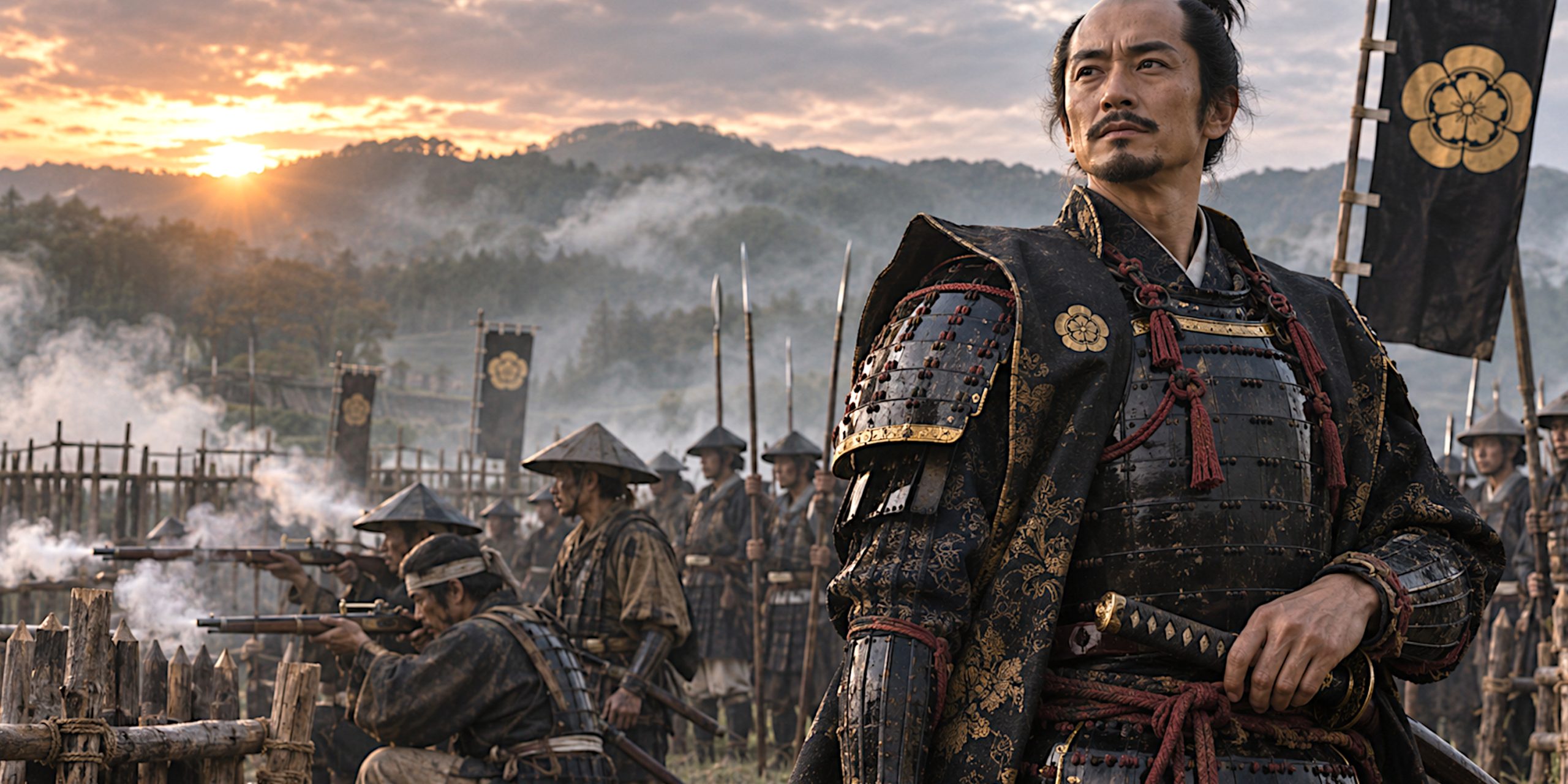
Oda Nobunaga helped make the reunification of Japan possible, then died before he could finish it. Between his startling victory at Okehazama in 1560 and his betrayal at Honnō-ji in 1582, he transformed a regional power into the dominant military force around Kyoto.
His reputation tends to arrive in two versions: the brilliant innovator who understood guns, or the merciless tyrant who burned temples. Both contain truth. Neither adequately explains a man whose power depended on alliances, commercial wealth, delegated command and a willingness to use appalling violence.
What interests me most is how practical his ambition could be. Nobunaga understood that commanding armies meant controlling the resources that kept them moving. A splendid sword was useful. Rice, roads and dependable subordinates were rather harder to do without.
Who Was Oda Nobunaga?
Oda Nobunaga was a sixteenth-century Japanese daimyō, or territorial lord, and the first of the figures conventionally called Japan’s three unifiers. Toyotomi Hideyoshi and Tokugawa Ieyasu followed him, each building a different settlement upon the conquests and political changes of his predecessors.
| Detail | Summary |
|---|---|
| Born | 1534, Owari Province, now western Aichi Prefecture |
| Died | 21 June 1582, Kyoto |
| Family | Oda clan; son of Oda Nobuhide |
| Principal bases | Kiyosu, Gifu and Azuchi |
| Key ally | Tokugawa Ieyasu |
| Best-known victories | Okehazama and Nagashino |
| Political significance | Established dominance in central Japan and expelled the last Ashikaga shōgun from Kyoto |
He never became shōgun and did not complete Japan’s unification. Calling him its sole unifier gives him his successors’ achievements as well as his own.
From Owari to Kyoto
Nobunaga began his career in a fractured political landscape. The Ashikaga shogunate retained prestige, but regional lords increasingly exercised power through their own armies, alliances and administration. Even succession within a family could require fighting rather more relatives than was comfortable.
His breakthrough came at Okehazama in 1560. A sudden attack killed Imagawa Yoshimoto and overturned a dangerous invasion of Owari. Nobunaga’s force was substantially smaller, although precise army totals and the familiar reconstruction of a perfectly concealed approach deserve caution. The secure point is the consequence: Yoshimoto’s death disrupted Imagawa power and transformed Nobunaga’s standing.
In 1567, Nobunaga took the Saitō stronghold of Inabayama from Saitō Tatsuoki and renamed it Gifu. The following year he entered Kyoto in support of Ashikaga Yoshiaki’s claim to the shogunate.
For a time, the relationship suited both men. Yoshiaki gained military backing; Nobunaga gained access to the authority of the shogunal office. Their interests eventually diverged, and Nobunaga expelled Yoshiaki from Kyoto in 1573. This conventionally marks the end of the Muromachi shogunate, although Yoshiaki continued political activity afterwards.
Battles and the Limits of Military Genius
Nobunaga could take extraordinary risks, but his rise also involved prolonged resistance and repeated campaigning. The effortless conqueror belongs more comfortably in retrospective storytelling than in the field.
| Campaign | Why it mattered |
|---|---|
| Okehazama, 1560 | Removed Imagawa Yoshimoto and secured Nobunaga’s reputation |
| Inabayama, 1567 | Gave him control of Mino and a stronger route towards Kyoto |
| Mount Hiei, 1571 | Destroyed an important hostile religious and political centre, with extensive killing |
| Nagashino, 1575 | Oda and Tokugawa forces inflicted a major defeat on Takeda Katsuyori |
| Ishiyama Honganji, 1570–1580 | A long struggle ended through a negotiated evacuation |
| Takeda campaign, 1582 | Destroyed the remaining Takeda power before Nobunaga’s own death |
Did Nobunaga Invent Volley Fire?
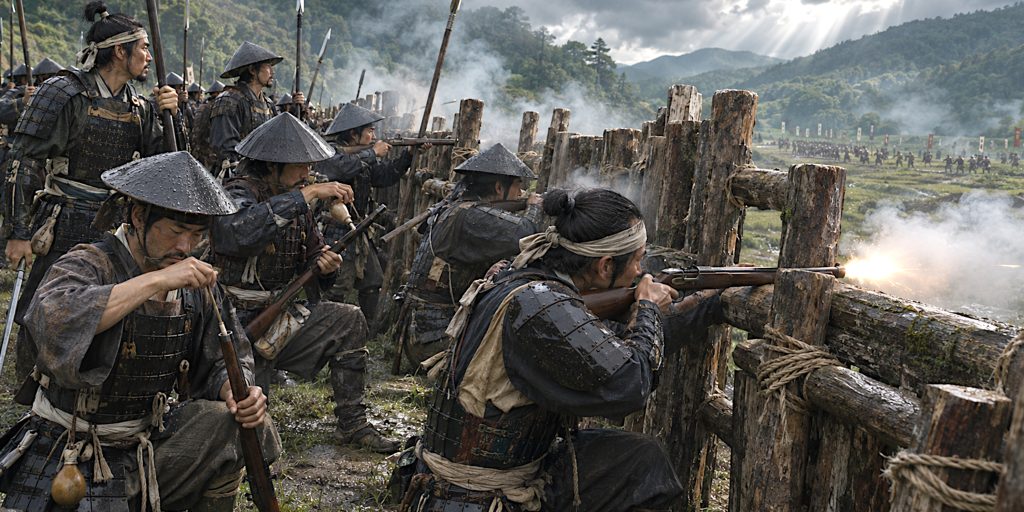
The familiar account of Nagashino describes 3,000 gunners firing in three rotating ranks behind wooden palisades, defeating waves of Takeda cavalry. It makes a wonderfully tidy explanation. Its precision exceeds what the evidence securely supports.
Historians dispute the gun totals, firing arrangements and presentation of the Takeda army as an undifferentiated cavalry charge. Nobunaga did not introduce firearms to Japan, and rival armies also possessed experienced gunners.
The stronger explanation combines firearms with prepared defences, terrain, infantry support and allied action. Nagashino demonstrates effective organisation and a costly Takeda attack. It does not require a lone visionary inventing modern warfare over breakfast.
Arms and Armour in Nobunaga’s Armies
These were armies of mixed weapons and varied equipment. Swords mattered, but so did the less glamorous business of keeping formations together under fire.
| Equipment | Battlefield role |
|---|---|
| Matchlock arquebus, often called teppō or tanegashima | Missile weapon requiring ammunition, loading time and management of the burning match |
| Yari | Spear used by infantry and mounted warriors, with length varying by role |
| Yumi | Bow that remained useful alongside firearms |
| Uchigatana | Curved sword worn edge upwards through the belt, increasingly prominent in this period |
| Tachi | Curved sword traditionally suspended edge downwards, still present in warrior equipment |
| Short blades | Close combat and other practical uses, with terminology and fittings varying |
Armour was changing too. Older lamellar constructions coexisted with the developing forms grouped under tōsei gusoku, which used combinations of plates, lacing and articulated defences. Equipment reflected wealth, status and the demands of service.
It would be misleading to give every soldier identical armour or impose the fully regulated sword-wearing conventions of the later Edo period on Nobunaga’s forces. Equally, claims about his personal battlefield equipment need firmer evidence than an attractive modern illustration.
Religion, Resistance and Massacre
Nobunaga’s religious enemies were powerful institutions with land, resources, armed followers and political alliances. Understanding that power helps explain his campaigns. It does not make their victims disappear.
In 1571, his forces attacked the Enryakuji complex on Mount Hiei and neighbouring settlements. The violence extended beyond armed opponents to civilians and people seeking refuge. Exact death tolls and the extent of destruction require care, but describing the operation merely as the defeat of warrior monks conceals its character.
The Honganji struggle also resists a simple tale of irresistible conquest. Its own institutional history emphasises prolonged resistance and the imperial mediation that enabled the evacuation of Ishiyama in 1580. Nobunaga obtained a major strategic result through an agreement after years of fighting.
His protection of Christian missionaries should likewise be understood politically as well as personally. Curiosity about foreign visitors and the usefulness of new relationships could coexist with hostility towards particular Buddhist institutions. He was not conducting a consistent campaign against religion itself.
Governing Through Markets, Castles and Patronage
Nobunaga’s power rested on more than victories. Market privileges, changes to tolls and access to commercial centres helped support his expanding regime. Policies associated with rakuichi rakuza reduced certain commercial restrictions and privileged monopolies, although their application varied. This was selective intervention by a warlord, rather than a national programme of modern free trade.
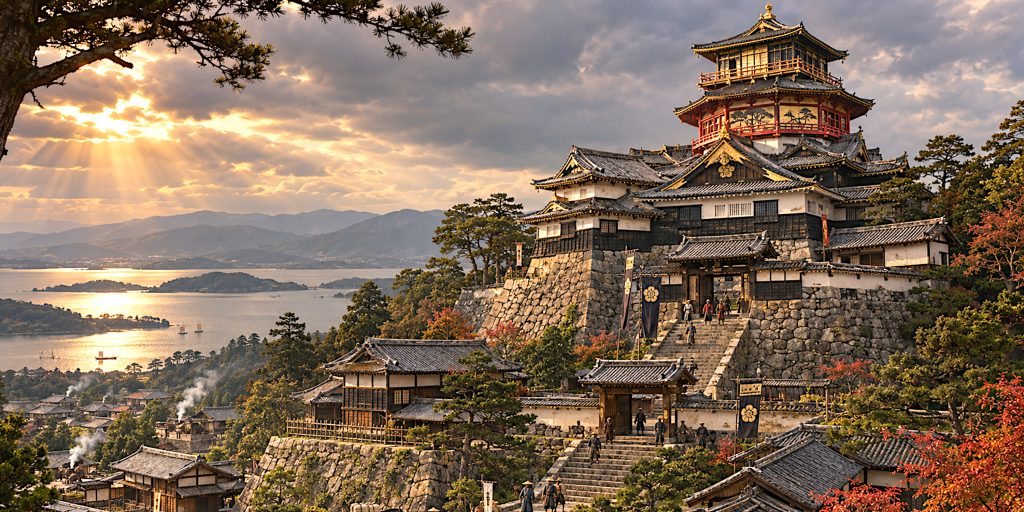
Azuchi Castle expressed the same ambition in stone, timber and decoration. Construction began in 1576, and Nobunaga moved into its completed principal tower in 1579. Overlooking the Lake Biwa region, it combined military strength with the spectacle of lordly authority.
Power needed to be visible. Nobunaga also needed commanders who could exercise it elsewhere. Hideyoshi and Shibata Katsuie were among the men directing major campaigns as his dominion expanded. Delegation allowed conquest across several fronts. It also left enormous power in the hands of subordinates.
Honnō-ji: Betrayal and an Unfinished Conquest
On 21 June 1582, Akechi Mitsuhide turned his troops against Nobunaga in Kyoto. Nobunaga was staying at Honnō-ji with a small following, separated from his main armies. He died during the attack, traditionally understood to have taken his own life as the temple burned. His heir, Nobutada, died in a separate confrontation in Kyoto that day.
Mitsuhide’s motive remains unresolved. Personal grievances, political ambition and disputes over policy have all been proposed. Elaborate conspiracy theories have proved particularly durable, despite the shortage of decisive evidence.
Hideyoshi responded quickly and defeated Mitsuhide at Yamazaki. Nobunaga’s conquests survived their creator, but control over his political inheritance was contested. The eventual settlement was not simply his original plan carried out by someone else.
Archaeology: What Survives at Azuchi?
Azuchi offers unusually valuable material evidence for Nobunaga’s regime. Excavation has investigated roads, gates, residences, drainage and the principal castle area. Finds include ceramics, tea utensils, incense burners and decorated roof tiles.
These remains reveal a place organised for ceremony and elite life as well as defence. The broad approach road, residential compounds and carefully planned entrances help explain how visitors encountered authority before they ever reached Nobunaga himself.
The evidence also has limits. Reconstructions of the lost tower draw upon surviving remains, texts and interpretation; they are not recovered photographs. Particularly detailed modern images should be appreciated with that distinction in mind.
Where to Explore Nobunaga’s History
The Azuchi Castle ruins preserve substantial stonework and the terrain of his final headquarters. The Shiga Prefectural Azuchi Castle Archaeological Museum provides regional and archaeological context, while Nobunaga no Yakata is associated with a reconstruction of the upper portions of the lost castle tower.
In Kyoto, Honnō-ji maintains its connection with Nobunaga and his commemoration. The present temple occupies a different location from the site attacked in 1582, an essential distinction when following his final movements.
Museum reconstructions and objects with traditional associations can be illuminating. They should still be distinguished from securely documented personal possessions.
Nobunaga’s Legacy
Nobunaga accelerated the concentration of military and political power in central Japan. He exploited firearms, commerce, castles and capable commanders with formidable effect. His career also involved deliberate destruction and the killing of non-combatants.
I find him most compelling when those facts remain together. His intelligence does not diminish his brutality, and his brutality does not explain away his intelligence. The man who helped break the old political order also exposed the weakness of a regime dependent on his personal command: when he died, its armies remained, but its future had to be fought over.
Sources and Further Reading
- Kawai Atsushi, Oda Nobunaga and the Struggle to Unify Japan, Nippon.com. Overview of his rise, policies and death.
- J. P. Lamers, Japonius Tyrannus: The Japanese Warlord Oda Nobunaga Reconsidered (2000). Further reading on his political and military career.
- Ōta Gyūichi, The Chronicle of Lord Nobunaga, translated and edited by J. S. A. Elisonas and J. P. Lamers (2011). Important near-contemporary narrative, to be read with attention to its perspective and composition.
- Oda Nobunaga, Guns, and Early Modern Warfare in Japan. Scholarly discussion of firearms and the conventional Nagashino narrative.
- Japan Tourism Agency, Memorial Stupa for the Martyrs of the Genki Rebellion of 1571. Context for the Mount Hiei attack and its commemoration.
- Jōdo Shinshū Hongwanji-ha, History of the Hongwanji. The institution’s account of its conflict with Nobunaga and the negotiated evacuation.
- Shiga Prefecture, Ruins of Azuchi Castle. Construction chronology and excavation findings.
- Honnō-ji, About the Temple. Institutional history and relocation.