Richard Neville, 16th Earl of Warwick, was the most formidable English nobleman of the Wars of the Roses. He helped Edward IV seize the throne, rebelled against him, restored Henry VI and died trying to prevent Edward from taking the crown back. It is a career that makes ordinary political disloyalty look rather under-rehearsed.
Yet the familiar title “Warwick the Kingmaker” can be misleading. Warwick did not control kings as if they were pieces on a board. His authority depended on land, marriage, office, armed retainers, popular reputation and the willingness of other magnates to follow him. When those supports aligned, he could shake the kingdom. When they failed, as they did at Barnet in 1471, his power disappeared in a morning.
This is the story of how Richard Neville became England’s greatest political broker, why he turned against the king he had helped to crown, and how his final gamble ended in mud, mist and confusion.
Richard Neville at a Glance
| Detail | Information |
|---|---|
| Born | 22 November 1428 |
| Parents | Richard Neville, Earl of Salisbury, and Alice Montagu |
| Wife | Anne Beauchamp |
| Principal title | 16th Earl of Warwick |
| Other major title | Earl of Salisbury, inherited in 1462 |
| Main residences | Middleham Castle, Warwick Castle and other Neville estates |
| Leading offices | Captain of Calais, Admiral of England and Warden of the West March |
| Political allegiance | Yorkist, then rebel Yorkist, then Lancastrian ally |
| Children | Isabel Neville and Anne Neville |
| Died | 14 April 1471 at the Battle of Barnet |
| Burial | Bisham Abbey, later destroyed during the Dissolution |
Family, Marriage and a Vast Inheritance
Warwick was born into the northern Neville family, one of the most influential noble houses in England. His father, Richard Neville, Earl of Salisbury, possessed substantial estates and close ties to Richard, Duke of York. His mother, Alice Montagu, was herself a great heiress.
The marriage that transformed the younger Richard’s prospects came early. He was betrothed to Anne Beauchamp, daughter of Richard Beauchamp, Earl of Warwick. After the deaths of Anne’s brother Henry and Henry’s infant daughter, the Warwick inheritance became bitterly contested. Richard and Anne eventually secured the earldom and a remarkable collection of estates spread across the Midlands, the Welsh Marches and southern England.
This wealth mattered because medieval power was intensely practical. A great lord needed halls in which to receive petitioners, officers to administer estates, money to reward service and households capable of becoming armies. Warwick had all of these. He did not possess a modern private army waiting permanently under arms, but he could draw on an exceptional web of tenants, servants, clients and local allies.
His marriage also linked the Neville and Beauchamp inheritances. The heraldry became correspondingly elaborate. Medieval aristocrats rarely resisted the chance to put another quartering on a shield.
Why Was Warwick Called the Kingmaker?
The nickname was not normally used during Warwick’s lifetime. The Latin phrase regum creator, meaning maker of kings, appeared in the work of the Scottish historian John Major in the early sixteenth century. “Kingmaker” became the enduring English label later still.
It survives because it neatly describes Warwick’s involvement in two changes of monarch:
- In 1461 he helped Edward, Earl of March, become King Edward IV after the Lancastrian collapse.
- In 1470 he drove Edward into exile and restored Henry VI in the event known as the Readeption.
The title remains useful, but only if handled carefully. Edward IV won the decisive victory at Towton and possessed his own dynastic claim, personal following and military talent. Henry VI’s restoration depended on an alliance involving Warwick, Margaret of Anjou, Louis XI of France and the king’s Lancastrian supporters. Warwick was central to both revolutions, but he did not accomplish either one alone.
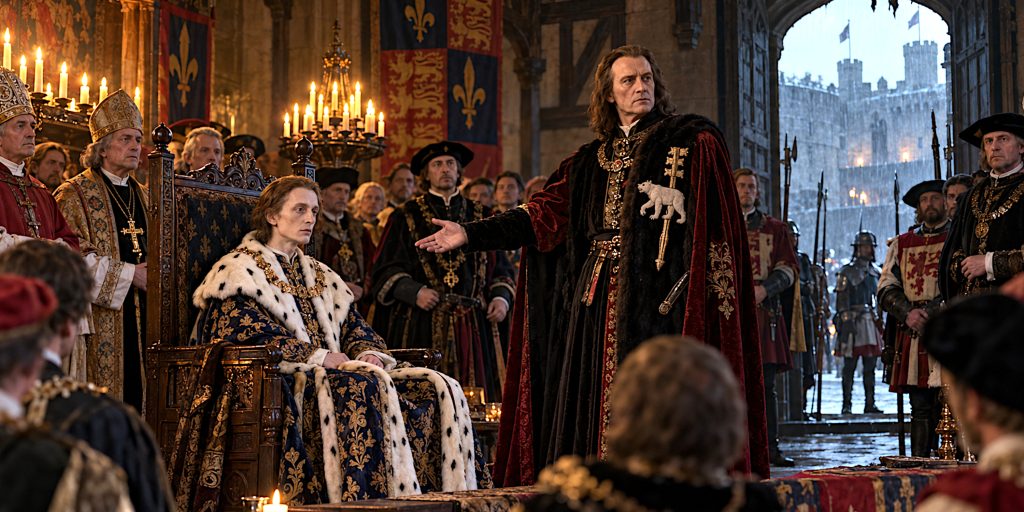
I find the later nickname reveals as much about our appetite for a single dramatic protagonist as it does about fifteenth-century politics. Civil wars are untidy. “The exceptionally well-connected coalition manager” would be more accurate, though admittedly less likely to sell a television series.
Warwick and the Beginning of the Wars of the Roses
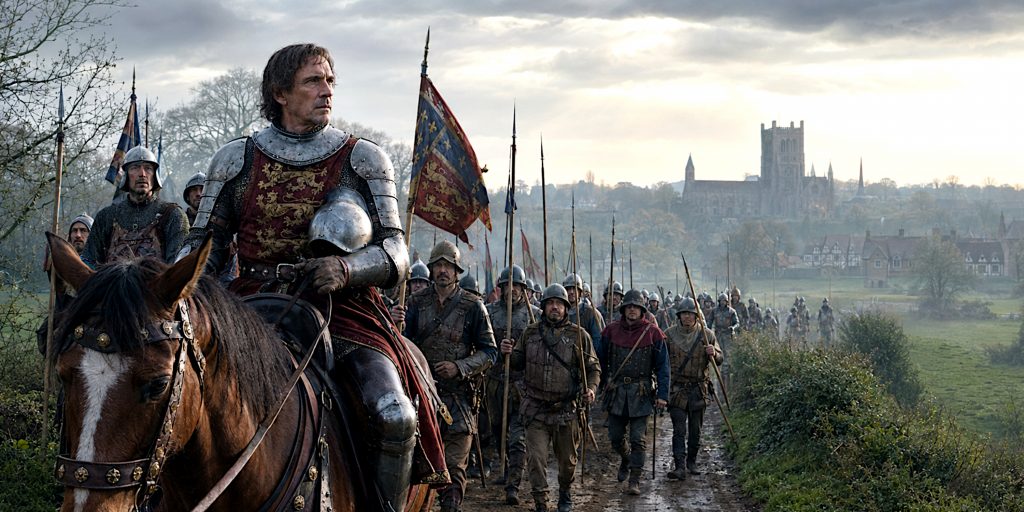
During the early 1450s, government under Henry VI was weakened by military failure in France, factional hostility and the king’s periods of mental incapacity. The Nevilles aligned themselves with Richard, Duke of York. Their regional feud with the Percy family in northern England added a local struggle to the national crisis.
Warwick fought at the First Battle of St Albans on 22 May 1455. The Yorkist force broke into the town through gardens and back lanes, defeating the royal army and killing several leading Lancastrian lords. Henry VI was wounded and captured. It was a short battle with enormous consequences: political argument had become armed conflict.
Warwick’s appointment as Captain of Calais in 1455 gave him control of England’s most experienced permanent garrison and its best bridgehead into continental affairs. Calais also allowed him to cultivate merchants and London opinion. In 1458, while acting as Admiral, he attacked Castilian and Hanseatic shipping in the Channel. These operations were legally questionable, diplomatically inconvenient and popular among English merchants. That combination tells us quite a lot about his political instincts.
When the Yorkist cause collapsed at Ludford Bridge in 1459, Warwick escaped to Calais with his father and Edward, Earl of March. From there, they returned to England in June 1460. London admitted them, and Warwick defeated the royal army at Northampton on 10 July. Henry VI was once again taken into Yorkist custody.
Making Edward IV
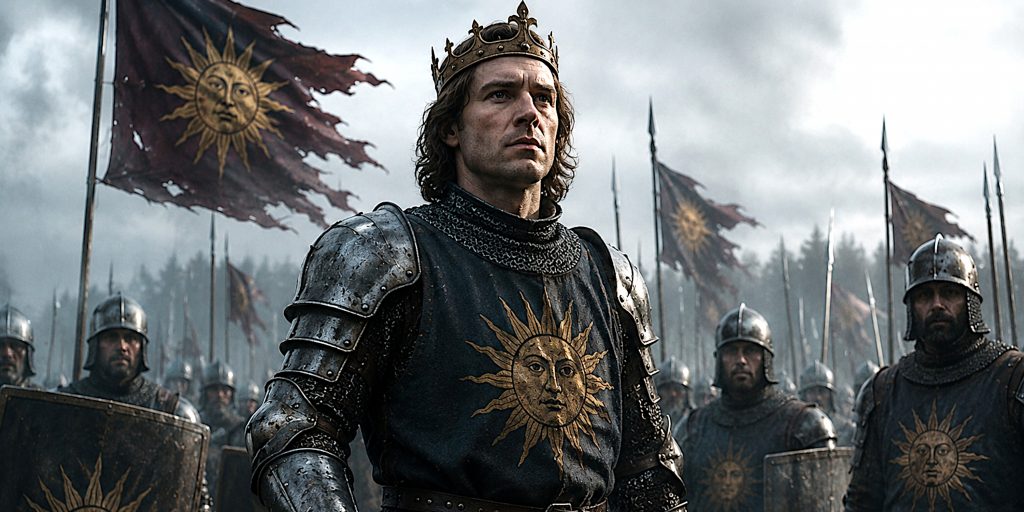
The Yorkist position almost disintegrated at the end of 1460. Richard, Duke of York, and Warwick’s father were killed after the Battle of Wakefield. Warwick then suffered defeat at the Second Battle of St Albans in February 1461, losing control of Henry VI.
Edward, Earl of March, changed the situation. After defeating a Lancastrian army at Mortimer’s Cross, he joined Warwick in London. Edward was proclaimed king on 4 March 1461. Warwick’s political network and access to the capital were crucial, but Edward’s claim still had to be defended in battle.
That reckoning came at Towton on 29 March. Edward commanded the Yorkist host in person during what was probably the largest and bloodiest battle fought on English soil. Warwick was present, though later legend sometimes grants him a more decisive role than the surviving evidence supports. The victory belonged above all to Edward’s army and to a brutal day of close fighting in snow and wind.
In the first years of the new reign, Warwick was the king’s leading nobleman. He conducted diplomacy, defended the north and negotiated abroad. Philippe de Commynes, the Burgundian diplomat and memoirist, later described him as “the greatest man in England”, apart from the king, and noted the scale of his following. Translations vary, but the judgement is unmistakable: continental observers understood that Warwick was no decorative courtier.
Why Warwick Turned Against Edward IV
The break between Warwick and Edward was gradual rather than theatrical. There was no single goblet hurled across a council table, tempting though such a scene would be.
Several disputes converged:
- Edward secretly married Elizabeth Woodville in 1464, frustrating Warwick’s diplomatic plans for a French marriage.
- The rapid advancement of the Woodville family reduced Warwick’s influence and competed with the interests of established magnates.
- Edward increasingly pursued an alliance with Burgundy, while Warwick favoured an accommodation with France.
- The king blocked proposed marriages between Warwick’s daughters and Edward’s brothers, George, Duke of Clarence, and Richard, Duke of Gloucester.
- Warwick appears to have resented Edward’s determination to rule for himself.
The old interpretation presented Warwick as an offended baron defending his natural place beside the throne. A harsher reading sees a magnate who could tolerate royal authority only while he exercised it. Both contain some truth. Edward was entitled to choose his own policy, but he handled Warwick’s declining influence without much tact. Warwick, meanwhile, answered political defeat with armed rebellion, which is a rather severe response to losing an argument over foreign policy.
Rebellion, Captive Kings and a Failed Settlement
In 1469 Warwick allied with Clarence, who married Isabel Neville against the king’s wishes. Their supporters encouraged rebellion in northern England. After Edward’s forces were defeated at Edgecote Moor, the king fell into Warwick’s hands.
Warwick now faced the central weakness in his position. Capturing a king was easier than governing without him. The country did not rally to a regime directed by Warwick and Clarence, and disorder spread. Edward was released and temporarily reconciled with them.
A second rising in 1470 failed. Warwick and Clarence fled to France, where Louis XI arranged one of the most improbable alliances of the period. Warwick came to terms with Margaret of Anjou, whose husband, Henry VI, he had helped depose and whose supporters he had fought for fifteen years. The agreement was sealed by the marriage of Warwick’s younger daughter, Anne, to Margaret’s son, Edward of Westminster.
Contemporary chronicler John Warkworth recorded Warwick’s return in language that shows the scale of his remaining support. In modernised spelling, he wrote that “much people drew to him” as Edward’s position collapsed. The exact loyalty of “the people” is hard to measure, but Warwick clearly retained enough prestige and organisation to make his landing politically explosive.
Edward fled to the Low Countries in October 1470. Henry VI was brought out of the Tower and restored to the throne. This Readeption government depended heavily on Warwick because Henry was physically and politically incapable of active rule.
For a few months, the Kingmaker appeared to have justified the name.
The Battle of Barnet and Warwick’s Death
Edward returned to England in March 1471 with a small force. He claimed at first that he sought only the Duchy of York, a statement believed by almost nobody but useful enough to get him through the door. Clarence deserted Warwick and reconciled with his brother. Edward entered London, took Henry VI into custody and marched north to meet Warwick.
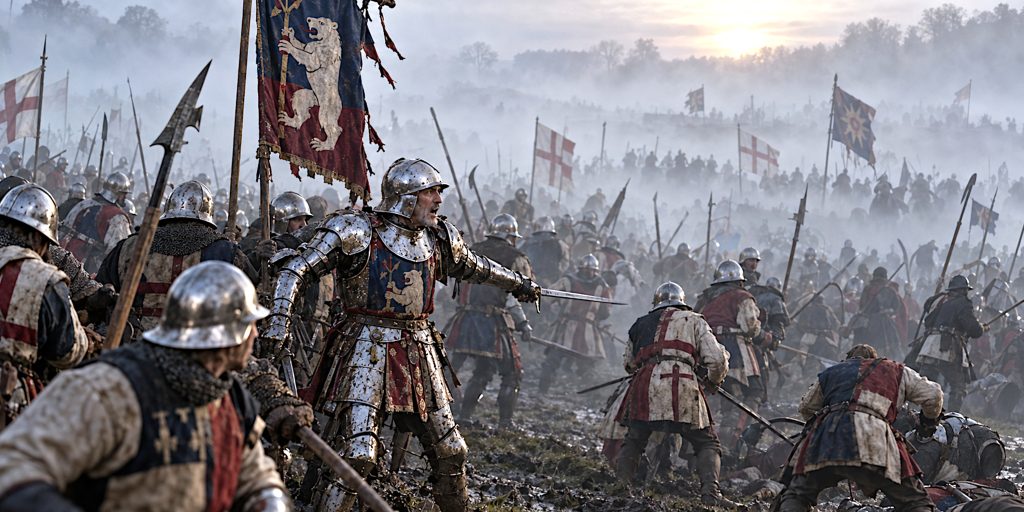
The two armies fought at Barnet on Easter Sunday, 14 April 1471. Thick mist concealed the battlefield. The opposing lines were slightly misaligned, allowing each army’s right wing to outflank its opponent’s left. Warwick’s ally John de Vere, Earl of Oxford, drove part of Edward’s army from the field. When Oxford’s troops returned through the fog, Lancastrian soldiers apparently mistook Oxford’s star badge for Edward’s sun emblem and fired upon them. Cries of treason spread, and Warwick’s army began to break.
The near-contemporary Historie of the Arrivall of Edward IV describes Warwick and his brother John Neville, Marquess of Montagu, being “slain and taken in the field”. The work favours Edward, as its title and purpose hardly attempt to conceal, but its account is indispensable. Warwick seems to have been killed while trying to escape the collapse. His body, together with Montagu’s, was displayed at St Paul’s in London before burial at Bisham Abbey.
His death was not quite the end of the campaign. Edward destroyed the remaining Lancastrian army at Tewkesbury on 4 May. Henry VI died in the Tower later that month, almost certainly murdered on Edward’s orders or with his approval.
Warwick’s Arms and Armour
No securely identified personal sword or complete field harness belonging to Warwick survives. Any reconstruction therefore needs to distinguish likelihood from proof.
As one of England’s richest noblemen, Warwick could obtain excellent equipment. By the 1460s, an aristocratic man-at-arms would normally fight in a complete plate harness, often incorporating imported Italian armour or English work influenced by continental styles. A sallet and bevor could protect the head and throat, while a brigandine might be worn in some military settings.
His likely battlefield weapons included:
- A pollaxe for armoured combat on foot
- A lance for mounted service
- A sword as a versatile sidearm and mark of rank
- A rondel dagger for close fighting
- A mace or war hammer, depending on personal preference
It is tempting to nominate a “bastard sword” as Warwick’s signature weapon, but there is no firm evidence that he habitually carried one. Fifteenth-century nobles owned multiple weapons and equipped themselves according to context. The bill was especially important among English infantry and household retainers, alongside bows, polearms and handguns in growing numbers.
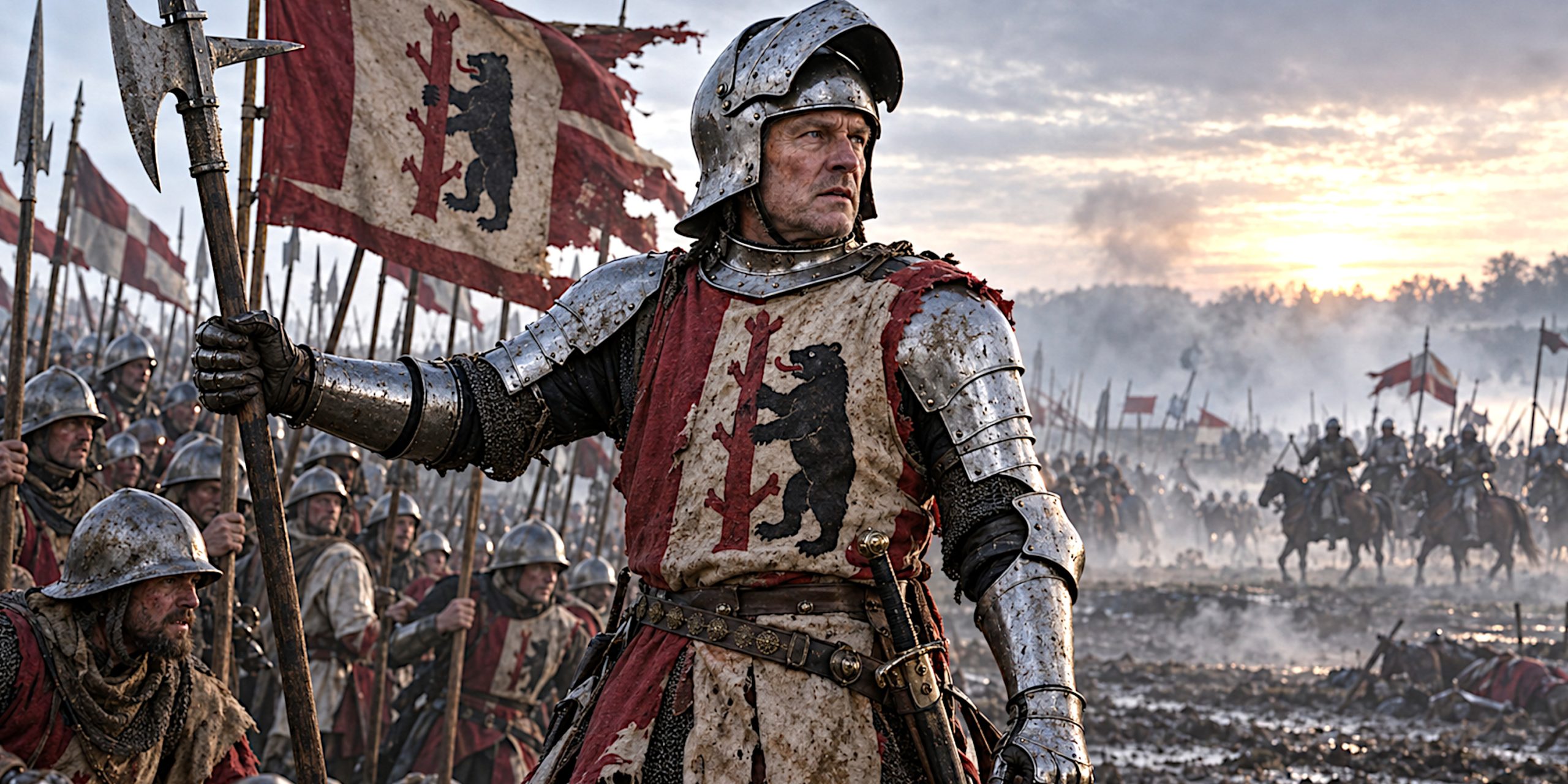
Warwick’s famous badge was the bear and ragged staff, inherited through the Beauchamp earls. His complex arms displayed the family claims and inheritances on which much of his authority rested. Heraldry in this period was identification, inheritance record and political advertising rolled into one brightly coloured package.
Was Warwick a Good Commander?
Warwick was an energetic organiser, an experienced admiral and an outstanding mobiliser of political support. He understood ports, garrisons, propaganda, patronage and the strategic value of London. His command of Calais gave him military resources unavailable to most English magnates.
His battlefield record was mixed:
| Engagement | Date | Result for Warwick | Significance |
|---|---|---|---|
| First St Albans | 1455 | Victory | Helped breach the town and capture Henry VI |
| Northampton | 1460 | Victory | Royal army defeated and Henry VI captured |
| Second St Albans | 1461 | Defeat | Lost custody of Henry VI |
| Towton | 1461 | Victory | Edward IV secured the throne |
| Edgecote campaign | 1469 | Political victory | Edward IV captured after the royalist defeat |
| Barnet | 1471 | Defeat and death | Edward IV destroyed Warwick’s coalition |
He was dangerous because military, political and financial power reinforced one another. He was not, however, an undefeated tactical genius. At Second St Albans his defensive arrangements failed, and at Barnet his coalition lacked cohesion at the worst possible moment. His finest weapon was probably his network. Unfortunately for Warwick, networks cannot see through fog.
Contemporary Voices on Warwick
Fifteenth-century accounts are partisan, sometimes retrospective and rarely interested in modern standards of balance. They remain our closest witnesses.
“The greatest man in England.”
Philippe de Commynes used words to this effect when describing Warwick’s position and extraordinary following. English translations differ because Commynes wrote in French and revised his memoirs later. His testimony nevertheless confirms Warwick’s international reputation.
“Much people drew to him.”
John Warkworth’s chronicle describes the support Warwick attracted after returning to England in 1470. The phrase should not be mistaken for an opinion poll. It does show that Warwick’s appeal reached beyond a tiny group of titled conspirators.
“Slain and taken in the field.”
The Yorkist Historie of the Arrivall of Edward IV records the deaths of Warwick and Montagu at Barnet. Its wording is terse, almost brutally so. A man who had dominated English politics for more than a decade becomes, in the victorious account, another enemy removed from the field.
These quotations use modernised spelling or established English translation. That matters because presenting cleaned-up Middle English as if it were verbatim modern prose can give a false impression of precision.
Warwick’s Family and the Fate of His Inheritance
Warwick left no surviving son. His two daughters became central to the dynastic struggles that followed:
- Isabel Neville married George, Duke of Clarence. Their children included Margaret Pole and Edward, Earl of Warwick.
- Anne Neville first married Edward of Westminster, the Lancastrian Prince of Wales. After his death at Tewkesbury, she married Richard, Duke of Gloucester, who became Richard III in 1483.
Warwick’s widow, Anne Beauchamp, survived until 1492 but lost effective control of much of her inheritance. Clarence and Gloucester divided the Neville lands through their marriages to her daughters. The settlement was ruthless even by the accommodating standards of late medieval property politics.
The family’s later history was grim. Clarence was executed in 1478. Warwick’s grandson Edward was imprisoned for most of his life and executed by Henry VII in 1499. Margaret Pole survived much longer, only to be executed under Henry VIII in 1541.
Warwick had sought to secure his house at the centre of royal power. Instead, proximity to the crown made his descendants exceptionally vulnerable to it.
Where to Find Warwick Today
Several surviving places retain strong connections with Warwick and his family:
- Warwick Castle was one of the principal seats attached to his earldom, although later rebuilding has transformed much of its appearance.
- Middleham Castle in North Yorkshire was a major Neville stronghold and household centre.
- The Beauchamp Chapel at St Mary’s Church, Warwick preserves the magnificent tomb of Richard Beauchamp, Warwick’s father-in-law, together with heraldry connected to the dynasty.
- Barnet Museum interprets the local history of Warwick’s final battle.
- The Royal Armouries holds fifteenth-century arms and armour that help explain the equipment used by aristocratic soldiers and their retinues.
Warwick’s burial place at Bisham Abbey has not survived. The priory was dissolved under Henry VIII, and the location of his grave is now uncertain.
How Powerful Was Warwick Really?
At his height, Warwick combined resources rarely held by one subject. He possessed vast landed wealth, commanded Calais, influenced London, maintained affinities across several regions and stood near the centre of the royal family. His public image also mattered. The Paston correspondence and narrative chronicles suggest that contemporaries watched his movements closely because they expected other people to follow him.
Still, his authority was conditional. He could not govern successfully while holding Edward IV captive in 1469. He needed a French-backed Lancastrian alliance to restore Henry VI in 1470. He lost vital support when Clarence defected in 1471. Once defeated at Barnet, he had no institution or independent state capable of preserving his position.
That is the essential limit behind the legend. Warwick could destabilise kingship, but he could not replace it.
Legacy: Magnate, Rebel or Kingmaker?
Warwick has been interpreted as a patriotic statesman, a champion of overmighty nobles, a popular hero, an arrogant rebel and the last great representative of bastard feudalism. None of those labels works perfectly on its own.
He was not simply a cynical turncoat. Loyalty in fifteenth-century politics was bound to family interest, honour, patronage and expectations of good government. Edward’s policies genuinely threatened Warwick’s influence and diplomatic programme. Yet Warwick repeatedly chose coercion when persuasion failed. His restoration of Henry VI required an alliance with former enemies and offered no convincing long-term settlement.
His real talent lay in converting private resources into public power. He understood that a magnate needed more than estates. He cultivated shipping interests, soldiers, urban opinion, noble connections and a reputation for hospitality. Commynes claimed that when Warwick came to Calais, he was so popular that people wore his badge. Whether every detail is accepted or not, the image fits a lord who treated visibility as power.
The Kingmaker legend therefore contains a solid core of truth. Richard Neville did more than most subjects ever could to place kings on the throne and remove them from it. His mistake was believing that the political world he had assembled would continue to turn around him. At Barnet, it stopped.
Frequently Asked Questions
Why was Richard Neville called Warwick the Kingmaker?
He helped Edward IV gain the crown in 1461 and played the leading role in restoring Henry VI in 1470. The familiar nickname was applied after his lifetime and exaggerates the extent to which he personally controlled either succession.
Was Warwick related to Edward IV?
Yes, though not closely by modern standards. Both belonged to the extended network of families descended from Edward III, and Warwick was allied by blood and marriage to the House of York. His daughter Isabel married Edward’s brother George, Duke of Clarence, while Anne later married Edward’s brother Richard III.
Did Warwick fight at Towton?
Yes. Warwick supported Edward IV during the 1461 campaign and was present at Towton. Edward commanded the Yorkist army, and Warwick’s precise tactical role is less clear than popular accounts sometimes suggest.
How did Warwick die?
He was killed during the Yorkist victory at the Battle of Barnet on 14 April 1471, probably while attempting to escape after his army collapsed.
Where is Warwick buried?
He was buried at Bisham Abbey in Berkshire. The abbey was dissolved in the sixteenth century, and his grave has not survived as an identifiable monument.
Did Warwick own a famous sword?
No surviving sword can be securely identified as his. He would have had access to high-quality weapons, but claims about a particular personal sword remain speculative.
Sources and Further Reading
- A. J. Pollard, Warwick the Kingmaker: Politics, Power and Fame
- Michael Hicks, Warwick the Kingmaker
- Charles Ross, Edward IV
- The Historie of the Arrivall of Edward IV
- The Wars of the Roses overview from Historic Royal Palaces
- The Battlefields Trust