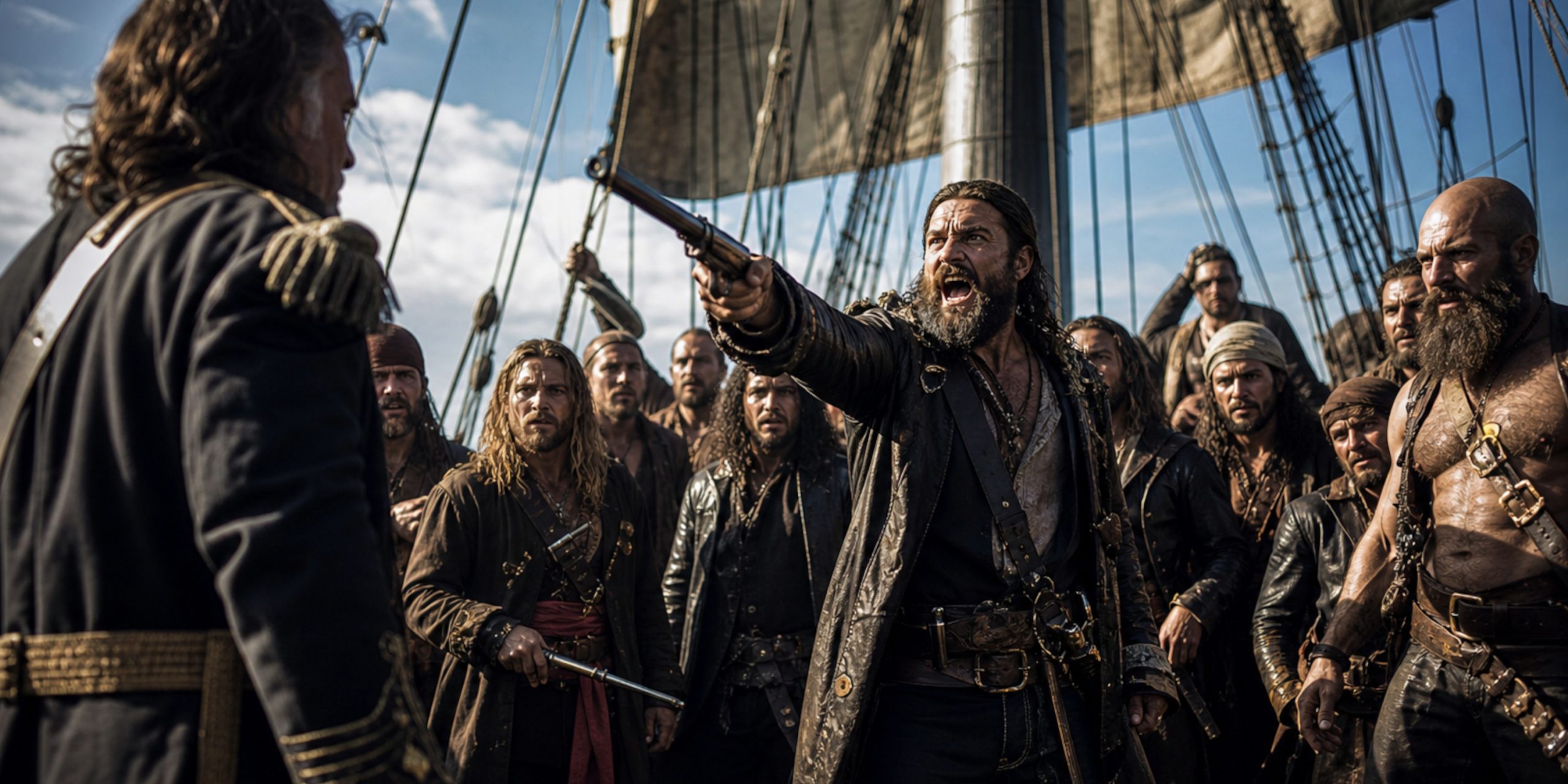
Mutiny sits at the heart of pirate mythology, though the reality is less romantic and far more pragmatic. Life at sea was harsh, authority was fragile, and a captain’s survival often depended on consent as much as command. Pirates, for all their lawlessness, operated within surprisingly strict codes. Break those, or push your crew too far, and the result could be swift and brutal.
What follows is not a collection of tall tales, but a closer look at mutinies that actually shaped pirate history. Some are famous, others quietly influential, all revealing just how precarious leadership could be on the open sea.
The Mutiny Against William Kidd
William Kidd’s story is often framed as a fall from grace, but the truth is messier. Originally commissioned as a privateer, Kidd’s voyage began with legitimacy and ended in infamy.
His crew grew restless early. Promised riches did not materialise, discipline tightened, and tensions simmered. The breaking point came when Kidd killed his gunner, William Moore, in a heated dispute. It was not just murder, it was a violation of the fragile trust that held the crew together.
While not a textbook mutiny, the crew’s gradual defiance effectively stripped Kidd of real authority. By the time he turned to outright piracy, he was already losing control. The voyage became a slow-motion collapse rather than a single explosive revolt.
A useful reminder that mutiny does not always begin with shouting and swords. Sometimes it looks like quiet disobedience and a captain being ignored.
Henry Avery and the Mutiny on the Charles II
If you want a clean example of mutiny, Henry Avery provides it.
Serving aboard the Charles II, Avery and his fellow sailors had gone unpaid for months. Morale was low, patience thinner still. One night in 1694, Avery led a carefully planned takeover of the ship. The captain was deposed with minimal bloodshed, which suggests this was less a riot and more a coordinated change in management.
Avery was elected captain, the ship renamed Fancy, and the crew promptly embraced piracy.
The success that followed, particularly the capture of the Mughal treasure ship Ganj-i-Sawai, turned this mutiny into one of the most profitable decisions in pirate history. It also demonstrates something often overlooked. Pirate mutinies were not always acts of desperation. Sometimes they were calculated career moves.
The Deposition of Charles Vane
Charles Vane was, by most accounts, difficult.
Aggressive, stubborn, and occasionally reckless, he commanded respect through fear rather than loyalty. That approach works until it does not. In 1718, after Vane chose to flee from a French warship rather than engage, his crew had enough.
The following day, they voted him out.
This is one of the clearest examples of pirate democracy in action. Leadership was conditional. A captain who appeared cowardly, or simply unprofitable, could be removed. Vane’s quartermaster, Calico Jack Rackham, replaced him.
Vane was marooned, which feels almost polite given the circumstances.
There is a certain irony here. A man feared across the Caribbean undone not by the navy, but by a vote.
Bartholomew Roberts and the Rise from Mutiny
Bartholomew Roberts did not begin his pirate career by choice. He was captured by pirates and forced into service under Howell Davis. When Davis was killed, the crew faced a leadership vacuum.
What followed was not chaos, but selection.
Roberts was elected captain by the crew, effectively a mutiny against uncertainty itself. He had been among them for only a short time, yet his competence stood out. The crew recognised it and acted.
Under Roberts, the ship transformed into one of the most successful pirate operations of the era. His strict enforcement of pirate codes, combined with tactical discipline, made him an unlikely advocate for order within lawlessness.
This case flips the usual narrative. Mutiny did not destroy the crew. It stabilised it.
The Mutiny on the Whydah under Samuel Bellamy
Samuel Bellamy, often called Black Sam, is remembered as a relatively fair captain. Which makes the tensions aboard the Whydah all the more interesting.
While full-scale mutiny never quite erupted, there were clear signs of division within the crew. Bellamy’s leadership style leaned toward equality, yet even that had limits. Disagreements over loot distribution and risk-taking created friction.
The crew held together, but only just. Before matters could escalate, the ship was lost in a violent storm in 1717.
It is tempting to imagine what might have followed had they survived. My suspicion is that Bellamy’s authority, though more humane than most, would eventually have been tested in exactly the same way as his peers.
Even the most reasonable captain sails on borrowed time.
Why Pirate Mutinies Happened
Pirate crews were not anarchic mobs. They operated under agreed rules, often written and signed. That structure is what made mutiny both possible and, in some cases, justified.
Common causes included:
- Failure to secure prizes or wealth
- Excessive cruelty or arbitrary punishment
- Perceived cowardice in battle
- Unequal distribution of loot
- Broken promises, especially regarding pay or conditions
Unlike naval crews, pirates expected a degree of fairness. When that expectation was broken, removal of the captain was not rebellion in their eyes. It was correction.
A Historian’s View, With a Raised Eyebrow
Mutiny tends to be portrayed as explosive and dramatic. The reality is more procedural, occasionally almost bureaucratic. Votes were taken. Leaders replaced. Ships renamed with alarming efficiency.
There is something faintly amusing in how organised it all was. These were criminals, certainly, but criminals with minutes of meetings, if only in spirit.
At its core, mutiny reflects a simple truth about pirate life. Authority existed only so long as it delivered results. Fail, and your crew would remind you, sometimes politely, sometimes not.
And if you ever find yourself captaining a pirate vessel, which I do not recommend, remember this. It is not the navy you should fear most. It is the men standing directly behind you.