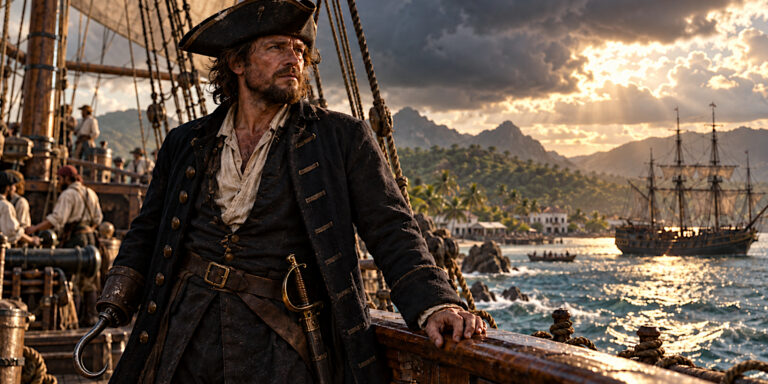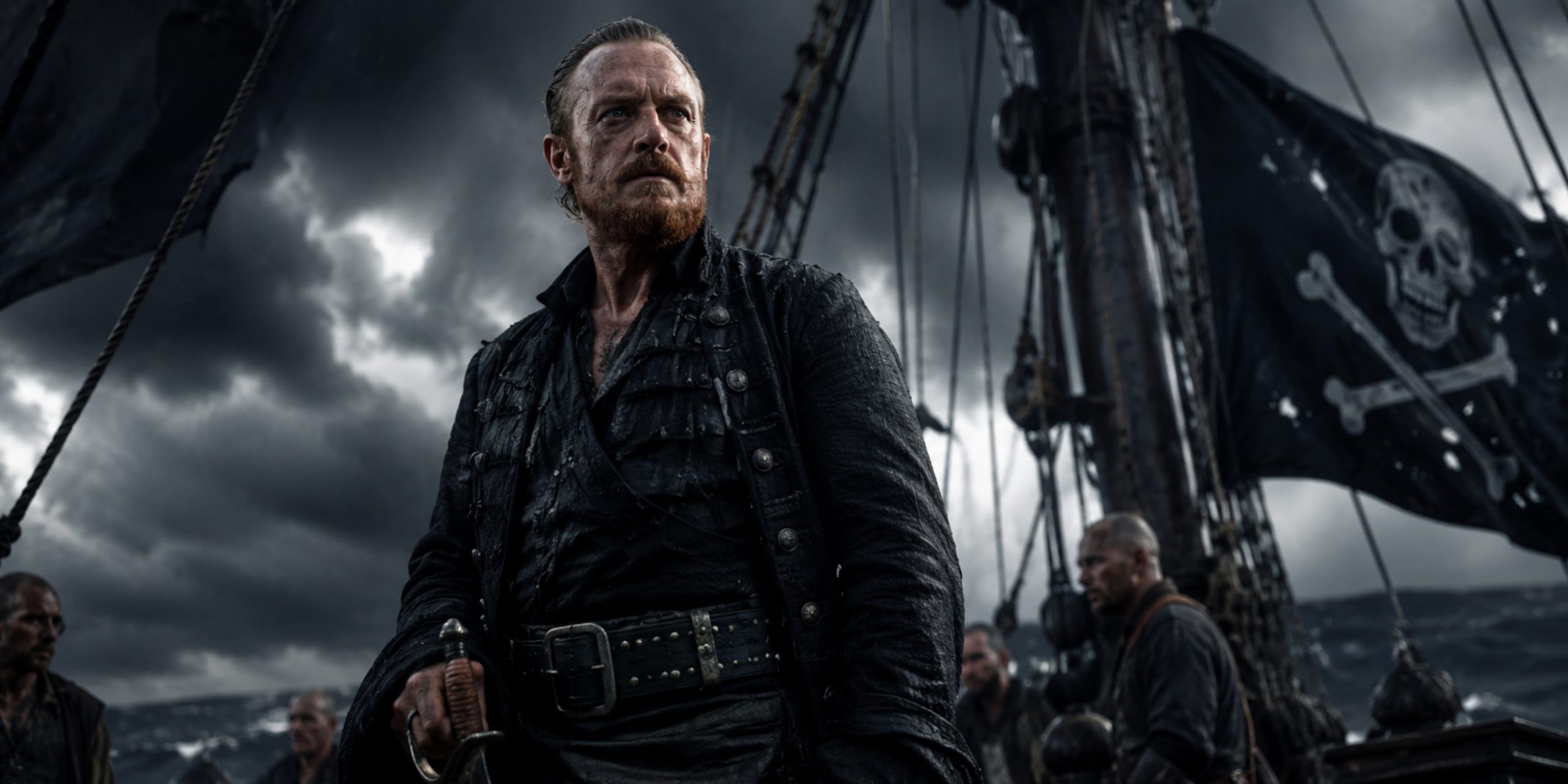
Captain Flint is one of those fictional pirates who somehow escaped the page and became part of pirate folklore itself. Plenty of characters fade after a novel ends. Flint went in the opposite direction. He grew larger, darker and considerably more dramatic with every retelling.
Part of that comes from the fact that he barely appears in Robert Louis Stevenson’s Treasure Island. Flint is already dead when the story begins, yet his shadow hangs over every scene like a thunderstorm that refuses to move offshore. Men who survived him still tremble at the sound of his name. That is not normal villain behaviour. That is the literary equivalent of hearing veterans go quiet in a pub.
Then Black Sails arrived and decided to ask the obvious question: what sort of man inspires that level of fear?
The answer, apparently, was a deeply intelligent, charismatic and emotionally wrecked pirate captain who could deliver speeches like a revolutionary one moment and start a bloodbath the next. Which, frankly, feels accurate for the golden age of piracy.
Who Is Captain Flint?
Captain Flint is a fictional pirate captain created by Robert Louis Stevenson for the novel Treasure Island.
Within the story, Flint is remembered as the former captain of the Walrus, a pirate ship that terrorised the Caribbean and amassed an enormous buried treasure. By the time the novel begins, Flint has already died, reportedly from drink and declining health in Savannah.
That sounds almost disappointingly ordinary for such a terrifying figure. One expects a pirate called Flint to explode during cannon fire while laughing at a hurricane.
Instead, Stevenson made an interesting choice. Flint exists mostly through reputation. Other pirates speak about him with genuine dread. His former quartermaster, Long John Silver, treats Flint almost like a force of nature rather than a former employer.
That approach works brilliantly because imagination fills the gaps. Readers picture someone far worse than anything directly shown on the page.
Captain Flint in Treasure Island
In Treasure Island, Flint serves as the ghost at the feast. The entire plot revolves around the treasure he buried and the map leading to it.
Key details about Flint from the novel include:
| Detail | Information |
|---|---|
| Ship | Walrus |
| Role | Pirate captain |
| Treasure Location | Skeleton Island |
| Closest Associate | Long John Silver |
| Reputation | Ruthless and feared |
| Fate | Died in Savannah |
Flint’s most famous phrase in the novel is:
“Darby McGraw, fetch aft the rum!”
Which becomes chilling because dying pirates repeat it in terror throughout the story. Stevenson understood something modern writers occasionally forget. Repetition creates myth.
Even Flint’s parrot survives him. Silver’s bird constantly screeches “Pieces of eight!”, which is either brilliant atmospheric storytelling or the most annoying pet imaginable on a long voyage.
Probably both.
Was Captain Flint Based on a Real Pirate?
4
Flint was fictional, but Stevenson clearly borrowed elements from real pirates of the Golden Age of Piracy.
Possible inspirations include:
- Edward Teach, particularly his terrifying reputation
- William Kidd, due to buried treasure legends
- Bartholomew Roberts, for leadership and success
- Caribbean pirate crews active during the early 18th century
Real pirates were often brutal, politically chaotic and surprisingly organised. Flint reflects that world well. He is not written as a cartoon villain with a skull-patterned dressing gown. He feels like someone hardened by violence, greed and betrayal.
Historically, pirates also depended heavily on reputation. Fear prevented resistance. A ship surrendering immediately was far more profitable than a prolonged battle that damaged cargo and killed crew.
Flint’s legend operates exactly like that.
Captain Flint in Black Sails
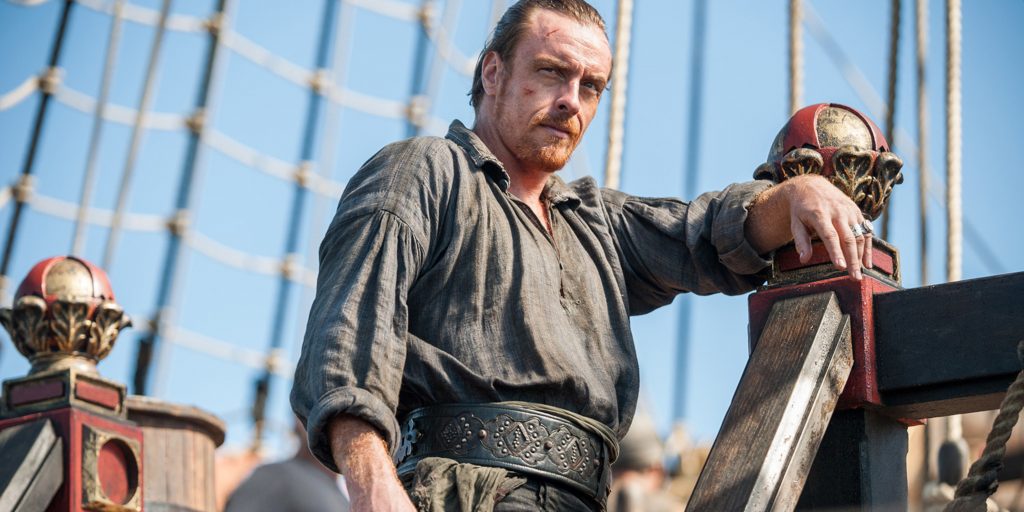
Black Sails transformed Captain Flint from myth into a fully realised central character.
Played by Toby Stephens, Flint became one of the most compelling pirate portrayals in modern television. Not because he was heroic, necessarily. More because he constantly balanced brilliance against self-destruction.
The series presents Flint as:
- A former British naval officer
- A strategic thinker
- A political radical
- A deeply traumatised man
- A captain obsessed with survival and legacy
What makes this version work is that Flint genuinely believes he is fighting a larger war against empire and civilisation itself. Sometimes he sounds like a revolutionary philosopher. Other times he sounds like a man who has slept three hours in six days and absolutely should not be near gunpowder.
That instability becomes part of his magnetism.
The show also explores his relationship with Nassau and the pirate republic concept. Rather than treating pirates as random criminals, Black Sails presents them as desperate people resisting imperial control, class systems and execution.
It gives Flint surprising depth without softening him too much.
The Walrus and Flint’s Crew
The Walrus is one of the most iconic pirate ships in fiction.
In both Treasure Island lore and Black Sails, it represents freedom, violence and instability in equal measure. Life aboard pirate vessels was harsh, crowded and dangerous. Disease, storms and mutiny were constant threats.
Flint’s crew included several notable figures:
| Character | Role |
|---|---|
| Long John Silver | Quartermaster |
| Billy Bones | Former first mate |
| Israel Hands | Gunner |
| John Rackham | Pirate associate in Black Sails |
| Charles Vane | Rival and ally |
The dynamic between Flint and Silver is especially important. They operate almost like opposing philosophies.
Flint believes in force and destiny.
Silver believes in survival and adaptation.
Watching them cooperate while clearly distrusting each other is half the fun.
Captain Flint’s Personality
Flint is fascinating because he never fits neatly into one category.
He is intelligent but reckless.
Charismatic but terrifying.
Idealistic but extraordinarily violent.
Modern audiences tend to like morally grey characters, though Flint practically lives in a moral fog bank somewhere off Nassau. He can inspire loyalty one moment and create horror the next.
That unpredictability gives him weight. Other pirates in fiction often feel theatrical. Flint feels dangerous.
There is also something tragic about him. Beneath all the rage and ambition sits a man consumed by loss and humiliation. He is constantly trying to overpower the world before it crushes him first.
Which is surprisingly human for someone associated mainly with treasure maps and buried gold.
Weapons and Fighting Style
Captain Flint is usually depicted using weapons associated with early 18th century pirates.
Common arms include:
- Cutlasses
- Flintlock pistols
- Naval sabres
- Boarding axes
- Daggers
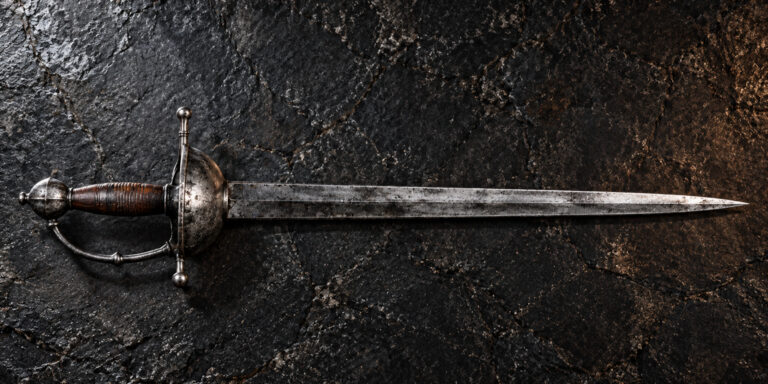
The cutlass became especially associated with pirates because it was compact and effective during boarding actions. Naval combat was cramped, chaotic and brutally close range. Elegant duelling swords were less useful when slipping on blood and seawater beside a cannon.
A sentence that somehow manages to ruin fencing forever.
Why Captain Flint is important
Flint survives because he represents more than piracy.
He represents rebellion.
Fear.
Freedom.
Self-destruction.
The fantasy of escaping civilisation completely, while also showing the cost of doing so.
Modern pirate fiction owes an enormous debt to Stevenson’s creation. Without Flint, there is probably no modern pirate archetype as we recognise it today.
You can see traces of him in countless later characters across games, films and television.
Even now, the name “Captain Flint” still sounds sharp. Dangerous. Slightly cursed.
That is good character design.
Captain Flint in Popular Culture
Flint continues to appear in:
- Pirate-themed novels
- Television adaptations
- Video games
- Tabletop RPGs
- Fan reinterpretations
- Historical fiction inspired by the Golden Age of Piracy
His strongest modern appearance remains Black Sails, which many fans consider one of the finest pirate dramas ever produced. It managed the rare trick of expanding literary lore without completely flattening the original mystery.
Not an easy thing to pull off.
Takeaway
Captain Flint works because he feels believable beneath the myth.
He is not cleanly heroic or purely monstrous. He is proud, bitter, brilliant and frequently horrifying. The best versions of the character understand that piracy was never really about treasure maps and catchy songs. It was about desperation, power and survival at the violent edge of empire.
Also, frankly, terrible workplace management.
Few fictional pirates carry the same weight as Flint. Even after more than a century, his shadow still stretches across the genre like cannon smoke drifting over black water.
And that is probably exactly how he would have wanted it.