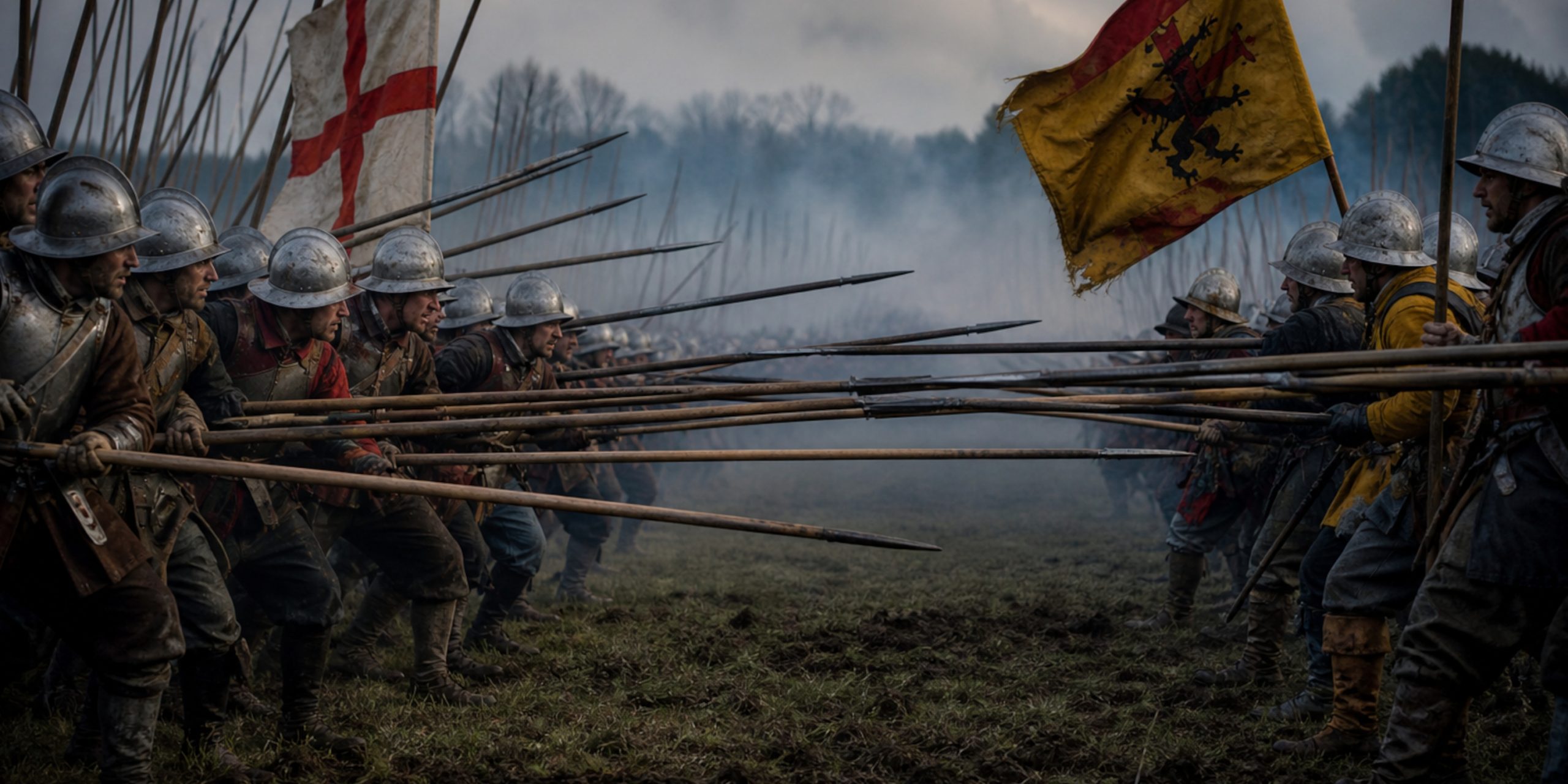
The First Battle of Newbury sits in that category of engagements that neither side could afford, yet both insisted on fighting. It came at a moment when the English Civil War still had the air of something undecided, a conflict not yet hardened into inevitability. Here, on the fields and hedgerows around Newbury, Parliament’s army forced its way past a Royalist blocking position, and in doing so proved something quietly important. The King could be resisted in the open field.
Background
By late summer 1643, Charles I had reason to feel cautiously confident. Royalist successes in the west and north had strengthened his position, and his field army, under the experienced Earl of Essex’s opposite number Prince Rupert of the Rhine, had shown flashes of aggression that Parliament struggled to match.
Yet confidence is not strategy. Essex had marched west to relieve Gloucester, succeeded, and now needed to return to London. The Royalists moved to intercept, choosing the ground near Newbury, a place of narrow lanes, hedged enclosures, and awkward open ground. It was not ideal for cavalry, which should have raised a few eyebrows in Rupert’s camp, though hindsight is always the most disciplined of generals.
Foces
Parliamentarian Army
- Commander: Earl of Essex
- Estimated strength: 14,000 to 15,000
- Composition:
- Infantry brigades, largely pike and shot
- Cavalry regiments, less aggressive than Royalist counterparts
- Artillery train, limited but effective in defensive use
Royalist Army
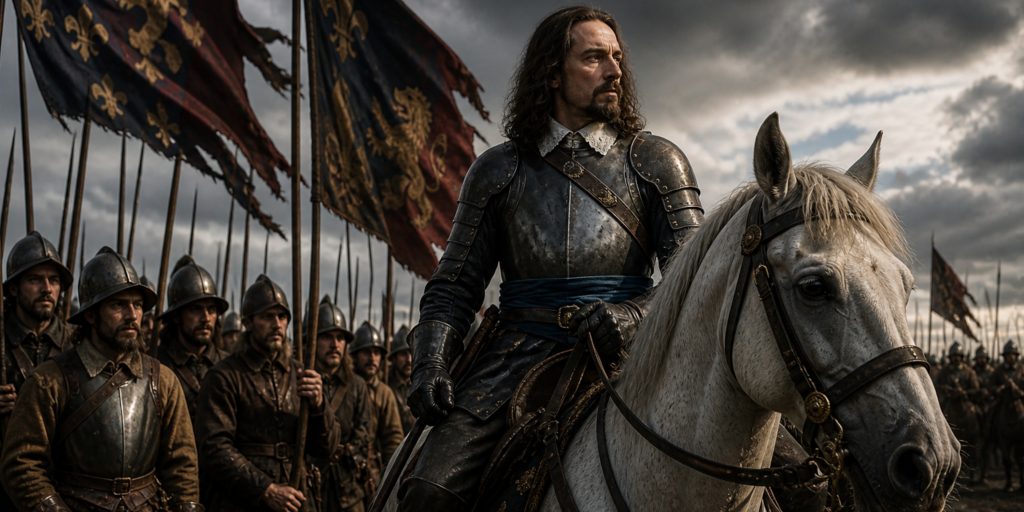
- Commander: Charles I
- Senior officers:
- Prince Rupert of the Rhine
- Lord Falkland
- Estimated strength: 12,000 to 14,000
- Composition:
- Strong cavalry arm, including elite horse under Rupert
- Infantry brigades, often less cohesive
- Artillery positioned defensively
Arms and Armour
The English Civil War was not an age of uniformity. Equipment varied widely, and Newbury reflects that unevenness.
Infantry Equipment
- Pikemen
- Long pikes, often 12 to 16 feet
- Breastplates and helmets, though many lacked full armour
- Musketeers
- Matchlock muskets
- Bandoliers with powder charges
- Minimal armour, mobility preferred
Cavalry Equipment
- Royalist Cavalry
- Breastplates and buff coats
- Pistols and swords
- Favoured aggressive charges
- Parliamentarian Cavalry
- Similar equipment, though often more disciplined in formation
- Less prone to pursue recklessly
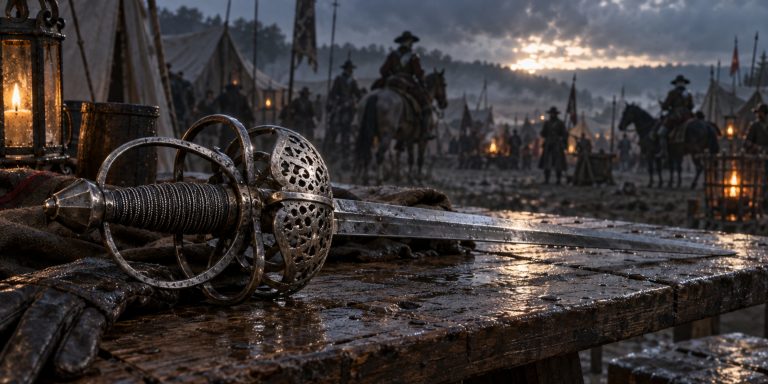
Sword Types in Use
- Basket-hilted broadswords, common among cavalry
- Backswords, single-edged and practical
- Rapier-influenced blades, though less suited to battlefield work
There is something almost charming in the persistence of the sword at this stage. Firearms dominated, yet men still closed with steel, often because formations broke down and the tidy diagrams of theory gave way to panic and proximity.
The Battle
The fighting opened with Parliamentarian forces advancing through enclosed ground near Wash Common. This was not open terrain. It was cramped, broken, and poorly suited to sweeping cavalry manoeuvres.
Royalist infantry held their ground stubbornly. Rupert attempted to use his cavalry as he always did, aggressively, but the terrain blunted his advantage. Charges lost cohesion. Pursuits became confused.
Essex, to his credit, did not lose control. His infantry pushed forward in a series of hard, grinding engagements. This was not a battle of sudden collapse. It was a contest of endurance.
At the centre, fighting around hedgerows and lanes turned brutal and close. Muskets fired at short range. Pike formations pressed forward. Casualties mounted steadily, without the drama of a decisive moment.
The death of Lord Falkland stands out, less for its tactical impact and more for what it symbolised. A thoughtful royalist, weary of the war, he rode into the thick of it and did not return. One suspects he knew the odds and accepted them.
By evening, the Royalists withdrew. Essex had forced a passage. It was not a crushing victory, but it was enough.
Battle Timeline
- Early morning
- Parliamentarian army advances toward Newbury
- Initial contact near Wash Common
- Mid-morning
- Infantry engagements intensify in enclosed terrain
- Royalist defensive positions hold
- Midday
- Cavalry actions led by Prince Rupert, limited effectiveness due to terrain
- Heavy fighting across the line
- Afternoon
- Parliamentarian infantry gains ground incrementally
- Death of Lord Falkland
- Late afternoon to evening
- Royalist forces begin withdrawal
- Essex secures route to London
Archaeology
The landscape around Newbury still holds traces of the battle, though not in the dramatic fashion one might hope. This is not Towton, where mass graves tell grim stories. Newbury is subtler.
- Musket balls and pistol shot have been recovered across Wash Common
- Distribution patterns suggest close-range firefights rather than long-distance exchanges
- Occasional fragments of equipment, including buckles and fittings, indicate the presence of cavalry in confined spaces
The archaeology supports what the sources imply. This was a battle fought at uncomfortable distances, in terrain that denied elegance and encouraged chaos.
Contemporary Quotes
From a Parliamentarian account:
“The enemy stood very stiffly to it, and the fight was maintained with much resolution on both parts.”
From a Royalist perspective:
“The ground was much to their advantage, being enclosed and not fit for horse.”
And perhaps most tellingly, reflecting the mood rather than the tactics:
“We have beaten them, yet are not masters of the field.”
That last sentiment captures the battle neatly. Victory, yes. Control, not quite.
Aftermath and Significance
The First Battle of Newbury did not end the war, nor did it settle the question of supremacy. What it did was erode the idea that Royalist momentum was unstoppable.
Essex returned to London with his army intact. That alone mattered. Parliament retained a field force capable of continued resistance, which in 1643 was no small thing.
Strategically, the battle was a check rather than a turning point. Psychologically, it was more valuable. It showed that disciplined infantry, used well, could blunt cavalry and hold ground against the King’s army.
Takeaway
Newbury is not a battle that announces itself loudly in the history books. It lacks the drama of Naseby or the scale of Marston Moor. Yet it has a certain stubborn importance.
It reminds us that wars are not only decided by grand victories. Sometimes they hinge on whether an army can simply keep moving, keep fighting, and avoid being broken. Essex managed that here, and for Parliament in 1643, that was enough.
One suspects many of the men involved would have preferred a clearer result. Historians, on the other hand, are left with something far more interesting.