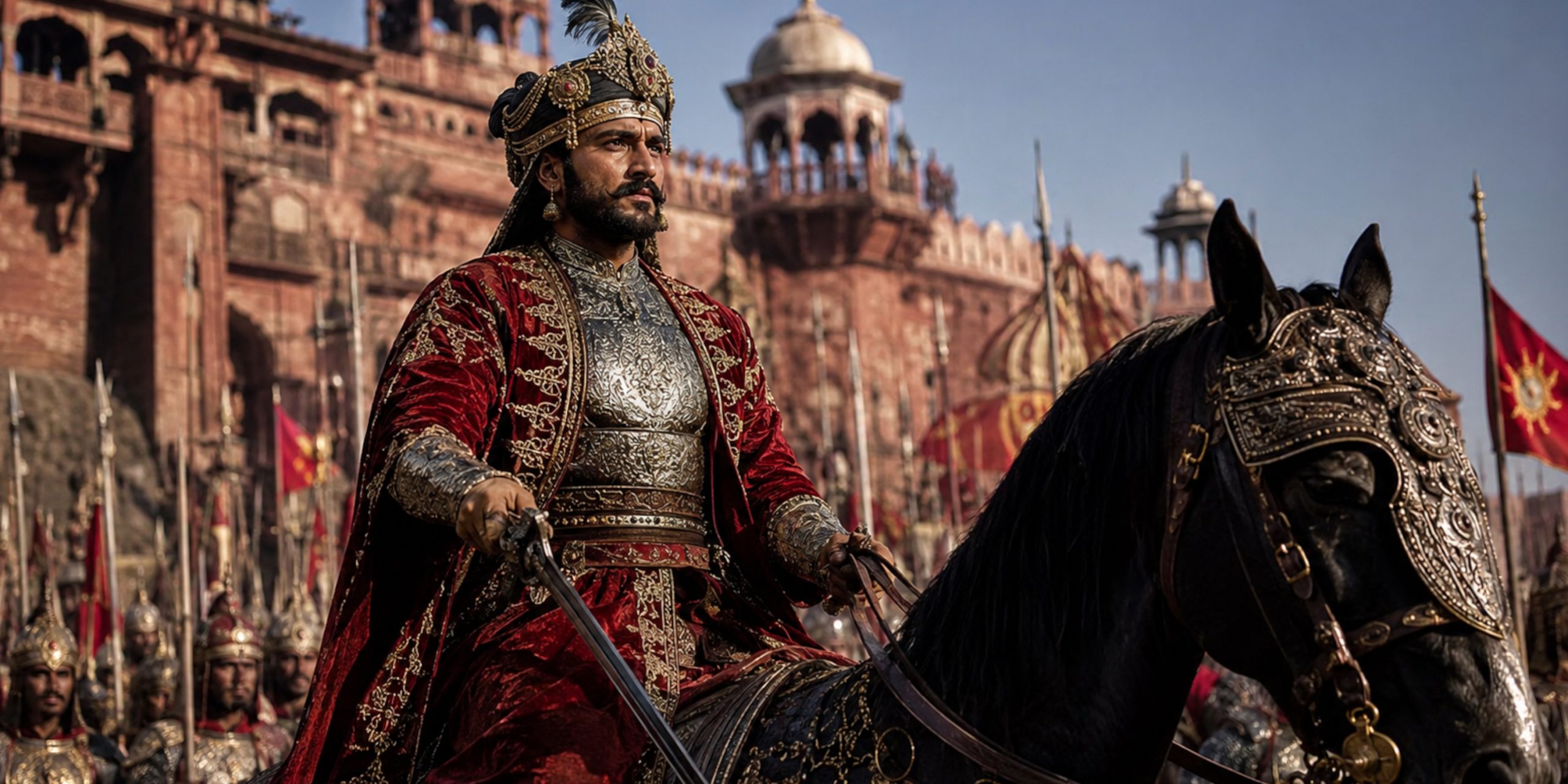
Jalal-ud-din Muhammad Akbar remains one of those rulers who resists simple judgement. Conqueror, reformer, opportunist, patron, he could be all of these in a single decade. When he inherited the Mughal throne in 1556, he was a teenager surrounded by enemies and advisers who thought they knew better. By the time of his death in 1605, he had forged one of the most formidable empires in early modern history.
There is a tendency to flatten Akbar into a benevolent ideal. That misses the point. His tolerance was not softness, it was strategy. His wars were not chaos, they were structured expansion. What makes him compelling is the balance between ambition and restraint, and how often he recalibrated both.
Rise to Power
Akbar’s early reign was shaped by instability. His father Humayun had only recently regained control of parts of northern India before dying suddenly. The empire Akbar inherited was fragile, contested by Afghan warlords and ambitious regional rulers.
The young emperor’s fortunes turned decisively at the Second Battle of Panipat in 1556. Under the guidance of his regent Bairam Khan, Mughal forces defeated Hemu, a powerful Hindu general who had seized Delhi. That victory did more than secure a throne. It set the tone for Akbar’s reign, a blend of disciplined warfare and calculated alliances.
Once he came of age, Akbar dismissed Bairam Khan and began ruling in his own right. That transition is often overlooked, but it matters. He did not remain a puppet, and he did not tolerate rivals at court for long.
Expansion of the Mughal Empire
Akbar’s territorial ambitions were relentless, though rarely reckless. Over the course of his reign, he expanded Mughal authority across northern and central India, incorporating regions such as Gujarat, Bengal, and parts of the Deccan.
What stands out is how he consolidated these gains. Rather than ruling through fear alone, he integrated local elites into his administration. Rajput rulers, in particular, were brought into the Mughal fold through diplomacy, marriage alliances, and selective military pressure.
The result was an empire that did not constantly fracture under its own weight. It held together because it adapted.
Battles and Military Acumen
Akbar’s reputation as a commander rests on more than individual victories. It lies in his ability to shape campaigns, logistics, and command structures.
Key campaigns and traits include:
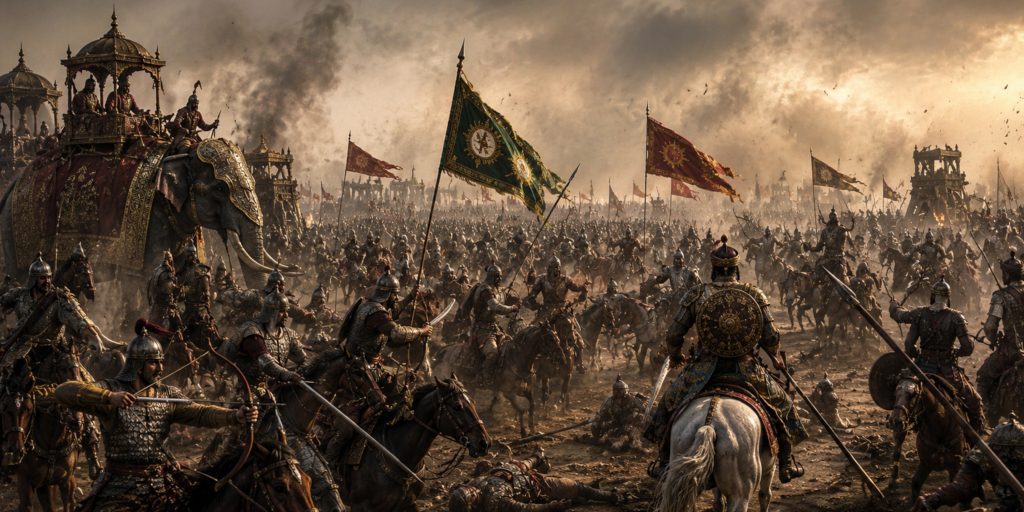
- Second Battle of Panipat (1556)
A decisive early victory that re-established Mughal dominance in northern India. The use of disciplined formations and artillery proved critical. - Siege of Chittorgarh (1567–1568)
A brutal but strategically important campaign against a major Rajput stronghold. Akbar demonstrated patience, engineering skill, and willingness to endure prolonged sieges. - Gujarat Campaign (1572–1573)
Notable for rapid mobilisation and decisive strikes. Akbar personally led forces across long distances with surprising speed. - Use of Combined Arms
Mughal armies under Akbar balanced cavalry, infantry, artillery, and war elephants. This was not unique, but the coordination was unusually effective. - Flexible Command Structure
The mansabdari system organised officers by rank and responsibility, tying military service directly to administrative authority.
He was not always present on the battlefield, but when he was, he took risks. Contemporary accounts describe him fighting from the back of an elephant, which was either a sign of courage or a flair for theatre. Possibly both.
Arms and Armour of Akbar’s Forces
The Mughal military machine was built on a mix of Central Asian, Persian, and Indian traditions. Equipment reflected this blend.
Weapons
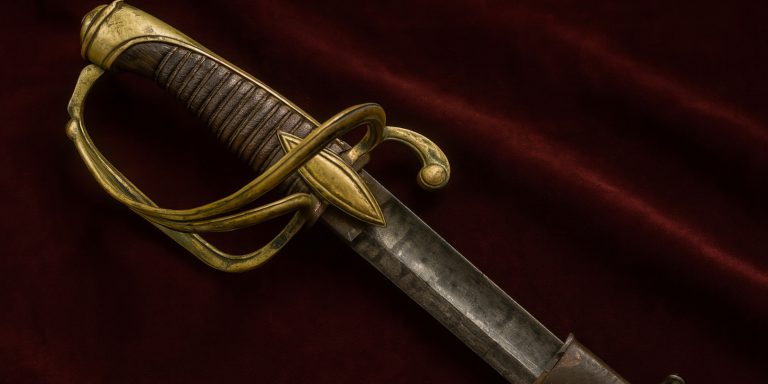
- Talwar
A curved sword designed for slashing from horseback, often richly decorated. - Katar
A push dagger capable of penetrating armour at close range. - Composite Bow
Highly effective in skilled hands, especially for mounted archers. - Matchlock Muskets
Increasingly important during Akbar’s reign, though slower to reload. - Artillery
Cannons played a growing role in sieges and field battles, often decisive.
Armour
- Mail and Plate Armour
Combined flexibility with protection, widely used by elite troops. - Helmets with Nasal Guards
Designed to protect the face without limiting visibility. - Elephant Armour
War elephants were fitted with protective coverings and often carried archers or commanders in howdahs.
There is a visual richness to Mughal military equipment that still stands out. It was functional, but it was also expressive, a statement of power and prestige.
Governance and Reform
Akbar’s administrative reforms were as significant as his military campaigns. He reorganised revenue systems, standardised taxation, and reduced the influence of hereditary elites who could challenge central authority.
His policy of religious accommodation is often highlighted, and for good reason. He abolished the jizya tax on non-Muslims and encouraged debate among scholars of different faiths. Whether driven by conviction or pragmatism, it helped stabilise a diverse empire.
One senses a ruler who was constantly experimenting. Not all of his ideas endured, but the willingness to try them is striking.
Cultural and Architectural Legacy
Akbar’s reign saw the flourishing of Mughal art and architecture. His court became a centre for painters, historians, and craftsmen.
Fatehpur Sikri, his short-lived capital, remains one of the most intriguing sites from his reign. It reflects both ambition and impermanence. Built with grandeur, abandoned within decades, it feels like a statement interrupted.
Where to See Artefacts from Akbar’s Reign
Artefacts and structures linked to Akbar can still be explored across India and beyond:
- Agra Fort
A major Mughal stronghold expanded under Akbar, containing palaces, halls, and military structures. - Fatehpur Sikri
His planned capital, rich in architectural detail and symbolic design. - National Museum, Delhi
Houses Mughal weapons, manuscripts, and courtly objects. - Victoria and Albert Museum, London
Contains fine examples of Mughal decorative arts, including arms and textiles.
These sites offer a tangible sense of scale. Akbar’s world was not abstract, it was built in stone, steel, and pigment.
Latest Archaeology and Research
Recent archaeological work has focused on Mughal urban centres and military infrastructure. Excavations at Fatehpur Sikri have revealed more about water systems, suggesting a sophisticated approach to urban planning that may explain both the city’s rise and its abandonment.
Studies of Mughal weaponry have also advanced, with metallurgical analysis showing high levels of craftsmanship in blades and armour. Some findings suggest regional variations in production that reflect the empire’s diversity.
There is also ongoing work on administrative records, particularly the Ain-i-Akbari, which continues to provide insight into the structure of the empire. Each new study tends to reinforce the same conclusion, this was not a loosely held dominion, it was a carefully managed system.
Personality and Historical Perspective
Akbar is often presented as unusually enlightened for his time. That is partly true, though it risks making him seem detached from the realities of empire. He could be ruthless when needed, especially in suppressing rebellion.
What I find most interesting is his curiosity. He listened, debated, experimented, and occasionally contradicted himself. There is a human quality there that does not always survive in imperial narratives.
He did not simply inherit power. He shaped it, tested it, and in some cases, redefined it.
Takeaway
Akbar’s legacy rests on more than conquest. He created a durable political structure, encouraged cultural exchange, and built an empire that could absorb difference rather than collapse under it.
That balance is difficult to achieve. It is even harder to sustain. Akbar managed both, at least for a time, and that is why his reign still draws attention centuries later.