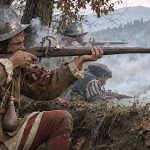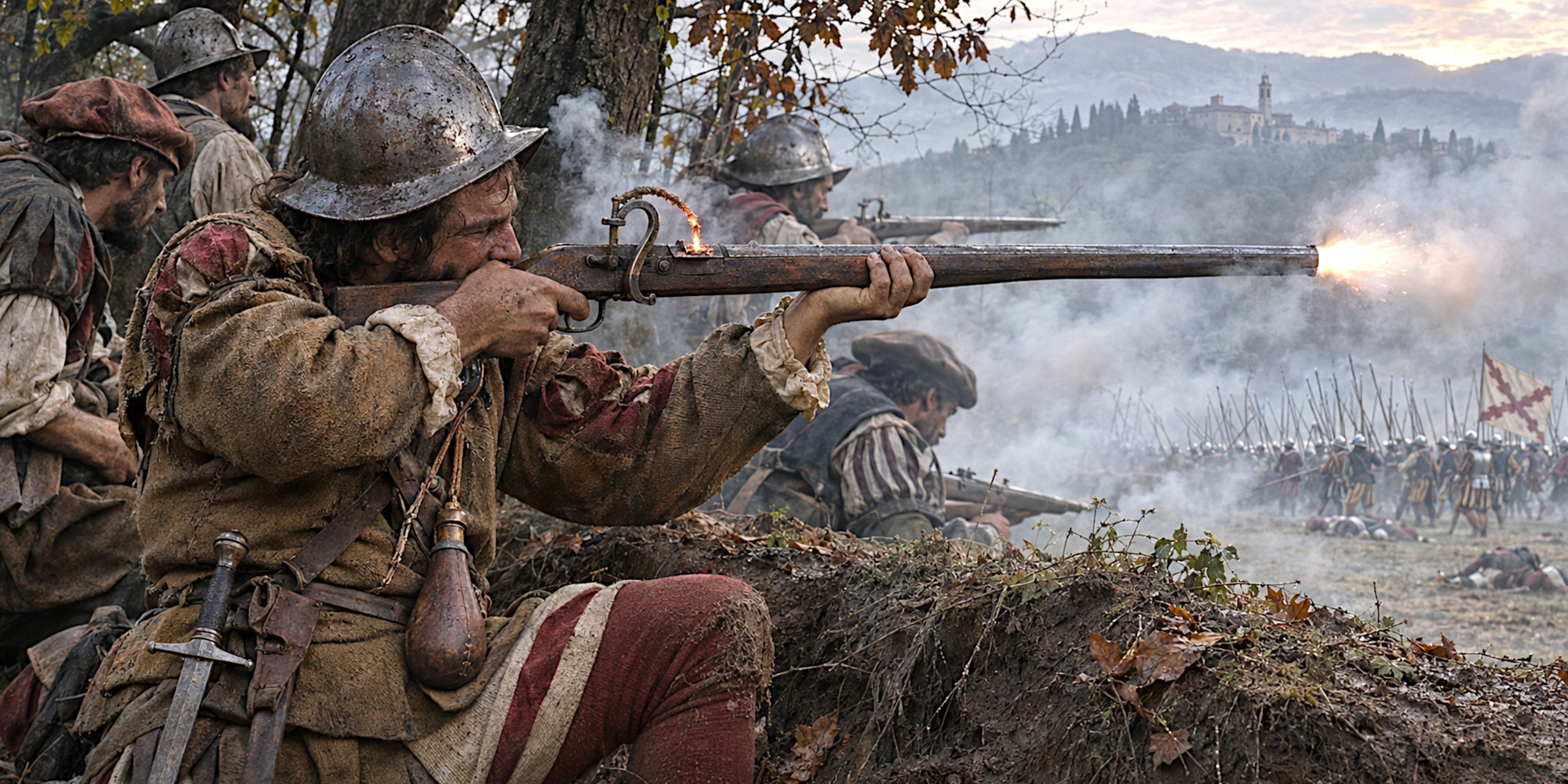
An arquebusier needed dry powder, a glowing match and the nerve to keep working while someone tried to kill him. His weapon could misfire, his smoke could hide the target, and an enemy horseman could cover an alarming distance while he reloaded. Yet by the sixteenth century, commanders across Europe increasingly wanted these men in their armies.
Their importance lay in more than the damage a lead ball could do. Arquebusiers helped change the relationship between infantry, cavalry, fortifications and armour. They fought from ditches, defended breaches, accompanied assaults and worked alongside pikemen. Their success depended on organisation as much as invention.
What interests me most is the gap between the weapon’s apparent simplicity and the soldier’s difficult job. Lighting powder was straightforward. Keeping a company useful through a wet march, a confused deployment and several hours of fighting was another matter.
What Was an Arquebusier?
An arquebusier was a soldier armed with an arquebus, usually a muzzle-loading, smoothbore firearm fitted with a matchlock. Spellings included harquebusier, while English and Scottish sources also used words such as hackbut and hagbut for related weapons.
The terminology was untidy. Arquebus could describe different guns in different places and decades. By the later sixteenth century, many European writers distinguished the relatively light arquebus from the heavier musket. English sources also referred to the caliver, associated with efforts to standardise bore size and ammunition.
These were overlapping categories rather than a universal classification system. A museum label and a military account may use different names for very similar objects.
| Feature | General pattern |
|---|---|
| Main period of prominence in Europe | Late fifteenth to late sixteenth centuries |
| Principal weapon | Matchlock arquebus firing a lead ball |
| Battlefield roles | Skirmishing, defensive fire, assaults and support for other troops |
| Typical protection | Clothing, sometimes a helmet or limited body armour |
| Close-combat weapons | Sword and often a dagger, varying by army and date |
| Principal dependencies | Powder, ammunition, match, maintenance and supporting troops |
This article concentrates on infantry. In later usage, particularly in the seventeenth century, harquebusier could also mean a mounted soldier equipped with firearms and lighter armour than a cuirassier.
Origins and Development
European arquebuses developed from earlier handguns during the fifteenth century. Improvements to stocks and ignition mechanisms made it easier to support a gun, aim it and discharge it without manually applying a separate ignition source to the touch-hole.
The matchlock was central to that development. A metal arm, usually called the serpentine, held a length of slow-burning match. Operating the firing mechanism brought its glowing end into the priming powder in the pan. Fire passed through a small vent into the barrel’s main charge.
This was a considerable improvement, although it left the soldier carrying an ignition source beside his ammunition. Early modern warfare was generous with occupational hazards.
By the Italian Wars, arquebusiers were important components of several European armies. Spanish forces became particularly associated with effective combinations of firearms, infantry support and defensive terrain. German Landsknechts, Italian troops, French infantry and others also fielded shot. No single nation possessed a monopoly on learning.
Surviving guns illustrate the variety. The Metropolitan Museum of Art records a French matchlock petronel of about 1570–80 measuring 114.9 cm and weighing about 3.49 kg. Its sharply curved stock was braced against the chest. A German or Austrian military matchlock of the late sixteenth or early seventeenth century weighs about 5.24 kg and has a 17.5 mm bore. Neither should become a universal specification for every arquebus.
How Arquebusiers Fought
Arquebusiers were useful wherever a commander could give them time to shoot and some protection while they prepared another discharge. Banks, walls, fieldworks, vineyards and broken ground could all help.
Their employment included:
- Skirmishing ahead of the main infantry.
- Holding ditches, buildings and defensive positions.
- Supporting pikemen from the flanks or from smaller detached groups.
- Firing into enemy formations before an assault.
- Defending or attacking breaches during sieges.
- Fighting aboard ships, where distance and cover differed sharply from an open field.
Pikemen supplied protection against close attack, particularly cavalry, but the relationship was flexible. Arquebusiers did not spend every battle standing neatly beside an immaculate square. They might move well forward, exploit cover or become dangerously separated from support.
Ordered firing methods developed over time. Commanders tried different arrangements to keep some men firing while others prepared their weapons. It would be misleading to give every early sixteenth-century company the elaborate countermarch drill familiar from later manuals.
At Pinkie in 1547, firearms formed part of an English system combining infantry, cavalry and artillery. Historic Environment Scotland identifies the battle as an important early British example of their effective integration. That is the useful lesson: guns worked within an army, rather than replacing the need for one.
Range, Accuracy and Rate of Fire
There is no honest single figure for an arquebus’s effective range. Bore, barrel, powder, ball fit, weather and the shooter’s experience all mattered. So did the target. Hitting an individual and putting balls into a dense body of infantry were different tasks.
Arquebuses could kill well beyond the distance at which a soldier could reliably select an individual target. Close-range fire was generally easier to direct and could be especially dangerous against crowded formations or men obstructed by terrain.
Nor should an ideal demonstration become a battlefield rate of fire. A trained man might manage several discharges in a minute under favourable conditions, but sustained combat could be much slower. Fouling, damaged equipment, obscured targets and the need to move all intervened.
The matchlock’s limitations were substantial:
- Rain could compromise exposed priming and match.
- Wind complicated ignition and handling.
- Smoke reduced visibility and made control harder.
- Reloading left men vulnerable.
- Powder, balls and match needed constant replenishment.
Firearms nevertheless offered serious advantages. They could deliver powerful projectiles without requiring the same physical conditioning as a heavy war bow. Learning the basic mechanism was easier than becoming an accomplished military archer, although competent battlefield service still demanded practice.
Arms and Armour
The Arquebus and Its Equipment
The gun was the centre of a larger set of equipment. A soldier needed ammunition, powder containers, slow match and the means to maintain his weapon. Arrangements varied considerably across the period.
| Equipment | Purpose and qualifications |
|---|---|
| Matchlock arquebus | Main firearm, usually with a smoothbore barrel |
| Slow match | Smouldering cord used to ignite the priming powder |
| Powder flask and priming container | Carried the main charge and finer priming powder; arrangements varied |
| Ball pouch | Held lead ammunition |
| Ramrod | Used in loading and maintenance |
| Measured-charge containers | Found in some later sixteenth-century equipment, not universal throughout the period |
| Sword and dagger | Personal defence when firing was impossible or enemies closed |
The lighter arquebus was often fired without the forked rest associated with heavier muskets. Not every stock was held in precisely the same way, however, and early forms should not automatically be given a modern shoulder-fired stance.
Specific Sword Types
There was no standard arquebusier’s sword across Europe. Sidearms reflected local manufacture, personal means, military fashion and date.
| Sword type | Relevant context |
|---|---|
| Katzbalger | Short, broad-bladed infantry sword associated with German Landsknechts, including firearm troops; often recognisable by its curved guard |
| Single-handed cut-and-thrust sword | A broad category of practical European military sidearms with straight blades suited to cutting and thrusting |
| Sidesword, in modern terminology | Useful for describing some sixteenth-century straight swords with developing hand protection; the term does not identify a universal issue pattern |
The Royal Military Museum in Brussels displays an early sixteenth-century Landsknecht carrying a short matchlock, a Katzbalger and a dagger. This is a useful combination grounded in a specific military context. It does not justify equipping every Spanish or French arquebusier in the same way.
Long civilian rapiers should likewise not be treated as the automatic sidearm of every firearm soldier. A sword’s practical military role mattered more than its suitability for a fashionable portrait.
Helmets and Body Armour
Many arquebusiers fought with less armour than heavily equipped pikemen. Mobility, expense and the work of carrying and operating a firearm encouraged lighter equipment.
Some wore helmets, including forms of iron cap, burgonet or morion according to region and date. Others wore soft caps or hats. Mail, breastplates and other protection could appear, but a fully armoured arquebusier should not be assumed to represent the ordinary soldier.
The familiar image of a Spanish gunner in a morion is more useful for some later sixteenth-century settings than as a costume for every stage of the Italian Wars.
Firearms did not make all armour instantly useless. Protection depended on plate quality, thickness, impact angle, projectile and distance. Armour continued to develop, while soldiers and commanders balanced protection against weight and cost.
Recruitment, Training and Life on Campaign
Arquebusiers might serve as mercenaries, members of royal armies, urban defenders or troops raised through local obligations. Their circumstances differed widely. A veteran in a long-serving company and a hastily equipped recruit were not interchangeable because both carried a matchlock.
Effective training extended beyond discharging the weapon. Soldiers had to maintain equipment, recognise commands, manage their ammunition, use cover and move without disrupting neighbouring troops. Above all, they had to avoid becoming isolated while their weapons were unavailable.
Their effectiveness also depended on people behind the firing line: gunmakers, powder suppliers, armourers, transport workers and those paying the bills. Campaigns consumed ammunition and equipment. A gun without supplies was an awkwardly shaped burden.
I find this logistical side particularly revealing. The arquebus could reduce one barrier to recruiting missile troops, but it created demands of its own. States had to supply those men repeatedly, not simply hand over a weapon at muster and hope for the best.
Battles That Show Their Importance
Cerignola, 1503
At Cerignola on 28 April 1503, Gonzalo Fernández de Córdoba’s Spanish army used prepared positions to help defeat the French. Arquebusiers fought in an army that also included crossbowmen, pikemen, cavalry and artillery.
The ground and fieldworks mattered. Cerignola is often presented as a defining victory for firearms, but its stronger lesson is how effectively shooting could work when an enemy had to negotiate obstacles under fire.
Pavia, 1525
At Pavia on 24 February 1525, Imperial arquebusiers contributed significantly to the defeat of Francis I’s French army. Their fire helped undermine heavily armoured cavalry, but the action also involved infantry combat, confused movements and the intervention of other forces.
Pavia did not prove that cavalry had become obsolete. It demonstrated how expensive the consequences could be when cavalry lost favourable conditions and came under effective fire.
Pinkie, 1547
Pinkie on 10 September 1547 shows firearms operating within a combined force in Britain. It also offers an important archaeological problem: separating the evidence of different missile weapons and distinguishing the battle’s material from later activity.
Nagashino, 1575
At Nagashino in 1575, Japanese firearm troops played an important role in the victory of Oda Nobunaga and Tokugawa Ieyasu over Takeda Katsuyori. Defensive obstacles helped make their fire effective.
The famous account of precisely organised, rotating three-rank volleys should be treated cautiously. The importance of firearms is clearer than every detail of the familiar reconstruction. A memorable diagram is not an eyewitness.
Arquebusiers Beyond Western Europe
Matchlock warfare developed across interconnected regions. Ottoman firearm infantry, Portuguese maritime expansion and the adoption of guns in Asia belong within the wider story, although local weapons and military institutions deserve their own treatment.
In Japan, the arrival of Portuguese-associated matchlocks at Tanegashima in 1543 became a celebrated episode. Japanese craftsmen reproduced the weapons and developed substantial domestic production. The guns became known as tanegashima, while teppō was a broader term for firearms.
This was not passive imitation. Japanese commanders incorporated firearms into existing armies, and craftsmen adapted production to local requirements. Matchlocks remained in use in Japan long after European armies adopted newer ignition systems.
Archaeology and Surviving Evidence
What Battlefield Finds Can Reveal
Lead ammunition is among the most useful surviving traces of early firearm warfare. Recorded distributions can help archaeologists investigate areas of firing, concentrations of activity and possible movements across a battlefield.
But interpretation requires care. A lead ball’s diameter does not automatically identify a particular gun. Ammunition varied, balls could be smaller than the bore, and later shooting might leave material on the same ground. Impact damage can add evidence without resolving every question.
At Pinkie Mains, a 2014 evaluation recovered 25 objects reported as musket balls. Their presence is valuable, but that label alone does not establish that every ball came from a particular weapon or was fired in 1547. Historic Environment Scotland specifically notes the possibility of seventeenth-century ammunition overlapping the battlefield.
The strongest interpretations combine find locations, terrain, documentary accounts and the material itself. An unrecorded find loses much of the information that would make it historically useful.
Surviving Guns and Pictures
Museum firearms reveal mechanisms, dimensions, construction methods and patterns of wear. Plain arsenal guns are especially valuable for understanding military equipment. Richly decorated hunting and presentation pieces cannot automatically stand for what an ordinary infantryman carried.
Paintings, prints and military manuals add information about posture, clothing and formations. They also contain conventions, political messages and idealised arrangements. An illustration may show what an author wanted troops to do rather than what frightened soldiers actually managed.
This is where the historian earns her tea: making different kinds of evidence answer the same question without pretending they all say the same thing.
Contemporary Voices
Humfrey Barwick on Firearms and Archery
Humfrey Barwick’s late sixteenth-century defence of firearms announces its position in its title, referring to:
“the disability of the long bowe or archery”
The tract is catalogued by the Folger Shakespeare Library as probably published in 1592. These are words from its title, not a battlefield speech. They belong to a vigorous argument about the relative military value of bows and firearms. Barwick was making a case, and should be read with that purpose in mind.
Cervantes on Gunpowder and Chivalry
In the first part of Don Quixote, published in 1605, Cervantes has his knight complain about:
“those devilish engines of artillery”
The character fears that powder and lead can destroy a courageous man without giving his personal prowess much say in the matter. The passage captures the literary tension between gunpowder warfare and chivalric ideals, with Cervantes allowing the comedy to remain visible.
This is fiction, not a direct statement by a serving arquebusier. The quotation follows John Ormsby’s later English translation, Part I, Chapter XXXVIII.
Timeline of the Arquebusier
| Date | Development | Significance |
|---|---|---|
| Fifteenth century | Stocks and matchlock mechanisms develop | Handheld firearms become easier to aim and operate |
| Late fifteenth century | Arquebusiers become more prominent in European armies | Firearms increasingly influence infantry organisation |
| 1503 | Battle of Cerignola | Defensive positions help arquebusiers contribute to a major Spanish victory |
| 1525 | Battle of Pavia | Imperial firearm infantry help defeat the French army |
| 1543 | Traditional date of the Tanegashima introduction | European-style matchlocks stimulate Japanese manufacture |
| 1547 | Battle of Pinkie | Firearms contribute to an important British combined-arms battle |
| 1575 | Battle of Nagashino | Japanese gun troops demonstrate their value within prepared defences |
| Late sixteenth century | Heavier muskets and more developed firing systems gain importance | Infantry equipment and tactical organisation continue changing |
| Seventeenth century | Musketeers increasingly replace arquebusiers in European terminology | The development is gradual and differs between armies |
Why Arquebusiers Matter
Arquebusiers helped make firearms a normal part of organised infantry warfare. Their importance came from the interaction of weapons, training, terrain and support. A ditch could be as consequential as an improved mechanism; a reliable ammunition supply could matter more than an impressive opening volley.
They did not end cavalry, abolish armour or remove skill from soldiering. They changed what armies needed to practise and provide. The soldier at the firing line remained exposed, fallible and dependent on the men around him.
That makes the arquebusier more interesting than a simple symbol of progress. He belonged to a difficult, uneven transition, often carrying a sword from one military tradition and a firearm that was helping reshape another.
Sources and Further Reading
The following museum records, archaeological reports and contemporary texts support the article’s discussion of weapons, tactics and surviving evidence.
Weapons and Military Equipment
- Metropolitan Museum of Art: French matchlock petronel, about 1570–80 and German or Austrian matchlock gun. Collection records documenting dimensions, construction and different stock forms.
- Royal Military Museum, Brussels: Landsknecht, early sixteenth century. A useful reference for the combination of matchlock, Katzbalger and dagger.
- Metropolitan Museum of Art: Landsknecht’s sword. A surviving example of the sword type associated with German infantry.
Battles and Archaeology
- Spanish Army Museum: Battle of Cerignola, 1503. An account of the army’s composition, fieldworks and deployment.
- Research hosted by Manchester Metropolitan University: Italian firearms manufacture and supply. Further reading on the arms industry, with discussion of Pavia.
- Historic Environment Scotland: Battle of Pinkie, 1547. Battlefield inventory covering the action, landscape and archaeological potential, including the problem of later ammunition.
- CFA Archaeology: Pinkie Mains archaeological evaluation, 2014. The report recording the recovery of 25 objects described as musket balls.
- Japan Tourism Agency: Battle of Nagashino and Guns in Early Modern Japan. Introductions to Japanese matchlock adoption and the familiar account of Nagashino, whose precise firing arrangements require caution.
Contemporary Texts
- Humfrey Barwick: A breefe discourse concerning firearms and archery, probably published in 1592. The Folger Shakespeare Library catalogue supplies the title quoted in the article.
- Miguel de Cervantes: Don Quixote, Part I, Chapter XXXVIII, first published in 1605. The quotation follows John Ormsby’s later English translation and represents the fictional knight’s words.