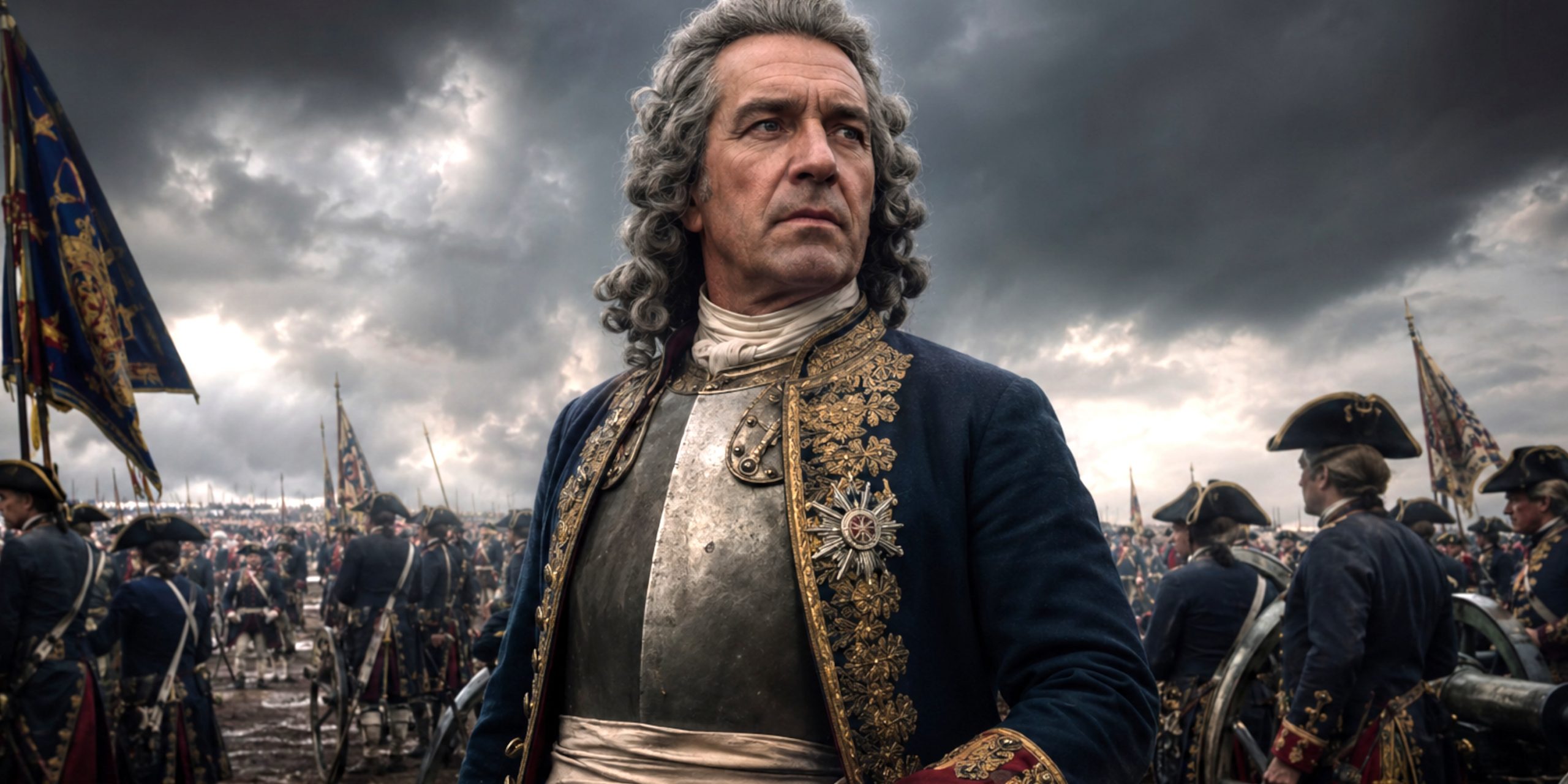
Maurice de Saxe was one of those commanders who seems almost designed to annoy tidy historians. He was German-born, the illegitimate son of a Polish king, briefly a would-be ruler in the Baltic, an Imperial soldier who became a French marshal, a military intellectual who distrusted excessive intellectualising, and a man whose private life was every bit as energetic as his campaigns.
More importantly, he could command an army.
Born Moritz, Count of Saxony, on 28 October 1696, he became known in France as Maurice, comte de Saxe. His reputation rests particularly on the War of the Austrian Succession, when he transformed French operations in the Low Countries and won the great victories of Fontenoy, Rocoux and Lauffeld. Fontenoy in 1745 remains his masterpiece.
Saxe interests me because his military thinking feels unusually modern. He cared about morale, movement, terrain, logistics and the physical condition of soldiers. He disliked rigid systems when they interfered with practical soldiering. In an age routinely caricatured as one of generals politely arranging infantry in straight lines before firing at each other, Saxe was considerably more imaginative.
Who Was Maurice de Saxe?
Maurice was born at Goslar in the Holy Roman Empire. His father was Augustus II the Strong, Elector of Saxony and later King of Poland and Grand Duke of Lithuania. His mother was Maria Aurora von Königsmarck, one of Augustus’s mistresses.
Being illegitimate excluded Maurice from the straightforward dynastic career that might otherwise have been available to a prince of his blood. It also gave him a certain freedom. He had to manufacture his own importance.
He began military service remarkably young and acquired practical experience during the Great Northern War. He subsequently served under Prince Eugene of Savoy against the Ottoman Empire and participated in the siege of Belgrade in 1717.
That early exposure mattered. Maurice saw different armies, different styles of command and warfare conducted across very different environments. He was not formed entirely inside a single military establishment.
In 1720 he entered French service. France would eventually give him what Saxony could not: an army large enough for his ambitions.
The Attempt to Become Duke of Courland
Before Maurice became one of France’s great commanders, he made a rather ambitious attempt to acquire a country.
In 1726 he was elected Duke of Courland, a Baltic duchy corresponding broadly with part of modern Latvia. His candidacy became entangled in the politics of Poland-Lithuania and Russia, particularly through his association with Anna Ivanovna, the future Empress Anna of Russia.
The arrangement collapsed under political pressure.
Maurice was eventually forced out.
It is a revealing episode. He was not merely a professional soldier looking for promotion. He wanted rank, territory, wealth and political independence. His later devotion to French service should therefore not be mistaken for simple patriotism. Maurice was a European aristocratic soldier in an age when military careers frequently crossed political borders.
France simply proved to be the state capable of making the best use of him.
Rise in French Service
Maurice’s advancement accelerated during the War of the Polish Succession between 1733 and 1735. His performance helped establish his reputation as a capable battlefield commander.
He became a lieutenant-general in 1734.
The decisive phase of his career came during the War of the Austrian Succession. France entered a complicated European struggle involving Austria, Britain, the Dutch Republic, Prussia, Bavaria and numerous German states.
Maurice initially campaigned in Bohemia and participated in operations around Prague. His greatest opportunity, however, came in the Austrian Netherlands.
He was made a Marshal of France in 1744.
By this stage his health was deteriorating, but his capacity for command was not.
Military Acumen
Saxe’s greatest strength was not tactical cleverness in isolation. It was his ability to see an army as a complete organism.
That distinction matters.
Many eighteenth-century military theorists concentrated on drill, formations and geometrical manoeuvre. Saxe certainly understood these things, but he recognised that battles were fought by tired, hungry and frightened human beings rather than diagrams.
His military ideas were recorded most famously in Mes Rêveries, usually translated as My Reveries or Reveries on the Art of War.
Morale
Saxe regarded morale as central to warfare.
He understood that soldiers rarely behaved according to the neat expectations of drill manuals once cannon shot began passing through their ranks. Confidence, cohesion and trust in officers could matter as much as theoretical firepower.
He therefore placed considerable importance on maintaining the psychological condition of an army.
Physical Fitness
Saxe was unusually interested in the physical conditioning of soldiers.
He argued that troops should be accustomed to marching and hardship rather than merely drilled on parade grounds. He understood that campaigning demanded endurance.
This sounds obvious now. Eighteenth-century armies nevertheless lost enormous numbers of men to exhaustion, disease, desertion and logistical collapse without ever placing them in a major battle.
Movement
Mobility fascinated him.
Saxe wanted armies capable of manoeuvring rapidly and unexpectedly. He was sceptical of excessive baggage and understood that operational speed could produce opportunities before an enemy had properly concentrated.
Terrain
His use of terrain was particularly impressive.
Fontenoy demonstrated this beautifully. Saxe did not simply deploy an army and await attack. He created a defensive system incorporating villages, field fortifications, artillery positions and natural obstacles.
He effectively persuaded his opponent to attack the battlefield he had prepared for him.
That is usually a good afternoon’s work for a general.
Flexibility
Saxe distrusted rigid tactical formulas.
He understood that commanders needed principles rather than recipes. A formation useful on one battlefield might be disastrous on another.
This flexibility is one reason his writings remained influential beyond his lifetime.
Saxe’s Ideas on Infantry
Saxe questioned some established assumptions about infantry warfare.
He was sceptical about very deep formations and recognised the advantages of firepower combined with manoeuvrability. Yet he also doubted whether musketry alone could decide battles.
The smoothbore flintlock musket was inaccurate by modern standards, particularly against individual targets. Its effectiveness depended on massed volleys, discipline and proximity.
Saxe consequently continued to value shock action.
He also proposed organisational reforms intended to produce smaller, more manageable tactical formations. Some of his proposals were never fully implemented, but they demonstrate that he was thinking seriously about the relationship between command structure and battlefield effectiveness.
Cavalry and Shock Action
Maurice believed cavalry remained capable of delivering decisive battlefield effects.
Speed was essential.
He disliked cavalry tactics that sacrificed momentum through unnecessary firing or complicated manoeuvres before contact. Cavalry existed primarily to strike, exploit disorder and pursue defeated troops.
This emphasis anticipated later developments in European cavalry doctrine.
Saxe was not advocating mindless charges. Cavalry had to be committed at the correct moment. But once committed, he wanted it moving with determination rather than performing an elaborate equestrian committee meeting within musket range.
Artillery
Saxe’s handling of artillery was particularly important at Fontenoy.
French artillery during his period was becoming more mobile and increasingly capable of supporting battlefield manoeuvre rather than simply occupying fixed positions. At Fontenoy, Saxe integrated guns into his defensive arrangement and subsequently moved artillery forward as the Allied attack developed.
The French artillery association’s historical account of Fontenoy particularly emphasises this combination of prepared positions and the movement of guns during the battle.
For me, this is one of the most interesting elements of Saxe’s command. His reputation sometimes rests upon his apparent instinctive brilliance, but Fontenoy was not won through inspiration alone. Preparation, engineering and artillery placement created the conditions in which his battlefield decisions became effective.
Arms and Armour
The battlefield of Maurice de Saxe belonged firmly to the age of gunpowder, although swords and other edged weapons remained important.
| Weapon or Equipment | Typical Users | Battlefield Role |
|---|---|---|
| Flintlock musket | Line infantry | Massed volley fire |
| Socket bayonet | Infantry | Close combat and defence against cavalry |
| Infantry hanger | Some infantry and NCOs | Sidearm and close combat |
| Small sword | Officers and gentlemen | Personal sidearm and symbol of status |
| Cavalry sword | Horsemen | Mounted cutting and thrusting |
| Heavy cavalry sword | Cavalry | Shock combat |
| Pistol | Cavalry and officers | Short-range firearm |
| Carbine | Cavalry | Mounted firearm |
| Field cannon | Artillery | Long-range and close-range fire support |
| Breastplate | Some heavy cavalry | Protection against edged weapons and limited ballistic threats |
Infantry Weapons
The standard infantryman’s principal weapon was the flintlock smoothbore musket fitted with a socket bayonet.
The bayonet had transformed European infantry warfare. Earlier armies required pikemen to protect musketeers from cavalry. By Saxe’s period, the bayonet allowed the musketeer to become his own pikeman.
Infantry officers generally carried swords, particularly small swords or military variants suited to both status and combat.
Hangers, short single-edged or slightly curved swords, were also used by various soldiers and non-commissioned officers.
Cavalry Swords
Cavalry remained an important arm in Saxe’s armies.
Heavy cavalry required substantial straight or slightly curved blades capable of powerful cuts and thrusts from horseback. Lighter cavalry increasingly favoured curved swords suited to mounted cutting.
The distinction was not always as tidy as modern collectors might like. Eighteenth-century military equipment has a habit of refusing to organise itself according to later museum labels.
Armour
Full battlefield armour had largely disappeared.
Some heavy cavalry continued to use cuirasses, particularly breastplates, but infantry fought essentially without metal body armour.
Protection increasingly came from formation, terrain and firepower rather than steel plate.
Major Battles and Campaigns
| Date | Battle or Campaign | Role | Result |
| 1712 | Gadebusch | Young Saxon soldier | Swedish victory |
| 1717 | Siege of Belgrade | Imperial service | Imperial victory |
| 1741 | Prague | French-aligned operations | Initial Franco-Bavarian success |
| 1745 | Siege of Tournai | French commander | French victory |
| 11 May 1745 | Fontenoy | French commander | Major French victory |
| 1746 | Brussels campaign | French commander | French capture of Brussels |
| 11 October 1746 | Rocoux | French commander | French victory |
| 2 July 1747 | Lauffeld | French commander | French victory |
| 1748 | Siege of Maastricht | French commander | French success before peace |
The Battle of Fontenoy
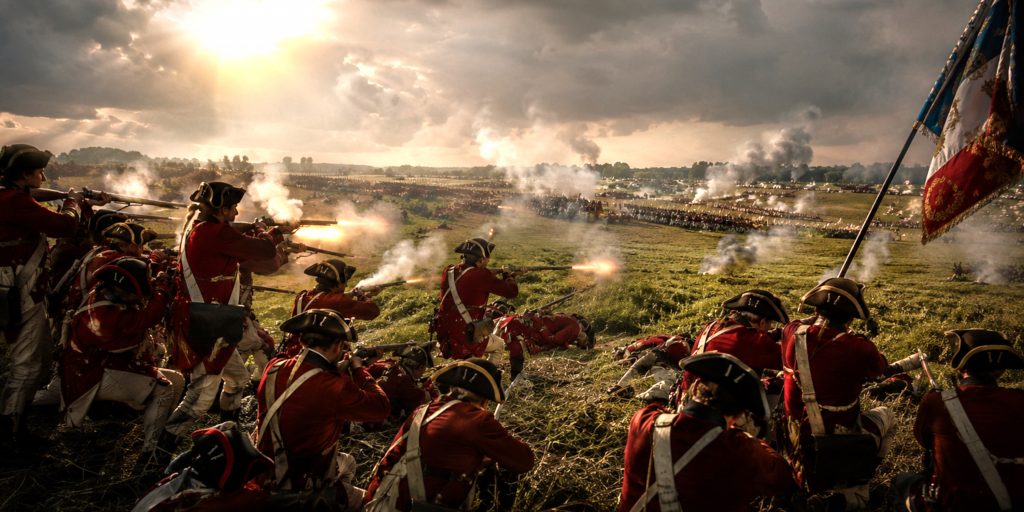
Fontenoy made Saxe immortal.
On 11 May 1745 an Allied army commanded by William Augustus, Duke of Cumberland, advanced against the French near Tournai in the Austrian Netherlands.
Saxe prepared his position carefully.
Fontenoy and Antoing anchored sections of the French line, while redoubts and artillery strengthened the approaches. Woods and villages restricted Allied manoeuvre.
The Allied army nevertheless launched a formidable attack.
British and Hanoverian infantry advanced in a large formation that penetrated the French position and created a genuine crisis. This is worth stressing because Fontenoy is sometimes presented as though Saxe simply constructed an impregnable position and watched Cumberland obligingly destroy his army against it.
The reality was considerably less comfortable.
French counterattacks initially failed. The Allied infantry maintained cohesion under severe fire and pushed deeply into Saxe’s position.
Saxe responded by coordinating infantry, cavalry and artillery against the increasingly isolated Allied formation. Guns were brought forward and fired into the Allied ranks while renewed attacks struck the column.
Eventually it withdrew.
French losses were severe, but Allied casualties were worse. The victory opened the way for further French successes in the Austrian Netherlands.
What impresses me most is Saxe’s behaviour during the crisis. He had prepared the battlefield extremely well, yet his plan still came close to failure. Great commanders are often judged by elegant plans. They should perhaps be judged more severely by what they do when those plans start falling apart.
Saxe remained composed.
The Wicker Carriage at Fontenoy
There is an almost theatrical detail to Fontenoy.
Saxe was seriously ill with dropsy, now generally associated with severe oedema, and was reportedly unable to remain mounted. He directed parts of the battle from a wicker carriage.
Contemporary and later representations made much of the image.
The National Army Museum in London holds an eighteenth-century print depicting Saxe being transported across the battlefield in his carriage.
It certainly contributes to the legend: the dying marshal, too ill to ride, calmly defeating an Allied army from what looks rather like an unusually aggressive garden chair.
Yet the underlying point is serious. Saxe was physically in poor condition and still retained enough mental clarity to manage a rapidly changing battle.
Rocoux, 1746
Saxe followed Fontenoy with another victory at Rocoux on 11 October 1746.
The battle demonstrated his ability to concentrate force against selected portions of an enemy position rather than attacking uniformly across an entire front.
French forces attacked the Allied left around a series of villages while pressure elsewhere prevented the opposing commanders from responding freely.
The Allies eventually withdrew.
Rocoux lacked Fontenoy’s dramatic reputation, but it confirmed that Fontenoy had not been a lucky accident.
Lauffeld, 1747
At Lauffeld in July 1747, Saxe again faced the Duke of Cumberland.
The battle centred on villages that repeatedly changed hands. Fighting became extremely severe, with French infantry making repeated assaults against Allied positions.
Saxe eventually achieved another victory, although the Allied army escaped destruction.
Lauffeld demonstrates both the strengths and limitations of eighteenth-century warfare. Winning the battlefield did not necessarily mean annihilating the enemy army.
Maurice could defeat Cumberland repeatedly. Destroying Cumberland’s army was another matter entirely.
The Conquest of the Austrian Netherlands
Individual battles can obscure Saxe’s larger achievement.
Between 1745 and 1748, French forces under his direction captured much of the Austrian Netherlands.
Tournai, Brussels, Antwerp, Mons, Namur and other important positions fell during the campaigns.
This operational success is arguably more important than any individual victory. Saxe demonstrated that he could coordinate sieges, manoeuvres and battles across successive campaigning seasons.
A general who wins one spectacular battle may have enjoyed favourable circumstances. A commander who repeatedly outmanoeuvres his opponents across several years deserves rather more attention.
Mes Rêveries and Saxe as a Military Thinker
Saxe wrote Mes Rêveries in the 1730s, although it was published after his death.
The work ranges widely across military organisation, recruitment, discipline, fortification, tactics, clothing, physical fitness and command.
Some ideas were eccentric. Others were strikingly perceptive.
Saxe opposed excessive dependence upon drill and mechanical obedience. He believed military institutions had to account for human behaviour.
He also thought carefully about recruitment. He was interested in systems that could provide trained manpower without exhausting the population through conventional conscription.
His ideas later attracted the attention of military thinkers because they combined theoretical speculation with substantial campaigning experience.
He was not writing warfare from an armchair.
He had spent much of his life discovering precisely how uncomfortable campaigning could be.
Leadership Style
Maurice possessed charisma, confidence and an ability to inspire troops.
He was also ambitious, extravagant and hardly a model of restrained eighteenth-century virtue.
His private life generated numerous stories, some better documented than others. He had several relationships and illegitimate children. His daughter Marie-Aurore de Saxe became the grandmother of the novelist George Sand.
Yet Saxe’s personal excesses should not distract from his professionalism as a commander.
He studied military problems intensely.
That combination is rather characteristic of the period. Enlightenment rationalism and aristocratic extravagance could inhabit the same person without apparently finding the arrangement troublesome.
Château de Chambord
Following his successes, Louis XV rewarded Maurice handsomely.
He was granted the use of the Château de Chambord in 1745.
Chambord became his principal residence and an expression of his extraordinary social elevation. The illegitimate Saxon adventurer who had once failed to secure Courland was now occupying one of the greatest royal châteaux in France.
He maintained a substantial household there and continued to cultivate military, theatrical and social interests.
Chambord therefore offers one of the strongest surviving physical connections with Maurice de Saxe.
Death
Maurice died at Chambord on 20 November 1750, aged only 54.
The precise medical explanations offered for his death have varied, although his health had clearly been poor for some time.
Because he was a Protestant, burial within the traditional royal Catholic environment presented complications.
His remains were eventually placed in the Protestant Church of Saint-Thomas in Strasbourg.
There stands his remarkable funerary monument by Jean-Baptiste Pigalle, commissioned by Louis XV.
It is one of the most impressive military memorials of eighteenth-century France.
Where to See Artefacts and Places Connected with Maurice de Saxe
Château de Chambord, France
Chambord is essential for understanding Saxe’s later life.
Louis XV granted him the château following his military successes, and Maurice lived there until his death.
The building itself therefore functions as an artefact of royal favour and military prestige.
Church of Saint-Thomas, Strasbourg
Maurice’s monumental tomb by Pigalle can be seen here.
The sculpture presents the marshal descending towards death while allegorical figures surround him. It is grand, theatrical and unmistakably eighteenth century.
Saxe would probably have approved.
Musée Antoine Lécuyer, Saint-Quentin
Maurice Quentin de La Tour produced one of the most celebrated images of Saxe.
His 1747 portrait shows the marshal in armour. The French national collections database records the work as Le maréchal de Saxe en armure.
It is valuable because the armour is representational as much as practical. By the middle eighteenth century, depicting a commander armoured in a formal portrait evoked martial authority and heroic tradition rather than necessarily showing what he wore while commanding infantry and artillery in the field.
Fontenoy, Belgium
The battlefield remains accessible around modern Fontenoy near Antoing and Tournai.
Visiting it is useful because the geography makes Saxe’s defensive thinking easier to understand. The relationship between Fontenoy, Antoing, the woods and the Allied avenue of advance is far clearer on the ground than on many simplified battle maps.
Tournai Military History Museum
Tournai has preserved the memory of the 1745 siege and Battle of Fontenoy particularly strongly. Local exhibitions place the battle within the wider struggle for the fortified city.
National Army Museum, London
The museum’s collection includes an aquatint depicting Saxe in his wicker carriage at Fontenoy.
It is held in the study collection rather than necessarily being on permanent display, so checking current access arrangements before travelling specifically to see it would be sensible.
Royal Military Museum, Brussels
For anyone interested in the material culture of Saxe’s period rather than objects personally owned by him, the Royal Military Museum’s Arms and Armour collection is useful. Its displays trace European weapon development through the eighteenth century, including swords, firearms and armour.
Archaeology of Maurice de Saxe’s Battlefields
There is an important distinction to make when discussing the “latest archaeology” surrounding Maurice de Saxe.
There has not been a spectacular recent excavation producing something conveniently labelled “Maurice de Saxe’s sword”. Archaeological work relating to eighteenth-century battlefields tends instead to reconstruct combat through ammunition, military objects, landscape evidence and the archaeology of fortifications.
Fontenoy is particularly promising because the battlefield landscape remains identifiable.
Archaeological investigation of eighteenth-century battlefields can potentially recover:
- Musket balls and impacted lead projectiles
- Cannon shot and artillery fragments
- Buckles, buttons and uniform fittings
- Coins and personal possessions
- Weapon components
- Horseshoes and cavalry equipment
- Evidence of temporary defensive works
- Concentrations of projectiles indicating firing positions
- Material associated with camps and supply areas
The great value of such evidence is spatial.
A musket ball by itself tells us relatively little. Hundreds of projectiles plotted accurately across a landscape can reveal firing lines, zones of intense combat and potentially the movement of formations.
For Fontenoy, this matters enormously because historians continue to examine exactly how the Allied infantry advanced and how French counterattacks developed.
The surviving battlefield and the material collections at nearby Tournai therefore remain important areas for future research. Claims of dramatic new discoveries should be treated cautiously unless supported by archaeological publication. Battlefield metal detecting has produced enormous quantities of material across Europe, but objects without securely recorded locations lose much of their historical value.
That is the frustrating thing about battlefield archaeology: a rusty fragment recorded properly can be more useful than a beautiful sword pulled from the ground without context.
How Good Was Maurice de Saxe?
Very good indeed, although not infallible.
His strongest claim to greatness comes from the combination of battlefield command and operational success between 1744 and 1748.
Fontenoy demonstrated defensive preparation and crisis management.
Rocoux demonstrated concentration against a selected part of an enemy position.
Lauffeld demonstrated persistence and tactical control during confused fighting.
The conquest of much of the Austrian Netherlands demonstrated something broader: Saxe could sustain successful operations across multiple campaigning seasons.
He also understood soldiers.
That may have been his greatest intellectual advantage.
Saxe recognised that military effectiveness depended upon health, morale, training, confidence and leadership as much as weapons or mathematical formations. His writings occasionally wander into speculation, but the central philosophy is remarkably practical.
War was a human activity.
Was Maurice de Saxe Ahead of His Time?
In certain respects, yes.
It would be misleading to turn him into a proto-Napoleon. Saxe belonged thoroughly to the military world of Louis XV. He commanded dynastic armies dependent upon magazines, formal sieges, professional officers and eighteenth-century political objectives.
Yet several aspects of his thinking point forward.
His concern with mobility anticipated later operational thinking. His emphasis on morale and physical conditioning challenged overly mechanical conceptions of soldiers. His willingness to combine field fortifications, artillery, infantry and cavalry according to circumstances demonstrated tactical flexibility.
Perhaps most importantly, he understood that doctrine should serve circumstances rather than dictate them.
That remains fairly good advice.
Legacy
Louis XV promoted Saxe to the exceptional dignity of Marshal General of the King’s camps and armies.
Only a tiny number of French commanders ever held equivalent status.
His victories restored French military prestige during a period when France’s strategic position was often more complicated than battlefield triumphs suggest. The eventual Treaty of Aix-la-Chapelle in 1748 returned many French conquests, producing understandable frustration among those who had fought to obtain them.
Saxe had conquered much of the Austrian Netherlands.
Diplomats proceeded to give much of it back.
Soldiers have been complaining about diplomats ever since someone first invented a negotiating table.
His deeper legacy lies in Mes Rêveries. Later military writers studied his thoughts on tactics, morale, organisation and training, while Fontenoy became one of the canonical battles of eighteenth-century European warfare.
Maurice de Saxe deserves to be remembered as more than the colourful marshal in the wicker carriage. He was a thoughtful and highly experienced commander who understood both the technical and psychological dimensions of warfare.
There were more systematic military theorists and more transformative generals after him. Few combined battlefield success, intellectual curiosity and sheer personality quite so effectively.
Maurice de Saxe: Key Facts
| Detail | Information |
| Full name | Maurice, Count of Saxony |
| German name | Hermann Moritz Graf von Sachsen |
| Born | 28 October 1696 |
| Birthplace | Goslar, Holy Roman Empire |
| Father | Augustus II the Strong |
| Mother | Maria Aurora von Königsmarck |
| Principal allegiance | France |
| Rank | Marshal General of France |
| Famous victory | Fontenoy, 1745 |
| Other major victories | Rocoux and Lauffeld |
| Military work | Mes Rêveries |
| Residence | Château de Chambord |
| Died | 20 November 1750 |
| Age | 54 |
| Burial | Church of Saint-Thomas, Strasbourg |