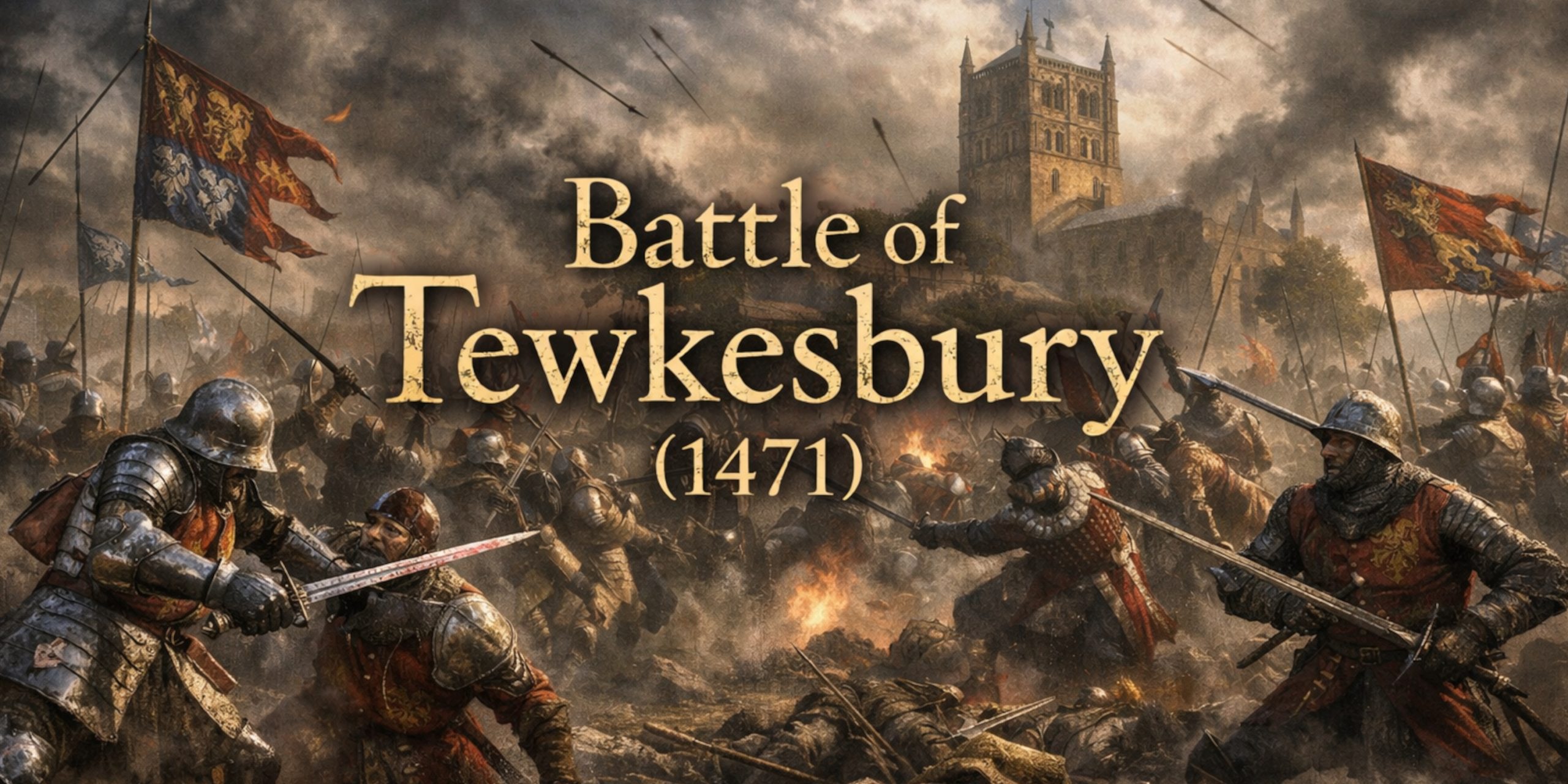
The Battle of Tewkesbury, fought on 4 May 1471, was one of the most important and brutal clashes of the Wars of the Roses. It did not merely decide who held the throne for the next few years. It effectively destroyed the Lancastrian cause in a single afternoon.
When the dust settled outside the Gloucestershire town of Tewkesbury, the Lancastrian army had been smashed, Prince Edward of Westminster was dead, and Queen Margaret of Anjou had been captured. Within days, Henry VI was back in Yorkist hands and soon afterwards died in the Tower of London. The House of Lancaster, already wobbling like a knight who had enjoyed too much ale before the melee, had finally collapsed.
For Edward IV, Tewkesbury was the battle that secured his throne. For historians, it remains one of the clearest examples of how leadership, discipline and terrain could decide a medieval battle.
Background
The battle came after one of the most chaotic years of the Wars of the Roses. In 1470, Edward IV had been driven from England by the Earl of Warwick, the famous “Kingmaker”. Warwick restored Henry VI to the throne, despite the slight inconvenience that Henry was an ineffective ruler and looked permanently bewildered by the entire business of kingship.
Edward returned from exile in early 1471. In April he defeated and killed Warwick at the Battle of Barnet. Yet the war was not over.
On the very day that Warwick fell, Queen Margaret of Anjou landed in the south-west with her son, Prince Edward. She hoped to unite with remaining Lancastrian forces in Wales and western England. Edward IV moved quickly to stop them.
The Lancastrians marched north through Gloucestershire, trying to cross the River Severn before the Yorkists could catch them. They failed to secure the bridge at Gloucester and eventually halted near Tewkesbury. There, exhausted and trapped, they were forced to fight.
Why Tewkesbury Was So Important
Tewkesbury was not the largest battle of the Wars of the Roses, but it was arguably the most decisive.
Before the battle:
- Henry VI was still alive.
- Prince Edward of Westminster remained the Lancastrian heir.
- Queen Margaret was still free.
- Many powerful Lancastrian nobles remained in arms.
After the battle:
- Prince Edward was dead.
- Queen Margaret was captured.
- The leading Lancastrian nobles had been killed or executed.
- Henry VI became politically useless and soon died.
The Lancastrian dynasty did not recover.
Forces
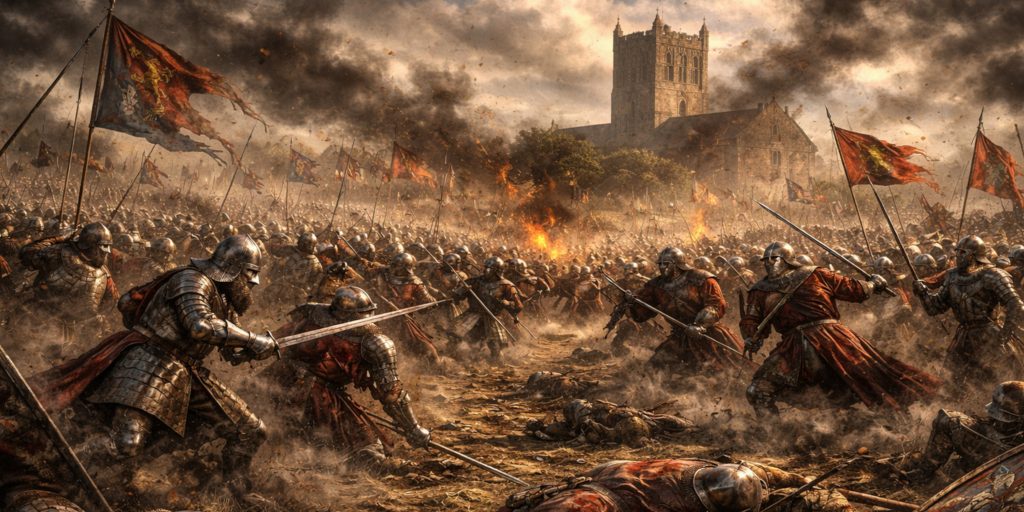
The exact numbers are uncertain, but most historians believe the two armies were relatively close in size.
| Army | Estimated Strength | Commander |
|---|---|---|
| Yorkist Army | 5,000 to 6,000 men | Edward IV |
| Lancastrian Army | 4,500 to 6,000 men | Edmund Beaufort, Duke of Somerset |
The Lancastrians had marched hard for days and were exhausted before the battle began. Edward IV’s men were fresher, better organised and more confident after their victory at Barnet.
Leaders and Troop Composition
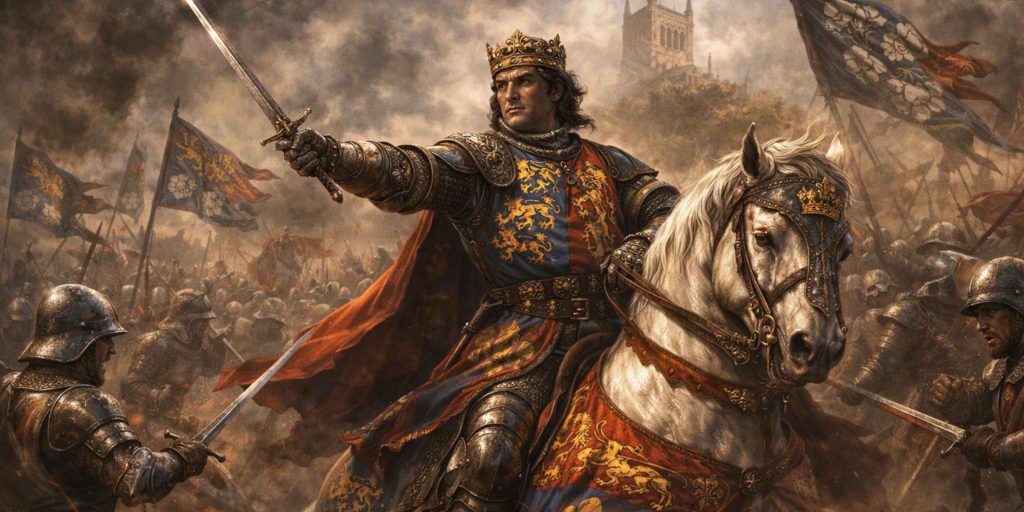
Yorkist Commanders
| Commander | Role |
| Edward IV | Commander of the army and centre division |
| Richard, Duke of Gloucester | Led one wing, later Richard III |
| William Hastings | Senior Yorkist commander |
Lancastrian Commanders
| Commander | Role |
| Edmund Beaufort, Duke of Somerset | Main field commander |
| John Wenlock, Baron Wenlock | Senior Lancastrian noble |
| Prince Edward of Westminster | Lancastrian heir, present with the army |
| Queen Margaret of Anjou | Accompanied the army, though not on the battlefield |
Troop Composition
Yorkist Army
- Men-at-arms in plate armour
- Retainers of the great northern and midland nobles
- Longbowmen
- Billmen
- Mounted knights and household cavalry held in reserve
- Artillery, probably small field guns
Lancastrian Army
- Noble retainers and household troops
- Welsh and western levies
- Longbowmen and billmen
- Men-at-arms in heavy armour
- A small number of handguns and artillery pieces
The Yorkist army was more cohesive. The Lancastrians contained a mixture of tired troops and local reinforcements who had only recently joined.
The Battlefield
The battle took place south of Tewkesbury, near a ridge called Gastons and a small stream known as the Swilgate.
The Lancastrians chose a defensive position with woods and marshy ground protecting their flanks. At first glance, it was a sensible choice. The trouble was that it left them with little room to manoeuvre. Somerset, their most aggressive commander, soon discovered that attacking from such a position is rather like trying to charge from the back seat of a cart.
The battlefield included:
- Open fields suitable for infantry combat
- Hedgerows and enclosed ground
- Small streams and marshes
- Woodland known as the Park and the Gastons
These features played a major role in the battle.
Battle Timeline
| Time | Event |
| Early Morning, 4 May 1471 | Lancastrian army forms defensive line near Tewkesbury |
| Around 9:00 AM | Edward IV arrives and deploys his army |
| Mid-Morning | Artillery and archery exchanges begin |
| Late Morning | Somerset launches a surprise attack on the Yorkist right |
| Shortly After | Yorkists counterattack and Somerset’s assault collapses |
| Midday | Lancastrian line begins to break |
| Early Afternoon | Prince Edward is killed and Lancastrian forces rout |
| Later That Day | Many Lancastrians flee into Tewkesbury Abbey seeking sanctuary |
The Course of the Battle
At the beginning of the battle, both armies exchanged arrows and artillery. The Yorkists advanced carefully. Edward IV avoided rushing forward blindly, which was probably wise given that medieval commanders who ignored terrain often ended up remembered mainly for how quickly everything went wrong.
Somerset attempted the decisive move. He led a force through concealed ground on the Lancastrian right and struck at the Yorkist flank. Initially the attack had some success. Richard, Duke of Gloucester’s division was pressed hard.
However, the attack lacked support. Somerset expected John Wenlock to reinforce him. Wenlock did not move.
Whether through confusion, fear or simple incompetence is still debated. Medieval chroniclers claimed Somerset was so furious that he rode back and killed Wenlock with an axe. It is one of those stories that sounds almost too dramatic to be true, which unfortunately means it was probably perfectly suited to the Wars of the Roses.
The Yorkists quickly exploited the confusion. Edward IV committed reserves hidden in nearby woodland. Somerset’s men were attacked from the front and flank, then driven back into the main Lancastrian line.
The Lancastrian army collapsed.
As the line broke, hundreds of men were cut down while trying to flee across the fields and streams. Prince Edward of Westminster was killed during or immediately after the fighting. The exact circumstances remain uncertain. Some accounts claim he died in battle. Others say he was captured and executed.
Either way, the Lancastrian heir was gone.
Arms and Armour
The Battle of Tewkesbury was fought during the late medieval period, when English armies were equipped with a mixture of advanced plate armour and traditional infantry weapons.
Typical Weapons Used
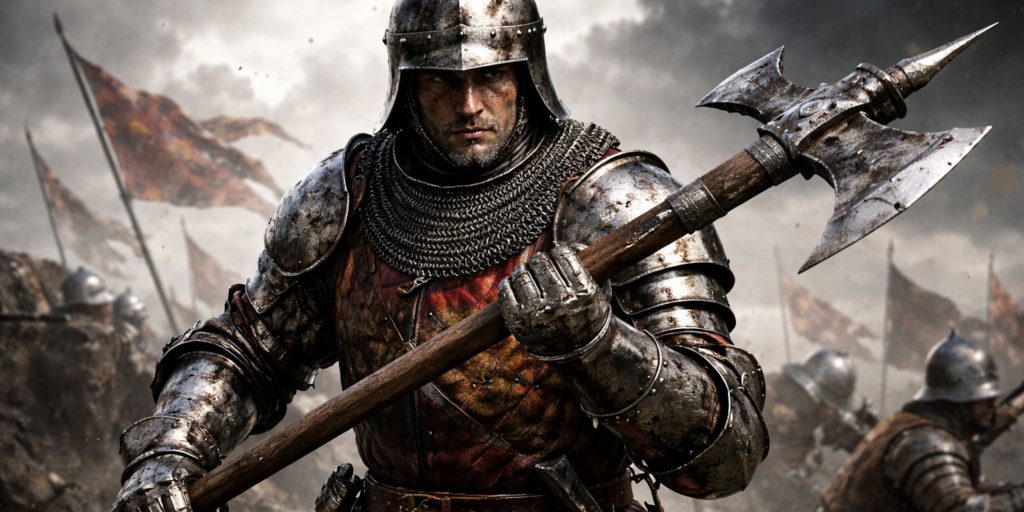
| Weapon | Used By | Notes |
| Longbow | Both armies | Still one of the deadliest battlefield weapons in England |
| Bill | Both armies | The standard infantry polearm of English armies |
| Poleaxe | Men-at-arms and nobles | Used in close combat against armoured opponents |
| Spear and Lance | Mounted men-at-arms | Mainly for cavalry and dismounted retainers |
| Handgun | Some troops | Early firearms, rare but increasingly common |
| Dagger | All ranks | Used in close combat and after a foe was brought down |
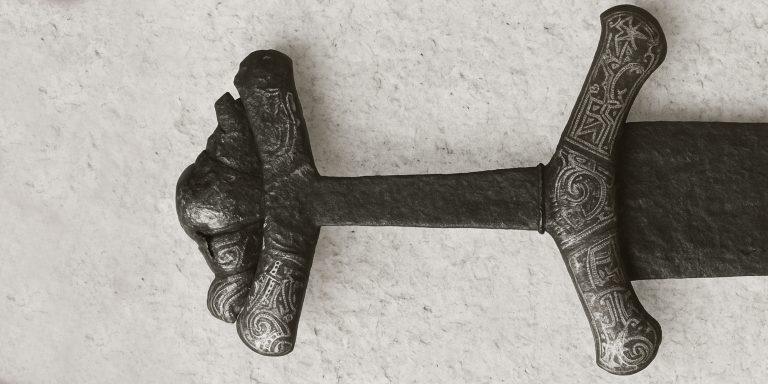
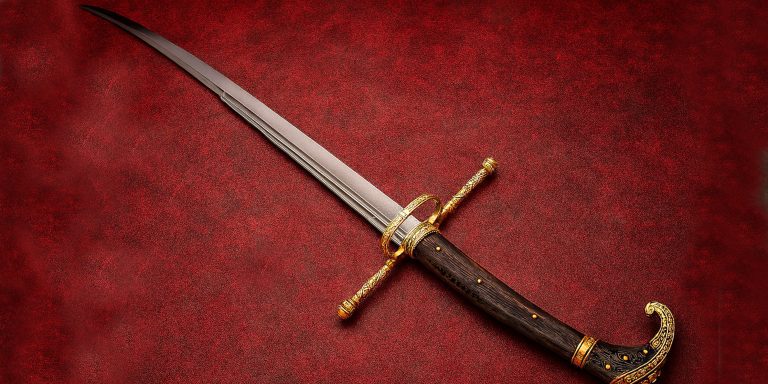
Sword Types Present at Tewkesbury
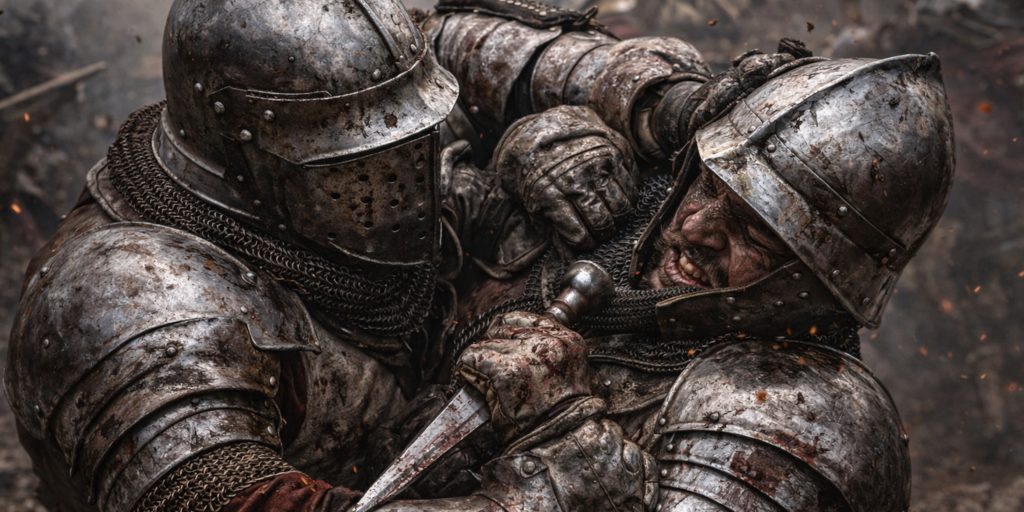
Several forms of late medieval sword were likely used:
- Arming swords, worn by ordinary men-at-arms
- Hand-and-a-half swords, sometimes called bastard swords
- Longer war swords carried by knights and nobles
- Falchions and messers among some infantry and retainers
The most likely Oakeshott types present include:
| Sword Type | Description |
| Type XV | Strongly tapered thrusting sword suited to piercing armour gaps |
| Type XVIII | Elegant but deadly hand-and-a-half sword common in the late 15th century |
| Type XX | Longer two-handed weapon used by wealthier men-at-arms |
Armour
By 1471, wealthy soldiers wore sophisticated plate armour.
- Full plate harness for nobles and leading men-at-arms
- Sallet and bevor helmets
- Brigandines worn by lesser troops
- Mail protecting joints and vulnerable areas
- Padded jacks for poorer infantry
A fully armoured knight at Tewkesbury looked formidable. He also weighed enough that if he slipped into one of the marshes, extracting him would have required either several loyal retainers or a team of very patient oxen.
Casualties
| Side | Estimated Losses |
| Yorkists | Around 500 |
| Lancastrians | 2,000 to 3,000 |
Many Lancastrian nobles died, including:
- Edmund Beaufort, Duke of Somerset
- John Courtenay, Earl of Devon
- John Langstrother, Prior of St John
Several leading Lancastrians who fled into Tewkesbury Abbey were dragged out and later executed.
Aftermath
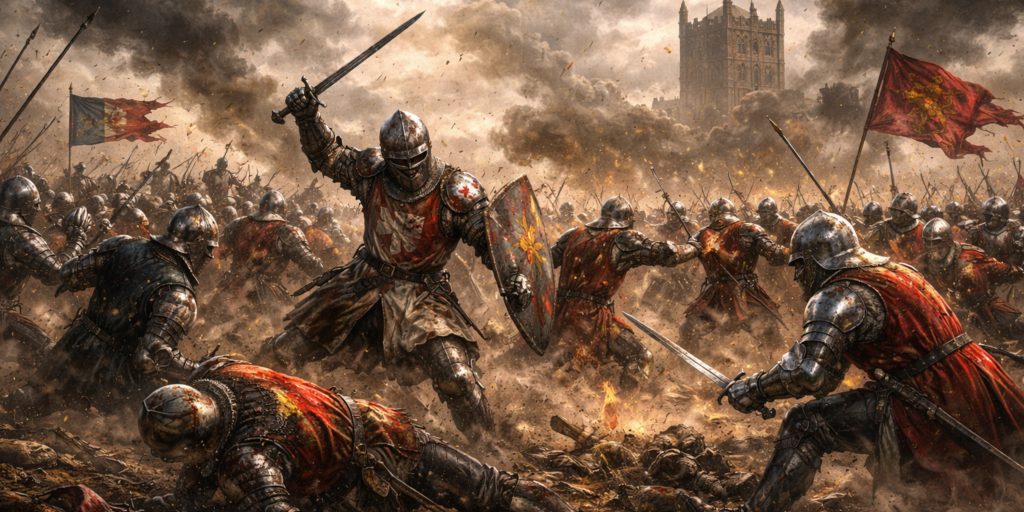
The consequences of Tewkesbury were enormous.
Queen Margaret was captured soon after the battle. Prince Edward was dead. Henry VI, left without an heir or supporters, was imprisoned again in the Tower of London.
On 21 May 1471, Henry VI died. Most historians believe he was murdered on Edward IV’s orders, though the king naturally denied any involvement. Medieval kings were often wonderfully innocent when unpleasant things happened to their enemies.
Edward IV now ruled England securely for more than a decade.
Tewkesbury therefore marks the end of the main phase of the Wars of the Roses. There would still be later rebellions and the eventual rise of the Tudors, but the Lancastrian cause never again posed a serious threat.
Archaeology
Archaeological work around Tewkesbury has revealed a surprising amount about the battle.
Finds from the battlefield include:
- Arrowheads
- Lead shot from early handguns
- Fragments of armour and horse equipment
- Medieval buckles and harness fittings
Metal detecting surveys have helped confirm the approximate position of parts of the battle, especially around the meadow and marshland south of the town.
Modern historians increasingly believe that the decisive fighting took place across a wider area than once thought. The battlefield was not a single neat line. It was a confused and chaotic struggle spread across fields, woodland and streams.
The nearby abbey also preserves traces of the battle’s aftermath. Tewkesbury Abbey became a place of sanctuary for fleeing Lancastrians. Some of those seeking refuge survived. Others discovered that sanctuary in medieval England could occasionally be interpreted rather creatively.
Contemporary Quotes
“The most deadliest battle that ever was fought in England.”
Attributed to a contemporary chronicler describing Tewkesbury
“Prince Edward was taken fleeing and slain in the field.”
From the Yorkist chronicler Edward Hall
“The Duke of Somerset, seeing his enterprise fail, fell into great fury.”
From later accounts of the battle
These sources are not entirely reliable. Medieval chroniclers were often fiercely partisan and quite capable of turning a battle into something halfway between a history book and an exceptionally dramatic tavern story.
Where to Visit Today
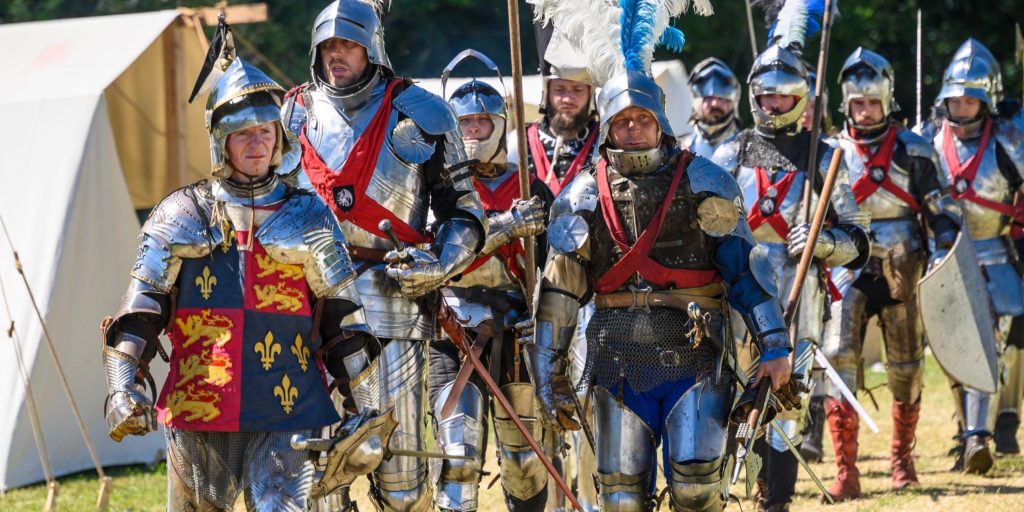
Visitors can still explore much of the battlefield and the town as well as Battle Re-Enactments.
Important sites include:
- Tewkesbury Abbey
- The battlefield interpretation area
- Gastons Meadow
- The Bloody Meadow, where many Lancastrians were killed during the rout
Tewkesbury Abbey remains one of the finest medieval churches in England and contains memorials connected to the battle. Standing inside it, it is difficult not to think about the men who fled there in terror after the fighting. The abbey offered silence and shelter, though in 1471 it turned out to be rather less secure than advertised.
Takeaway
The Battle of Tewkesbury was the final destruction of Lancastrian hopes. It combined clever Yorkist leadership, poor Lancastrian coordination and a battlefield that punished mistakes mercilessly.
Edward IV emerged victorious and secure. Prince Edward died. Margaret of Anjou lost everything. The Lancastrian cause, already battered and exhausted, ended in the muddy fields outside Tewkesbury.
Few battles of the Wars of the Roses had consequences as immediate or as dramatic. Tewkesbury did not simply change the war. It ended one side of it completely.t just a victory, it was a reckoning.
Watch the documentary:
The Tewkesbury Medieval Festival is one of Europes biggest re-enactment festivals with battles, activities and crafts.