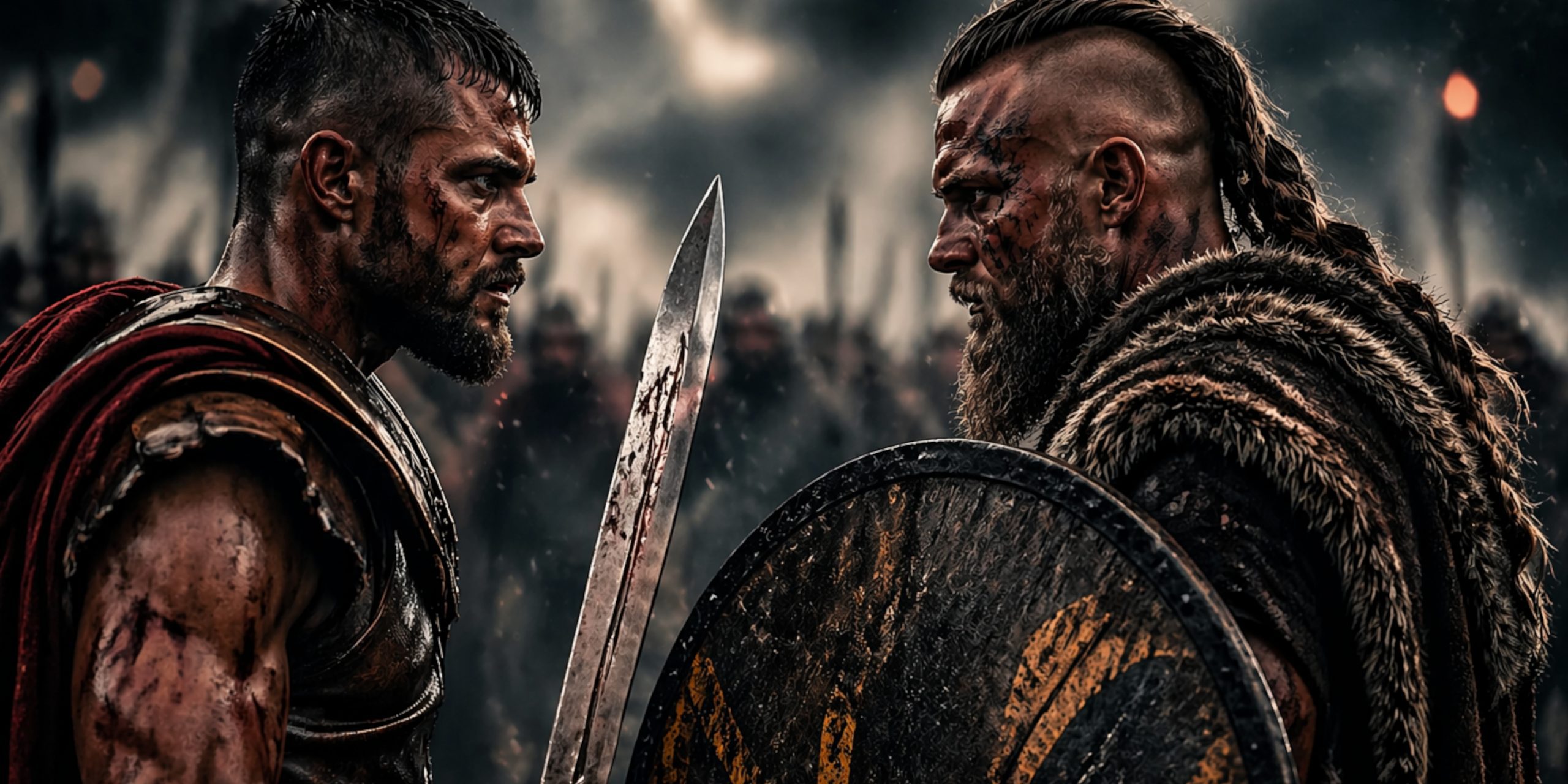
If television had a hall of fame for people getting dramatically stabbed while shouting about destiny, freedom, or Odin, these two shows would be standing front and centre.
Spartacus and Vikings arrived with very different ideas about history. One went all-in on blood-soaked spectacle, sharpened abs, and enough slow-motion violence to make a Roman senator faint into his wine. The other took a moodier route, mixing mud, politics, Norse myth and long, meaningful stares into the middle distance.
Yet both became massive hits because they understood the same thing. History is fun, but history with betrayal, giant battles, questionable life choices and people yelling before charging into combat is even better.
So which series does it better? Which has the stronger characters, the more memorable battles, the better mythology, and the greater ability to make you immediately want to buy a sword you absolutely do not need?
Let us settle this like civilised people, by comparing them in several highly opinionated categories.
What Each Show Is Actually About

At first glance, these series seem wildly different.
Spartacus follows the Thracian gladiator Spartacus, who is enslaved by Rome and eventually leads a massive slave revolt against the Roman Republic. The show begins in the arena and gradually expands into a full-scale war story involving rebel armies, Roman politics and enough backstabbing to make Julius Caesar look over his shoulder.
Vikings starts with Ragnar Lothbrok, a farmer and raider who becomes obsessed with exploring west across the sea. From there, the show grows into a sprawling saga covering raids, kings, England, Paris, family feuds, and the rather awkward reality that most Viking succession plans involved murdering your relatives.
The key difference is scale.
Spartacus is tighter, louder and more focused. It knows exactly where it is going and charges toward it with the enthusiasm of a gladiator holding two swords and several unresolved issues.
Vikings is broader. It covers years, generations and entire kingdoms. Sometimes that makes it richer. Sometimes it means you spend an episode watching somebody stare at a fjord while quietly having an existential crisis.

Which Show Has the Better Main Character?
This is unfairly difficult.
Spartacus is driven by rage, grief and the stubborn refusal to stay dead when Rome really wishes he would. He is straightforward in the best way. You always know what he wants. Freedom. Revenge. Less Romans.
There is something deeply satisfying about a protagonist who enters almost every situation with the energy of “I have had enough of this nonsense.”
Ragnar Lothbrok, meanwhile, is more complicated. He is charismatic, strange, clever, funny, occasionally terrifying and often impossible to understand. One moment he is making a brilliant strategic decision. The next he is grinning at somebody in a very unsettling way and saying something cryptic about fate.
Ragnar feels more layered. Spartacus feels more iconic.
If you want a hero to follow into battle, Spartacus probably wins. If you want a character who keeps surprising you, Ragnar has the edge.
Supporting Cast: Gladiators vs Norse Legends
This is where both shows become dangerously good.
Spartacus has one of the strongest supporting casts in television. Crixus, Gannicus, Oenomaus, Batiatus, Lucretia and Ashur all feel larger than life.
Batiatus in particular is an all-time great TV villain. He is smug, petty, ambitious and somehow capable of making every sentence sound like a Shakespearean insult wrapped in a threat. Watching him argue with people is half the fun of the series.
Then there is Gannicus, who somehow manages to swagger through the show with the confidence of a man who has never once considered the possibility of consequences.
Vikings counters with Lagertha, Floki, Bjorn, Rollo and Ivar the Boneless.
Lagertha may quietly be the best character in the entire series. She is fierce, intelligent and seems permanently exhausted by the stupidity of the men around her. Honestly, fair enough.
Floki brings chaos. Rollo brings betrayal. Ivar brings the kind of deeply unhinged energy that makes every family dinner feel like a hostage situation.
Spartacus probably has the more consistently entertaining cast. Vikings has the more emotionally complicated one.
The Violence: Stylised Madness vs Muddy Brutality
Neither of these shows could ever be accused of subtlety.
Spartacus treats violence like an art form. Limbs fly through the air. Blood explodes across the screen in quantities that suggest every Roman contained roughly fifty litres of it. Battles are filmed with extreme slow motion, dramatic music and enough theatrical flair to make you briefly forget how ridiculous it all is.
And somehow, against all odds, it works.
The show knows it is exaggerated. It leans into it. Every fight feels like a graphic novel has come to life after drinking three cups of very strong coffee.
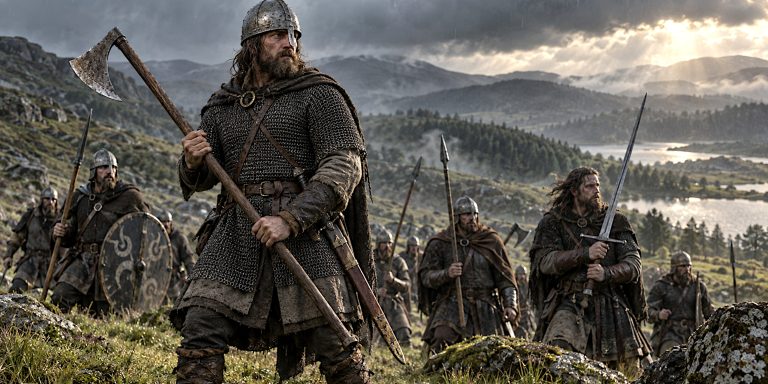
Vikings goes the other way. Its battles are raw, muddy and messy. People get tired. Shields splinter. Axes hit with horrifying force. You can practically smell the damp leather and poor life choices.
The fight scenes in Vikings often feel more believable. The ones in Spartacus feel more unforgettable.
Your favourite will probably depend on whether you want your historical violence served like prestige drama or like a heavy metal album cover.
Which Series Is More Historically Accurate?
This is the awkward category because neither show exactly treats history like a sacred document.
Spartacus plays very loosely with events, timelines and historical figures. Julius Caesar turns up looking far younger than he should. Characters meet people they almost certainly never met. Some events are compressed or completely invented.
Still, the broad outline of the slave revolt is real. Spartacus did escape, did build a huge rebel force, and did terrify Rome.
Vikings has even more freedom with history. Ragnar Lothbrok himself may not have existed in the way the show presents him. Events that happened decades apart are often pushed together. Characters from different eras somehow end up sharing scenes, which would have been quite surprising for them.
That said, Vikings often captures the feeling of the Viking world better. The ships, clothing, social structure and pagan beliefs generally feel grounded, even when the story is not.
If you want historical accuracy, neither show should be your first stop. A good documentary is probably safer. If you want history filtered through drama, myth and several gallons of fake blood, you are in exactly the right place.
Myth and Religion

This is where Vikings really separates itself.
Religion is everywhere in the series. Odin, the gods, visions, prophecies and the clash between paganism and Christianity shape almost every character. The show loves ambiguity. Did the gods actually intervene, or are the characters simply seeing what they want to see?
That uncertainty gives Vikings a strange, dreamlike quality. Some scenes feel less like history and more like somebody recounting a legend around a fire while dramatically poking at the flames.
Spartacus has mythology too, but in a different way. Rome itself becomes the myth. The arena, the gladiators, the rebellion and the idea of freedom are all turned into something larger than life.
The show is not interested in gods. It is interested in people becoming symbols.
Spartacus starts as a man. By the end, he feels like a story people would whisper about generations later.
Which Show Has the Better Battles?

Spartacus has the bigger individual moments.
The gladiator rebellion, the arena fights and the final confrontations are ridiculously entertaining. The battles are designed to make you leap off the sofa and immediately regret trusting any Roman politician.
Vikings has the stronger campaigns.
The raids on England, the attack on Paris and the civil wars in Scandinavia give the series more room to build tension. The battle scenes feel more tactical. Shield walls matter. Terrain matters. Somebody usually makes a terrible decision involving a river.
If you want spectacle, go with Spartacus.
If you want atmosphere and strategy, Vikings wins.

The Style Question
These shows look completely different.
Spartacus is bright, loud and theatrical. It looks like somebody took ancient Rome, poured red paint over everything and then asked, “What if this was also a rock concert?”
Some people bounce off that style immediately. Others fall in love with it within ten minutes.
Vikings is colder and more restrained. Grey skies, dark forests, flickering firelight and lots of meaningful silence. It wants to feel ancient and harsh.
Watching Spartacus feels like stepping into a fever dream.
Watching Vikings feels like waking up in a freezing longhouse and realising somebody has handed you an axe and a complicated inheritance dispute.
So, Which One Is Better?
Annoyingly, the answer depends on what you want.
Choose Spartacus if you want:
- Huge personalities
- Wild action scenes
- Endless quotable dialogue
- A story with a clear beginning, middle and end
- The television equivalent of being hit in the face by a flaming chariot
Choose Vikings if you want:
- Slower, richer storytelling
- More historical atmosphere
- Complex characters
- Myth, religion and politics
- Several seasons of people making increasingly disastrous family decisions
Personally, Spartacus is probably the more entertaining show. It never forgets to have fun. Even at its most tragic, it still feels alive, energetic and just slightly ridiculous in the best possible way.
But Vikings stays with you longer. Its best moments have a strange melancholy to them. You remember the battles, but you also remember the silence before them.
In the end, this is not really a contest between gladiators and Vikings.
It is a contest between two different ways of telling history. One says history should roar. The other says it should whisper, then hit you with an axe.
Honestly, there is room for both.
Final Verdict
If you have never watched either show, start with Spartacus if you want immediate chaos, brilliant villains and some of the most entertaining nonsense television has ever produced.
Start with Vikings if you want something moodier, stranger and a little more thoughtful.
Then, inevitably, watch both.
Because once you have seen gladiators plotting revolution and Vikings sailing toward England while muttering about fate, ordinary television suddenly feels painfully under-equipped.