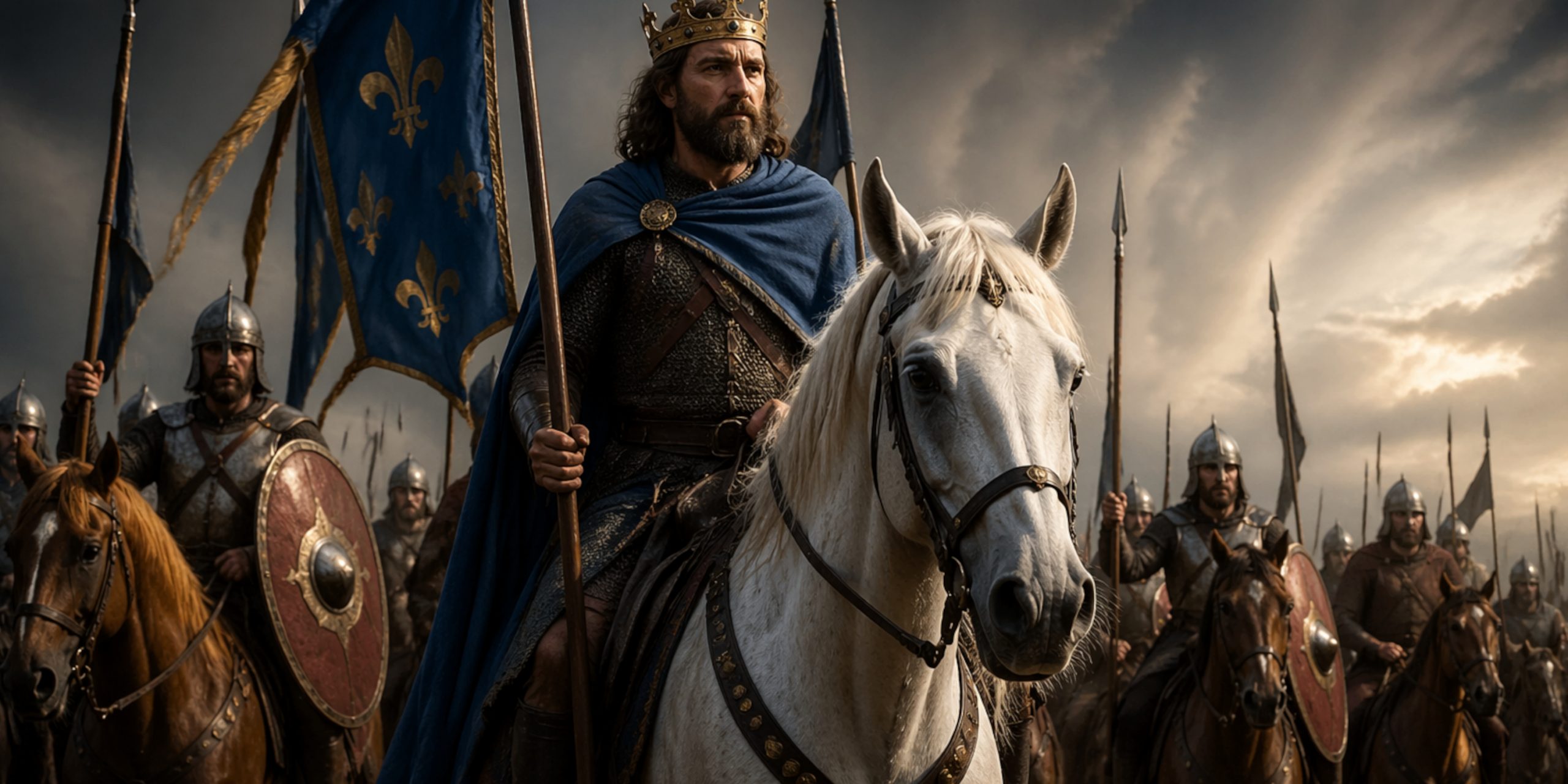
Clovis I remains one of the most important and elusive rulers of the early Middle Ages. He appears at the point where the old Roman world was falling apart and something new, rougher and far more unpredictable, was taking shape. By the time he died in 511, he had transformed a loose Frankish kingdom in northern Gaul into the strongest power in western Europe.
He did not do it through diplomacy, patient administration, or inspiring speeches. Clovis built his kingdom through calculated violence, careful alliances, ruthless opportunism and, when it suited him, a rather useful conversion to Christianity.
There is a temptation to see him as the first king of France. French kings certainly encouraged that idea later. In reality, Clovis belonged to a world that still looked more Germanic than French and more Roman than medieval. His court probably smelled of horses, smoke and wet wool. His kingdom was held together by personal loyalty and fear. Yet without him, the political map of western Europe would have looked very different.
Who Was Clovis I?
Clovis was born around 466, probably in what is now Belgium or northern France. He was the son of Childeric I, a Frankish king who ruled the Salian Franks from Tournai. When Childeric died in about 481, Clovis inherited his father’s position while still a young man.
The world he inherited was deeply unstable. Roman rule in western Europe had collapsed only a few years earlier. Gaul was divided between rival Frankish groups, surviving Roman commanders, Visigoths, Burgundians and Alamanni. Almost everyone claimed to be in charge of something. Most of them were carrying swords while doing it.
Clovis quickly emerged as the most ambitious and dangerous of these rulers. Over the next thirty years he defeated rival Frankish kings, crushed Roman enclaves, conquered much of Gaul and established the Merovingian dynasty.
Clovis and the End of Roman Gaul
One of Clovis’s first major victories came in 486 at the Battle of Soissons. There he defeated Syagrius, the last major Roman ruler in northern Gaul.
Syagrius had maintained a fragment of Roman authority after the fall of the Western Roman Empire. To Roman writers he may have seemed like the last guardian of civilisation. To Clovis he looked more like a convenient obstacle.
The defeat of Syagrius ended the last independent Roman state in Gaul. Clovis seized Soissons and expanded southward. In practical terms, this was the moment when northern Gaul stopped being Roman and became Frankish.
The chronicler Gregory of Tours later described how Clovis acquired the famous Vase of Soissons after this campaign. The story is probably partly legendary, but it captures his character perfectly. A Frankish warrior damaged a valuable church vessel against the king’s wishes. Clovis waited an entire year before publicly killing him with an axe during a military inspection. Clovis had many qualities. Forgiveness was not one of them.
The Conversion of Clovis
Perhaps the most important moment of Clovis’s reign came not on a battlefield, but in a church.
Around 496, after defeating the Alamanni, Clovis converted to Nicene Christianity. According to Gregory of Tours, he had promised to convert if the Christian God granted him victory.
His wife, Clotilde, had long urged him to abandon his pagan beliefs. Clovis resisted for years. One suspects that he found the old gods more straightforward. They demanded sacrifices and courage. Bishops demanded meetings.
Yet Clovis eventually recognised the political value of conversion. Most Germanic kings in western Europe at the time followed Arian Christianity, which many Roman Christians considered heretical. By converting to Nicene Christianity, Clovis aligned himself with the Roman population of Gaul and gained the support of powerful bishops.
His baptism, probably at Reims, became one of the foundational myths of French history.
Gregory of Tours claimed that the bishop told him:
“Bow your head, Sicambrian. Worship what you have burned, and burn what you have worshipped.”
Whether those exact words were spoken is impossible to know. Medieval chroniclers had a weakness for dramatic speeches. Still, the message mattered. Clovis was presenting himself not simply as a conqueror, but as the chosen ruler of a Christian kingdom.
Clovis’s Battles and Military Acumen
Clovis was not merely fortunate. He was an unusually skilled military leader who understood timing, alliance-building and intimidation.
He rarely fought fair, which is usually a sign of intelligence rather than weakness.
Battle of Soissons, 486
Opponent: Syagrius and the last Roman forces in Gaul
Result: Frankish victory
This battle gave Clovis control of northern Gaul. He moved quickly against Syagrius before his enemies could unite. The campaign shows one of Clovis’s greatest strengths: he understood that speed often mattered more than numbers.
Battle of Tolbiac, c. 496
Opponent: The Alamanni
Result: Frankish victory
Tolbiac was one of Clovis’s hardest battles. According to later accounts, the Franks were close to defeat before Clovis prayed to the Christian God.
Whatever the truth of the story, the battle was decisive. The Alamanni were defeated and Frankish influence expanded eastward.
Tolbiac also reveals Clovis’s talent for turning military success into political advantage. A lesser king might simply have celebrated the victory. Clovis used it to reinvent himself as a Christian ruler.
War Against the Burgundians
Clovis intervened in Burgundian politics in the early sixth century, supporting one claimant against another and using the resulting confusion to expand his influence.
This was classic Clovis. He often preferred to divide enemies rather than confront them directly. His campaigns combined diplomacy, intimidation and sudden violence. One gets the impression that Clovis viewed treaties as useful temporary pauses between wars.
Battle of Vouillé, 507
Opponent: The Visigoths under Alaric II
Result: Frankish victory
The Battle of Vouillé was Clovis’s greatest triumph.
The Visigoths ruled much of southern Gaul and were the most powerful rival kingdom in western Europe. Clovis invaded their territory and defeated them near Poitiers.
Alaric II was killed during the battle, perhaps by Clovis himself according to later tradition.
The victory gave Clovis control of most of Gaul and shattered Visigothic power north of the Pyrenees.
This campaign shows Clovis at his best. He prepared carefully, secured support from the eastern Roman Empire, and struck at the moment when the Visigoths were politically vulnerable.
How Clovis Fought
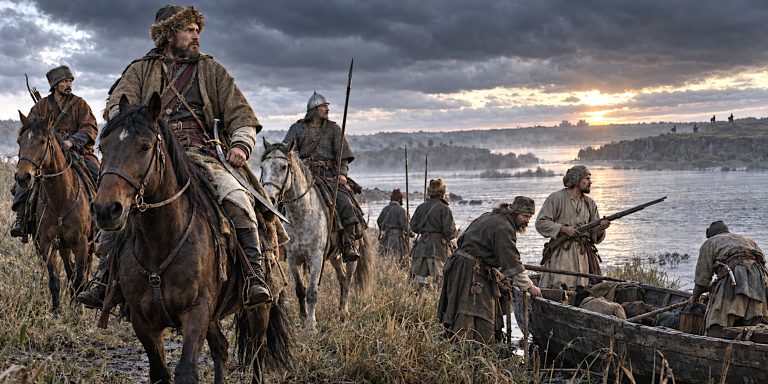
Clovis’s armies were typical of the early Franks. They were built around warbands of loyal warriors rather than a permanent standing army.
Frankish warfare relied on:
- Aggressive infantry attacks
- Heavy use of throwing axes and spears
- Personal loyalty between king and followers
- Shock tactics and close combat
- Sudden campaigns designed to overwhelm opponents quickly
Clovis also understood the importance of removing rivals. After conquering other Frankish rulers, he frequently had them killed, along with any inconvenient relatives. Gregory of Tours records these episodes with a kind of horrified fascination.
At one point Clovis is supposed to have lamented that he had no family left around him. This was technically true, although largely because he had arranged matters that way himself.
Arms and Armour
The Frankish warriors who followed Clovis were heavily armed by the standards of the late fifth century. Many combined Roman military traditions with Germanic weapons and styles.
Weapons Used by Clovis and the Franks
The Francisca
The most famous Frankish weapon was the francisca, a short throwing axe with a curved head.
Frankish warriors hurled these axes just before charging. The weapon could shatter shields, injure opponents and throw enemy formations into confusion.
Roman and Byzantine writers were impressed by the francisca. It was one of the defining weapons of Frankish warfare.
Spatha Swords
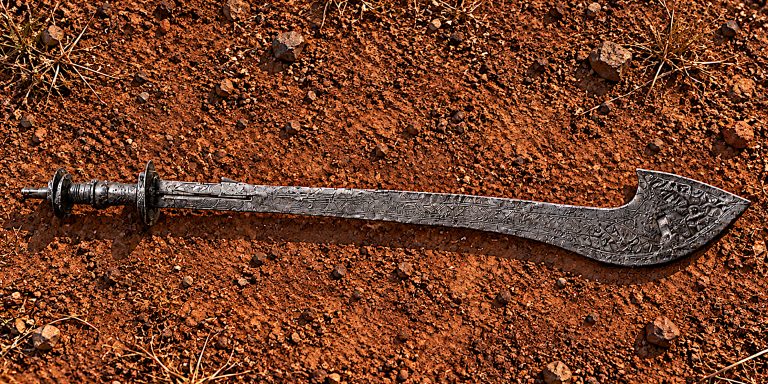
The main sword used by Frankish nobles and elite warriors was the spatha, a long double-edged sword descended from Roman cavalry weapons.
These swords were usually around 75 to 90 centimetres long, with straight blades and simple crossguards. High-status examples were richly decorated with gold, garnets and pattern-welded steel.
Clovis himself probably carried an ornate spatha suitable for a king. Merovingian swords found in rich graves suggest that elite Frankish rulers valued swords as symbols of authority as much as practical weapons.
Spears
Most Frankish warriors fought with spears. They were cheaper and easier to produce than swords.
The typical Frankish spear could be used both for thrusting and throwing. Some warriors carried several.
Seaxes
Many Franks also carried a seax, a large knife or single-edged short sword. These were practical sidearms and everyday tools.
The seax would later become one of the best-known weapons of the Germanic world.
Armour and Protection
Frankish warriors under Clovis wore a mixture of Roman and Germanic armour.
Typical equipment included:
- Round wooden shields with iron bosses
- Mail shirts for wealthier warriors
- Iron helmets, often based on late Roman designs
- Thick wool or leather tunics for ordinary soldiers
- Cloaks fastened with ornate brooches
Many helmets from the period were segmented spangenhelms, made from iron plates joined together. These offered good protection without requiring the expensive technology needed for a single-piece helmet.
The wealthiest Frankish nobles wore mail shirts and decorated belts that signalled rank and status. Archaeological finds from Merovingian graves suggest that appearance mattered greatly. A Frankish king was expected to look rich, dangerous and slightly alarming.
Clovis and the Merovingian Court
Clovis ruled through a travelling court that moved constantly around his kingdom.
He spent time at cities such as Soissons, Paris and Tours. Paris eventually became one of his main centres of power.
His court mixed Roman administrators, Frankish nobles and Christian bishops. It was not yet a royal court in the later medieval sense. There were no grand stone palaces or elaborate ceremonies.
Instead, Clovis ruled through personal relationships, gifts, military success and fear. Quite a lot of fear.
Yet he also understood the value of Roman traditions. He used Roman law, employed former Roman officials and accepted the title of consul from the eastern emperor.
Clovis was not trying to destroy the Roman world entirely. He was trying to take possession of it.
Death and Burial
Clovis died in 511, probably in Paris.
He was buried in the Church of Saints Peter and Paul, later known as the Abbey of Sainte-Geneviève.
After his death, his kingdom was divided among his sons according to Frankish custom. This division weakened the kingdom, although the Merovingian dynasty continued for generations.
Clovis left behind no autobiography, no palace and no grand inscription explaining his ambitions. Instead, we know him through the fragments left by others: chronicles, graves, weapons and churches.
That makes him frustrating, but also fascinating. Clovis feels less like a distant king and more like a shadow moving through the ruins of the Roman world.
Surviving Artefacts from the Reign of Clovis
Very few objects can be directly connected to Clovis himself, but several remarkable artefacts survive from his era.
The Tomb of Childeric I
The richest source of material linked to Clovis’s family is the tomb of his father, Childeric I, discovered in Tournai in 1653.
The tomb contained:
- Gold and garnet jewellery
- Weapons and military equipment
- Hundreds of gold bees, perhaps symbols of royal power
- A signet ring bearing Childeric’s image and name
- Horse harness fittings and burial goods
Although these objects belonged to Childeric rather than Clovis, they provide a vivid picture of the world in which Clovis grew up.
Many of these artefacts were later stolen in the nineteenth century, although some survive in museums and casts.
Merovingian Weapons and Jewellery
Museums in France, Belgium and Germany contain swords, axes, helmets and jewellery from the reign of Clovis and the early Merovingians.
Particularly important examples include:
- Decorated spatha swords from Frankish graves
- Francisca axes from northern Gaul
- Gold brooches and belt buckles
- Early Christian reliquaries and church furnishings
These artefacts reveal a culture that combined Roman craftsmanship with Germanic taste. Frankish kings liked fine goldwork almost as much as they liked conquering their neighbours.
Where to See Artefacts from the Time of Clovis
Visitors interested in Clovis and the early Franks should look for collections in:
- The Musée d’Archéologie Nationale at Saint-Germain-en-Laye
- The Musée de Cluny in Paris
- The Royal Museums of Art and History in Brussels
- The treasury and archaeological collections at Tournai
- Regional museums in Reims, Soissons and Cologne
These museums preserve weapons, jewellery, grave goods and early Christian objects from the Merovingian age.
Latest Archaeology and Recent Discoveries
Archaeology has transformed our understanding of Clovis and the Frankish world.
For centuries, historians relied heavily on Gregory of Tours, who wrote decades after Clovis’s death. Modern excavations have shown that the reality was both more complex and more interesting.
Merovingian Cemeteries
Large Frankish cemeteries discovered across France, Belgium and western Germany have revealed thousands of graves from the late fifth and early sixth centuries.
These excavations have uncovered:
- Warrior burials with swords, axes and spears
- Female graves containing elaborate jewellery
- Imported Roman goods
- Evidence of trade networks stretching across Europe
The graves suggest that Frankish society was wealthier and more connected than historians once believed.
Reassessing the Battlefields
Archaeologists continue to search for the exact sites of battles such as Tolbiac and Vouillé.
The precise location of Tolbiac remains uncertain. Several sites in western Germany have been proposed. The debate continues, which is historian’s shorthand for admitting that everyone still disagrees politely.
At Vouillé, excavations have uncovered evidence of early medieval activity, although no definitive battlefield remains have yet been identified.
The Baptism of Clovis
Excavations at Reims have revealed more about the late Roman and early Christian buildings that existed when Clovis was baptised.
Although the original church no longer survives, archaeology has confirmed that Reims was already an important religious centre in Clovis’s time.
This strengthens the idea that his baptism was a carefully staged political event rather than a sudden personal revelation.
DNA and Early Medieval Migration
Recent genetic studies of early medieval cemeteries have shown that the Frankish world was highly mixed.
The population of Gaul during Clovis’s reign included people of Roman, Germanic and other backgrounds. The old idea of vast migrating tribes sweeping across Europe has become much less convincing.
Clovis did not rule over a purely Frankish kingdom. He ruled over a changing and remarkably diverse society.
Contemporary and Near-Contemporary Quotes
Gregory of Tours, writing in the sixth century, described Clovis as:
“A man of great ability and courage.”
The eastern Roman emperor Anastasius honoured Clovis after the victory at Vouillé, granting him the title of consul.
Gregory also recorded Clovis’s own words after eliminating rival Frankish kings:
“Woe is me, who remain as a stranger among strangers, and have no relatives left to help me.”
It is one of the darker moments in early medieval history. Clovis had become so successful at removing his rivals that he found himself briefly inconvenienced by the lack of surviving family.
Legacy
Clovis changed western Europe.
He created the first great Frankish kingdom, established the Merovingian dynasty and linked royal power with Christianity in a way that would shape medieval Europe for centuries.
Later French kings looked back on him as the founder of their monarchy. Medieval chroniclers turned him into a heroic Christian ruler. The truth is more complicated.
Clovis was ambitious, violent, intelligent and often deeply ruthless. He could be charming when necessary and terrifying when useful. He understood that a king needed to win battles, reward followers and control the story told about him.
In that sense, Clovis was not simply the first medieval king of France. He was one of the first recognisably medieval rulers in Europe.
And he remains strangely compelling. Perhaps because he lived in a world where everything was uncertain and survival depended on force, luck and judgement. Or perhaps because, beneath the legends, Clovis still feels unsettlingly real.