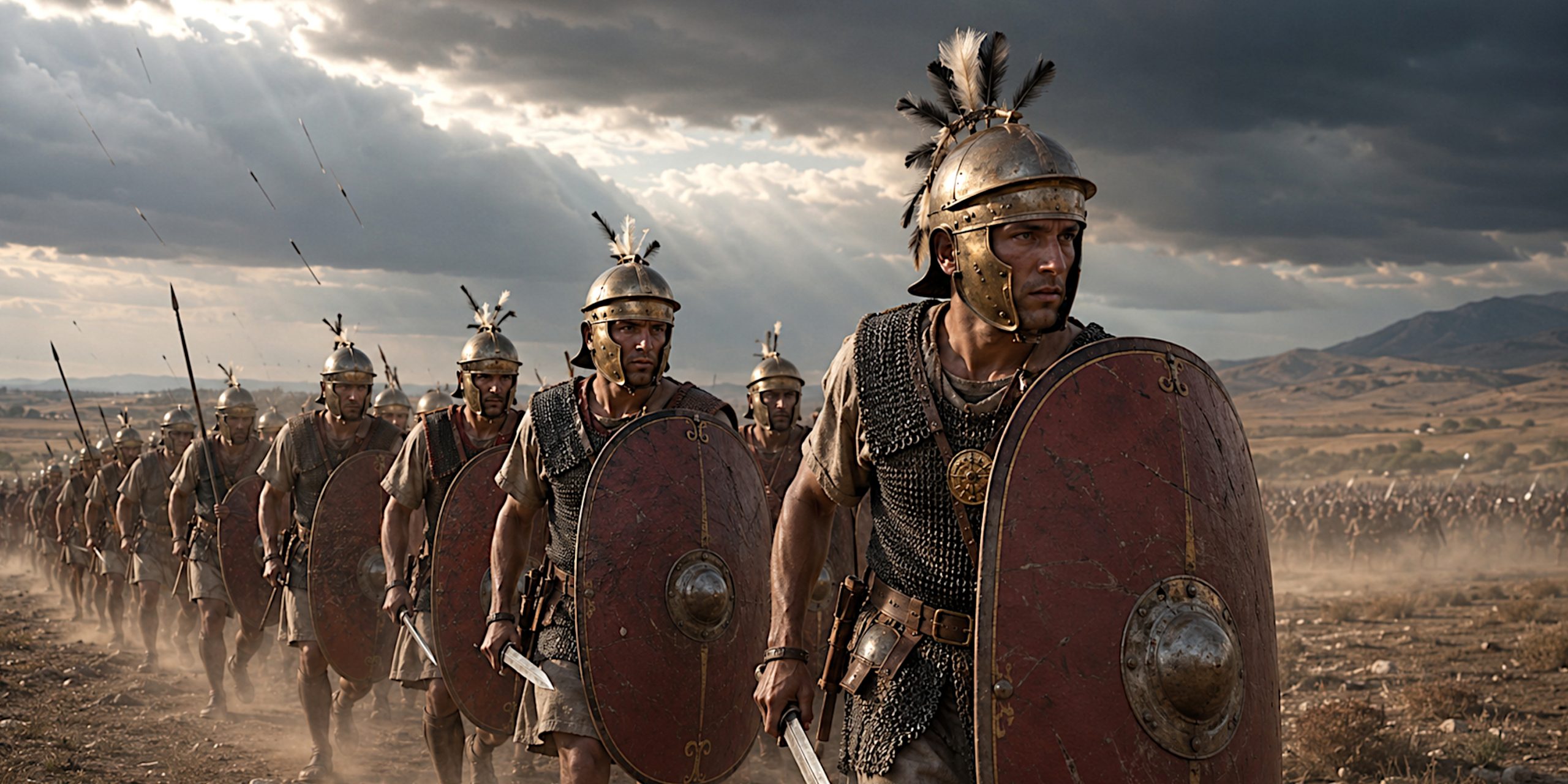
The hastati occupied one of the least comfortable positions in the Roman Republic. They stood in the first line of heavy infantry, advanced after the skirmishers had withdrawn and were expected to begin the serious work of breaking the enemy.
They are often described simply as Rome’s youngest and least experienced legionaries. That is broadly true for the army recorded by Polybius, but it needs qualification. The poorest and youngest recruits generally served as velites, while the hastati were young men with sufficient property to equip themselves for close combat. They were not expendable beginners pushed forward with whatever happened to be lying around the armoury.
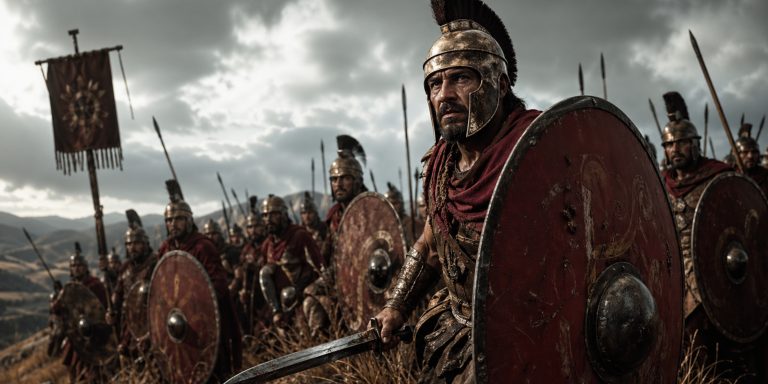
By the middle Republic, a hastatus carried a large scutum, one or more pila and a Spanish-style sword. His protection might consist of a bronze pectoral and helmet, although wealthier men could afford mail. He fought as part of a maniple rather than as an isolated swordsman, supported by principes and triarii arranged behind him.
That system helped Rome survive defeats which might have destroyed less flexible armies. The hastati were expected to attack, but they were also expected to withdraw in good order when the attack failed. Retreating without turning the battle into a stampede is a military skill that receives rather less admiration than it deserves.
Hastati at a Glance
| Detail | Mid-Republican hastati |
|---|---|
| Period most securely documented | Third and second centuries BC |
| Position in the legion | First line of heavy infantry |
| Typical age | Younger adult soldiers |
| Organisation | Ten maniples in a standard legion |
| Approximate strength | 1,200 men in Polybius’ 4,000-man legion |
| Primary missile weapon | Pilum |
| Sword | Gladius Hispaniensis |
| Shield | Large curved scutum |
| Common body protection | Bronze pectoral |
| Wealthier soldiers | Mail shirt |
| Helmet | Usually bronze, including Montefortino-type forms |
| Battlefield purpose | Open the main infantry engagement and disrupt the enemy line |
| Replaced by | A more uniform legionary system during the late Republic |
What Does Hastati Mean?
The singular Latin form is hastatus, while hastati is plural. The name is connected with the hasta, the Roman thrusting spear. It can therefore be understood as meaning “spearmen” or “men armed with spears”.
This is slightly awkward because the best surviving description of the mid-Republican hastati gives them pila rather than long thrusting spears. The name probably survived after their equipment had changed. Military terminology often proves more conservative than military practice. Armies are quite capable of modernising a weapon while retaining a title inherited from another age.
Livy’s account of an earlier Roman formation associates at least some hastati with the hasta. Whether this preserves genuine early practice or reflects later antiquarian reconstruction remains debated. Livy was writing centuries after the fourth-century BC army he described, and his neat system should not be treated as a photograph taken on parade.
The safest conclusion is that the hastati may have originated as spear-bearing troops before becoming the pilum-armed first line known to Polybius.
When Did the Hastati Serve?
The origins of the hastati are difficult to date precisely. Roman military organisation changed gradually as Rome fought neighbouring Italian peoples, particularly during the Samnite Wars of the fourth and early third centuries BC.
Traditional accounts present a tidy progression:
- An early citizen militia fought in a broadly hoplite manner.
- The army adopted a more flexible manipular formation.
- Heavy infantry was divided into hastati, principes and triarii.
- The velites operated as light infantry ahead of these three lines.
- During the late Republic, distinctions between the heavy infantry classes faded.
Reality was probably less orderly. Different weapons, formations and recruitment principles may have overlapped for decades. Rome rarely woke on a Tuesday morning and replaced its entire military system before lunch.
The hastati are most clearly visible during the Punic Wars and Rome’s subsequent expansion into the Mediterranean. By the late second and early first centuries BC, the old distinctions between hastati, principes and triarii had largely disappeared as the legion became more uniform and the cohort replaced the maniple as its principal tactical unit.
Recruitment, Age and Social Position
Polybius describes a levy in which Roman citizens were divided according to age. The youngest became velites, the next group became hastati, more mature men entered the principes and the oldest served as triarii.
In a legion of roughly 4,000 infantry, he gives the following distribution:
| Troop type | Approximate strength |
|---|---|
| Velites | 1,000 |
| Hastati | 1,200 |
| Principes | 1,200 |
| Triarii | 600 |
If the legion was enlarged, the number of hastati, principes and velites increased proportionally. The triarii remained fixed at 600.
Age was not the only factor shaping a soldier’s appearance. Roman citizens were generally responsible for obtaining their own equipment, so wealth mattered. Two men could stand in the same hastati maniple while wearing noticeably different levels of protection.
The poorest eligible hastati might wear a small bronze plate over the chest. A richer man could possess a mail shirt. Helmets varied in design, decoration and quality. The uniform Roman legionary presented by films and games belongs more to costume departments than to the middle Republic.
How the Hastati Were Organised
In the Polybian legion, the hastati were divided into ten maniples. Each maniple contained approximately 120 men when the legion numbered around 4,000 infantry.
A maniple was divided into two centuries, although the word “century” did not always indicate exactly 100 soldiers. Each century was commanded by a centurion. The senior centurion of the maniple appears to have exercised overall authority when both centuries operated together.
The manipular system offered a practical balance. A maniple was large enough to hold its place in a battle line but small enough to manoeuvre more readily than a single solid phalanx.
Hastati did not fight alone. They formed part of a layered formation:
| Position | Troops | General role |
|---|---|---|
| Screening line | Velites | Skirmishing and missile harassment |
| First heavy line | Hastati | Begin the main infantry attack |
| Second heavy line | Principes | Reinforce or replace the hastati |
| Final line | Triarii | Reserve, defence and last resort |
The allies of Rome also supplied substantial infantry and cavalry contingents. A Roman consular army was consequently much larger and more complicated than the legions considered in isolation.
How the Hastati Fought
Before the heavy infantry engaged, the velites moved ahead of the legion and exchanged missiles with enemy skirmishers. They could also harass dense formations, target elephants or attempt to provoke an undisciplined advance.
Once the velites withdrew, the hastati moved forward. At effective range they threw their pila, aiming to kill, wound or disorder the opposing formation. A pilum that penetrated a shield could make it cumbersome, even if the man behind it escaped injury.
The hastati then closed with swords and shields. This did not necessarily mean a single wild charge followed by hundreds of private duels. Roman success depended upon cohesion, mutual protection, pressure and the ability of junior officers to keep formations functioning amid noise, dust and fear.
If the hastati failed to break the enemy, they could fall back and allow the principes to continue the battle. Precisely how Roman line relief worked remains uncertain. Ancient writers tell us that one line could replace another, but they do not provide the sort of drill manual modern readers would dearly like to possess.
Possible methods include withdrawal through intervals between maniples, movement around their flanks or a gradual passage through gaps opened in the supporting line. Different circumstances may have produced different solutions. Battlefields are notoriously unwilling to follow diagrams.
Arms and Armour
Polybius provides the fullest surviving description of the equipment carried by Roman heavy infantry during the middle Republic. He states that the hastati and principes shared broadly similar arms, while the triarii carried long spears in place of pila.
Gladius Hispaniensis
The principal sword associated with the mid-Republican hastati was the gladius Hispaniensis, or Spanish sword. It was probably adopted following Roman encounters with Iberian weapon traditions, although its precise development remains contested.
Polybius admired the weapon because it could cut with either edge and deliver an effective thrust:
“Besides the shield they also carry a sword, hanging on the right thigh and called a Spanish sword. This is excellent for thrusting, and both of its edges cut effectually.”
The Republican gladius Hispaniensis was generally longer than many familiar early imperial gladii. Surviving and reconstructed examples suggest a strong double-edged blade with an acute point, suited to both cuts and thrusts.
Specific sword forms relevant to the hastati include:
- Gladius Hispaniensis: The characteristic sword of the middle and late Republican legionary.
- Earlier Italic double-edged swords: Likely used before the Spanish type became widespread.
- La Tène-influenced blades: Celtic weapon-making traditions influenced arms across Italy, though not every long Republican sword should automatically be labelled Celtic.
- Shorter transitional gladii: Later Republican examples anticipated the Mainz and other imperial forms.
There is no good evidence that every hastatus carried an identical blade. Weapon production was not yet the tightly standardised imperial system often imagined by modern audiences.
Pilum
The pilum was the defining missile weapon of the Polybian hastatus. Polybius describes heavy and lighter forms, both combining a wooden shaft with a long iron shank.
A hastatus may have carried two pila, although scholars continue to debate whether every soldier always carried one heavy and one light example in practice.
The pilum served several purposes:
- It could penetrate flesh or light armour.
- Its narrow iron shank could pass through a shield.
- An embedded pilum made a shield more difficult to use.
- A volley could disrupt the enemy immediately before contact.
- Its construction discouraged easy reuse by the enemy.
The familiar claim that every pilum was deliberately designed to bend on impact is too confident. Some did bend, but the weapon’s behaviour depended upon its construction, the target and the angle of impact. Roman engineering was clever, though it was not obliged to perform the same party trick every time.
Scutum
The hastati carried the large Roman scutum. Polybius describes a curved shield approximately four Roman feet high and two and a half feet wide.
Its layered wooden construction was covered with canvas and hide. Iron edging strengthened vulnerable areas, while a central metal boss protected the hand and helped deflect blows.
The scutum offered extensive protection from shoulder to shin. It could receive missiles, cover the body during an advance and support aggressive close combat. Its curved surface also helped wrap protection around the soldier rather than presenting a completely flat face.
The shield was essential to the hastatus. Roman swordsmanship cannot be understood by looking at the sword alone. The scutum created the opportunity to use the sword safely and forcefully.
Bronze Pectoral
Polybius reports that ordinary soldiers wore a bronze plate measuring roughly a span across, positioned over the chest. This is commonly called a pectoral or heart-protector.
Such plates may have been circular, square or rectangular and could be secured by straps. Their limited coverage seems unimpressive beside a mail shirt, but the plate protected part of the torso without imposing the same cost or weight.
It should not be imagined as a miraculous shield for the heart. Ancient anatomical optimism had limits.
Mail Armour
Men assessed above a particular property qualification wore mail instead of the bronze pectoral. Polybius refers to this as a chain-work cuirass.
Roman mail, later called lorica hamata, was influenced by armour used among Celtic peoples. It provided far better coverage than a small chest plate, particularly against cutting attacks, although it was expensive and required considerable labour to produce.
A prosperous hastatus could therefore be better protected than a poorer soldier in the same line. The difference between hastati and principes was principally one of age and battlefield position, not a rigid equipment catalogue.
Helmets
Bronze helmets were standard protective equipment for Roman heavy infantry. The Montefortino family is particularly associated with Republican armies.
Typical features included:
- A rounded or conical bowl
- A projecting neck guard
- Hinged cheek pieces on some examples
- A top knob for attaching a crest or decoration
- Bronze construction, although iron helmets also appeared
Polybius describes soldiers wearing feathers fixed to the helmet so that each man appeared taller and more intimidating. Anyone who has watched military fashion across the centuries will recognise the principle.
Greaves
Polybius includes greaves in his description of the Roman panoply, but the archaeological and artistic evidence suggests that their use was not completely uniform. A soldier might wear a single greave on the exposed leading leg, a pair or none at all.
It is safer to regard greaves as part of the available equipment rather than a guaranteed component worn by every hastatus throughout the period.
Hastati on the Battlefield
The hastati appear in many of Rome’s most important Republican wars, even when ancient narratives do not describe every tactical movement in detail.
The Samnite Wars
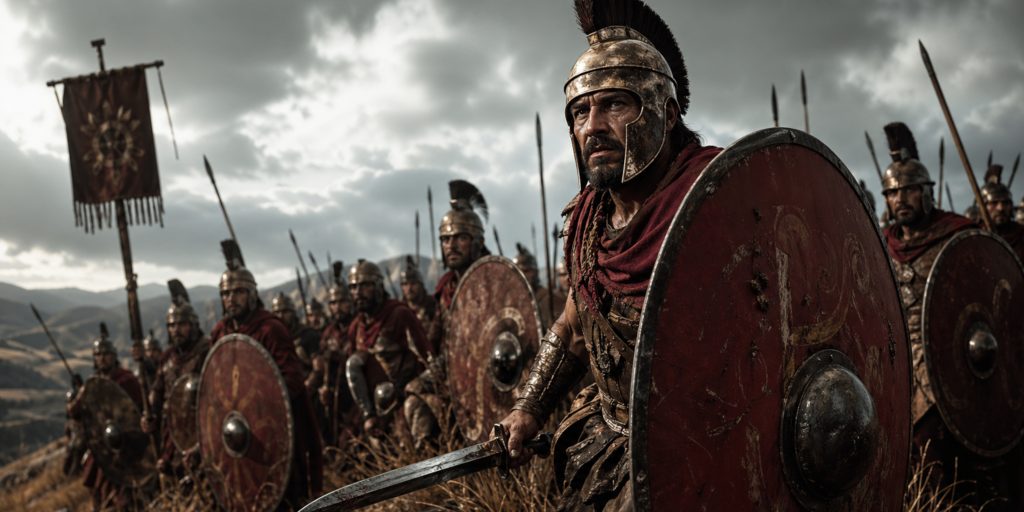
The difficult terrain of central and southern Italy is often associated with the development of Rome’s manipular tactics. Small, flexible units were better suited to broken ground than a rigid phalanx, although the precise relationship between the Samnite Wars and Roman military reform remains disputed.
Livy describes the hastati as the first line to engage in his account of fourth-century warfare. His reconstruction is valuable, but it combines genuine traditions with the assumptions of a much later Roman author.
The First Punic War
Hastati fought in Roman armies across Sicily and North Africa. These campaigns exposed Roman infantry to fortified positions, mercenaries, cavalry and Carthaginian war elephants.
The archaeological record from this period includes Republican helmets, weapons and naval remains, but individual objects cannot ordinarily be assigned to hastati rather than principes.
The Second Punic War
The struggle against Hannibal placed the manipular legion under exceptional pressure. Hastati fought in catastrophic defeats at the Trebia, Lake Trasimene and Cannae, as well as in Rome’s later recovery.
At Cannae in 216 BC, the depth and compression of the Roman infantry contributed to its encirclement. The manipular legion was flexible, but no formation was proof against poor deployment and a commander as capable as Hannibal.
The Battle of Zama
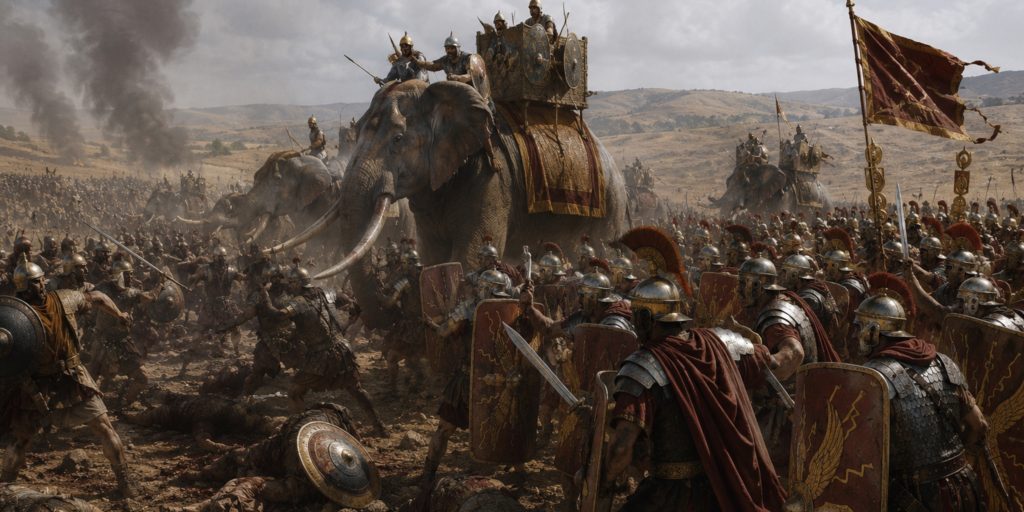
Polybius records that Scipio Africanus arranged the hastati at the front at Zama in 202 BC. The principes stood directly behind them rather than opposite the usual intervals because Scipio wanted open lanes through which Carthaginian elephants could pass.
“In front he placed the hastati with certain intervals between the maniples and behind them the principes.”
The hastati endured the first major infantry clashes. After hard fighting, Scipio reorganised his surviving lines before the final confrontation with Hannibal’s veterans. Zama demonstrates that the three-line system was adaptable rather than ceremonial.
Wars in Greece and Spain
Hastati later campaigned against Macedonian phalanxes and in the prolonged wars of the Iberian Peninsula. The pilum, scutum and manipular formation proved effective, but Roman victories also depended upon leadership, allied troops, cavalry and the ability to replace losses.
The legion did not conquer because the hastati possessed a secret sword technique. It conquered because Rome could recruit, organise and return after defeats which would have ended the ambitions of many rivals.
Contemporary and Ancient Accounts
No surviving hastatus left us a diary. Our principal literary witnesses were educated authors concerned with politics, command and the behaviour of armies, not the sore feet of ordinary infantrymen.
Polybius is the most valuable source because he lived during the second century BC, observed Roman institutions closely and knew senior Roman commanders. His description of the levy states:
“The next in seniority, called hastati, are ordered to wear a complete panoply.”
He also gives the strength of the principal infantry divisions:
“The principes twelve hundred, the hastati twelve hundred, the rest, consisting of the youngest, being velites.”
Livy, writing under Augustus, describes an earlier formation:
“The foremost line consisted of the hastati, formed into fifteen companies, drawn up at a short distance from each other.”
Livy then explains their battlefield role:
“When an army had been marshalled in this fashion, the hastati were the first of all to engage.”
These passages are invaluable, but they describe different periods through different literary lenses. Polybius offers the firmer foundation for reconstructing the hastati of the Punic Wars. Livy may preserve older material, though his account cannot be accepted without caution.
Archaeology and Material Evidence
Archaeology confirms many elements of Republican military equipment, but it rarely identifies the tactical class of the soldier who carried a particular object. A helmet does not arrive with “property of Gaius, hastatus” scratched neatly inside.
Republican Swords
Examples commonly associated with the gladius Hispaniensis have been found at sites in Spain, France and the wider Roman world. Important evidence includes swords from Roman military contexts at places such as La Tène-influenced sites, Numantia, Delos and the camps around the siege of Alesia.
These weapons vary in length and form. That variation warns against treating the Republican gladius as a single factory pattern.
Pila and Javelin Components
Iron pilum heads and shanks survive more readily than wooden shafts. Finds from Republican siege camps and battle sites confirm the use of long iron components consistent with literary descriptions.
Archaeological examples also show variation. Some pila used socketed heads, while others employed tangs secured within the wooden shaft. Design changed according to date, workshop and intended function.
Montefortino Helmets
Montefortino-type helmets have been recovered across Italy and regions reached by Roman armies. The type originated within a wider Celtic and Italic military environment and remained in service for centuries.
Finds from the waters around the Egadi Islands, associated with the naval battle of 241 BC, include remarkably preserved bronze helmets. They offer direct evidence for the equipment circulating during the First Punic War, although the multinational crews and troops involved make individual ownership difficult to establish.
Shield Fittings
Wood and leather usually decay, so complete Republican scuta are exceedingly rare. Metal bosses, edging and fittings provide partial evidence, while artistic depictions help reconstruct the shield’s shape.
The famous oval shield from Kasr el-Harit in Egypt belongs to a later context but demonstrates the kind of layered wooden construction described by Polybius. It is useful comparative evidence, not the personal shield of a Punic War hastatus.
Body Armour
Bronze pectorals are known from Italian archaeological contexts, including burials and sanctuary deposits. Mail fragments also survive, though corrosion and uncertain dating complicate interpretation.
The equipment record is regional and uneven. Burial customs changed, weapons were repaired and recycled, and defeated armies rarely left complete armour arranged for future archaeologists. They really might have shown more consideration.
What Did a Hastatus Look Like?
A historically plausible hastatus of the third or early second century BC might have worn:
- A bronze Montefortino-style helmet with cheek pieces
- A sleeveless woollen tunic
- A small bronze pectoral or mail shirt
- A belt supporting a gladius Hispaniensis
- One greave, a pair of greaves or no greaves
- Sandals or robust military footwear
- A large curved scutum
- One or two pila
His clothing and equipment need not have matched those of the men beside him. Colours were not necessarily uniform, metal fittings differed and repaired items could remain in service for years.
The popular image of every hastatus wearing a bright red tunic is not securely supported. Red was certainly known and used in the Roman world, but the evidence does not justify dressing the entire Republican legion as though it had received a bulk order from the same merchant.
Were the Hastati Inexperienced?
They were younger than the principes and triarii, but “young” should not be confused with completely untrained.
Roman citizens were liable for repeated military service. A man might remain within the general hastati age group across several campaigns. Some could have seen substantial fighting before advancing into the principes.
Training and experience also varied according to the demands of a particular war. A hastatus in a newly raised army might possess limited campaign experience. Another serving through the long wars against Carthage or in Spain could become a hardened soldier while still officially belonging to the first line.
Hastati were expected to perform one of the most demanding tasks in the legion. They had to advance under missiles, throw their pila, meet the enemy’s main formation and withdraw without collapsing if the attack failed. Rome would hardly have entrusted that work to a crowd of unprepared adolescents.
Hastati, Principes and Triarii Compared
| Feature | Hastati | Principes | Triarii |
|---|---|---|---|
| Relative age | Younger | Mature | Older veterans |
| Position | First heavy line | Second heavy line | Third line |
| Strength in a standard Polybian legion | 1,200 | 1,200 | 600 |
| Missile weapon | Pilum | Pilum | Usually long spear |
| Sword | Gladius Hispaniensis | Gladius Hispaniensis | Sword as secondary weapon |
| Shield | Scutum | Scutum | Scutum |
| Main purpose | Begin the heavy engagement | Reinforce or replace hastati | Final reserve |
| Typical reputation | Energetic front-line troops | Experienced main strength | Dependable last resort |
The distinctions were meaningful, but they should not be exaggerated. Hastati and principes carried broadly similar equipment in Polybius’ account. Their most important differences were age, experience and position within the formation.
The Decline of the Hastati
During the late second century BC, the distinctions between the three heavy infantry lines weakened. This development is traditionally attributed to the military reforms of Gaius Marius, but the transformation was broader and more gradual than a single reform programme.
Long overseas campaigns, changing recruitment, state provision of equipment and the growing importance of the cohort all encouraged greater uniformity. Legionaries increasingly carried similar weapons and could be deployed without the old age-based division into hastati, principes and triarii.
The names did not vanish immediately. Certain titles survived within the centurionate, including pilus prior, princeps prior and hastatus prior. By then, however, hastatus described an officer’s position within a cohort rather than a young swordsman standing in the legion’s first battle line.
Common Misconceptions
Hastati were Rome’s poorest soldiers
Not quite. The poorest and youngest generally served as velites. Hastati occupied the first category of heavy infantry and possessed enough property to equip themselves accordingly.
Every hastatus wore the same armour
Equipment depended partly upon wealth. Many wore bronze pectorals, while richer soldiers could afford mail. Helmets and other fittings also varied.
Hastati fought with spears throughout their history
Their name is derived from the hasta, and earlier formations may have used thrusting spears. The hastati described by Polybius carried pila and swords.
Hastati were disposable troops
They took the first heavy impact, but the Roman system was designed to support and recover them. Their withdrawal allowed the principes to enter the fight while the triarii remained in reserve.
Roman lines changed places through one perfect drill
Ancient sources do not explain the precise mechanism in sufficient detail. Several reconstructions are possible, and the method probably depended upon terrain, pressure and available space.
Why the Hastati where important
The hastati embodied the strengths and risks of Republican warfare. Rome placed younger heavy infantry at the front, gave them powerful missile weapons and supported them with successive lines of more experienced soldiers.
Their purpose was not merely to absorb casualties. They disrupted the enemy with pila, fought aggressively with sword and shield, and created the opening through which the rest of the legion might win. When they could not do so, the structure behind them prevented failure from becoming immediate disaster.
That is the most important point about the hastati. They were formidable soldiers, but their real value came from their place within a system. Rome’s genius lay less in producing invincible individuals than in building an army which expected plans to fail and had another line waiting when they did.
Frequently Asked Questions
What was a Roman hastatus?
A hastatus was a younger heavy infantryman who normally fought in the first main battle line of the mid-Republican Roman legion.
What sword did the hastati use?
During the middle Republic, hastati used the gladius Hispaniensis, a double-edged sword capable of powerful cuts and thrusts.
Did hastati carry spears?
Earlier hastati may have carried thrusting spears, which would explain their name. In Polybius’ second-century BC account, they carried pila rather than the long hasta used by the triarii.
How many hastati were in a legion?
Polybius gives 1,200 hastati in a legion of approximately 4,000 infantry. They were divided into ten maniples.
Did hastati wear mail armour?
Some did. Wealthier soldiers wore mail, while men of more modest means commonly used a small bronze pectoral.
Were hastati younger than velites?
The velites included the youngest recruits. Hastati were the next group in seniority and formed the youngest division of the heavy infantry.
What replaced the hastati?
The separate hastati, principes and triarii lines disappeared as the late Republican legion developed a more uniform body of heavy infantry organised principally into cohorts.