There is a tendency in Roman history to cast every opponent as a stepping stone on the way to empire. The Samnites deserve better. For much of the fourth and early third centuries BC, they were not a footnote but a persistent and highly capable rival to Rome.
Drawn from the rugged uplands of southern Italy, Samnite infantry were shaped by terrain that had little patience for parade ground formations. Their warfare reflects this. Flexible, aggressive, and often uncomfortable for their enemies, they forced Rome to adapt or lose. That Rome ultimately chose adaptation is, in a quiet way, the Samnites’ legacy.
Who Were the Samnites?
The Samnites were not a single unified state but a confederation of tribes, chiefly the Hirpini, Caudini, Caraceni, and Pentri. Their homeland, Samnium, lay in the Apennine mountains, a landscape that rewards endurance more than elegance.
Their society was pastoral and martial. Leadership was often situational rather than permanent, and their armies could be raised quickly when required. This produced soldiers who were not professionals in the later Roman sense, yet were hardened by environment and accustomed to violence.
Roman writers, particularly Livy, depict them as formidable and at times frustratingly elusive. That may say as much about Roman experience as Samnite intent.
The Nature of Samnite Warfare
Samnite infantry fought in a manner suited to broken ground. Large, rigid formations would have been a liability in their homeland, so flexibility was essential.
Key characteristics included:
- Use of ambush and terrain advantage
- Rapid movement across hills and valleys
- Smaller, more adaptable fighting groups rather than dense phalanxes
- Aggressive close combat once contact was made
The most famous example remains the Battle of the Caudine Forks, where a Roman army was trapped in a mountain pass and forced into surrender without a pitched battle. It was a lesson in humility that Rome did not forget.
Arms and Armour
Samnite equipment varied by wealth and status, though a few elements appear consistently in archaeological finds and artistic depictions.
Offensive Weapons
- Spears
The primary weapon for most infantry. Likely used both for thrusting and throwing, depending on the situation. - Javelins
Light projectiles for skirmishing and disrupting enemy formations before close combat. - Swords
Short swords were common, though not standardised. Likely types include:- Early Italic leaf-shaped swords
- Short iron blades that influenced the later Roman gladius
- Transitional forms between Greek and Italic designs
These swords were suited to close, decisive fighting rather than extended duelling.
Defensive Equipment
- Helmets
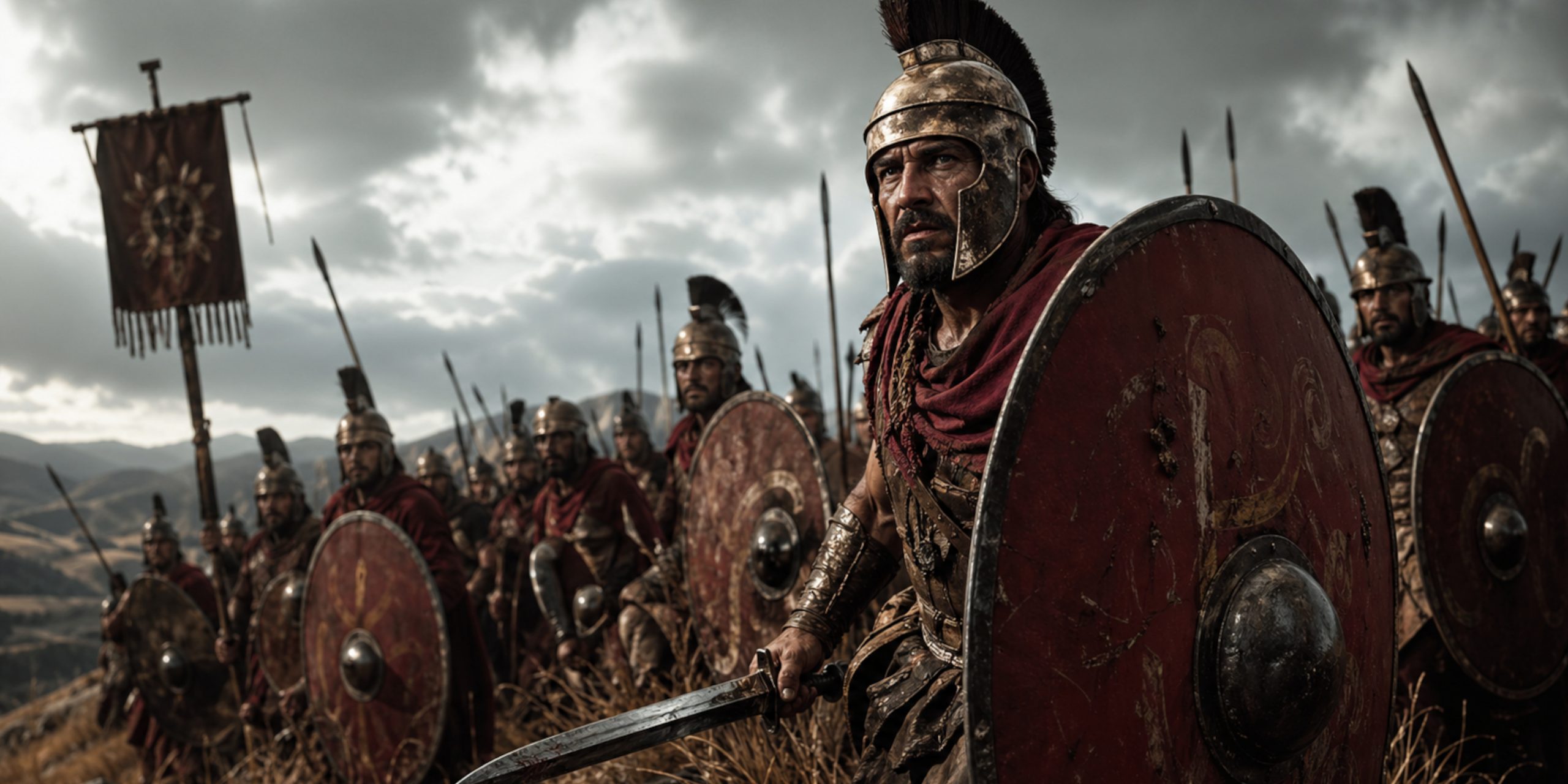
Often bronze, with distinctive crests or plumes. Some examples show elaborate decoration, suggesting both status and identity. - Shields
Oval or rectangular shields, sometimes considered precursors to the Roman scutum. Constructed from wood with metal reinforcement. - Body Armour
Wealthier warriors wore bronze cuirasses, sometimes of the triple-disc type. Others relied on lighter protection or none at all. - Greaves
Usually worn on one leg, a practical compromise between protection and mobility.
The overall impression is one of practicality with flashes of individuality. Samnite warriors did not march as uniform ranks, and their equipment reflects that.
Tactics and Battlefield Role
Samnite infantry were not line soldiers in the classical Greek sense. Their strength lay in adaptability.
Typical battlefield approach:
- Initial harassment using javelins
- Exploitation of terrain to break enemy cohesion
- Swift transition to close combat
- Use of local knowledge to outmanoeuvre opponents
Against early Roman armies, which still relied heavily on phalanx-style formations, this approach proved highly effective. It exposed the rigidity of Roman tactics and forced a rethink.
It is widely accepted that Rome’s later manipular system, with its more flexible structure, owes something to these encounters. The Samnites, in effect, taught Rome how not to lose in Italy.
Archaeology
Archaeological evidence provides a more grounded view than Roman literary sources, which can be coloured by hindsight.
Key findings include:
- Tomb paintings
Particularly from Campania, showing warriors with distinctive helmets, shields, and tunics. These images are among the clearest visual records of Samnite equipment. - Grave goods
Weapons and armour buried with individuals, indicating status and martial identity. - Oscan inscriptions
Offering insight into language and cultural identity, though not always directly tied to military practice. - Settlement remains
Hilltop fortifications and defensive positions reinforce the importance of terrain in Samnite life.
Archaeology confirms variation rather than uniformity. There was no single Samnite kit, only a shared martial culture expressed in different ways.
Contemporary and Near-Contemporary Voices
Ancient writers leave us with impressions that are often shaped by conflict.
Livy describes the Samnites as:
“A nation warlike by nature and trained by constant conflict.”
Meanwhile, Diodorus Siculus notes their resilience and persistence in the face of Roman expansion, though he writes with the benefit of hindsight.
These accounts are not neutral. They reflect Roman and Greek perspectives, often admiring but rarely sympathetic. Still, they underline a consistent point. The Samnites were taken seriously.
The Samnite Wars and Decline
The Samnites fought Rome in three major conflicts, collectively known as the Samnite Wars.
Across these wars:
- Rome suffered early setbacks, including humiliation at Caudine Forks
- The conflict dragged across decades, with shifting alliances
- Roman persistence, organisation, and resources gradually turned the tide
By the end of the third war, Samnite independence was effectively broken. Resistance continued, notably during the Social War, but the balance had shifted permanently.
Legacy
The Samnites did not leave behind an empire or a unified historical narrative. What they left is subtler, and arguably more important.
- They forced Rome to abandon rigid phalanx tactics
- They influenced the development of the manipular legion
- They demonstrated the effectiveness of flexible infantry warfare in difficult terrain
In short, they helped shape the army that would later dominate the Mediterranean. It is an irony worth noting. Rome’s success owes something to those it defeated.
Takeaway
There is a quiet satisfaction in studying the Samnites. They resist simplification. They were not simply Rome’s opponents, nor were they a single coherent state.
They were, instead, a collection of mountain communities that fought hard, adapted quickly, and refused to be easily subdued. For a time, that was enough to trouble one of history’s most determined powers.
One suspects they would have appreciated the inconvenience they caused.