Some swords in Tolkien’s legendarium dominate every conversation. Andúril gets the glory. Glamdring steals scenes. Sting has its own fan club. Then there is Aranrúth, quietly sitting in the background as one of the oldest and most prestigious weapons in Middle-earth.
It barely appears compared with Tolkien’s better-known blades, yet its history stretches back to the First Age and one of the most powerful rulers ever to walk Middle-earth. This was the sword of King Thingol, ruler of Doriath, husband of the Maia Melian, and one of the few Elven kings who could genuinely make other rulers feel slightly underdressed.
Like much of Tolkien’s mythology, Aranrúth is intriguing because so much is left unsaid. Every brief mention hints at a much larger story. For readers willing to explore The Silmarillion, Unfinished Tales, and The History of Middle-earth, it becomes one of the most fascinating legendary weapons Tolkien ever created.
What Is Aranrúth?
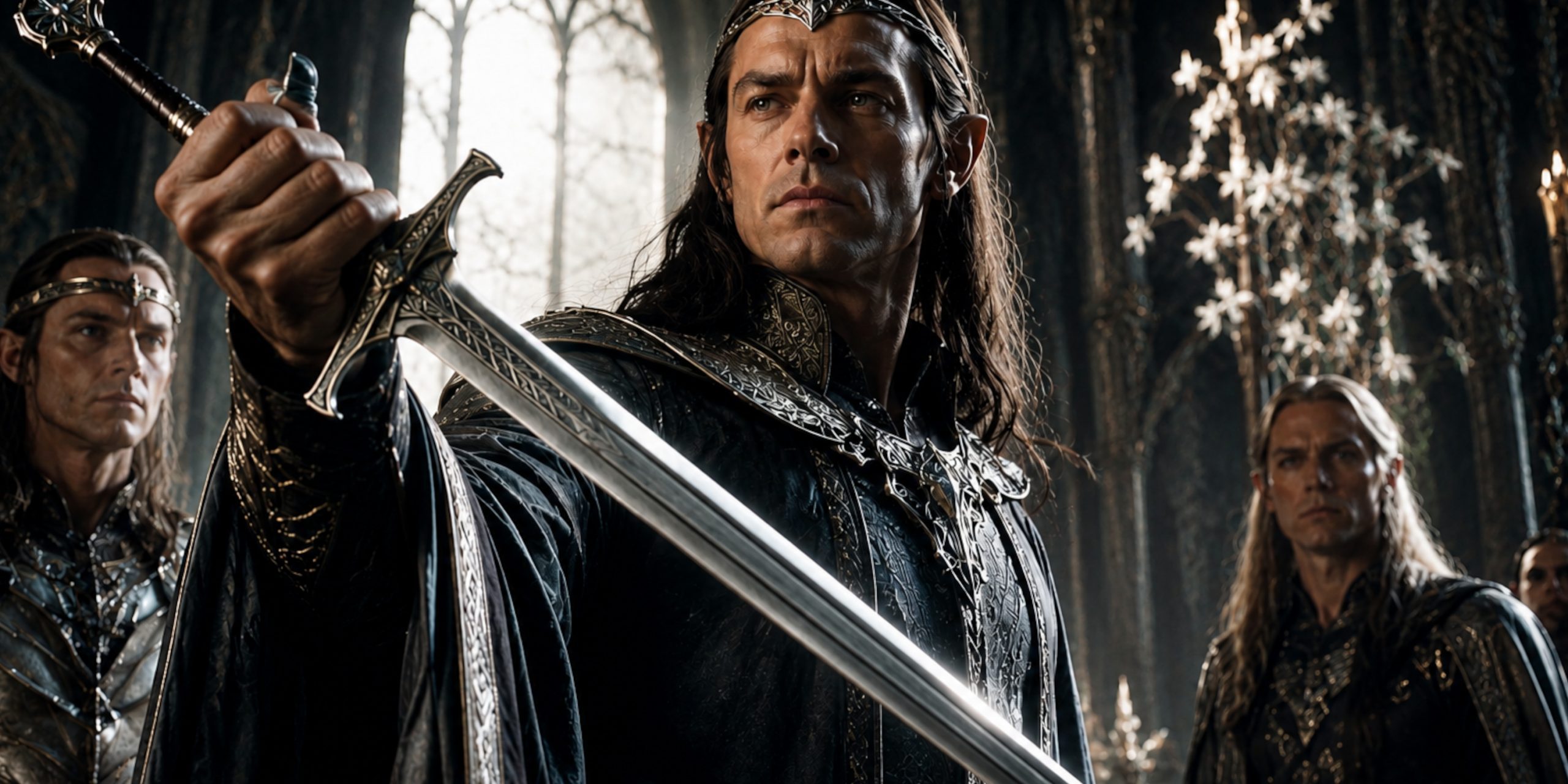
Aranrúth was the personal sword of Elu Thingol, High King of Doriath during the First Age.
Its name is generally translated as “King’s Wrath” in Sindarin.
Unlike many famous fantasy swords, Tolkien never describes its dimensions, appearance, decoration, or magical abilities. Instead, Aranrúth earns its legendary status through the prestige of its owner and the remarkable lineage that followed.
It represents royal authority more than battlefield spectacle.
Known facts include:
| Feature | Details |
|---|---|
| Name | Aranrúth |
| Meaning | King’s Wrath |
| Owner | King Thingol |
| Race | Sindarin Elves |
| Age | First Age |
| Material | Unknown |
| Fate | Passed to the Kings of Númenor |
Even with this limited information, Aranrúth occupies an important place in Tolkien’s wider mythology.
The Meaning Behind the Name
Tolkien’s linguistic precision gives Aranrúth considerable weight.
The Sindarin word aran means king.
Rûth is commonly interpreted as wrath or anger.
Together they form King’s Wrath, a name suggesting authority backed by deadly force rather than uncontrolled rage.
That feels appropriate for Thingol himself.
He was not an impulsive warrior king charging recklessly into battle. Instead, he ruled one of the most secure kingdoms in Middle-earth through wisdom, prestige, and the supernatural protection provided by Melian’s Girdle.
When Aranrúth was drawn, it symbolised that diplomacy had failed.
Who Was Thingol?
Understanding Aranrúth means understanding its owner.
Thingol began life as Elwë Singollo, one of the original leaders of the Elves before the Great Journey westward.
Everything changed when he encountered Melian.
Rather than continuing his journey, the two stood entranced together for years beneath the trees of Beleriand. Upon awakening, Thingol established the kingdom of Doriath, becoming one of the greatest rulers of the First Age.
His court became legendary for its wealth, beauty, learning, and power.
Among those connected to Thingol were:
- Melian the Maia
- Lúthien Tinúviel
- Beren
- Dior
- Elwing
- Elrond through his descendants
That family tree alone explains why almost every major event in Tolkien’s mythology somehow circles back to Doriath.
Aranrúth During the First Age
Interestingly, Tolkien never records a famous duel fought with Aranrúth.
Unlike Glamdring or Gurthang, it has no celebrated battlefield victory attached to it.
That absence is probably deliberate.
Thingol himself rarely sought glory through combat. His influence came through kingship, alliances, and political authority.
Aranrúth therefore becomes almost ceremonial in significance.
It symbolised:
- The authority of Doriath
- The legitimacy of Thingol’s rule
- The ancient dignity of the Sindar
- The independence of his kingdom
Sometimes the sword you never need to draw says more than the one constantly swinging around in battle.
Connection to the Silmaril
Aranrúth inevitably becomes connected with the tragedy surrounding the Silmaril.
Thingol demanded one of Fëanor’s Silmarils as the bride price for Beren.
Against overwhelming odds, Beren and Lúthien actually succeeded.
Unfortunately, possessing a Silmaril proved almost as dangerous as trying to steal one.
Thingol’s decision to have the jewel set into the Nauglamír led to conflict with the Dwarves.
The resulting violence caused the downfall of Doriath.
Although Tolkien never specifically mentions Aranrúth being used during these events, it undoubtedly remained part of Thingol’s royal regalia until his death.
From Doriath to Númenor
This is where Aranrúth’s story becomes unexpectedly important.
Following the destruction of Doriath and later Beleriand, the sword eventually passed through Thingol’s descendants.
It ultimately became one of the treasured heirlooms of the Kings of Númenor.
That journey makes Aranrúth one of the oldest surviving royal artefacts in Tolkien’s world.
Its path links:
- Doriath
- The Half-elven
- Elros
- Númenor
- The royal line that eventually produced Aragorn
Although Andúril receives most of the attention, Aranrúth quietly sits much further back in the same royal inheritance.
Was Aranrúth Magical?
Tolkien never explicitly says so.
Unlike Sting, which glows near Orcs, or Gurthang, which appears almost sentient, Aranrúth displays no recorded supernatural abilities.
That does not necessarily mean it lacked enchantment.
Weapons forged by the Elves, especially those carried by great kings, often possessed exceptional craftsmanship.
Possible qualities include:
- Extraordinary sharpness
- Exceptional durability
- Symbolic royal authority
- Ancient Elven craftsmanship
Its greatest power may simply have been what it represented.
How Aranrúth Compares With Other Tolkien Swords
| Sword | Owner | Age | Primary Significance |
|---|---|---|---|
| Aranrúth | Thingol | First Age | Royal authority |
| Andúril | Aragorn | Third Age | Kingship restored |
| Glamdring | Gandalf | First Age | Heroic warfare |
| Sting | Bilbo and Frodo | Third Age | Adventure and survival |
| Gurthang | Túrin | First Age | Tragic destiny |
| Anglachel | Beleg then Túrin | First Age | Dark enchantment |
Aranrúth feels unique because it bridges the ancient Elven kingdoms and the later kingdoms of Men.
Few swords possess such an extensive dynastic legacy.
Symbolism
Aranrúth represents several recurring Tolkien themes.
Ancient Kingship
Thingol belonged to one of the oldest generations of Elves.
His sword embodies a civilisation already ancient before Númenor even existed.
Legitimacy
The weapon reinforces lawful authority rather than personal ambition.
That distinction matters throughout Tolkien’s mythology.
Legacy
Perhaps more than anything else, Aranrúth illustrates Tolkien’s fascination with inheritance.
Objects outlive kingdoms.
Weapons survive their wielders.
History echoes across thousands of years.
That idea appears repeatedly throughout The Silmarillion and The Lord of the Rings.
Did Tolkien Ever Describe Aranrúth?
Surprisingly, no.
There is no detailed physical description.
Fans have imagined everything from an elegant Sindarin longsword to an ornate greatsword covered in silver vines.
The reality is that Tolkien leaves its appearance entirely open.
Personally, I quite like that. Modern fantasy often explains every gemstone, rune, and leather strap until nothing is left to imagine. Tolkien trusted readers to fill in the gaps. Aranrúth becomes more mysterious precisely because it is never fully described.
Influence on Fantasy
Although Aranrúth rarely appears in adaptations, its influence can still be seen in fantasy storytelling.
Many later fictional settings include ancient royal swords that function less as magical weapons and more as symbols of dynastic legitimacy.
Games and fantasy novels regularly borrow this concept:
- Lost royal heirlooms
- Ancient Elven blades
- Weapons passed through noble bloodlines
- Kings whose authority is tied to legendary swords
Aranrúth helped establish that tradition long before it became commonplace.
Aranrúth in Adaptations
Aranrúth has never enjoyed the screen time given to Andúril or Glamdring.
It has not appeared prominently in Peter Jackson’s films, largely because the events of The Silmarillion remain outside those adaptations.
However, if Tolkien’s First Age stories ever receive a major television or cinematic adaptation, Aranrúth would almost certainly feature as one of the defining symbols of Thingol’s reign.
Given the popularity of visually distinctive fantasy weapons, it feels like an opportunity waiting to happen.
Frequently Asked Questions
What does Aranrúth mean?
The name translates as King’s Wrath in Sindarin.
Who owned Aranrúth?
King Thingol of Doriath during the First Age.
Was Aranrúth magical?
Tolkien never attributes explicit magical powers to the sword.
What happened to Aranrúth?
It became one of the heirlooms passed to the Kings of Númenor through Thingol’s descendants.
Is Aranrúth stronger than Andúril?
There is no evidence that Tolkien intended direct comparisons between the two. Their importance lies in their symbolism rather than measurable power.
Legacy
Aranrúth occupies a fascinating place in Tolkien’s mythology. It never slays a Dark Lord, never dominates an epic battle, and never receives pages of detailed description. Yet it carries the authority of one of Middle-earth’s greatest kings and survives long enough to become part of the heritage of Númenor itself.
That understated importance is part of its appeal. Tolkien often reserved his greatest significance for details that casual readers could easily overlook. Aranrúth rewards anyone willing to dig deeper into the history of the First Age, where every heirloom, every name, and every forgotten kingdom contributes to the immense tapestry of Middle-earth.
It may not be the most famous sword in Tolkien’s world, but it is certainly one of the most regal. Sometimes a legendary weapon does not need a long list of victories. Sometimes simply belonging to Thingol is enough.