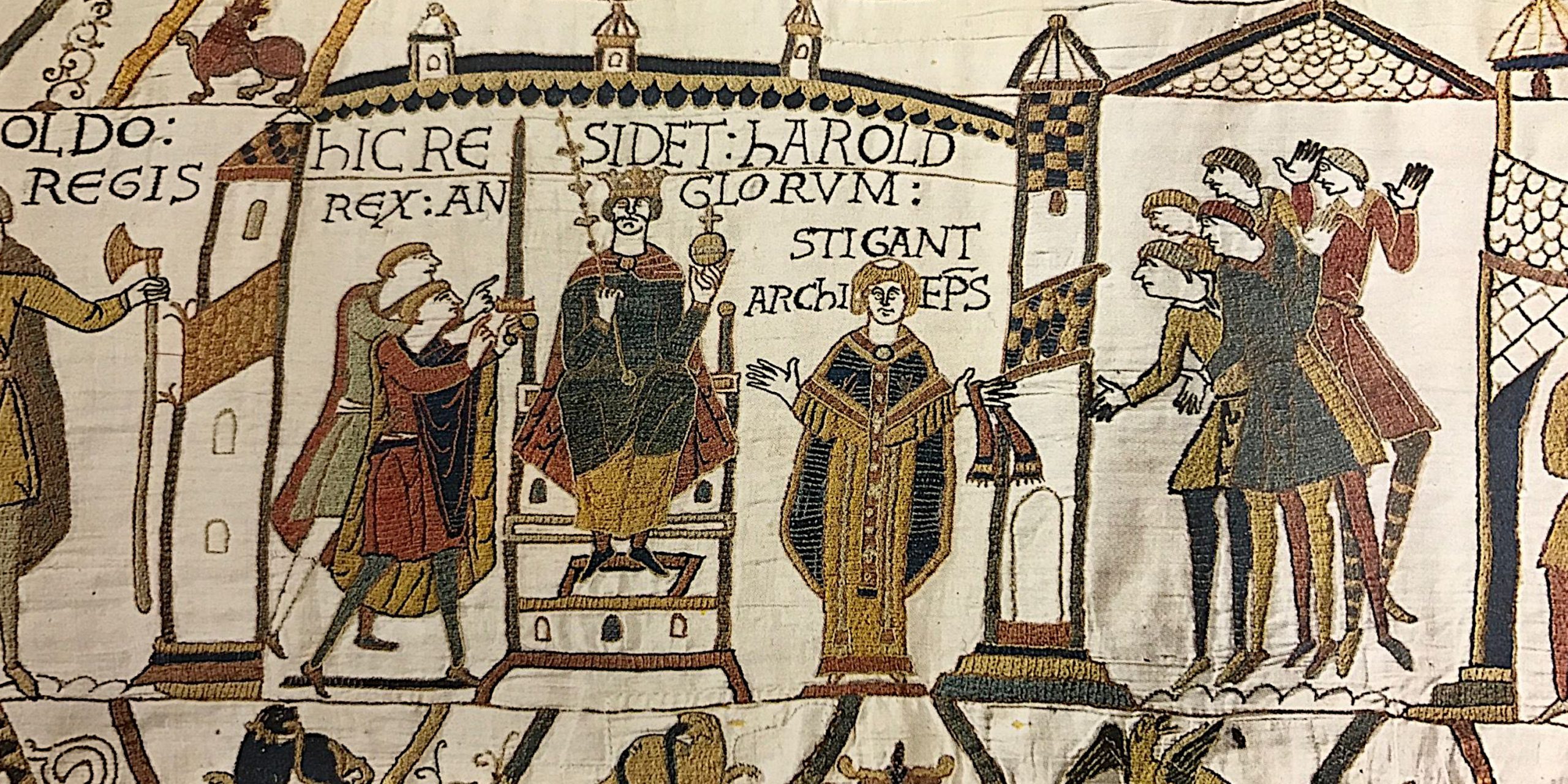
The Bayeux Tapestry is an embroidered chronicle of the Norman Conquest. At over 70 metres long, this Bayeux Tapestry: Symbols, Stories and the Politics of 1066
The Bayeux Tapestry tells the story of the Norman Conquest with ships, feasts, frightened horses and an impressive quantity of stabbing. Its most consequential weapon, though, may be the oath it shows Harold Godwinson swearing. Across nearly 70 metres of embroidery, the makers explain why William of Normandy believed he should be king and why Harold, in their telling, should not.
That makes the work an extraordinary source and a difficult witness. It was made within living memory of 1066, probably in England, but we do not know who designed it, who stitched each section or precisely what its first audience was expected to conclude. The images deserve close attention. They also deserve questions.
What Is the Bayeux Tapestry?
Despite its name, it is an embroidery, made with coloured wool on linen rather than woven as a tapestry. It was probably produced in the later eleventh century. Bishop Odo of Bayeux, William’s half-brother, is a plausible patron, although no surviving commission proves the case. The English origin often proposed for the workmanship rests on its style and context, not the signatures of its makers. Bayeux Museum.
The surviving strip begins with Harold travelling to Normandy and follows his encounter with William, the succession crisis, the invasion and the Battle of Hastings. Its ending is lost. We cannot say exactly what followed the final surviving scene, however tempting it is to supply a coronation and finish the story neatly.
The Oath: A Political Argument in Thread
Harold places his hands on reliquaries as he swears to William. The inscription identifies the event, but does not set out the oath’s exact terms. That distinction matters. William’s supporters held that Harold had promised to support his claim to the English throne. Harold was crowned after Edward the Confessor died in January 1066; the embroidery makes the earlier oath look like the moral centre of his offence.
The holy objects give the moment its force. An oath before relics carried religious weight, and a broken oath could be presented as more than ordinary political opportunism. What Harold believed he had promised, and under what pressure, remains open to debate. The scene shows what the makers wanted remembered, not a transcript of the meeting.
Comet, Crown and Omen
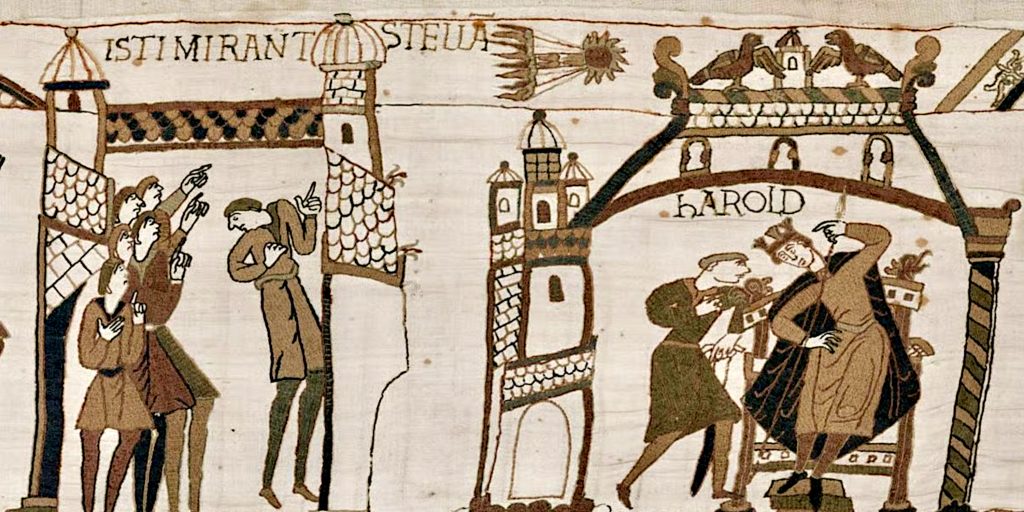
After Harold’s coronation, onlookers point to a comet above him. It is generally identified as Halley’s Comet, visible in 1066. In the picture it also works as an omen: the new king sits beneath an unsettling sign while ships appear in the lower border. We know what happened next, so the visual forecast is easy to read. Harold could not.
Medieval observers did not all assign a comet the same meaning. Its placement in this account encourages the viewer to connect celestial disturbance with an unstable reign, but the stitching does not supply a written verdict from heaven. Explore the embroidery scene by scene at Bayeux Museum.
What Do the Borders Mean?
Animals, birds, imagined creatures and figures occupy the bands above and below the central action. Some recall familiar fables, while others seem to echo or unsettle the events beside them. During the battle, the lower border fills with the dead and wounded; there it is difficult to call the margin merely decorative.
There is no secure key that translates every beast into a named politician or moral failing. I would be wary of any reading that makes the borders behave like a crossword with one perfect answer. Their power lies partly in how they draw a viewer back from the official story to its messier edges.
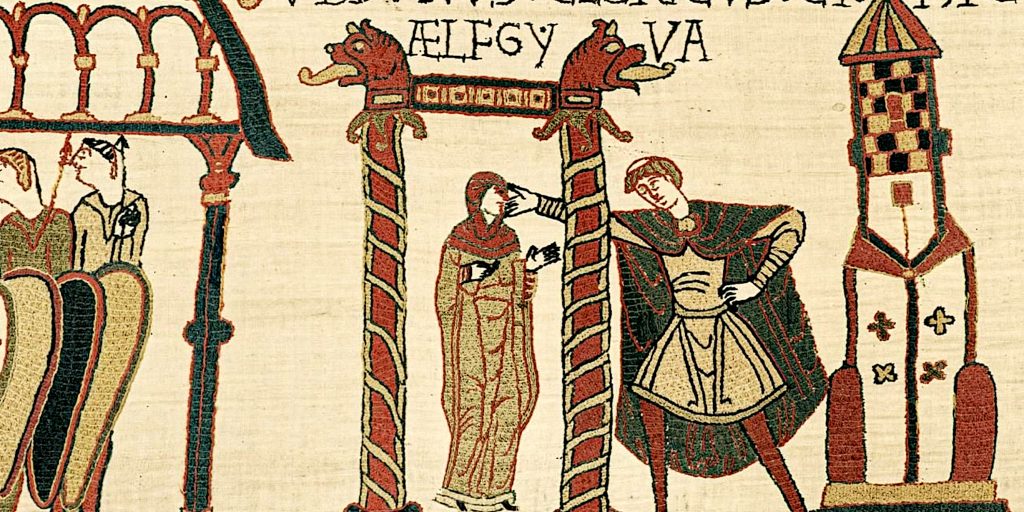
One especially stubborn puzzle is Ælfgyva. A cleric appears to touch her face, and the caption names her without explaining why she matters. Several identifications have been proposed; none is certain. The scene may have meant a great deal to its first audience. It gives modern historians rather less to work with, which has not stopped us from trying.
Arms and Armour: What the Stitching Shows
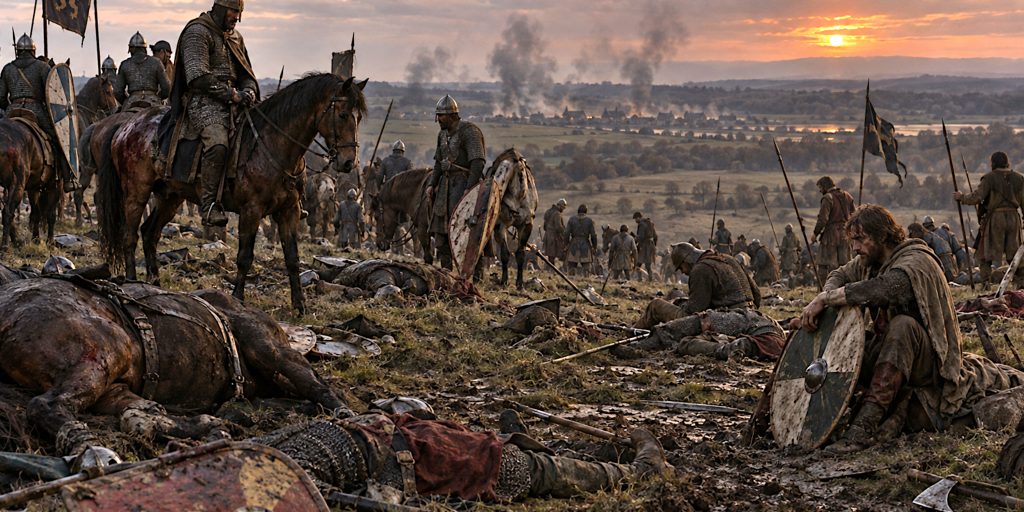
The battle scenes are rich evidence for how eleventh-century warriors were represented. They are not scale drawings or a complete kit list. Arms also overlap across the two armies: the picture should not be read as a catalogue of uniquely Norman and uniquely English equipment.
| Equipment | What to look for | How to read it |
|---|---|---|
| One-handed swords | Straight, double-edged blades with short crossguards, wielded with a shield | These belong to the broad family of late Viking-age and early medieval swords. The embroidery cannot distinguish a precise archaeological subtype from a few stitches. |
| Early arming swords | One-handed cruciform swords carried by mounted and foot warriors | This is a useful descriptive term for developing eleventh-century forms, not evidence that every sword had the same blade or hilt. |
| Spears and lances | Thrusting and throwing weapons used by infantry and cavalry | The spear was central to both sides; the mounted lance should not be imagined as the fully developed jousting weapon of later centuries. |
| Dane axes | Long-handled, broad-headed axes especially associated with English warriors | Formidable in experienced hands, though the embroidery cannot establish how common they were in the army. |
| Bows and arrows | Norman archers shooting toward English positions | Their presence matters to the story of the battle, but the image alone cannot count archers or reconstruct every volley. |
| Mail and helmets | Mail shirts, conical helmets, sometimes with nasal guards, and kite or round shields | Artists simplify material and construction. A stitched pattern of mail is evidence for representation, not a metallurgical analysis. |
The swords are most responsibly described as one-handed, double-edged medieval swords, including late Viking-age forms and the emerging arming-sword tradition. Labels such as Oakeshott Type X or XI can help compare surviving blades, but assigning one to an embroidered figure would be false precision. There are no longswords or plate-armoured knights here, despite the enthusiasm of later costume departments.
Archaeology: Where the Picture Meets the Ground
The embroidery itself is a surviving material object. Its linen, wool, seams, repairs and later interventions can reveal how it was made and preserved. That is a different kind of evidence from the battlefield: a restitched detail may tell us about the object’s history without proving what happened at Hastings.
The traditional battle site is associated with Battle Abbey, founded after the conquest. Archaeology has not produced a neatly labelled battlefield assemblage that verifies the precise sequence of charges, the number of casualties or Harold’s fatal wound. Weapons can be recovered, reused and lost elsewhere; nearly a thousand years of land use complicates the search. The absence of a decisive find is a limit on certainty, not proof that the battle occurred somewhere else.
Surviving eleventh-century swords, spearheads, axeheads and pieces of equipment provide physical comparisons for the shapes depicted in the embroidery. They cannot be assigned to an individual figure merely because the hilt looks familiar. The strongest reading sets image, material evidence and written testimony alongside one another, and admits when they refuse to line up.
Contemporary Words and What They Leave Out
The embroidery’s own Latin captions offer some of the closest contemporary words to its scenes. Short inscriptions guide the eye, but they rarely explain motive.
“Hic Harold sacramentum fecit Willelmo duci.”
“Here Harold made an oath to Duke William.”
This records an oath in the makers’ account, without giving its wording or Harold’s side of the bargain.
“Isti mirant stellam.”
“These men marvel at the star.”
The caption describes the watchers. The interpretation of the comet as a warning comes from its place in the narrative.
“Hic Harold rex interfectus est.”
“Here King Harold was killed.”
Even the final statement does not tell us precisely how he died. An arrow-struck figure stands close to a warrior cut down by a sword, and the image has been repaired over time. Certainty about the famous arrow in the eye asks more of this scene than it can safely give.
Harold’s Death and the Limits of the Story

The embroidery gives William a compelling sequence: Harold’s oath, Harold’s crown, an ominous sky and Harold’s fall. Yet it also grants space to English courage, Norman fear and the grim disorder of battle. It is partisan, but it is not a modern campaign poster with tidy edges.
The question I return to is who had the power to turn events into memory. The makers gave Harold a visible death and William a case for rule. They also left us those unruly borders, ambiguous gestures and a missing ending. The Bayeux Tapestry remains fascinating because it argues so confidently while showing just enough detail to make us argue back.
Where Can You See the Bayeux Tapestry?
The original belongs to the Bayeux Museum collection. Its Bayeux display is closed for renovation, with reopening planned for autumn 2027; check the museum’s current information for access and exhibition arrangements. The museum also offers an online scene-by-scene view. Reading Museum holds a full-scale Victorian copy, useful for following the complete narrative at a more leisurely pace.
Further Reading and Sources
English Heritage: Battle Abbey and the battlefield
Bayeux Museum: discover the embroidery
Bayeux Museum: explore it online
Bayeux Museum: current access information