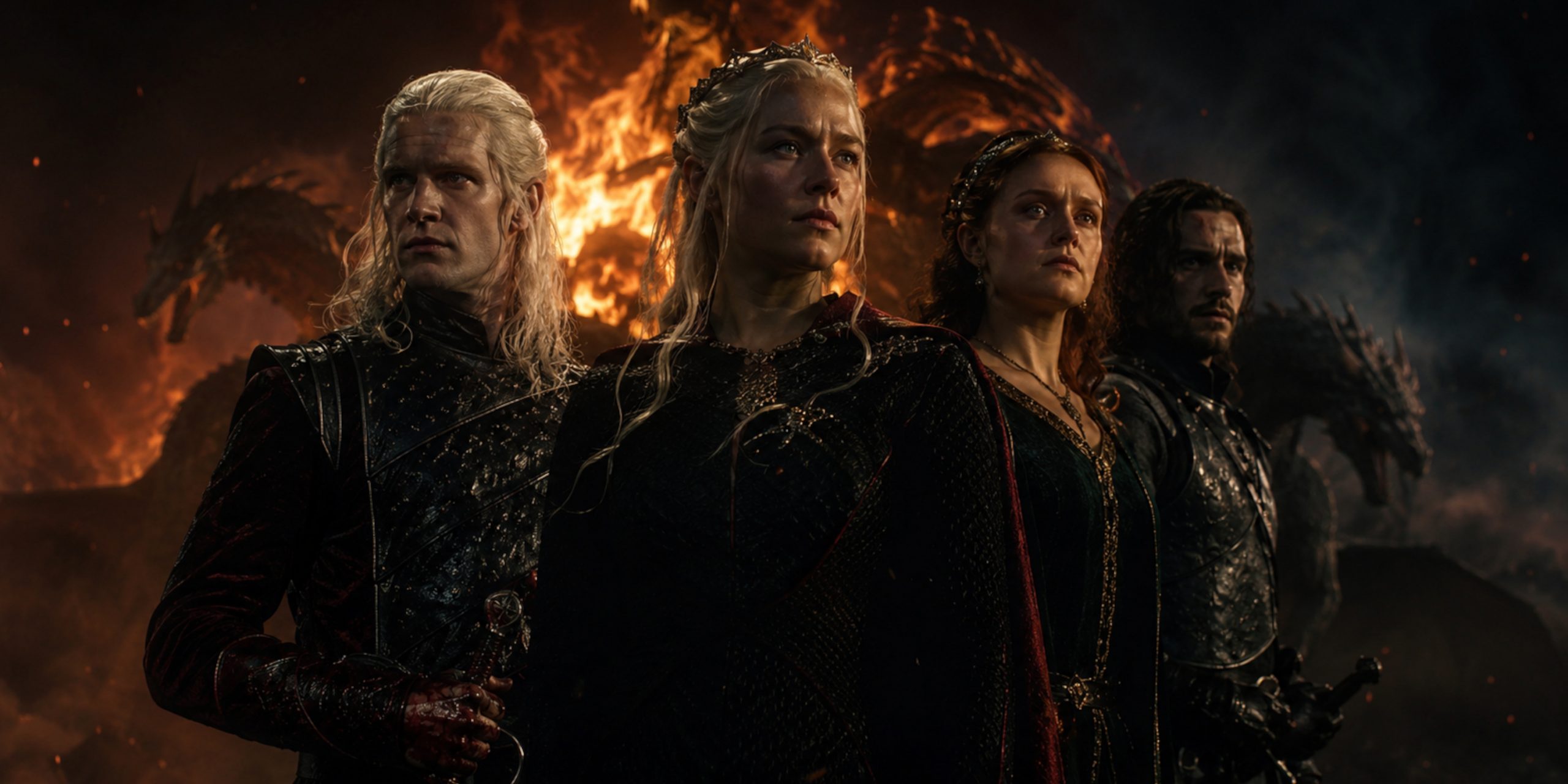
Heroism in House of the Dragon is a complicated thing. Westeros is not exactly a healthy place for idealists. Most “heroes” end up burned alive, betrayed by relatives, eaten by dragons, or emotionally ruined before breakfast.
Still, among the political snakes, war criminals, and deeply dysfunctional dragon-riders, a few characters genuinely rise above the rest. Some fight for honour. Some protect their family at impossible cost. Others stumble into heroism while carrying enough emotional baggage to sink a fleet.
After looking at bravery, sacrifice, leadership, loyalty, and overall impact, this ranking feels the most balanced. A few placements are debatable, naturally. This fandom could argue over soup recipes and somehow turn it into a civil war.
10. Ser Harrold Westerling
Harrold Westerling quietly became one of the most respected men in the show simply by maintaining basic honour. Which says quite a lot about King’s Landing.
He protects Rhaenyra from childhood, refuses to support political corruption, and walks away rather than betray his oath. In a world full of opportunists, Harrold feels refreshingly solid.
He ranks lower mainly because his influence on the wider conflict is limited, but morally? One of the cleanest men in Westeros. Quite possibly the only person in the Red Keep who sleeps without hearing ominous violin music.
9. Baela Targaryen
Baela Targaryen inherits Daemon’s fearlessness without fully inheriting the terrifying unpredictability that comes with it.
She is brave, fiercely loyal, and completely willing to stand beside her family during the coming war. Baela also has a grounded quality that makes her easy to root for. She does not waste time delivering dramatic speeches about destiny. She simply gets on with things.
That practicality alone puts her ahead of half the nobility in Westeros.
8. Ser Erryk Cargyll
The Cargyll twins storyline lands harder than many viewers expected.
Erryk Cargyll chooses loyalty to Rhaenyra despite knowing the decision could destroy him. His final confrontation with his brother becomes one of the most tragic moments in the series because neither man truly wants the fight.
Erryk’s heroism feels painfully human. No dragons, no crowns, no prophecies. Just loyalty pushed to its absolute limit.
That makes his story unforgettable.
7. Lucerys Velaryon
Lucerys Velaryon represents innocence trapped inside a dynastic nightmare built by older generations.
He tries to carry responsibility far beyond his years and still answers the call when his family needs him. His mission to Storm’s End is genuinely courageous, especially considering the terrifying political atmosphere surrounding him.
Luke ranks highly because his death changes everything. The Dance stops being a tense political dispute and becomes full-scale tragedy.
Also, facing Aemond Targaryen in a thunderstorm while riding a much smaller dragon is nightmare fuel.
6. Alicent Hightower
This placement will annoy people. Which probably means it is correct.
Alicent Hightower absolutely contributes to the war, but she is also one of the series’ most emotionally layered figures. She spends much of her life trapped between duty, manipulation, religion, motherhood, and political survival.
What keeps her in the hero conversation is intention. Alicent genuinely believes she is preserving stability and protecting her children. The tragedy is that the system surrounding her rewards fear instead of compassion.
She is not a classic fantasy hero. She is something more uncomfortable and realistic.
And frankly, surviving Otto Hightower’s parenting should earn a medal.
5. Cregan Stark
Cregan Stark barely appears for long, yet immediately feels important. That is the Stark effect.
He represents northern honour in its purest form. Direct, loyal, practical, and deeply unimpressed by southern political games. Every time a Stark walks into a Targaryen storyline, the entire atmosphere shifts. Suddenly actions matter again.
Cregan ranks this high because his reputation carries enormous weight within the wider lore of the Dance. He embodies the kind of grounded leadership Westeros desperately lacks.
Also, there is something deeply satisfying about a man from the freezing north arriving to clean up dragon aristocrat nonsense with pure disappointment.
4. Viserys I Targaryen
Viserys I Targaryen is arguably the emotional heart of the series.
He is not a conqueror or battlefield legend. In truth, he lacks the ruthlessness needed to fully control his court. Yet his defining quality is decency. He genuinely wants peace, unity, and stability in a realm built on ambition and resentment.
His final walk to the Iron Throne remains one of the strongest scenes in modern fantasy television. Frail, exhausted, and visibly dying, he still drags himself forward to defend Rhaenyra.
For one brief moment, the family almost heals.
Then Westeros immediately remembers what franchise it belongs to.
3. Rhaenys Targaryen
Rhaenys Targaryen combines wisdom, restraint, courage, and authority better than almost anyone else in the series.
She sees the coming catastrophe long before others do and repeatedly attempts to avoid unnecessary bloodshed. Her refusal to massacre the Greens during the Dragonpit scene remains controversial, yet it perfectly reflects her moral limits. She refuses to become a butcher simply because she has power.
Then comes Rook’s Rest.
Her final battle against impossible odds cements her status as one of the great tragic heroes of Westeros. Riding Meleys into near-certain death feels less like warfare and more like an ancient legend unfolding in real time.
Honestly, Westeros did not deserve her.
2. Daemon Targaryen
Daemon Targaryen is an absolutely terrible role model and one of the greatest fantasy characters HBO has ever produced.
He is reckless, violent, arrogant, emotionally unstable, and somehow still heroic when it matters most. Daemon repeatedly risks himself for his family and thrives in moments where everyone else freezes.
The Stepstones campaign alone turned him into a mythic figure. Charging alone through enemy lines because patience is apparently beneath him remains one of the show’s defining images.
What elevates Daemon is complexity. He feels like a warrior from an older age trapped inside a political system he despises. He is capable of tenderness one moment and horrifying brutality the next.
Basically, he is Westeros distilled into one platinum-haired menace.
1. Rhaenyra Targaryen
Rhaenyra Targaryen earns the top spot because the entire emotional and political weight of House of the Dragon rests on her shoulders.
Her story is tragic precisely because she begins with genuine hope. She wants legitimacy, stability, and eventually peace. Instead, she spends her life battling systems designed to deny her authority at every turn.
Rhaenyra’s heroism comes through endurance. She survives betrayal, grief, political sabotage, public humiliation, and devastating personal loss while still attempting to hold together a collapsing dynasty.
Even when war becomes inevitable, she hesitates before unleashing destruction. In Westeros, restraint is rarer than dragon eggs.
She is flawed, stubborn, proud, and occasionally reckless, but that humanity is exactly what makes her compelling. She does not feel like a distant fantasy icon. She feels painfully real.
And in a world filled with people desperate to seize power, Rhaenyra remains one of the few characters who understands the cost of it.
The Seven Swords Takeaway
The best heroes in House of the Dragon are rarely perfect people. Some are noble. Some are disasters in expensive armour. Some desperately need therapy, which unfortunately has not been invented in Westeros yet.
That complexity is what makes the series work.
Heroism here is not about shining purity or grand speeches. It is about surviving impossible pressure without completely losing yourself. Sometimes it means charging into battle on dragonback. Sometimes it means standing by your principles while the realm tears itself apart around you.
And sometimes it means surviving a Targaryen family dinner without someone reaching for a dagger.
A genuinely elite achievement, honestly.