The Byzantine Empire loved paperwork, ceremony, gold embroidery, and theological arguments that could somehow turn into street violence. Yet beneath the silk and incense stood something brutally practical, the Tagmata. These were the professional elite regiments of the Byzantine military, stationed close to Constantinople and loyal directly to the emperor. They were not farmers handed spears during a panic. They were full-time soldiers, drilled, mounted, heavily equipped, and often terrifyingly effective.
For several centuries the Tagmata formed the hard centre of Byzantine military power. They marched against Arabs, Bulgars, Rus’, rebels, and occasionally each other. They guarded emperors, crushed uprisings, and projected imperial authority from Italy to Anatolia. Byzantine chroniclers admired them, feared them, and occasionally blamed them for palace coups, which is usually a sign a unit mattered.
The story of the Tagmata is also the story of Byzantium itself. Sophisticated, disciplined, expensive, politically dangerous, and remarkably resilient.
What Were the Byzantine Tagmata?
The word tagma simply means “formation” or “unit” in Greek. In military terms, the Tagmata became the standing professional regiments of the middle Byzantine Empire, particularly from the eighth century onward.
They emerged after the empire suffered devastating losses during the Arab invasions of the seventh century. Earlier Roman field armies had collapsed or fragmented, and the Byzantines reorganised around regional military provinces known as the themes. The thematic troops were useful defensive forces, but emperors soon realised a dangerous truth. Provincial armies could become politically ambitious. Generals with loyal soldiers had an irritating habit of declaring themselves emperor.
The solution was the Tagmata.
These centrally controlled regiments were stationed near Constantinople and remained under imperial authority. They acted as shock troops, reserve forces, palace guards, and a counterweight to provincial military power.
The main Tagmata included:
- The Scholai
- The Excubitors
- The Arithmos or Vigla
- The Hikanatoi
Over time, additional elite formations joined the system, including foreign mercenaries such as the Varangian Guard.
Origins of the Tagmata
The roots of the Tagmata stretched back into the late Roman Empire. Units like the Scholae Palatinae originated under Emperor Constantine centuries earlier. However, the middle Byzantine Tagmata as most historians understand them truly developed under Emperor Constantine V in the eighth century.
Constantine V was a formidable military reformer and a deeply controversial ruler. His religious policies earned fierce criticism from later church writers, but militarily he understood the need for a reliable standing army. He expanded and institutionalised the Tagmata to secure imperial authority and improve battlefield performance.
This proved highly effective.
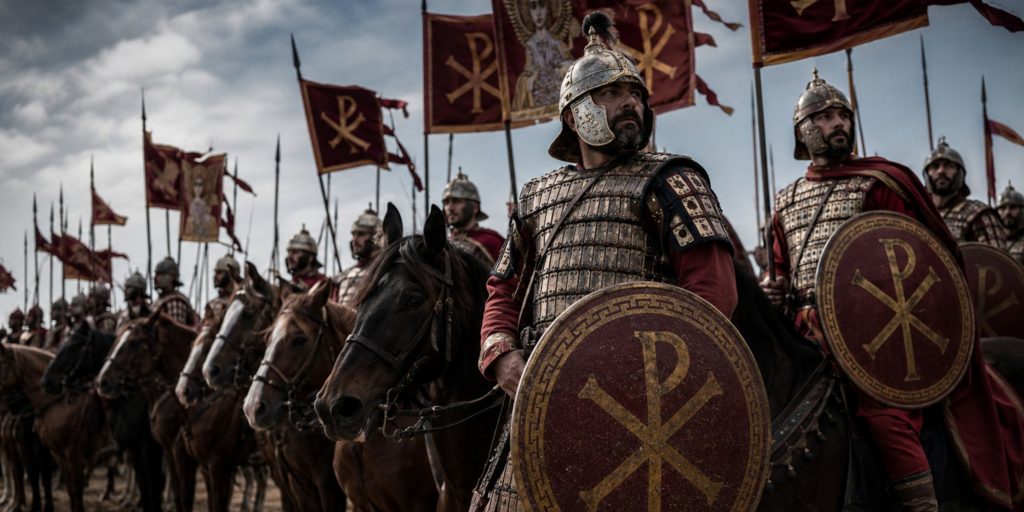
The Tagmata became professional cavalry-heavy formations that could rapidly reinforce threatened frontiers or accompany imperial campaigns. Unlike many thematic troops, they trained continuously and maintained better equipment standards.
Naturally, they also became involved in Byzantine palace politics. No elite guard unit in history has ever looked at a throne and thought, “best not get involved.”
Organisation and Structure
The exact size of the Tagmata remains debated because Byzantine sources often contradict each other with impressive confidence.
Most estimates suggest the major regiments ranged from roughly 1,000 to 4,000 men depending on period and circumstance. Collectively, the Tagmata may have numbered between 10,000 and 20,000 troops during their height in the ninth and tenth centuries.
Each regiment possessed a complex hierarchy of officers:
- Domestikos, senior commander
- Topoteretes, deputy commander
- Chartoularios, administrative officer
- Komes, lower-level field officer
Byzantine administration was famously detailed. The empire documented pay, equipment, logistics, and ceremonial duties obsessively. Somewhere in Constantinople there was probably a clerk arguing over saddle inventories while armies marched into Syria.
The Tagmata were primarily cavalry formations, though infantry elements existed. They operated alongside thematic armies during major campaigns and formed the disciplined reserve around which Byzantine battle plans often revolved.
Arms and Armour
The Tagmata were among the best-equipped soldiers in medieval Europe and the eastern Mediterranean.
Byzantine military manuals such as the Strategikon and later the Taktika provide valuable evidence regarding their equipment and battlefield methods.
Armour
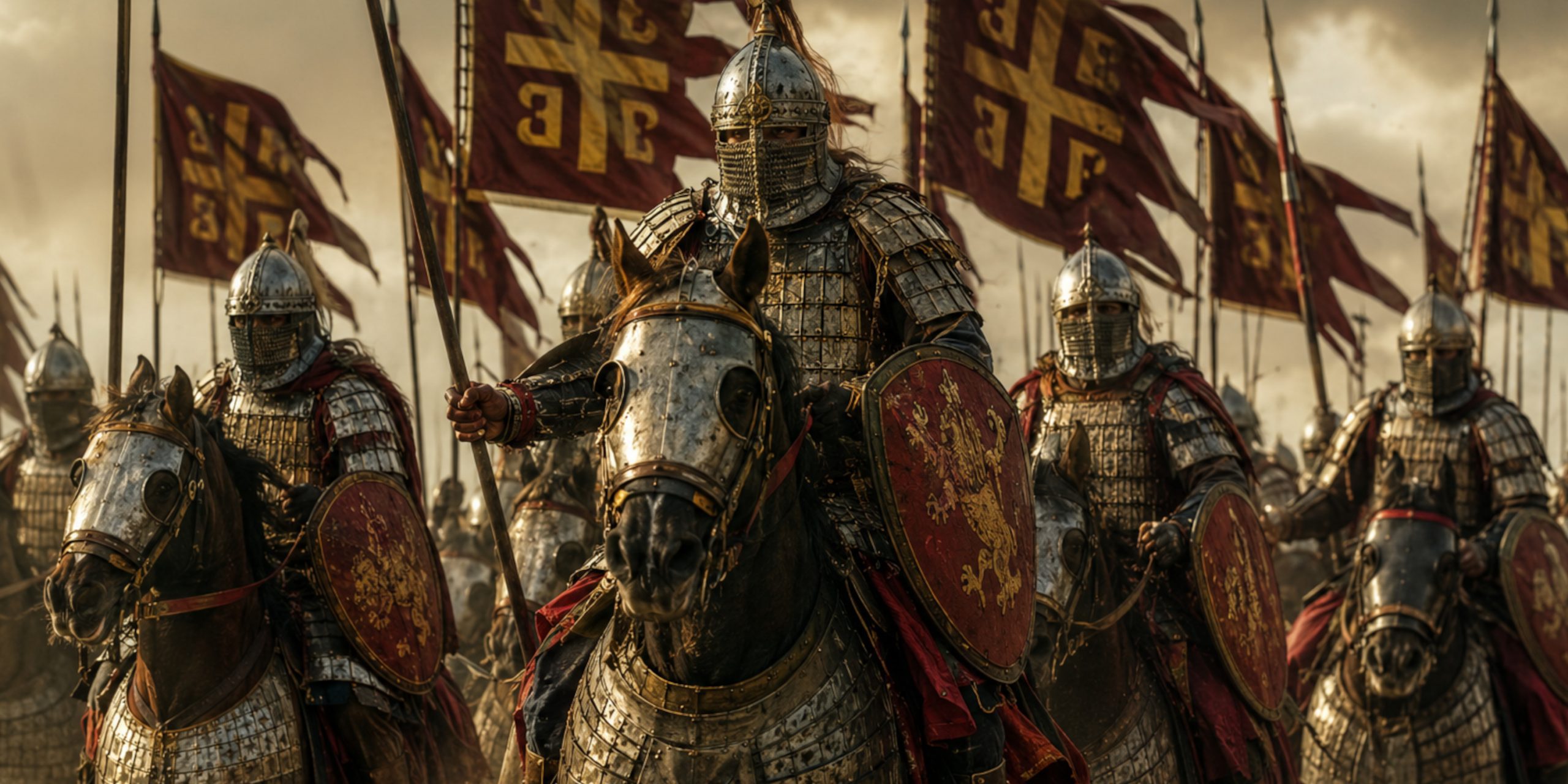
Elite Tagmatic troops commonly wore:
- Lamellar armour made from overlapping metal plates
- Scale armour
- Mail hauberks
- Padded quilted garments beneath armour
- Iron or steel helmets with nasal guards
- Arm guards and greaves for wealthier cavalrymen
Some officers likely wore highly decorated armour featuring gilded fittings and silk elements, because Byzantine officers rarely missed an opportunity to look expensive.
Shields varied depending on role. Cavalry units often carried rounded or kite-shaped shields decorated with Christian imagery, imperial symbols, or geometric patterns.
Weapons
The Tagmata used a wide range of weapons suited to cavalry warfare and disciplined combined-arms tactics.
Sword Types
Specific sword forms associated with Byzantine forces included:
- Spathion
The standard Byzantine straight sword descended from late Roman cavalry weapons. Double-edged and versatile, the spathion remained common for centuries. - Paramerion
A slightly curved sabre-like sword worn suspended from a baldric. This weapon became increasingly prominent during the middle Byzantine period and reflected eastern cavalry influences. - Spatha variants
Longer cavalry blades designed for mounted combat.
Many Byzantine swords displayed a fascinating blend of Roman, Persian, steppe, and Islamic influences. The empire sat at the crossroads of continents and borrowed useful ideas with very little embarrassment.
Other Weapons
Tagmatic soldiers also used:
- Kontarion cavalry lances
- Composite bows
- Spears
- Maces
- Axes
- Daggers
Mounted archery became increasingly important, particularly during campaigns against steppe enemies and Muslim cavalry forces.
Battlefield Role and Tactics
The Tagmata excelled as disciplined professional troops capable of rapid manoeuvre and coordinated attacks.
Byzantine warfare relied heavily on planning, deception, and flexibility rather than reckless frontal charges. The empire preferred winning intelligently, which occasionally caused western chroniclers to mutter darkly about Byzantine “trickery.” Modern historians usually call this “competent generalship.”
Tagmatic cavalry often served as:
- Elite reserve forces
- Shock cavalry
- Imperial bodyguards
- Strategic rapid-response troops
- Counterattack formations
The Byzantines frequently combined heavy cavalry charges with missile troops and feigned retreats. Manuals emphasised discipline and cohesion over individual heroics.
One of the empire’s great strengths lay in its ability to adapt. The Tagmata fought Arabs in Syria, Bulgars in the Balkans, Rus’ raiders near Constantinople, and Norman knights in Italy. Their tactics evolved constantly.
Famous Campaigns and Battles
The Tagmata appeared in many major Byzantine campaigns.
Wars Against the Bulgars
During the ninth and tenth centuries, Tagmatic units fought repeatedly against the Bulgarian Empire. Campaigns under emperors such as Basil II relied heavily upon elite professional troops.
At the Battle of Kleidion in 1014, Byzantine forces shattered the Bulgarians in one of the empire’s greatest victories.
Arab-Byzantine Wars
The Tagmata played critical roles during campaigns in Anatolia and Syria. Byzantine offensives under emperors like Nikephoros II Phokas and John Tzimiskes used highly mobile professional armies supported by elite cavalry.
These campaigns gradually reversed centuries of territorial losses.
Defence of Constantinople
Tagmatic regiments frequently defended Constantinople against rebellion and invasion alike.
During periods of crisis, these troops acted as the emperor’s most reliable military asset. Reliability, of course, was relative in Byzantine politics. Some Tagmatic officers eventually supported coups when the political winds shifted.
Archaeology and Material Evidence
Archaeological evidence for the Tagmata remains scattered but significant.
Finds from sites across modern Turkey, Greece, and the Balkans have uncovered:
- Lamellar armour fragments
- Byzantine helmets
- Sword fittings
- Spurs and horse equipment
- Military belt fittings
- Arrowheads and spearheads
Excavations at sites connected to Byzantine military activity, including parts of Constantinople and frontier fortresses in Anatolia, continue to reveal insights into elite military equipment.
Several surviving Byzantine military manuals also act almost like archaeological evidence in written form. The Taktika of Leo VI and the Praecepta Militaria provide detailed descriptions of cavalry organisation, battlefield formations, and ideal equipment.
Modern historians still debate how closely reality matched the manuals. Medieval commanders often described ideal armies rather than the exhausted men actually standing in mud wondering where the supply wagons had gone.
Contemporary Quotes
Byzantine and foreign writers left vivid impressions of imperial troops.
The historian Leo the Deacon described Byzantine cavalry in terms that emphasised discipline and spectacle:
“Their ranks shone with iron and bronze, and the glitter of arms flashed like lightning.”
Arab chroniclers also respected Byzantine military organisation, even while fighting against it for generations.
The emperor Leo VI wrote in the Taktika:
“The safety of the state rests upon the arms of its soldiers and the wisdom of its commanders.”
Meanwhile, western visitors to Constantinople frequently marvelled at the splendour of imperial guards and ceremonial regiments. The Byzantines understood psychological warfare very well. If ambassadors left slightly intimidated and dazzled by gold armour, the day had gone successfully.
Decline of the Tagmata
The Tagmata gradually weakened during the later Byzantine centuries.
Several factors contributed:
- Financial strain
- Civil wars
- Reliance on mercenaries
- Territorial losses
- Political instability
The catastrophic defeat at Manzikert in 1071 damaged the empire’s military foundations severely. Although Byzantine armies recovered somewhat under the Komnenian emperors, the old Tagmatic system never fully regained its earlier dominance.
Foreign mercenary forces increasingly replaced traditional professional regiments. The famous Varangian Guard endured, but the classic Tagmata faded into history.
By the time of the Fourth Crusade in 1204, the empire’s military structure had transformed dramatically from its ninth-century peak.
Legacy of the Tagmata
The Tagmata represented one of the most sophisticated standing military systems of the medieval world.
They preserved elements of Roman military professionalism long after the western empire collapsed. Their organisation, cavalry doctrine, logistics, and tactical flexibility influenced neighbouring powers for centuries.
Modern historians increasingly recognise how advanced Byzantine military thinking could be. These were not simply relics of Rome clinging to survival. They were adaptive, highly organised forces capable of remarkable operational effectiveness.
The Tagmata embodied the Byzantine state itself. Wealthy, cultured, disciplined, politically complicated, and surprisingly durable.
For an empire that supposedly spent a thousand years “declining,” Byzantium produced elite regiments that most medieval rulers would have desperately wanted at their side.
Where to See Byzantine Military Artefacts Today
Important collections of Byzantine arms and military artefacts can be seen at:
- Istanbul Archaeological Museums
- Byzantine and Christian Museum
- Topkapı Palace Museum
- The Metropolitan Museum of Art
- Dumbarton Oaks
These collections include Byzantine swords, armour fragments, helmets, icons depicting soldiers, and ceremonial military equipment tied to imperial service.
Sevenswords Takeaway
The Byzantine Tagmata remain among the most fascinating military institutions of the medieval world. They combined Roman heritage with medieval innovation in ways few states could match.
They were not invincible. No army facing centuries of invasions, coups, plagues, and budget disasters ever is. Yet for long stretches of history they provided the empire with a professional military core that repeatedly stabilised a state surrounded by enemies.
And perhaps that is the real achievement. The Tagmata did not merely fight battles. They helped keep Byzantium alive long enough to become one of history’s most extraordinary survivors.