Sibylla of Jerusalem remains one of the most controversial figures of the Crusading era. Medieval chroniclers rarely knew what to do with powerful women, particularly those who inherited crowns rather than merely marrying into them. As a result, Sibylla has often been reduced to caricature. Either a foolish romantic who doomed Jerusalem through love for Guy of Lusignan, or a tragic queen trapped by ambitious men around her.
The truth is more interesting and rather more human.
She lived through one of the most unstable periods in the history of the Latin East, survived palace intrigue that would make modern political advisers faint into their coffee, and inherited a kingdom already teetering towards disaster. By the time Jerusalem fell to Saladin in 1187, many contemporaries were desperate for someone to blame. Sibylla proved convenient.
Historians have spent centuries untangling the propaganda.
Who Was Sibylla of Jerusalem?
Sibylla was born around 1160, the elder daughter of Amalric I of Jerusalem and Agnes of Courtenay. Through her father she belonged to the ruling dynasty of the Kingdom of Jerusalem, one of the Crusader states founded after the First Crusade.
Her younger brother became the famous Baldwin IV, remembered today as the “Leper King”. That nickname has rather overshadowed everyone else in the family, which is unfortunate because Sibylla’s political importance was immense.
From childhood, she stood close to the centre of succession politics. In a kingdom constantly threatened by invasion, the question of who inherited the crown was never academic. It meant survival.
Sibylla spent part of her youth in the convent of Bethany under the care of her great-aunt, the abbess Ioveta. Medieval chroniclers often present this as evidence of piety and refinement, though convent education for noblewomen was also practical. It provided literacy, courtly education, and insulation from political danger.
Jerusalem, unlike many western kingdoms, could not afford weak rulers or endless succession disputes. Unfortunately, it got both anyway.
The Kingdom of Jerusalem Before Sibylla’s Reign
By the 1170s, the Crusader kingdom faced mounting pressure from the rising power of Saladin.
The Latin Kingdom of Jerusalem was wealthy by Crusader standards, but dangerously fragmented. Noble factions competed constantly, military orders gained enormous influence, and relations with neighbouring Muslim powers swung wildly between diplomacy and open warfare.
Baldwin IV’s leprosy transformed succession politics into a crisis. Since his illness made it unlikely he would produce heirs, attention shifted towards Sibylla and her younger half-sister Isabella.
Whoever married Sibylla could potentially become king.
That made her one of the most politically valuable women in the eastern Mediterranean. No pressure, then.
Sibylla’s First Marriage
Around 1176, Sibylla married William of Montferrat, a nobleman from a powerful Italian family connected to European royal courts.
Contemporaries viewed the match as prestigious and politically sensible. William had strong western connections and military credibility, both valuable assets for Jerusalem.
The marriage, however, was tragically short.
William died in 1177, likely from malaria or another disease common in the Levant. Sibylla was pregnant at the time and later gave birth to a son, Baldwin V.
The child immediately became politically significant. His existence complicated the ambitions of rival factions while strengthening Sibylla’s position within the succession.
Marriage to Guy of Lusignan
Few marriages in Crusader history have generated more argument than Sibylla’s union with Guy of Lusignan.
Guy arrived in the East as a relatively obscure Poitevin nobleman. Through family connections and court influence, particularly involving Sibylla’s mother Agnes, he rapidly rose in prominence.
Sibylla married Guy around 1180.
Many nobles opposed the match. Chroniclers hostile to Guy portrayed him as inexperienced, arrogant, and politically disastrous. Unfortunately for Guy, later events did little to repair his reputation.
Yet modern historians increasingly question whether Sibylla herself truly acted irrationally. Marriage in Jerusalem was inseparable from political necessity. Several powerful nobles were manoeuvring to control the succession, and Sibylla may have chosen Guy partly to avoid becoming a puppet for rival baronial factions.
That interpretation gives her considerably more agency than older histories allowed.
It also makes more sense.
Contemporary Views of Sibylla
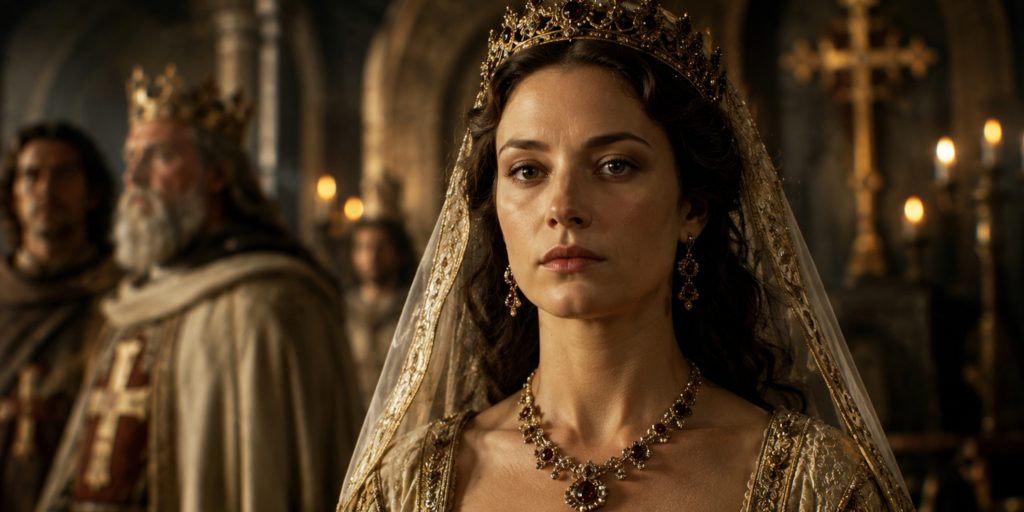
Medieval chroniclers often wrote with obvious political agendas. Sibylla’s reputation suffered heavily after the catastrophe at Hattin and the fall of Jerusalem.
William of Tyre, who disliked several court factions surrounding Sibylla, described her as:
“A woman not lacking in cunning.”
In medieval chronicler language, this was not necessarily praise. It usually meant the writer had lost patience with a politically active woman.
The hostile chronicle known as the Ernoul Chronicle blamed her marriage to Guy for the kingdom’s collapse:
“Through her affection for Guy, the kingdom was destroyed.”
That judgement is dramatic, memorable, and probably unfair.
Other contemporary accounts portray Sibylla as intelligent, charismatic, and capable of commanding loyalty. Even critics acknowledged her determination during moments of crisis.
Queen of Jerusalem
In 1186, Baldwin V died as a child king. His death triggered a succession struggle between supporters of Sibylla and supporters of Isabella.
Sibylla moved quickly.
In one of the most politically skilful episodes of Crusader history, she secured her coronation as Queen of Jerusalem. According to several accounts, she agreed to annul her marriage to Guy as a condition for gaining support from sceptical nobles.
Once crowned, she promptly crowned Guy herself anyway.
One almost has to admire the audacity.
Whether this was carefully planned from the beginning or a rapid improvisation remains debated. Either way, it demonstrated that Sibylla was not merely a passive figure manipulated by others. She understood power and how to wield it.
The nobles, predictably, were furious.
The Road to Hattin
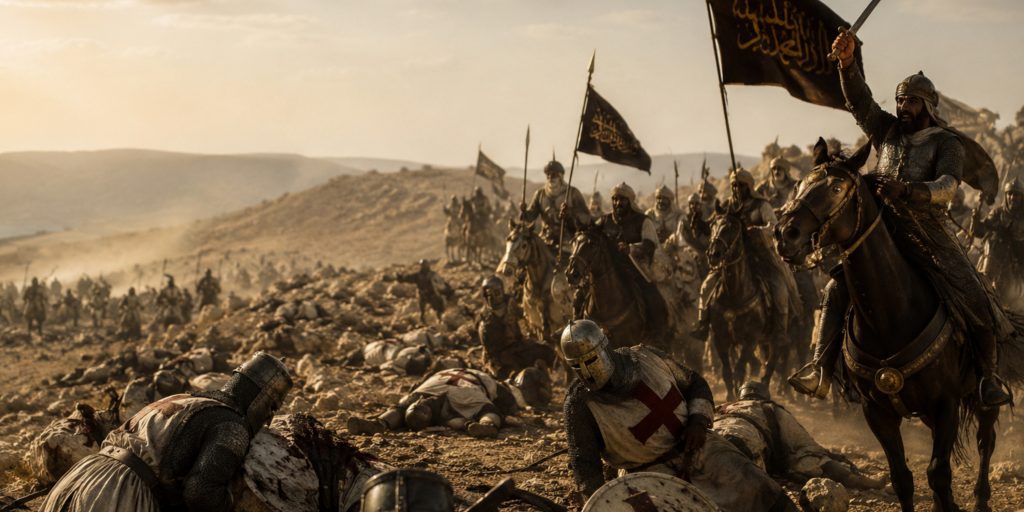
The Kingdom of Jerusalem in 1187 stood on the edge of military disaster.
Tensions with Saladin escalated following raids and provocations by Reynald of Châtillon, one of the most reckless men ever entrusted with military authority. Reynald possessed courage in abundance and judgement in alarmingly short supply.
Guy of Lusignan, now king through Sibylla, struggled to unite the kingdom’s factions. Some nobles distrusted him deeply, while others openly challenged royal authority.
Saladin exploited these divisions masterfully.
In July 1187, the Crusader army marched towards the Horns of Hattin under punishing heat and dwindling water supplies. The resulting battle became one of the greatest disasters in Crusader history.
The Crusader army was annihilated.
Guy was captured. Reynald was executed personally by Saladin. The relic of the True Cross was lost. Within months, Jerusalem itself surrendered.
For medieval Europe, the shock was immense.
For Sibylla, it was catastrophic on both political and personal levels.
Sibylla During the Fall of Jerusalem
After Hattin, Sibylla displayed resilience often ignored by older historians.
She joined Guy during the defence of Tyre and later accompanied him during the siege of Acre. Despite the collapse of the kingdom around her, she remained politically active and loyal to her husband.
This loyalty became central to both her criticism and admiration.
Some contemporaries viewed her devotion to Guy as blindness. Others saw steadfastness under extraordinary pressure.
The reality may have been simpler. In a collapsing kingdom surrounded by enemies and traitors alike, loyalty mattered.
Death at Acre
In 1190, during the harsh conditions of the siege of Acre, Sibylla died alongside her daughters, likely from disease.
Her death transformed the politics of the Crusader kingdom overnight.
Guy’s claim to the throne depended entirely on his marriage to Sibylla. Without her, support for him collapsed rapidly. Isabella became the new focus of succession politics.
Even in death, Sibylla remained central to the fate of the kingdom.
Was Sibylla Responsible for the Fall of Jerusalem?
This question has followed her for centuries.
Older historians often treated Sibylla as emotionally driven and politically naive. More recent scholarship paints a far more complicated picture.
The Kingdom of Jerusalem already faced severe structural problems long before her reign:
- Increasing military pressure from Saladin
- Noble factionalism
- Weak finances and manpower shortages
- Succession instability caused by Baldwin IV’s illness
- Strategic disagreements among leading barons
Blaming Sibylla alone ignores these realities.
Guy of Lusignan certainly made questionable decisions, especially before Hattin, but the kingdom’s problems ran deeper than one marriage or one queen.
Sibylla inherited a political crisis, not a stable throne.
Sibylla in Popular Culture

Modern portrayals of Sibylla often emphasise romance and tragedy, particularly after Ridley Scott’s Kingdom of Heaven.
In the film, she appears as intelligent, compassionate, and trapped within a doomed political world. While historically simplified, the portrayal helped revive interest in her life.
The real Sibylla was probably tougher than most cinematic versions suggest.
People did not survive Crusader politics by being delicate.
Historical Legacy
Sibylla of Jerusalem remains difficult to categorise neatly, which is usually a sign that a historical figure deserves closer attention.
She was ambitious when necessary, loyal to her husband despite enormous political pressure, and capable of decisive action during succession crises. She also became the unfortunate symbol of a kingdom’s collapse, blamed by writers eager for moral lessons and convenient scapegoats.
History often judges women in power harshly, especially when kingdoms fall around them.
Yet Sibylla endured civil division, dynastic crisis, invasion, and siege while remaining at the centre of events. That alone marks her as remarkable.
The Kingdom of Jerusalem did not collapse because one woman fell in love with the wrong man. Medieval politics was rarely that tidy.
If only chroniclers had been less interested in assigning blame and more interested in understanding complexity. Historians today would sleep better.