What We Know About the Struggle That Changed the Medieval East
The Byzantine–Seljuk Wars were not a single clean conflict with obvious beginnings and endings. They were decades of raids, betrayals, civil wars, shattered armies, desperate diplomacy and moments of astonishing incompetence. Entire regions changed hands while emperors argued with their own generals and Turkish warbands wandered through Anatolia looking for plunder, pasture and opportunity.
By the end of the 11th century, the Byzantine Empire had lost much of Anatolia, the great military heartland that had sustained it for centuries. The Seljuks, meanwhile, transformed from steppe newcomers into rulers of a vast Islamic power stretching across Persia, Iraq and much of Asia Minor.
This was not simply a border war. It altered the balance of power in the eastern Mediterranean, weakened Constantinople and helped create the conditions that eventually led to the Crusades. Medieval history has few moments where so much collapses so quickly.
And, naturally, several of the people responsible believed they were handling things brilliantly.
Who Were the Byzantines?
The Byzantine Empire was the continuation of the Eastern Roman Empire, centred on Constantinople. By the 11th century it remained wealthy, sophisticated and deeply conscious of its Roman identity. Its armies combined heavy cavalry, disciplined infantry and a highly developed system of provincial military administration.
Yet beneath the polished surface, cracks were widening.
The empire had become politically unstable after the death of Basil II in 1025. Court factions, aristocratic rivalries and short-lived emperors weakened central authority. Provincial armies declined, while mercenaries became increasingly common.
Unfortunately for Byzantium, this decline coincided with the arrival of one of the most dynamic military powers of the medieval world.
Who Were the Seljuks?
The Seljuks emerged from Turkic nomadic groups originating in Central Asia. Fiercely mobile and highly adaptable, they adopted Sunni Islam and rapidly expanded westward during the 11th century.
Under leaders such as Tughril Beg and Alp Arslan, the Seljuks conquered Persia, entered Baghdad and became protectors of the Abbasid Caliphate. Their armies relied heavily on mounted archers who excelled in mobility, harassment and feigned retreats.
To Byzantine commanders trained in more traditional warfare, fighting Seljuk cavalry could feel like trying to punch smoke.
The Seljuks did not initially seek to destroy Byzantium outright. Much of the early conflict involved raids into Anatolia, frontier warfare and opportunistic expansion. Over time, however, those raids became settlements, and settlements became permanent conquest.
Key Causes of the Conflict
Pressure on Anatolia
Anatolia was the strategic and agricultural backbone of Byzantium. Turkish raids into the region disrupted farming, trade and military recruitment.
Once nomadic groups began settling there permanently, Byzantine recovery became vastly harder.
Byzantine Political Instability
The empire was weakened by succession disputes and internal rivalries. Generals often feared political enemies in Constantinople as much as foreign armies.
At times, Byzantine leaders actively undermined one another during military campaigns. This is rarely ideal.
Seljuk Expansion
The Seljuks expanded rapidly after victories against rival Islamic dynasties and regional powers. Their success gave them momentum, manpower and prestige.
The Byzantine frontier became the next major zone of opportunity.
Weakening of the Theme System
The Byzantine provincial military structure, known as the theme system, had deteriorated badly by the mid-11th century.
Large landowners gained influence while local military recruitment declined. This left Anatolia increasingly exposed.
Major Battles of the Byzantine–Seljuk Wars
Battle of Kapetron (1048)
One of the earliest major clashes between Byzantines and Seljuk forces took place near Kapetron in Armenia.
The battle itself was inconclusive, but it demonstrated the growing Seljuk threat. Turkish mounted raiders proved difficult to pin down, while Byzantine frontier defences appeared increasingly stretched.
The raids continued.
Sack of Ani (1064)
The Seljuks captured the Armenian city of Ani after a brutal siege led by Alp Arslan.
Ani had once been known as the “City of a Thousand and One Churches”. Its fall shocked the Christian world and exposed the vulnerability of Byzantine Armenia.
Contemporary chroniclers described slaughter and devastation throughout the city.
Battle of Manzikert (1071)
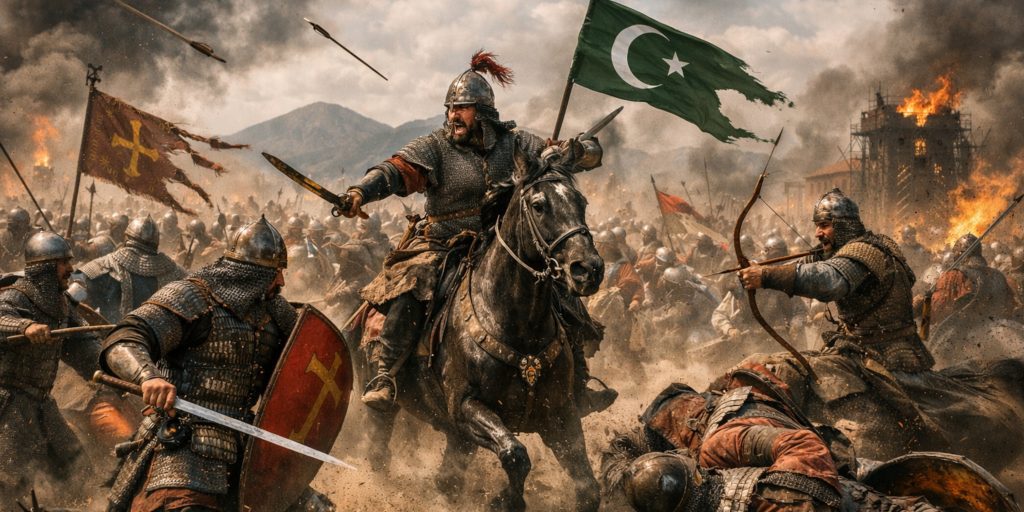
The most famous battle of the conflict, and arguably one of the most catastrophic defeats in Byzantine history.
Romanos IV Diogenes marched east to stabilise the frontier and confront Alp Arslan. The Byzantine army included native troops, mercenaries and unreliable political rivals.
That last detail mattered enormously.
The two armies met near Manzikert in eastern Anatolia. During the battle, confusion spread through the Byzantine ranks. Some units retreated prematurely while others may have deliberately abandoned the emperor.
Romanos IV was captured after the Byzantine collapse.
The battle itself was not necessarily annihilating in purely military terms. What followed was worse. Byzantine civil war erupted almost immediately, leaving Anatolia exposed to Turkish settlement and conquest.
The empire never truly recovered its grip on the region.
Contemporary historian Michael Attaleiates wrote:
“The whole West and East were filled with corpses.”
Another chronicler, Matthew of Edessa, described the defeat as:
“A calamity for all Christendom.”
Both men were not exaggerating for dramatic effect. Well, not entirely.
Battle of Dorylaeum (1097)
Although technically connected to the First Crusade, Dorylaeum reflected the continuing Byzantine–Seljuk struggle.
Crusader and Byzantine-allied forces defeated the Seljuks near Dorylaeum in western Anatolia. The victory temporarily restored some Byzantine control over coastal regions.
Yet the deeper transformation of Anatolia was already underway.
Important Figures
Romanos IV Diogenes
A capable but ultimately doomed Byzantine emperor, Romanos IV attempted to restore military discipline and frontier security.
His defeat at Manzikert destroyed his position politically. After returning from captivity, he was overthrown, blinded and died shortly afterwards.
The Byzantine habit of mutilating failed rulers was efficient in a grimly bureaucratic sort of way.
Alp Arslan
The Seljuk sultan Alp Arslan was one of the great commanders of the medieval Islamic world.
A skilled strategist and pragmatic ruler, he defeated Byzantium at Manzikert but reportedly treated Romanos IV with relative respect after capturing him.
According to later tradition, Alp Arslan asked the defeated emperor:
“What would you do if I were brought before you as a prisoner?”
Romanos allegedly replied:
“Perhaps I would kill you.”
Alp Arslan answered:
“My punishment is far heavier. I forgive you.”
Whether perfectly accurate or not, medieval writers adored this story.
Alexios I Komnenos
Alexios inherited a deeply weakened empire in 1081 and spent much of his reign trying to recover lost territory.
Unable to fully reverse Seljuk expansion alone, he appealed to the West for military assistance. This appeal helped trigger the First Crusade.
One can argue endlessly about who “caused” the Crusades, but Alexios certainly opened the door.
Arms and Warfare
Byzantine Forces
Byzantine armies still retained formidable elements during the 11th century.
Common Arms and Equipment
- Kontarion cavalry lances
- Composite bows
- Swords such as the spathion
- Maces and axes
- Lamellar armour
- Kite shields
Elite Byzantine cavalry, particularly the cataphract tradition, remained dangerous when properly organised.
Seljuk Forces
Seljuk armies excelled in mobility and ranged warfare.
Common Arms and Equipment
- Composite reflex bows
- Curved sabres
- Spears and light lances
- Leather and lamellar armour
- Horse archery equipment
Seljuk tactics relied on speed, encirclement and psychological pressure. Feigned retreats frequently lured heavier opponents into disorder.
Archaeology and Historical Evidence
Manzikert Battlefield Debate
The exact location of the Battle of Manzikert remains debated among historians and archaeologists.
Surveys around eastern Turkey have identified possible battlefield zones, though definitive evidence remains elusive. Terrain analysis suggests the geography strongly favoured mobile Seljuk cavalry.
Byzantine Fortifications
Excavations across Anatolia reveal the decline and abandonment of Byzantine frontier settlements during the late 11th century.
Many fortresses show evidence of hurried repairs, destruction layers and changing occupation patterns linked to Turkish expansion.
Coin Hoards and Settlement Shifts
Archaeologists have uncovered coin hoards buried during periods of instability, suggesting widespread insecurity across Anatolia after 1071.
Settlement patterns also changed significantly, with Turkish pastoral communities gradually integrating into formerly Byzantine regions.
The transformation was not immediate, but it was relentless.
Contemporary Views of the War
The Byzantine chronicler Anna Komnene, daughter of Alexios I, viewed the Turkish advance as both a military and civilisational disaster.
She described parts of Anatolia as effectively overrun and devastated by raids.
Islamic chroniclers, meanwhile, often celebrated Seljuk victories as evidence of divine favour and military superiority.
Perspectives differed sharply depending on which side had just burned your town.
Why the Byzantine–Seljuk Wars Matter
The wars reshaped the medieval Near East.
Byzantium lost much of Anatolia, weakening its economy, recruitment base and strategic depth. The Seljuks established themselves permanently in Asia Minor, laying foundations for later Turkish states, including eventually the Ottoman Empire.
The conflict also helped bring Western European crusaders into the eastern Mediterranean, permanently altering relations between Latin Christendom, Byzantium and the Islamic world.
In many ways, the medieval world after Manzikert looked fundamentally different from the world before it.
That is why historians still return to these wars. Not merely because armies fought and emperors failed, but because an entire geopolitical order shifted beneath their feet.
And because few historical collapses are quite so painful to watch in slow motion.