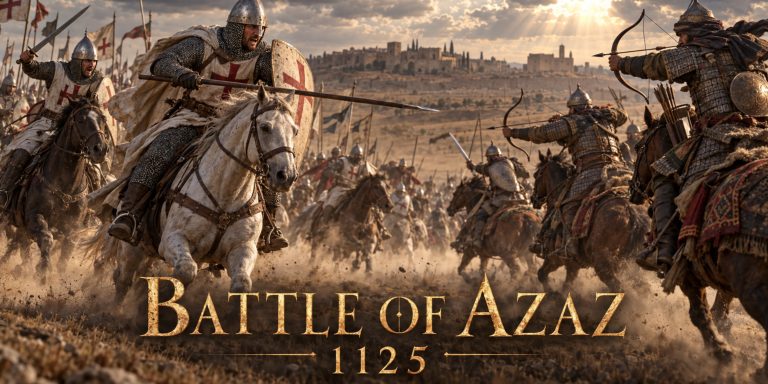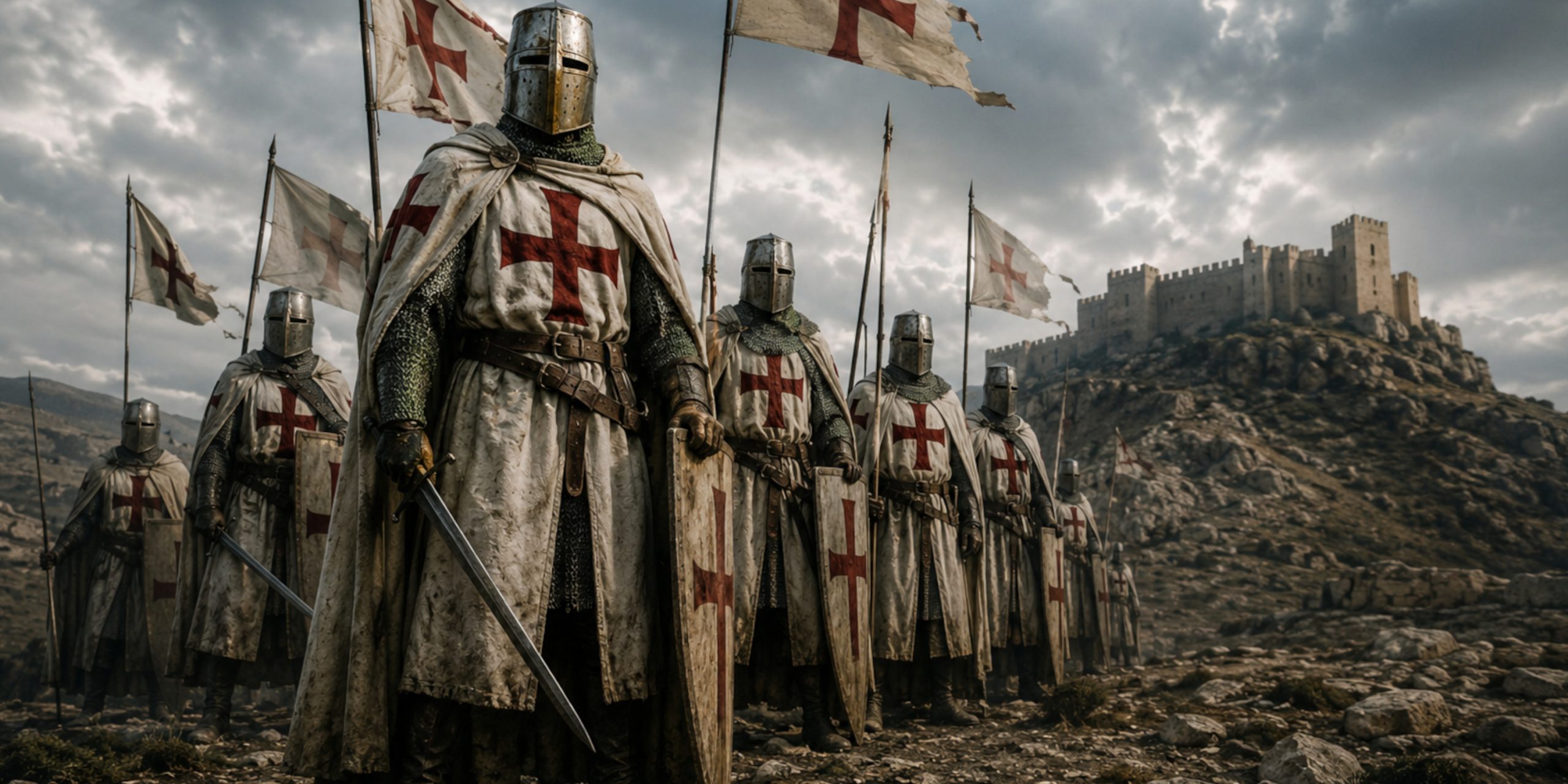
The Knights Templar sit in that strange corner of medieval history where hard fact and outright fantasy constantly wrestle each other for dominance. They were bankers, warriors, landowners, diplomats, crusaders and political operators wrapped into one organisation. Depending on who you ask, they were either holy defenders of pilgrims or dangerously wealthy men who forgot how much kings dislike debt collectors.
What makes them fascinating is not simply their battlefield reputation. Plenty of medieval knights fought well. The Templars built something much larger. They created one of the first truly international military institutions in Europe, with estates stretching from England to the Holy Land. Their white mantles became symbols recognised across Christendom long before modern branding existed. Medieval Europe essentially looked at them and thought, “Ah yes, the armed monks with suspicious amounts of money.”
And then it all collapsed with astonishing speed.
Origins of the Knights Templar
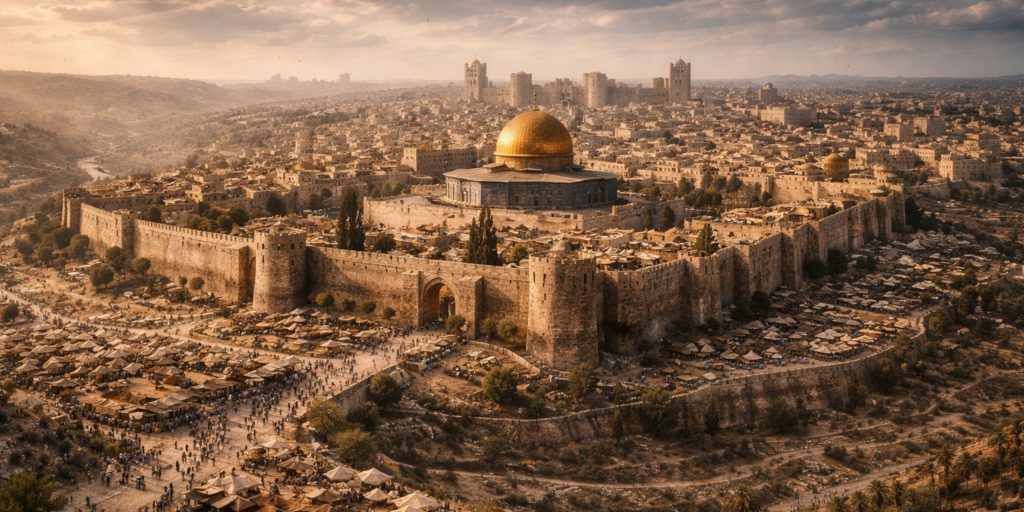
The official name of the order was the Poor Fellow-Soldiers of Christ and of the Temple of Solomon. The shorter title, Knights Templar, came from their headquarters on Jerusalem’s Temple Mount, believed in the medieval world to stand near the site of Solomon’s Temple.
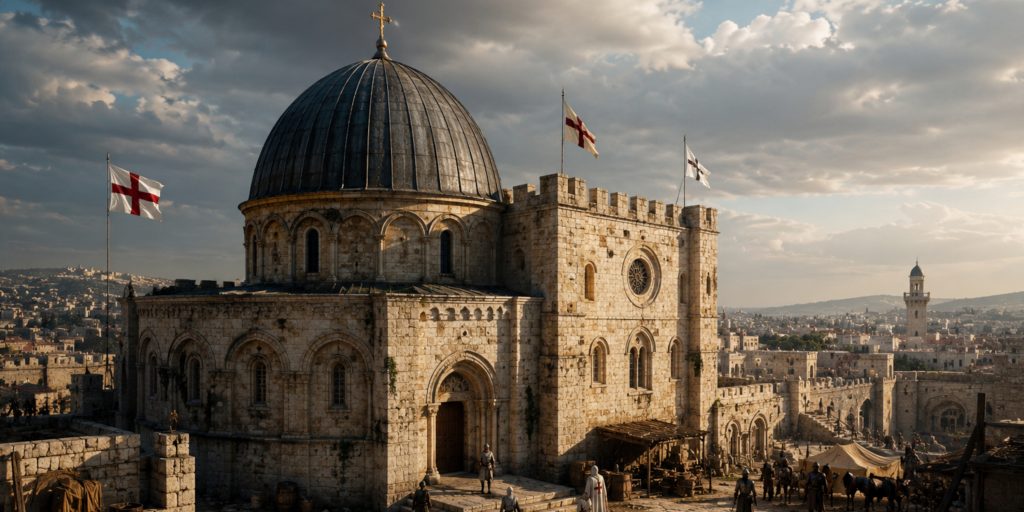
The order emerged around 1119, shortly after the success of the First Crusade. Jerusalem had fallen to Christian forces in 1099, but the roads leading to the city remained dangerous. Pilgrims travelling through the Holy Land were vulnerable to raids and bandit attacks.
A French knight named Hugues de Payens proposed the creation of a military brotherhood dedicated to protecting pilgrims. King Baldwin II of Jerusalem supported the idea and granted the group quarters near the Al Aqsa Mosque on the Temple Mount.
At first, the order was tiny. Contemporary chroniclers suggest there may have been only nine founding knights. Their early years were poor enough that later seals depicted two knights sharing a single horse, which may have symbolised humility or perhaps very real financial difficulties.
Everything changed after the support of Bernard of Clairvaux.
Bernard of Clairvaux and Papal Support
Bernard of Clairvaux was one of the most influential churchmen in Europe. His backing transformed the Templars from a curious experiment into a recognised institution.
At the Council of Troyes in 1129, the order received official Church approval. Bernard also wrote In Praise of the New Knighthood, a work that presented the Templars as spiritually pure warriors fighting for God rather than personal glory.
That mattered enormously in medieval Europe. Knights were often criticised by churchmen for violence, greed and vanity. The Templars offered an alternative image, disciplined soldiers who combined monastic vows with military service.
The order expanded rapidly afterward. Donations poured in from nobles across Europe. Land, castles, churches and entire estates were granted to them.
It turns out people are surprisingly generous when they believe donations might help save both Jerusalem and their immortal souls simultaneously.
The Templars in the Crusades
The Templars became one of the elite military forces of the Crusader states. They fought in nearly every major campaign in the Holy Land during the twelfth and thirteenth centuries.
Unlike feudal levies who served temporarily, the Templars maintained permanent professional forces. They trained constantly and developed fierce battlefield discipline.
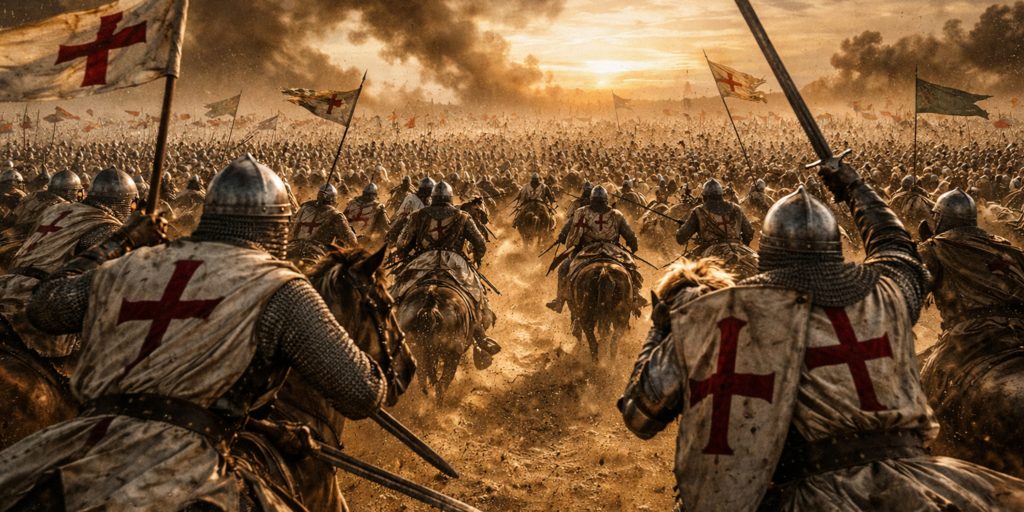
Templar knights were known for devastating cavalry charges. Their role was often to smash enemy lines at critical moments. Contemporary Muslim and Christian writers alike respected their courage, even if they occasionally questioned their judgement.
The order fought at major battles including:
- Montgisard
- Hattin
- Arsuf
- La Forbie
- Acre
The Battle of Hattin in 1187 proved catastrophic. Saladin destroyed the Crusader army and captured many Templars. Large numbers were executed afterward, partly because the order was viewed as too dangerous to ransom.
The Templars continued fighting long after the loss of Jerusalem. They defended remaining Crusader strongholds along the coast for over a century.
When Acre finally fell in 1291, it marked the effective end of the Crusader states in the Holy Land.
Life Inside the Order
The Templars were monks as well as soldiers. Members took vows of poverty, chastity and obedience.
Their daily lives followed strict routines involving prayer, military training and communal living. Rules governed clothing, food, conduct and discipline. Gambling, hunting and excessive luxury were forbidden.
The order had several ranks:
- Knight brothers
- Sergeant brothers
- Chaplains
- Servants and support personnel
Not every Templar was a heavily armoured noble knight. Many served administrative or logistical roles.
Their network across Europe became remarkably efficient. Templar houses handled supplies, recruitment, finances and communication between distant territories. Messages and funds could move across continents with unusual speed for the medieval world.
Some historians describe the order as a prototype multinational organisation. That sounds dramatic until you realise they operated estates from Portugal to the Levant while kings still struggled to manage roads properly.
Arms and Armour of the Knights Templar
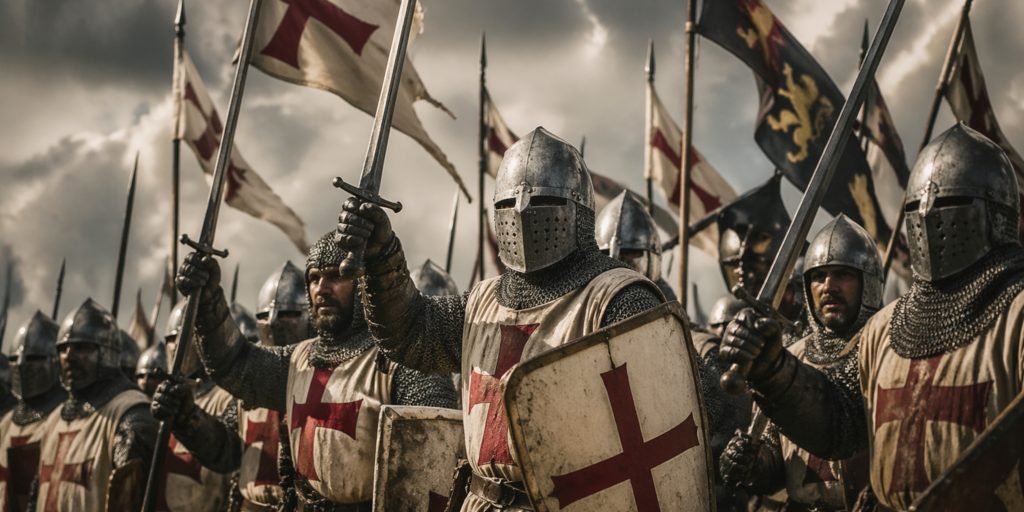
The image most people associate with the Templars is historically grounded, though modern films often exaggerate details.
The White Mantle and Red Cross
Templar knights wore white mantles symbolising purity. The red cross was later added as a mark of martyrdom and dedication to Christ.
Sergeants generally wore darker clothing rather than white.
Armour
Their armour evolved alongside broader medieval military developments.
Early Templars typically wore:
- Mail hauberks
- Nasal helmets
- Mail chausses
- Kite shields
- Gambesons beneath mail
By the thirteenth century many used:
- Flat-topped great helms
- Reinforced mail
- Early plate elements
- Surcoats over armour
Their equipment was practical rather than ornate. Regulations discouraged excessive decoration.
Sword Types Used by the Templars
Specific surviving Templar swords are difficult to identify with certainty, but the order almost certainly used standard knightly weapons common across Western Europe.
Likely sword types included:
- Oakeshott Type X arming swords
- Oakeshott Type XI crusading swords
- Oakeshott Type XII knightly swords
- Falchions for secondary use
The classic crusader sword was usually broad-bladed, double-edged and designed for cutting from horseback while still capable of thrusting.
Templars also carried:
- Lances
- Maces
- Daggers
- Spears
- Crossbows in supporting forces
Contrary to some romantic depictions, they were not mysterious masters of exotic secret weaponry. Most medieval warfare involved hitting people very hard with reliable steel objects while praying your horse remained calm.
Templar Castles and Fortresses
The Templars controlled major castles throughout the Crusader world.
Notable strongholds included:
- Safed
- Tortosa
- Château Pèlerin
- Gaza
- Bagras
These fortifications combined military practicality with strategic positioning. Some protected pilgrimage routes while others guarded frontiers or ports.
Château Pèlerin in particular impressed contemporary observers. Built along the coast south of Haifa, it was considered one of the strongest castles in the eastern Mediterranean.
Templar castles often contained:
- Massive curtain walls
- Chapel complexes
- Storage facilities
- Water systems
- Barracks and stables
Their defensive engineering reflected centuries of adaptation to siege warfare in the region.
The Templars and Medieval Banking
This is where the Templars become particularly modern in feel.
Pilgrims travelling to the Holy Land could deposit money with Templar houses in Europe and withdraw funds later in the East using coded letters of credit. That reduced the risk of robbery during travel.
The order also:
- Managed estates
- Lent money to monarchs
- Stored treasure
- Collected rents
- Facilitated financial transfers
Kings trusted them with royal wealth. The English crown even stored valuables in the Temple Church in London.
Their financial influence grew immense by the late thirteenth century. Unfortunately, powerful rulers rarely enjoy owing money to independent organisations protected by the Pope.
Which brings us neatly to Philip IV of France.
The Downfall of the Knights Templar
King Philip IV was deeply indebted to the Templars and increasingly determined to strengthen royal authority.
On Friday 13 October 1307, French officials arrested large numbers of Templars across France simultaneously. Charges included:
- Heresy
- Idolatry
- Blasphemy
- Secret rituals
- Corruption
Under torture, some confessed to shocking accusations, including denying Christ and worshipping strange idols.
Modern historians overwhelmingly view many of these confessions as coerced.
Pope Clement V initially hesitated but eventually dissolved the order in 1312 under political pressure.
The last Grand Master, Jacques de Molay, was burned alive in Paris in 1314 after retracting earlier confessions.
A famous legend claims de Molay cursed both the Pope and Philip IV before his death. Interestingly, both men died within a year.
Medieval people absolutely loved a dramatic curse story. Frankly, so do modern people.
Archaeology and Physical Evidence
Archaeology has revealed substantial evidence about Templar life, though separating fact from myth remains challenging.
Temple Church, London
The circular nave of the Temple Church remains one of the most important surviving Templar sites in Europe.
Stone effigies of medieval knights survive there, though identifying specific Templars is difficult.
Château Pèlerin Excavations
Excavations at Château Pèlerin have uncovered:
- Fortification remains
- Ceramics
- Military architecture
- Water systems
- Evidence of siege preparation
The scale of construction demonstrates the order’s wealth and organisational capacity.
Templar Sites Across Europe
Archaeological remains linked to the order exist in:
- Portugal
- France
- Spain
- England
- Cyprus
- Israel
These include chapels, commanderies, defensive towers and agricultural estates.
Modern archaeology has largely stripped away sensational myths about hidden treasure chambers and mystical relics. What remains is arguably more interesting, evidence of a disciplined organisation deeply embedded in medieval economic and military systems.
Contemporary Quotes About the Templars
Several medieval writers described the order in striking terms.
The chronicler William of Tyre wrote:
“They lived as regular canons in all humility and without property.”
Bernard of Clairvaux praised them by saying:
“They fear neither demons nor men.”
Muslim chronicler Usama ibn Munqidh, despite fighting Crusaders, occasionally described individual Templars with surprising respect, particularly those who had lived long in the East and behaved with courtesy.
Not every contemporary admired them. Some criticised their arrogance, political influence and wealth. By the late thirteenth century, accusations that the order had become too powerful circulated widely.
Myths, Legends and Secret Treasure
Few medieval organisations have attracted more conspiracy theories.
The Templars have been linked, often without evidence, to:
- The Holy Grail
- Hidden treasure fleets
- Freemasonry
- Secret bloodlines
- Lost relics
- Occult rituals
Most of these stories developed centuries after the order’s destruction.
The mystery surrounding missing Templar wealth helped fuel legends. When arrests occurred in France, some movable assets vanished beforehand. That has inspired endless speculation about hidden treasure.
In reality, much of the order’s wealth was tied up in land and infrastructure rather than giant underground vaults filled with glittering gold.
A disappointing answer for treasure hunters, admittedly.
The Legacy of the Knights Templar
The Templars became symbols larger than history itself.
In medieval memory they represented heroic sacrifice and tragic betrayal. Later generations transformed them into characters within romantic literature, nationalist mythology and conspiracy culture.
Their influence can still be seen in:
- Gothic revival architecture
- Popular fiction
- Films and games
- Modern fraternal organisations
- Crusader mythology
Yet beneath all the legends stood a very real institution that helped shape medieval warfare, finance and international politics.
The Templars were not flawless saints or sinister masterminds. They were ambitious, disciplined and deeply embedded in the brutal realities of the Crusading era. They defended castles, charged into battles, managed estates and navigated dangerous political waters until one of Europe’s most powerful kings decided they had become inconvenient.
That, perhaps, is the most medieval ending imaginable.