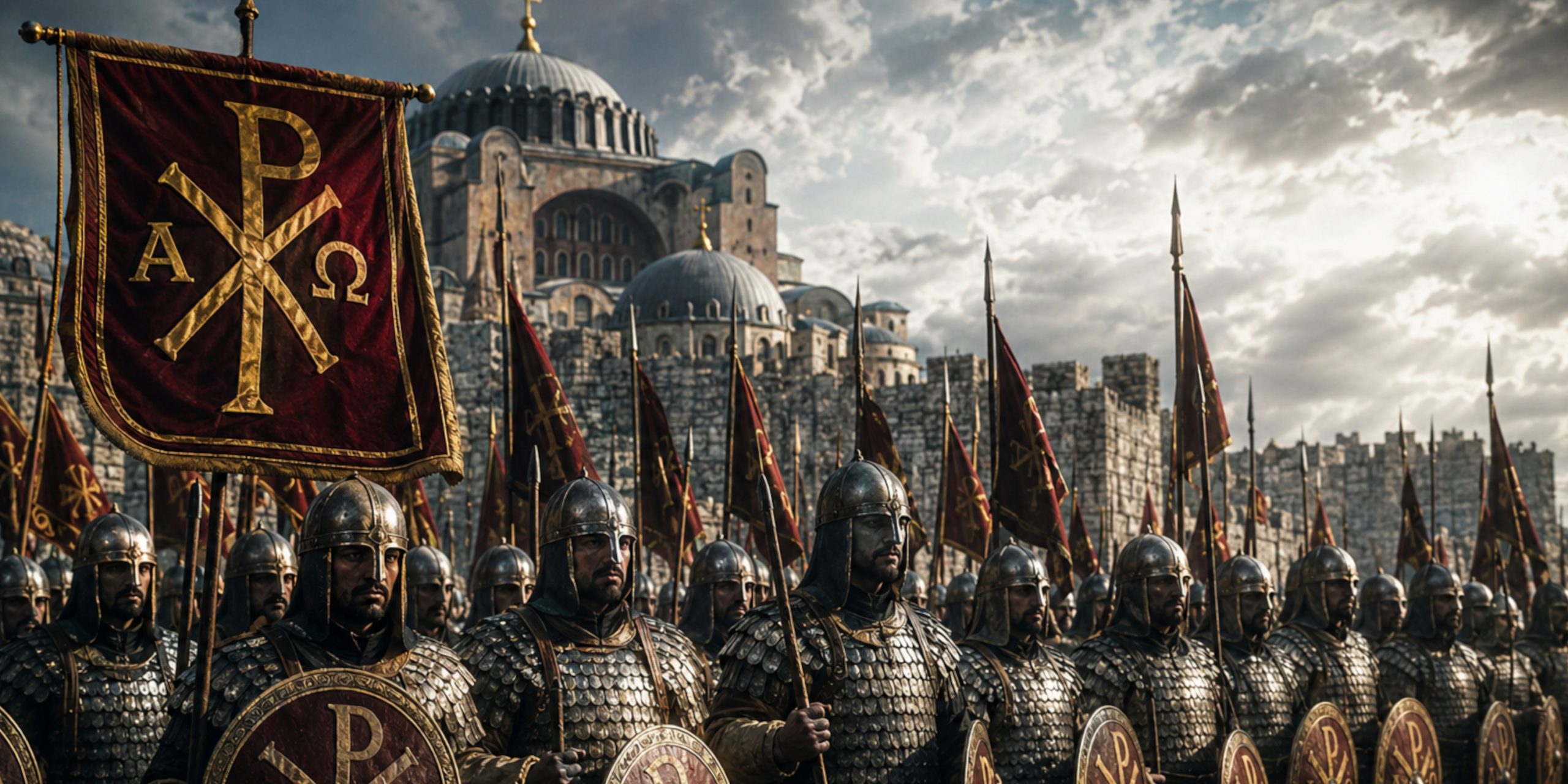
The Macedonian Dynasty was one of those rare stretches in history where an empire seemed to remember exactly what it was supposed to be. For nearly two centuries, Byzantium stopped merely surviving and started swaggering again.
The empire expanded. Armies marched victoriously across the east. Trade flourished. Scholars copied ancient texts with obsessive care. Constantinople glittered with enough gold and ceremony to make western kings look like damp provincial landlords arguing over sheep.
And naturally, because this is Byzantine history, the whole thing was also packed with assassinations, conspiracies, mutilations, theological arguments, impossible court etiquette, and enough palace intrigue to exhaust a modern television writer.
From Basil I in 867 to the death of Theodora in 1056, the Macedonian Dynasty oversaw what historians often call the Macedonian Renaissance. The phrase sounds terribly elegant. In practice, it involved a great deal of warfare, bureaucracy, tax collection, and the occasional blinding of rivals.
Still, it worked.
Origins of the Macedonian Dynasty
The dynasty began with Emperor Basil I, a man whose rise sounds suspiciously like historical fiction.
Basil was probably born into a peasant family in the Balkans, perhaps of Armenian origin. The dynasty’s name, “Macedonian”, likely came from the administrative region where he grew up rather than any direct connection to ancient Macedon. Byzantines did enjoy confusing future historians whenever possible.
Basil entered Constantinople with almost nothing. By the end of his life, he ruled the Roman Empire.
His path upward involved charm, physical strength, political intelligence, and strategic friendships. One contemporary noted his impressive appearance and athleticism. Medieval politics often pretends to be entirely ideological until one remembers that handsome giants tended to do surprisingly well.
Basil became close to Emperor Michael III, eventually rising to co-emperor before arranging Michael’s murder in 867.
This was not considered particularly unusual by Byzantine standards.
Constantinople at its Height
During the Macedonian period, Constantinople became the unquestioned centre of the eastern Mediterranean world.
The city was vast, wealthy, literate, and intimidating. Visitors described towering walls, glittering churches, endless markets, imperial palaces, and ceremonial processions so elaborate they bordered on theatre.
The Great Palace itself was a labyrinth of halls, gardens, chapels, mosaics, and mechanical marvels. Foreign ambassadors were occasionally greeted by golden lions that roared and mechanical birds that sang. Byzantine diplomacy relied heavily on convincing outsiders they had wandered into heaven by mistake.
The city controlled trade routes between Europe and Asia. Silks, spices, ivory, furs, grain, and slaves passed through its harbours.
While western Europe struggled through fragmentation and feudal violence, Byzantium maintained a functioning bureaucracy, professional taxation system, standing army, and sophisticated legal culture.
The Byzantines never stopped calling themselves Romans. Frankly, they had a decent argument.
Basil I and the Foundations of Recovery
Basil I ruled from 867 to 886 and spent much of his reign stabilising the empire.
He reformed laws, strengthened the military, and restored imperial authority after decades of instability. One of his major achievements was the revision of Roman law, eventually contributing to the Basilika, a vast legal compilation completed under his successors.
Militarily, Basil pushed against Arab forces in the east and recovered territory in southern Italy.
He also initiated major building projects, including work on the Nea Ekklesia church within the imperial palace complex. Byzantine emperors had a habit of commemorating victories with architecture. Modern politicians prefer memoirs and podcasts.
Basil died after a hunting accident in 886, allegedly dragged from his horse by a stag. Byzantine chroniclers sometimes describe imperial deaths with such dramatic flair that one half expects thunderclaps in the background.
Leo VI “The Wise”
Leo VI ruled from 886 to 912 and remains one of the dynasty’s most fascinating rulers.
He was deeply intellectual, highly educated, and more comfortable with books than battlefields. Unfortunately, emperors rarely get to choose the skill set history requires from them.
Leo continued legal reforms and produced extensive writings on theology, military strategy, and administration. His reign saw the completion of the Basilika, which updated and reorganised Roman law in Greek.
Yet Leo’s personal life caused immense controversy.
His multiple marriages triggered a scandal within the Church because Byzantine canon law frowned heavily upon repeated marriages. Leo persisted anyway, largely because he desperately needed a male heir.
Byzantine politics repeatedly demonstrates that entire empires can wobble because one emperor cannot produce a son.
Leo eventually secured the succession through Constantine VII.
The Macedonian Renaissance
The cultural revival under the Macedonian emperors was remarkable.
Classical Greek and Roman texts were preserved, copied, and studied with renewed enthusiasm. Scholars compiled encyclopaedias, histories, military manuals, and theological works.
Art flourished. Churches filled with intricate mosaics and icons. Manuscripts became richly illuminated. Education expanded among the elite.
This revival did not resemble the later Italian Renaissance exactly. Byzantines were not rediscovering antiquity because they had never entirely lost it. They saw themselves as heirs to Rome and custodians of classical civilisation.
One senses a certain smugness in Byzantine intellectual culture at times. To be fair, when Viking raiders are still figuring out monastery doors while your scholars debate Aristotle in marble libraries, smugness becomes understandable.
Constantine VII Porphyrogenitus
Constantine VII ruled effectively from 945 to 959, though he spent much of his earlier life overshadowed by regents and rivals.
His nickname, Porphyrogenitus, means “born in the purple”, referring to the imperial purple chamber where legitimate heirs were born.
No Byzantine title has ever sounded more gloriously self-important.
Constantine became one of the great scholar-emperors. His works included:
- De Administrando Imperio
- De Ceremoniis
- Historical compilations
- Diplomatic manuals
These texts remain priceless sources for historians because they explain how Byzantium governed itself and viewed neighbouring peoples.
Constantine also strengthened diplomacy with foreign rulers and reinforced Byzantine prestige abroad.
Byzantine Warfare and Expansion
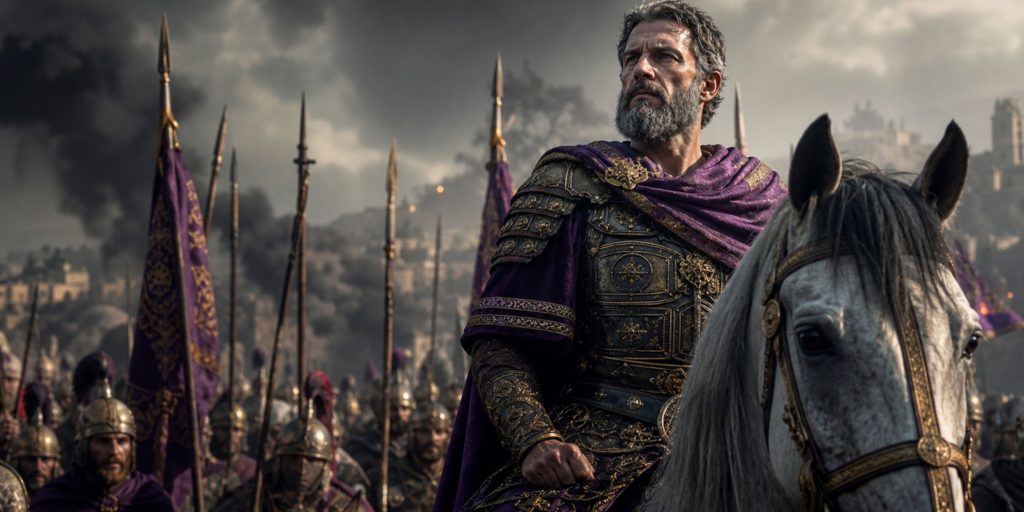
The Macedonian Dynasty oversaw a major military resurgence.
For generations, the empire had fought defensively against Arab invasions. Under the Macedonians, Byzantium regained confidence and territory.
Key military developments included:
- Professionalisation of eastern armies
- Greater use of heavily armoured cavalry
- Improved frontier fortifications
- Strategic reconquest campaigns
The Byzantine army combined discipline, engineering, intelligence gathering, and tactical flexibility.
Contrary to popular fantasy portrayals, Byzantines were not simply decadent schemers in silk robes. They were highly effective soldiers when properly led.
Nikephoros II Phokas
Nikephoros II Phokas ruled from 963 to 969 and was arguably the greatest Byzantine general of the age.
Tall, austere, deeply religious, and terrifying in battle, Nikephoros led successful campaigns against Muslim powers in the eastern Mediterranean.
His greatest achievement was the reconquest of Crete in 961 before becoming emperor. This ended decades of pirate raids that had plagued Byzantine shipping.
He also expanded imperial control into Syria and captured Antioch, one of Christianity’s ancient great cities.
Nikephoros was admired by soldiers but disliked by many aristocrats and city elites. His tax policies and military focus created enemies.
Eventually, he was assassinated in his palace by conspirators led by his nephew John Tzimiskes and his own wife, Theophano.
Sleeping peacefully in Constantinople was apparently an advanced military challenge.
John I Tzimiskes
John Tzimiskes ruled from 969 to 976 and continued Byzantine expansion.
He defeated the Kievan Rus after their invasion of the Balkans and campaigned successfully in the east against Muslim powers.
Tzimiskes was charismatic, energetic, and militarily gifted. His victories reinforced Byzantine dominance across the eastern Mediterranean.
Yet despite his successes, he remains slightly overshadowed by the emperor who followed him.
Which is unfortunate, because defeating invading Rus armies while stabilising an empire ought to guarantee stronger historical publicity.
Basil II: The Bulgar Slayer
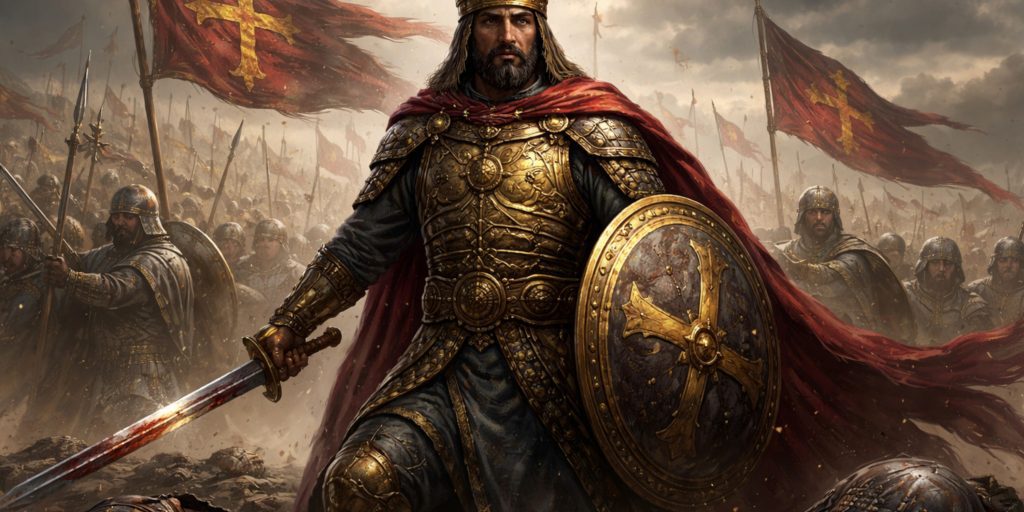
No ruler symbolises Macedonian Byzantium more than Basil II.
He ruled from 976 to 1025 and transformed Byzantium into the strongest power in the eastern Mediterranean.
Basil spent decades crushing rebellions, reforming the military, limiting aristocratic power, and fighting Bulgaria.
The struggle against the Bulgarian Empire became legendary.
After the Battle of Kleidion in 1014, Basil reportedly blinded thousands of Bulgarian prisoners, leaving one man in every hundred with a single eye to guide the others home.
The story horrifies modern readers, rightly so. Medieval warfare was brutally personal. Basil’s reputation for iron determination terrified enemies and impressed contemporaries.
The Bulgarian Tsar Samuel allegedly died from shock upon seeing the mutilated survivors.
Basil eventually destroyed the Bulgarian Empire entirely and expanded Byzantine authority deep into the Balkans.
He also campaigned in Georgia, Armenia, and Syria.
Remarkably, Basil lived simply compared to many emperors. He disliked excessive luxury and focused obsessively on military affairs.
He never married and left no heir.
Historians often stare at this fact with quiet despair because succession problems after Basil proved catastrophic.
Religion and Orthodoxy
Religion sat at the centre of Byzantine identity.
The Macedonian emperors presented themselves as defenders of Orthodoxy and guardians of Christian civilisation.
This period saw increasing tension between Constantinople and Rome, though the formal Great Schism would not occur until 1054.
Missionary activity expanded Byzantine influence abroad. Saints Cyril and Methodius helped spread Christianity among Slavic peoples and developed the basis for the Cyrillic script.
Byzantine religious art also flourished after the earlier Iconoclast controversies ended.
Church interiors glowed with mosaics depicting Christ, saints, emperors, and biblical scenes. Even now, surviving Byzantine churches possess a strange stillness that modern architecture rarely achieves.
Women of the Macedonian Court
Byzantine women could wield considerable political influence, particularly within the imperial court.
Figures such as Theophano and Empress Zoe shaped imperial politics through marriage alliances, patronage, and palace manoeuvring.
Theodora, one of the final rulers associated with the dynasty, proved especially formidable.
When she ruled alone in the 1050s, she demonstrated sharp political instincts and administrative competence despite enormous resistance from male elites.
Byzantine chroniclers often describe powerful women with a mix of admiration and panic, which usually indicates the women were effective.
Art, Architecture and Learning
The Macedonian era produced extraordinary artistic achievements.
Key features included:
- Domed churches
- Gold mosaics
- Ivory carvings
- Illuminated manuscripts
- Court ceremonial art
- Religious icons
The empire also preserved ancient learning.
Without Byzantine scholars copying classical texts for centuries, much of Greek literature and philosophy might have vanished entirely.
This preservation role rarely receives enough attention outside specialist circles. Medieval Byzantium often gets treated as a strange footnote between Rome and the Renaissance when in truth it acted as one of civilisation’s great vaults.
Economy and Trade
The Byzantine economy during this period was exceptionally sophisticated.
The gold solidus remained one of the most respected currencies in the medieval world. Byzantine merchants traded across Europe, North Africa, and Asia.
Agriculture remained central, but urban industries thrived too:
- Silk production
- Metalworking
- Ceramics
- Luxury crafts
- Shipbuilding
Constantinople’s markets astonished visitors from abroad.
Taxation could be harsh, but it funded roads, armies, diplomacy, and administration on a scale few medieval kingdoms could match.
One begins to understand why neighbouring rulers alternated between envying Byzantium and plotting against it.
Decline After Basil II
The death of Basil II in 1025 marked the beginning of decline.
His successors lacked his discipline and military focus. Court politics became increasingly unstable. Aristocrats regained influence. Military structures weakened.
The empire remained wealthy and impressive, but cracks widened beneath the surface.
By the end of the Macedonian period in 1056, Byzantium still appeared formidable. Yet within a generation, disaster loomed.
The catastrophic defeat at Manzikert in 1071 would expose just how fragile the empire had become.
History can be deeply unfair that way. A century of triumph may unravel because several mediocre rulers inherit systems they do not understand.
Archaeology and Surviving Evidence
Modern archaeology continues to reveal details about the Macedonian era.
Important surviving sites and artefacts include:
- The Hagia Sophia mosaics in Constantinople
- Byzantine walls of Constantinople
- Monastic sites at Mount Athos
- Illuminated manuscripts preserved in European libraries
- Coins bearing imperial portraits
- Military equipment recovered from Balkan and Anatolian sites
Archaeologists continue studying Byzantine urban infrastructure, trade networks, and frontier fortifications.
Much of Constantinople itself lies buried beneath modern Istanbul, which must drive Byzantine historians slightly mad on a weekly basis.
Contemporary Impressions and Quotes
The Byzantine court inspired awe among foreign observers.
Liutprand of Cremona described imperial ceremonies with fascination and irritation, which is usually the most honest diplomatic reaction.
One Byzantine writer described Basil II as:
“A man who regarded luxury as disgraceful.”
Michael Psellos, writing about later emperors, captured the strange atmosphere of the court beautifully:
“Everything in Byzantium was magnificent, but nothing was secure.”
That may be the finest summary of Byzantine political life ever written.
Legacy of the Macedonian Dynasty
The Macedonian Dynasty represented Byzantium at its cultural and military peak during the Middle Ages.
Its rulers restored imperial strength, expanded territory, preserved classical knowledge, and shaped Orthodox civilisation across eastern Europe.
Their influence reached:
- Russia
- The Balkans
- Armenia
- Georgia
- The eastern Mediterranean
Modern perceptions of Byzantium often swing wildly between admiration and caricature. In reality, the Macedonian era reveals an empire that was intelligent, ruthless, cultured, deeply ambitious, and astonishingly resilient.
Personally, I find the Byzantines impossible not to admire, even when they behaved appallingly. They preserved ancient learning while fighting on half a dozen frontiers, conducted diplomacy like theatrical performance art, and somehow maintained imperial grandeur for centuries after most observers assumed they should have collapsed.
That is not decadence.
That is endurance dressed in silk and gold.