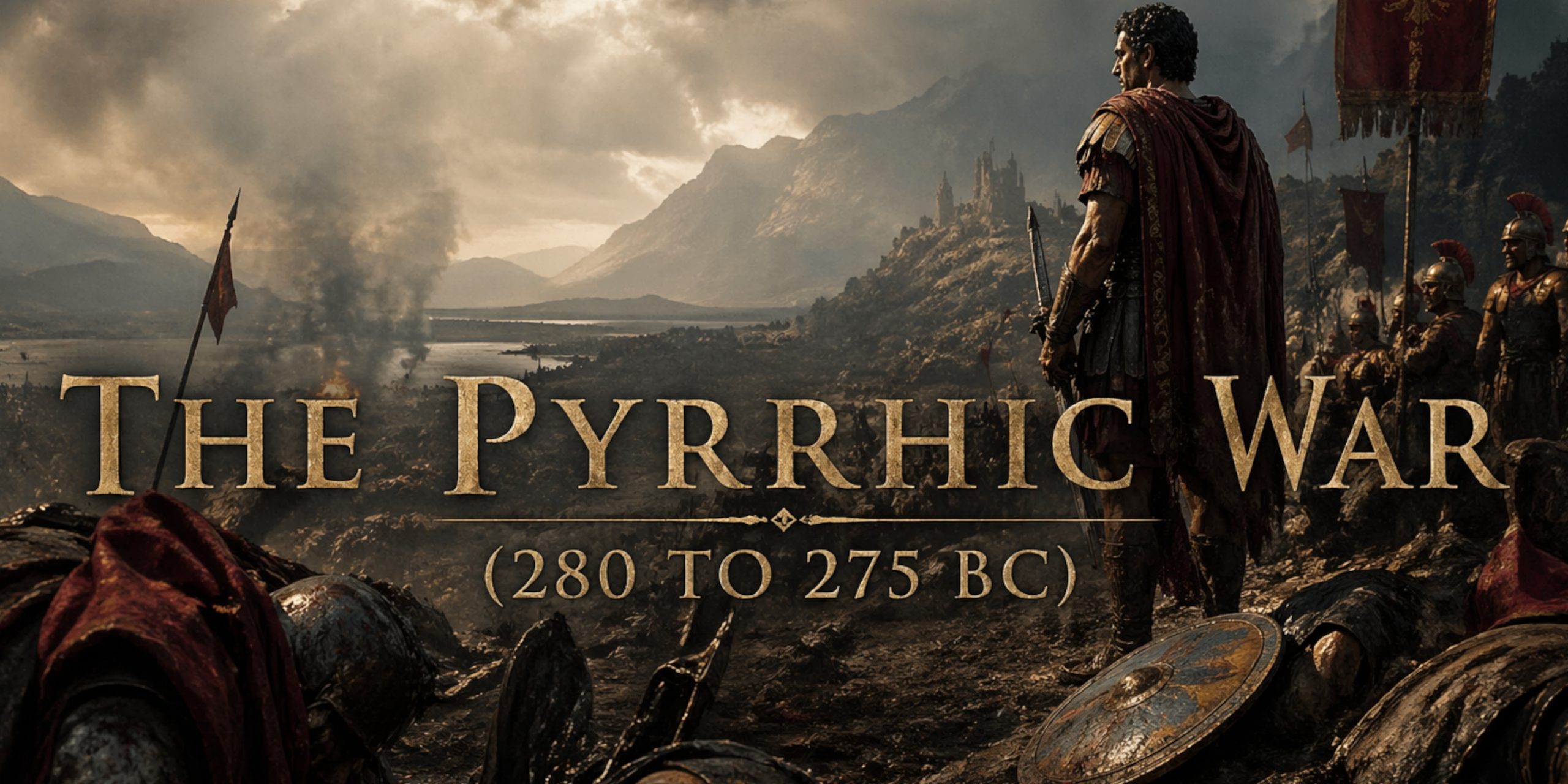
The Pyrrhic War was fought between 280 and 275 BC, and on the surface it ought to have been a triumph for King Pyrrhus of Epirus. He won battles, terrified the Romans, marched through southern Italy and Sicily, and fielded one of the finest Hellenistic armies of his age.
Yet by the end of the war Pyrrhus had achieved almost nothing durable. Rome, bruised and bloodied but stubborn beyond reason, simply kept raising more armies. Pyrrhus won enough victories to ruin himself. Rome lost enough battles to learn how to win the war.
As a historian, I have always found the Pyrrhic War oddly compelling because it feels so modern. One side won the headlines, the other won the long game. Pyrrhus looked brilliant. Rome looked battered, unimpressive and rather too fond of marching straight back into danger. Five years later, Rome controlled Italy.
The war also gave us one of history’s most enduring phrases: a “Pyrrhic victory”. It is the sort of expression every politician, general and football manager should probably keep in mind.
Background to the War
By the early third century BC, Rome had become the dominant power in central Italy. It had defeated many of its local rivals and was steadily moving south. This expansion alarmed the Greek cities of Magna Graecia, especially Tarentum, a wealthy Greek city on the southern coast.
Tarentum feared Roman influence and, in 282 BC, attacked a Roman fleet that had entered its harbour. Rome demanded compensation. Tarentum, in one of those decisions that seems bold after a few cups of wine and much less sensible the following morning, instead invited Pyrrhus of Epirus to intervene.
Pyrrhus was not an ordinary king. He was a cousin of Alexander the Great’s family, an ambitious soldier, and perhaps the most talented battlefield commander of his generation. He believed he could defeat Rome, build a western empire and perhaps even rival Alexander himself.
He crossed to Italy in 280 BC with around:
- 25,000 infantry
- 3,000 cavalry
- Skilled archers and slingers
- Twenty war elephants
The elephants caused immediate alarm. The Romans had never seen them in battle before. One imagines the first Roman recruit who spotted them in the distance and briefly wondered whether he had joined the wrong army.
Who Was Pyrrhus?
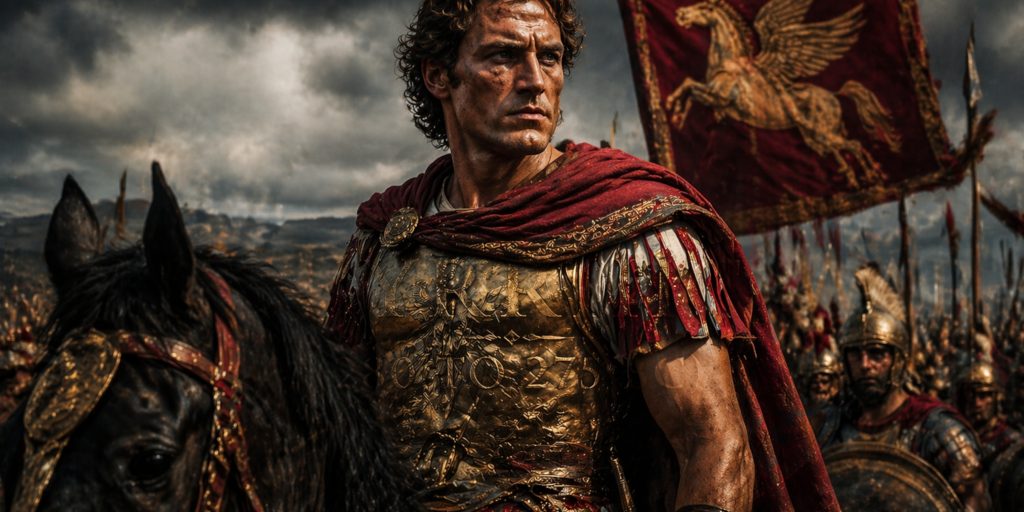
Pyrrhus was king of Epirus, a kingdom in north-western Greece. Ancient writers admired him enormously. The Greek historian Plutarch later wrote that Hannibal considered Pyrrhus one of the greatest generals in history.
Pyrrhus had spent much of his early life fighting, scheming and reclaiming his throne. He was brave to the point of recklessness and had a talent for inspiring troops. Unlike many kings, he fought close to the front.
He was also restless. Pyrrhus rarely seemed content to hold what he had. Every success encouraged him to attempt something larger, and usually more dangerous.
This was both his greatest strength and his fatal weakness.
Forces and Tactics
The Army of Pyrrhus
Pyrrhus brought a classic Hellenistic army to Italy.
| Unit | Description |
|---|---|
| Phalanx Infantry | Heavy infantry armed with long sarissa pikes, fighting in deep formation |
| Cavalry | Elite horsemen, including Thessalian cavalry |
| Light Troops | Archers, slingers and javelin men |
| War Elephants | Twenty elephants used to disrupt Roman lines and cavalry |
The core of his army was the Macedonian-style phalanx. This formation was formidable from the front. Rows of men carrying long pikes created a moving wall of spear points.
The problem was that the phalanx was difficult to manoeuvre over rough ground. Italy, rather inconveniently for Pyrrhus, contained a great deal of rough ground.
The Roman Army
Rome relied on the manipular legion.
| Unit | Description |
| Hastati | Younger soldiers in the front line |
| Principes | More experienced infantry in the second line |
| Triarii | Veteran spearmen in reserve |
| Cavalry | Roman and allied horsemen |
Roman soldiers were armed with:
- Spears and javelins
- The gladius-like short sword of the period
- Large shields
- Bronze helmets and cuirasses
The Roman legion was less elegant than the phalanx but more flexible. Roman commanders could break their lines into smaller units and adapt to difficult terrain.
This flexibility became increasingly important as the war continued.
Battles of the Pyrrhic War
Battle of Heraclea, 280 BC
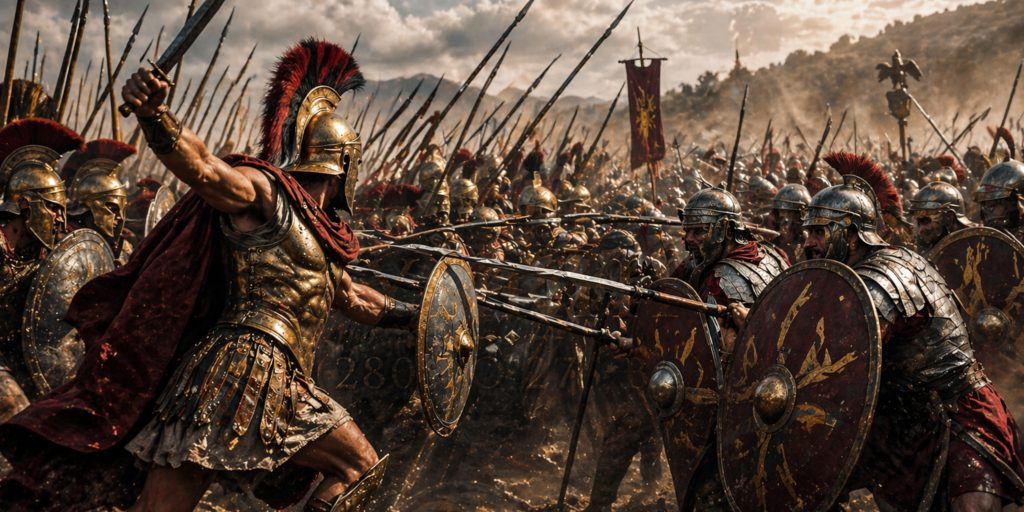
The first major battle took place near Heraclea in southern Italy.
Pyrrhus faced the Roman consul Publius Valerius Laevinus. The Romans fought fiercely and initially held their ground. Then Pyrrhus unleashed his elephants.
The Roman cavalry panicked, and the Roman line collapsed.
| Battle | Result |
| Heraclea | Victory for Pyrrhus |
Ancient estimates suggest Rome lost perhaps 7,000 men. Pyrrhus also suffered serious casualties.
After the battle, Pyrrhus reportedly walked across the field studying the Roman dead. He is said to have remarked that if he had soldiers like these, he could conquer the world.
It was an unusually generous comment for a victorious king and perhaps a revealing one. Pyrrhus had realised that Rome would not break easily.
Battle of Asculum, 279 BC
The following year Pyrrhus fought the Romans again near Asculum.
This battle lasted two days and was even bloodier than Heraclea.
On the first day, rough ground prevented Pyrrhus from using his phalanx and elephants effectively. On the second day, he found better terrain and eventually forced the Romans back.
| Battle | Result |
| Asculum | Narrow victory for Pyrrhus |
The victory came at terrible cost.
According to Plutarch, Pyrrhus declared:
“If we are victorious in one more battle with the Romans, we shall be utterly ruined.”
That sentence has echoed through history ever since.
Pyrrhus had won, technically. In practice, he had lost thousands of experienced troops that he could not replace. Rome, by contrast, simply recruited another army.
There is something almost maddening about Roman persistence at this stage. Defeat after defeat merely convinced the Romans that they ought to try again, only with more men.
Campaign in Sicily, 278 to 276 BC
After Asculum, Greek cities in Sicily asked Pyrrhus for help against Carthage.
Pyrrhus left Italy and campaigned in Sicily, where he initially enjoyed great success. He captured several cities and pushed the Carthaginians back to their strongholds.
For a moment he appeared close to creating the western empire he had dreamed of.
Then, as often happened with Pyrrhus, success slipped away. He quarrelled with his allies, demanded more men and money, and alienated the Sicilian Greeks.
By 276 BC he returned to Italy. The opportunity had gone.
Battle of Beneventum, 275 BC
The final major battle took place near Beneventum.
Pyrrhus again faced a Roman army, this time commanded by Manius Curius Dentatus.
The battle was confused and hard fought. Some of Pyrrhus’ elephants became disordered and caused chaos among his own troops. The Romans held firm and eventually forced Pyrrhus to retreat.
| Battle | Result |
| Beneventum | Roman victory |
This was the turning point of the war.
Pyrrhus abandoned Italy and returned to Epirus. He never came back.
Rome had survived the greatest foreign threat it had yet faced.
Why Rome Won
Rome won the Pyrrhic War for several reasons.
- Rome could replace its losses more easily than Pyrrhus.
- Roman alliances in Italy largely held together.
- The legion proved more flexible than the phalanx.
- Pyrrhus became distracted by Sicily.
- Pyrrhus lacked the resources for a long campaign.
The war revealed one of Rome’s greatest strengths. Rome was extraordinarily difficult to exhaust.
Pyrrhus could win a battle. He could not make Rome admit defeat.
That distinction would later frustrate Hannibal as well.
Contemporary Quotes
Ancient writers preserved several memorable comments about the war.
“Another such victory and we are undone.”
Pyrrhus after the Battle of Asculum
“The Romans are not barbarians, but men who know how to fight.”
Attributed to Pyrrhus
“Pyrrhus came like a thunderbolt.”
Later Roman tradition
The Roman and Greek sources often admire one another’s courage. There is relatively little of the usual ancient habit of dismissing the enemy as fools or cowards. Both sides knew they had fought a formidable opponent.
Archaeology of the Pyrrhic War
Archaeology has added intriguing details to our understanding of the conflict.
Excavations around Heraclea and Asculum have uncovered:
- Spearheads and javelin points
- Fragments of bronze armour
- Coins from Greek and Roman cities
- Remains of fortifications and camps
At Heraclea, archaeologists have found evidence of a large battlefield area and traces of military occupation dating to the early third century BC.
Near Beneventum, excavations have revealed Roman military remains and roads connected with the campaign.
The most interesting discoveries perhaps concern the elephants. Several artistic depictions and coin issues from the period suggest the enormous impression they made on Roman society. Roman writers never forgot them.
Pyrrhus’ elephants were not especially numerous, but to Roman soldiers who had never seen one before, they must have appeared halfway between a war machine and a nightmare.
Recent scholarship also suggests that the war accelerated Roman military adaptation. Archaeological finds show changes in Roman equipment and camp design in the decades after the conflict.
Rome had been forced to learn quickly.
The Legacy of the Pyrrhic War
The Pyrrhic War mattered far beyond Italy.
Rome emerged as the dominant power in the Italian peninsula. Greek cities in southern Italy increasingly fell under Roman control.
The war also prepared Rome for future struggles against Carthage and the Hellenistic kingdoms. The Romans learned how to fight elephants, how to face a phalanx, and how to survive disasters without collapsing.
Pyrrhus, meanwhile, entered history as one of the great tragic commanders. He was brilliant, daring and endlessly ambitious. Yet he never quite understood the scale of the opponent he had chosen.
There is a strange melancholy about Pyrrhus. He was perhaps too talented to settle for a small kingdom and too impatient to build a larger one carefully.
When people use the phrase “Pyrrhic victory”, they often forget there was a real man behind it. Pyrrhus was not a fool. Far from it. He was one of the finest generals of his age.
He simply discovered, before almost anyone else, that defeating Rome was not the same thing as beating Rome.
Seven Swords Takeaway
The Pyrrhic War was one of the defining conflicts of the ancient Mediterranean.
It marked Rome’s arrival as a major power and exposed both the strengths and weaknesses of Hellenistic warfare. Pyrrhus won famous battles, but Rome won the future.
That is why the war still matters. It was not merely a contest between armies. It was a contest between two ways of fighting, two political systems and two kinds of ambition.
Pyrrhus sought glory. Rome sought endurance.
In the end, endurance proved rather more useful.