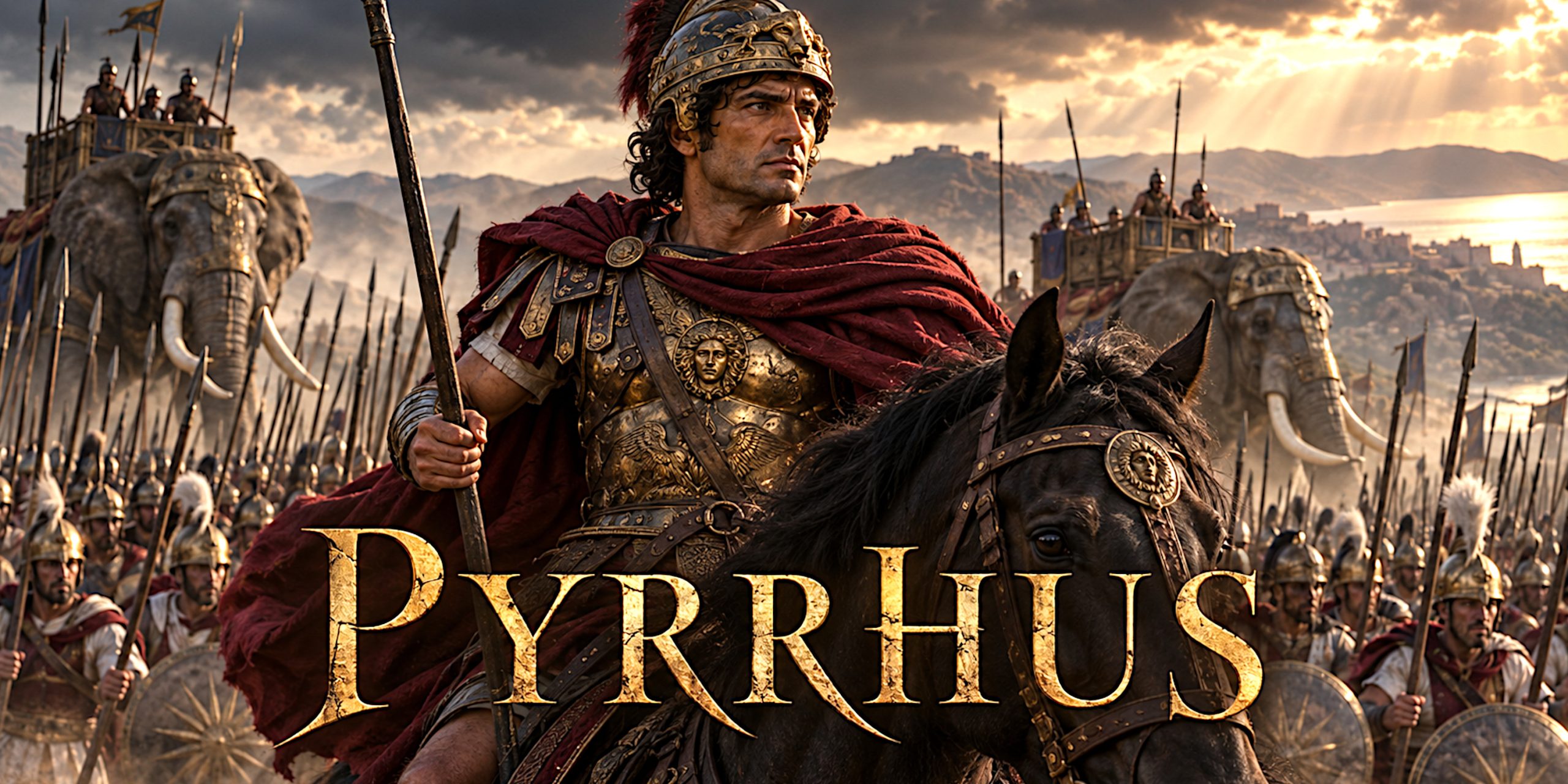
Pyrrhus of Epirus defeated Roman armies, challenged Macedonian kings and carried his ambitions from the Adriatic to Sicily. Yet his name survives most readily in an expression for winning at a ruinous cost. It is a rather severe historical review of a man whose contemporaries had good reason to fear him.
Born around 319–318 BCE and killed in 272 BCE, Pyrrhus belonged to the generation that inherited the fractured world of Alexander the Great. He was a gifted commander, an energetic dynastic politician and a king who repeatedly found fresh opportunities before securing the ones already in his grasp.
I find him more interesting than the familiar label allows. His victories were real, his opponents were formidable, and his failure was neither inevitable nor simply a matter of counting casualties. Understanding Pyrrhus means examining the kingdom behind him, the allies around him and the limits of the evidence we have inherited.
Pyrrhus of Epirus at a Glance
| Detail | What we know |
|---|---|
| Born | Around 319–318 BCE |
| Died | 272 BCE, during fighting in Argos |
| Dynasty | The Aeacid royal house of the Molossians |
| Parents | Aeacides and Phthia |
| Principal kingdom | Epirus, in north-western Greece and neighbouring territory |
| Reigns in Epirus | Approximately 307/306–302 BCE, then 297–272 BCE |
| Other ambitions | Control of Macedonia, southern Italy, Sicily and the Peloponnese |
| Principal Roman victories | Heraclea, 280 BCE; Asculum, 279 BCE |
| Defining setback in Italy | Beneventum, 275 BCE |
| Best-known legacy | The expression “Pyrrhic victory” |
Some dates in his early career differ between modern reconstructions. Ancient accounts do not provide the tidy chronological framework that a modern biography would prefer.
What Our Sources Can Actually Tell Us
The fullest surviving narrative is Plutarch’s Life of Pyrrhus, written several centuries after Pyrrhus died. Plutarch drew on earlier material, including the work of Hieronymus of Cardia, a historian who lived through the age of Alexander’s successors. Most of that earlier literature is now lost.
Other evidence comes from fragments of Dionysius of Halicarnassus, later Roman historical traditions, Pausanias and material remains such as coins. These sources overlap, but they do not always agree about battles, casualties or motives.
Plutarch was particularly interested in character. His Pyrrhus is brave, restless and perpetually drawn towards the next undertaking. That portrait is valuable, though its neatly revealing conversations should not be mistaken for transcripts.
No securely preserved eyewitness quotation spoken by Pyrrhus survives. Sayings attributed to him come through later writers. Even an apparently contemporary royal dedication must be distinguished from the later text that preserves it. That distinction matters, especially when a single memorable sentence has come to stand for an entire life.
Childhood, Exile and the Fight for Epirus
Pyrrhus was born into the Molossian royal house, which claimed descent from Achilles through his son Neoptolemus. This was a political and religious claim, not a genealogy that historians can verify. Heroic ancestors were useful possessions in a royal household, particularly when living relatives were proving troublesome.
His father, Aeacides, lost power amid the struggles surrounding Macedonia and Epirus. The infant Pyrrhus was taken to safety and raised under the protection of Glaucias, an Illyrian ruler. Plutarch embellishes the escape with dramatic details, including a dangerous river crossing. The basic picture of a displaced royal child is firmer than every incident attached to it.
With Glaucias’s support, Pyrrhus became king while still a boy, around 307 or 306 BCE. He was expelled again in 302 BCE and joined Demetrius Poliorcetes, who had married his sister Deidamia.
At Ipsus in 301 BCE, Pyrrhus fought on the losing side of the great struggle between Alexander’s successors. He subsequently went to Egypt as a diplomatic hostage. There he gained favour at the court of Ptolemy I and married Antigone, Ptolemy’s stepdaughter.
Egyptian money and military support helped him return to Epirus in 297 BCE. He initially shared power with Neoptolemus, then had his rival killed after an alleged conspiracy. His restoration owed as much to patronage, marriage and calculated violence as to battlefield talent.
For a useful modern account of these early struggles, see Jona Lendering’s biography of Pyrrhus at Livius.
His Kingdom, Family and Macedonian Ambitions
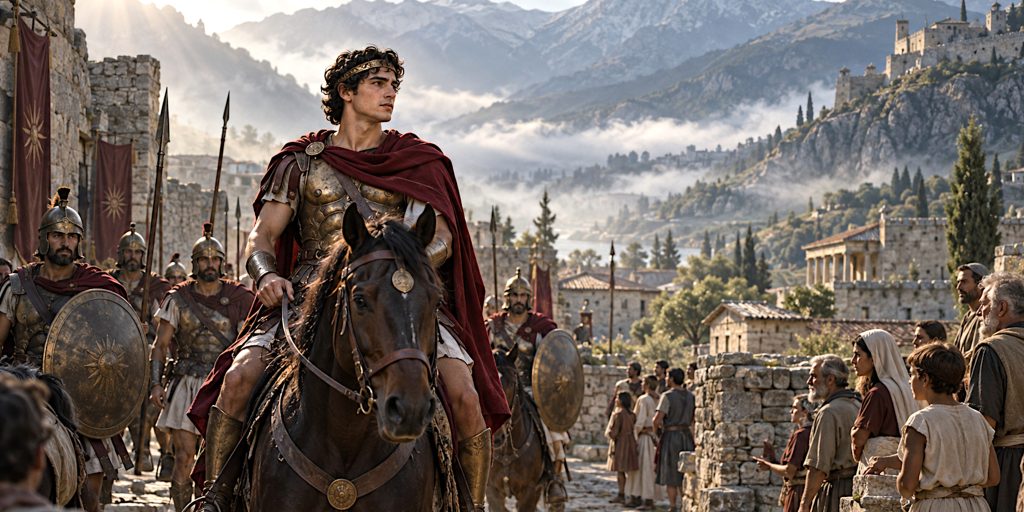
Epirus was a substantial regional power, but it could not sustain every ambition of its king indefinitely. Pyrrhus’s authority rested on royal prestige, relationships with Epirote communities and access to soldiers and revenue. His overseas armies also depended on allies and mercenaries.
Ambracia, modern Arta, became an important royal centre. Its access to the sea suited a ruler whose interests increasingly extended across the Adriatic. Dodona, with its famous sanctuary of Zeus, remained central to the religious identity of his kingdom.
Marriage widened his connections. After Antigone, his wives included Lanassa, daughter of Agathocles of Syracuse, Bircenna from an Illyrian royal family, and a daughter of Audoleon of Paeonia. These marriages connected Epirus to neighbouring powers and the Greek west. They did not guarantee enduring harmony. Lanassa eventually left him and married Demetrius.
Pyrrhus’s children included Ptolemy, Alexander and Helenus. Alexander II succeeded him in Epirus; Ptolemy died during his father’s final campaign in Greece.
Macedonia remained a recurring prize. Pyrrhus helped displace Demetrius in 288 BCE, sharing the gains with Lysimachus before losing his Macedonian position in the following years. He would return to challenge Antigonus II Gonatas after the Italian expedition.
Why Pyrrhus Went to War with Rome
The Greek city of Tarentum invited Pyrrhus to intervene against Roman expansion. For the Tarentines, he offered experienced troops and the authority of a powerful king. For Pyrrhus, southern Italy offered influence, resources and an opportunity to build a larger dominion.
He arrived in 280 BCE with an army that ancient accounts describe as including roughly 20,000 heavy infantry, 3,000 cavalry, archers, slingers and 20 elephants. These are reported figures rather than an independently verified muster roll.
Local support was essential. Greek cities and Italian peoples opposed to Rome could provide additional soldiers, supplies and strategic depth. Their interests, however, were not identical. Resistance to Rome did not automatically imply enthusiasm for permanent rule by Pyrrhus.
Plutarch illustrates the king’s ambition through a conversation with his adviser Cineas. After imagining successive conquests, Pyrrhus anticipates a life of leisure. Cineas asks, in effect, why they cannot enjoy that leisure immediately. It is an excellent piece of moral biography. It is less reliable as a verbatim record of a private discussion.
Heraclea and Asculum: Victories That Did Not End the War
| Battle | Date | Opponent | Outcome and significance |
|---|---|---|---|
| Heraclea | 280 BCE | Roman army under Publius Valerius Laevinus | Pyrrhus won; elephants helped decide a hard-fought engagement |
| Asculum | 279 BCE | Roman armies under Publius Decius Mus and Publius Sulpicius Saverrio | Generally treated as a costly victory for Pyrrhus, although ancient accounts differ |
| Beneventum | 275 BCE | Roman forces under Manius Curius Dentatus | A Roman success that helped bring Pyrrhus’s Italian intervention to an end |
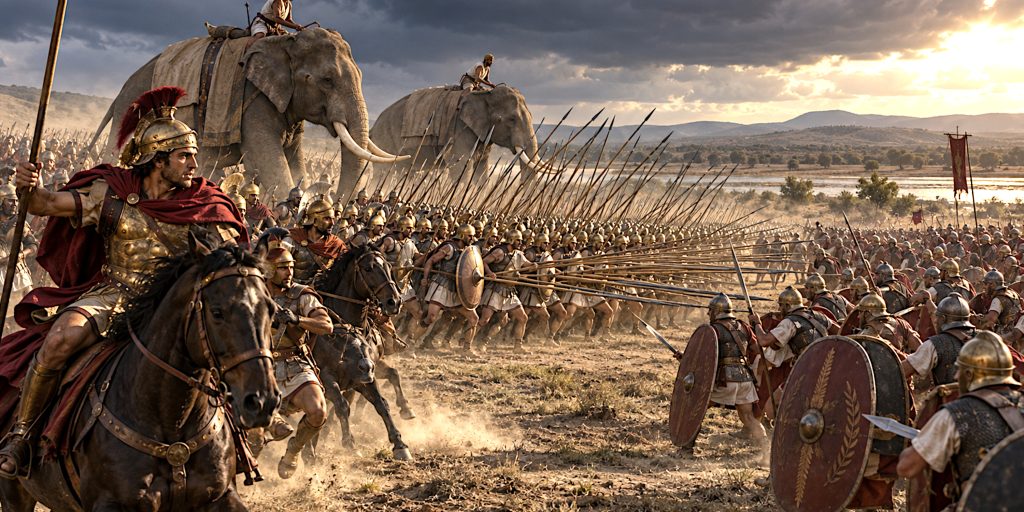
At Heraclea, near the river Siris in southern Italy, Roman troops faced the combined force of a Hellenistic army. Pyrrhus committed cavalry, infantry and eventually elephants. The animals frightened Roman horses and helped turn the battle.
This was not an effortless victory over soldiers who obligingly panicked on sight. Plutarch describes sustained fighting before the decisive intervention. Rome’s defeat demonstrated the strength of Pyrrhus’s army; its response demonstrated the resilience of the Roman state.
At Asculum, terrain complicated the use of the phalanx and elephants. Plutarch describes fighting over two days, with Pyrrhus better able to deploy his forces on the second. Other traditions complicate the reconstruction, so precise battlefield choreography deserves caution.
Ancient casualty totals vary. Plutarch himself reports conflicting figures for Heraclea. The sound conclusion is that Pyrrhus suffered serious losses, including experienced men whose replacement was difficult. The exact arithmetic is less secure.
What Pyrrhus Actually Said About His Victory
After Asculum, Plutarch attributes this reply to Pyrrhus when someone congratulated him:
“If we are victorious in one more battle with the Romans, we shall be utterly ruined.”
Attributed to Pyrrhus by Plutarch, Life of Pyrrhus, chapter 21; translated by Bernadotte Perrin.
This is the origin of the familiar association between Pyrrhus and ruinously expensive success. It is a saying preserved by a later author, rather than a surviving contemporary statement.
The underlying problem is convincing. Rome could draw on a large network of citizens and Italian allies. Pyrrhus had crossed the sea with an expeditionary force and depended on relationships that became harder to maintain as the war continued.
A Pyrrhic victory therefore means a success whose cost undermines its practical value. It does not mean that every battle Pyrrhus won was secretly a defeat. At Heraclea and Asculum, he achieved genuine military victories. He could not convert them into a settlement that secured his wider aims.
Diplomacy and the Limits of Victory
Pyrrhus pursued negotiation as well as combat. Cineas carried proposals to Rome, where the Senate ultimately refused a settlement on the terms offered. The tradition gives the elderly Appius Claudius Caecus an important role in resisting accommodation.
Accounts of Pyrrhus’s dealings with the Roman statesman Fabricius are full of moral theatre: rejected gold, an attempted fright with an elephant, and a warning about a plot to poison the king. These stories illuminate how later writers contrasted royal wealth with Roman virtue. Their polished presentation also invites scepticism.
The strategic obstacle was less theatrical. Rome’s alliance system endured, and Pyrrhus failed to force the political collapse that might have made his victories decisive.
My reading is that he understood the need for diplomacy, but repeatedly overestimated what another success could achieve. His campaigning offered his allies protection while also demanding their money, manpower and obedience. That bargain became less attractive as the war lengthened.
Sicily: From Rescuer to Unwelcome Ruler
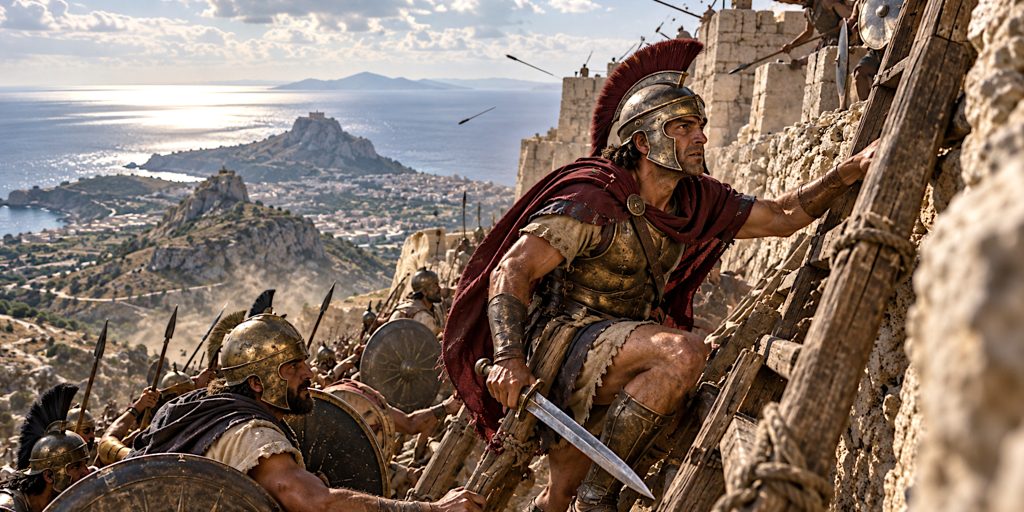
In 278 BCE, Pyrrhus moved to Sicily at the invitation of Greek communities threatened by Carthage. He initially achieved substantial gains, relieved Syracuse and captured strongholds including Eryx.
The Carthaginian position at Lilybaeum, modern Marsala, proved much harder to overcome. Its coastal location and access to naval support made it a stubborn obstacle to complete control of the island.
As Pyrrhus demanded greater resources, including support for naval preparations, his relationship with Sicilian allies deteriorated. Plutarch describes increasingly coercive conduct and the execution of Thoenon, one of the men who had helped bring him to Syracuse.
He returned to Italy in 276 BCE. The Sicilian venture had exposed a familiar difficulty: being welcomed as a military saviour did not provide unlimited consent to govern.
Beneventum and the Withdrawal from Italy
In 275 BCE, Pyrrhus fought the Romans near Maleventum, subsequently known as Beneventum. Plutarch describes a night approach disrupted by difficult terrain, followed by fighting in which the Romans captured elephants and drove others back towards their own troops.
The battle is conventionally described as a Roman victory, although its precise scale and sequence remain debated. Pyrrhus retained an army, but no longer possessed a convincing route to the settlement he wanted.
He withdrew to Epirus, leaving a garrison at Tarentum. The city eventually fell to Rome in 272 BCE.
His departure should not be reduced to one unsuccessful battle. The weakening of allies, losses of experienced troops, financial pressure and failure to obtain peace had accumulated over years.
Arms, Armour and the Army of Pyrrhus
No surviving sword, helmet or cuirass can securely be identified as Pyrrhus’s personal equipment. Reconstructions must combine ancient descriptions with broader evidence for Hellenistic warfare.
| Element | Likely equipment or role | Important qualification |
|---|---|---|
| Pyrrhus himself | Helmet, body armour, spear and sword; frequently fought mounted | Ancient descriptions establish conspicuous royal equipment, not a complete specification |
| Phalanx infantry | Sarissa pikes, shields and protective equipment | Armour and equipment varied; a sarissa was a formation weapon |
| Cavalry | Spears, swords and, in some contingents, javelins | Cavalry roles differed between units |
| Light troops | Bows, slings or javelins | Essential for screening, missiles and difficult ground |
| Italian allies | Equipment and fighting methods reflecting local traditions | His army was not a uniform Macedonian formation |
| Elephants | Battlefield disruption and support against cavalry and infantry | Their effectiveness depended on terrain, control and enemy response |
The xiphos and curved cutting swords conventionally described as kopides belong to the wider equipment of the period. Neither can confidently be named as his preferred personal sword.
Plutarch describes Pyrrhus exchanging armour with a companion at Heraclea to make himself less recognisable. At Argos, he reportedly removed the distinguishing ornament from his helmet. Such passages show the danger of being a conspicuous king in close combat.
They do not justify equipping him with every weapon used anywhere in the Greek world. In particular, the phalangite’s two-handed sarissa should not be casually assigned to a mounted commander.
How Good a General Was He?
Pyrrhus’s reputation rested on genuine strengths. He could combine different troop types, exploit battlefield opportunities and inspire soldiers through conspicuous personal courage. His ability to attract or win over troops was politically valuable as well as militarily useful.
Ancient traditions credit Hannibal with ranking him among the greatest commanders. The rankings differ between accounts, so they should be treated as evidence of reputation rather than a settled ancient league table.
Plutarch also credits Pyrrhus with military writings, now lost. We cannot reconstruct a complete tactical doctrine from works that no longer survive.
His weaknesses were most apparent in sustaining campaigns and holding together political coalitions. Yet calling him simply “a brilliant tactician but a poor strategist” is too comfortable. It risks making his opponents’ advantages disappear. Rome possessed exceptional reserves of manpower and a durable alliance network; Carthage could sustain coastal resistance; Macedonian rivals retained their own bases of power.
Pyrrhus’s choices mattered, especially his repeated pursuit of new campaigns. So did the strength of the states and communities resisting him.
The Final Campaign: Macedonia, Sparta and Argos
After returning east, Pyrrhus attacked Antigonus II Gonatas and regained much of Macedonia in 274 BCE. Plutarch describes Macedonian troops abandoning Antigonus and joining him.
The success was damaged by the behaviour of Gallic troops stationed at Aegae. According to Plutarch, they plundered royal tombs, while Pyrrhus failed to punish them adequately. For Macedonian subjects, this was an offence against their royal past, not a minor disciplinary lapse.
In 272 BCE, Pyrrhus invaded the Peloponnese, encouraged by the Spartan claimant Cleonymus. Sparta resisted behind improvised defences. Plutarch gives women an active role in digging the defensive trench and supplying the fighters. Reinforcements helped frustrate the attack.
During the subsequent movement towards Argos, his son Ptolemy was killed in fighting. Pyrrhus then became involved in a dispute between factions within Argos, while Antigonus stood nearby with his own army.
His troops entered the city at night. Narrow streets, contradictory movements and elephants obstructing the routes turned the operation into a confused struggle. An army capable of winning in open country had been forced into conditions where its strengths were difficult to use.
How Did Pyrrhus Die?
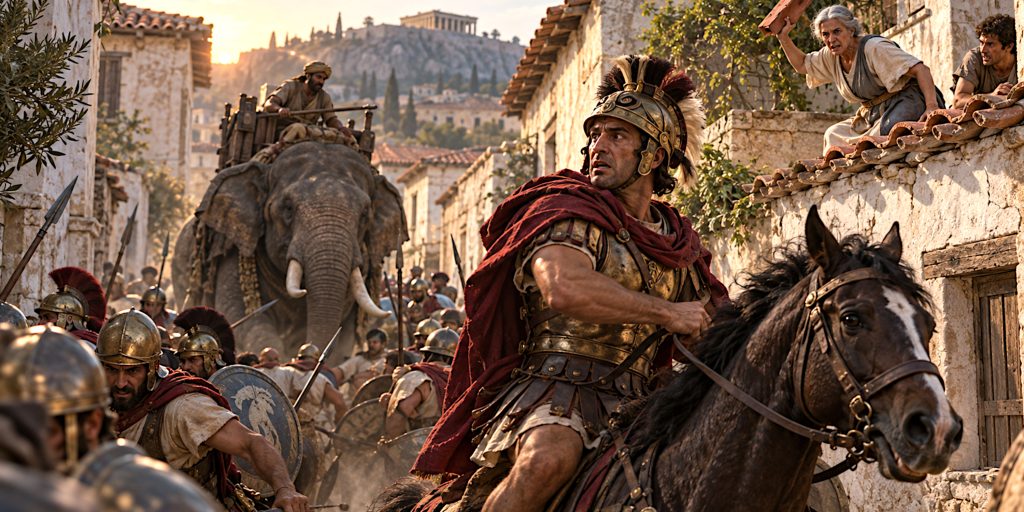
Plutarch says that an Argive woman, watching her son fight Pyrrhus from a rooftop, threw a tile that struck the king below his helmet and incapacitated him. A soldier serving Antigonus then killed and decapitated him.
The tile story also appears in Pausanias, although his account includes a local religious interpretation. Agreement between later traditions makes the story significant; it does not let us verify the injury in forensic detail.
What can be stated securely is that Pyrrhus died during the fighting at Argos in 272 BCE. According to Plutarch, Antigonus rebuked his son for presenting the severed head and arranged honourable funeral treatment for his rival.
There is something painfully human about this ending. A king accustomed to deciding battles died amid the fear and confusion of people whose city had become his battlefield. The woman in the story was trying to save her son. Pyrrhus had just lost his own.
A Contemporary Royal Voice, Preserved Later
Plutarch records a dedication attached to captured Gallic shields offered to Athena Itonis after Pyrrhus’s victory over Antigonus:
“These shields, now suspended here as a gift to Athena Itonis, Pyrrhus the Molossian took from valiant Gauls…”
Opening of the royal dedication quoted in Life of Pyrrhus, chapter 26; translated by Bernadotte Perrin.
Unlike an anecdotal conversation, this purports to reproduce a public statement made in Pyrrhus’s own lifetime. Its wording still reaches us through Plutarch, rather than a surviving inscription that we can examine independently.
The complete dedication links the victory to the fighting prowess of the Aeacid dynasty. Here Pyrrhus presents himself as a successful Molossian king and heir to a heroic lineage. It is a useful corrective to remembering him exclusively through the language of costly failure.
Archaeology, Coins and Surviving Artefacts
Coins issued under Pyrrhus provide direct material evidence for royal authority and imagery. Their designs can invoke gods and heroes, including the heroic ancestry claimed by his dynasty. A head on a coin should not automatically be identified as a portrait of Pyrrhus.
The British Museum’s collection record for Pyrrhus provides a starting point for examining coinage attributed to his rule. Collection ownership does not necessarily mean that an object is currently on display.
Archaeology in Epirus and Ambracia helps reconstruct the urban, religious and political setting of his kingdom. Sites associated with his period require careful interpretation: a Hellenistic building is not automatically his palace, and a weapon found in southern Italy does not automatically belong to one of his battles.
Claims that archaeology has identified his battlefield elephant armour, his personal weapons or remains demonstrating specific phalanx formations need published evidence before they can be repeated as fact.
No burial has been securely authenticated as his through modern archaeology. Pausanias describes a memorial at Argos and says his bones lay in the sanctuary of Demeter. That is evidence for an ancient local tradition, not the identification of a surviving tomb. The relevant account appears in Pausanias’s Description of Greece, Book 2.
For visitors, Dodona, the archaeology of modern Arta and the ancient remains at Argos offer meaningful connections to his world. Museum displays and access arrangements should be checked before travel.
Timeline of Pyrrhus’s Life
| Date | Event |
|---|---|
| c. 319–318 BCE | Born into the Molossian royal house |
| c. 307/306 BCE | Installed as king with Glaucias’s support |
| 302 BCE | Expelled from Epirus |
| 301 BCE | Fights at Ipsus alongside Demetrius |
| After Ipsus | Goes to Egypt as a hostage and marries Antigone |
| 297 BCE | Returns to power in Epirus with Egyptian backing |
| 288 BCE | Gains a share of Macedonia after Demetrius’s displacement |
| Following years | Loses his Macedonian position to Lysimachus |
| 280 BCE | Crosses to Italy and defeats Rome at Heraclea |
| 279 BCE | Fights at Asculum |
| 278–276 BCE | Campaigns in Sicily |
| 275 BCE | Fights at Beneventum and withdraws from Italy |
| 274 BCE | Attacks Antigonus and regains much of Macedonia |
| 272 BCE | Fails to take Sparta; dies during fighting at Argos |
The Legacy of Pyrrhus of Epirus
Pyrrhus never established the enduring Mediterranean dominion his campaigns might suggest he wanted. Rome survived his intervention and consolidated its position in southern Italy. His Sicilian gains did not become a lasting settlement, and his final Macedonian successes were cut short by his death.
Still, his career deserves more than a cautionary phrase. He exposed Roman armies to a formidable Hellenistic opponent, demonstrated the value and limitations of combined forces, and remained a major threat to rival kings until his final campaign.
For me, his life raises a question that is more useful than simply asking whether he won too expensively: what political result did each victory make possible, and could he sustain it?
Pyrrhus could win ground, allegiance and prestige with extraordinary speed. Keeping them required patience, resources and compromises that another campaign could not reliably supply. His courage was seldom in doubt. The lasting value of his successes was.