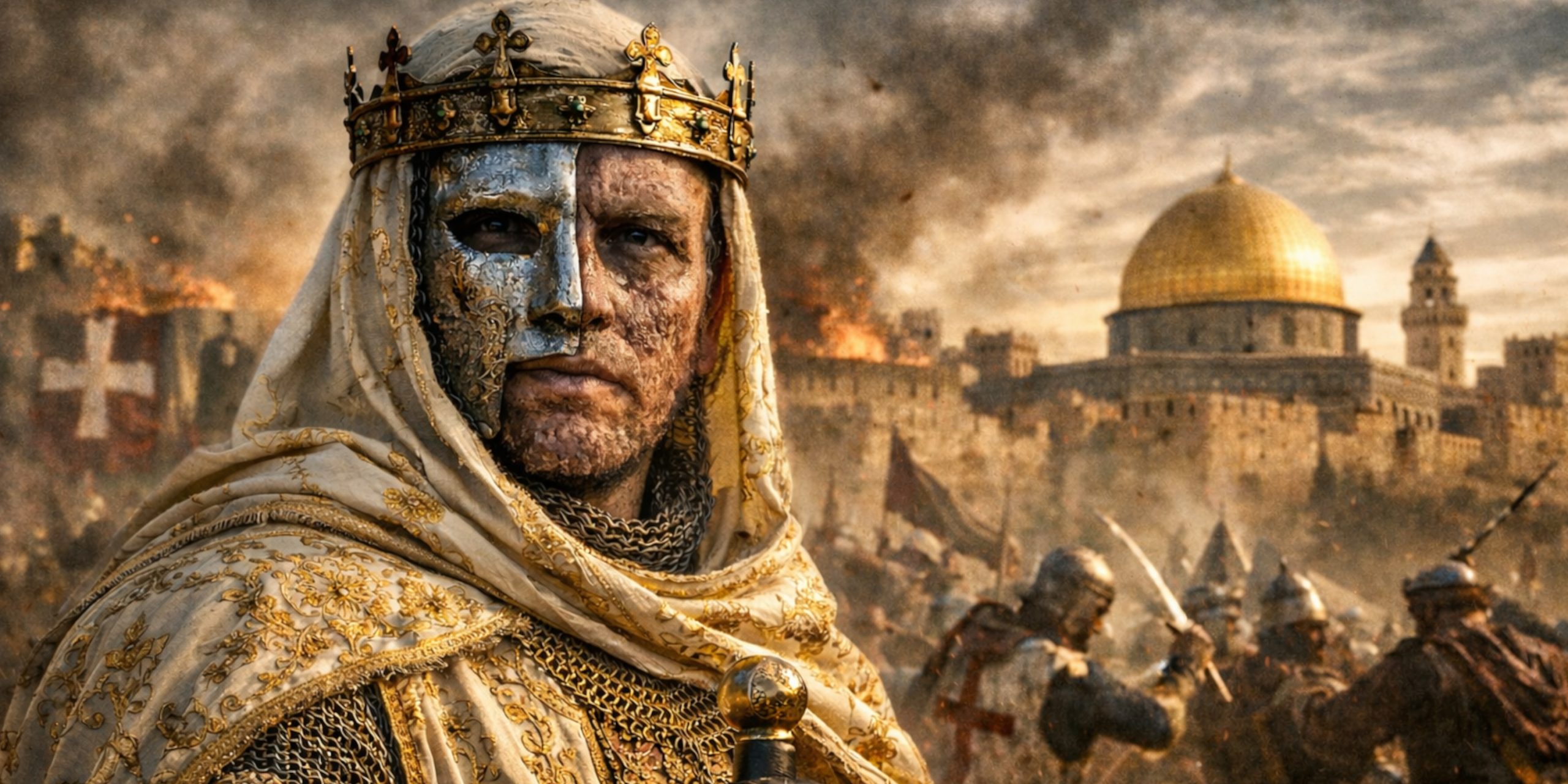
King Baldwin IV of Jerusalem is one of the most memorable figures in Kingdom of Heaven. He appears behind a silver mask, speaks softly, rules wisely, and somehow manages to be the calmest person in a kingdom where everyone else seems desperate to start an argument with a sword.
It is a remarkable performance, and one of the few moments in the film where history briefly strolls into the room, sits down, and looks rather disappointed in everyone.
The real Baldwin IV was every bit as fascinating as the film suggests. He was intelligent, politically astute, respected by his enemies, and tragically ill. Yet the film also reshapes his life to fit a cleaner, more dramatic story. Some changes make sense for cinema. Others are, frankly, the historical equivalent of hiding a trebuchet behind a curtain and hoping nobody notices.
Who Was the Real King Baldwin IV?
Baldwin IV was born in 1161, the son of King Amalric I of Jerusalem and Agnes of Courtenay. He became king in 1174 at only thirteen years old after the death of his father.
Even as a child, Baldwin was already showing signs of leprosy. According to the chronicler William of Tyre, his tutor noticed something unusual when Baldwin was playing with other boys. While they complained about roughhousing and pinching, Baldwin did not seem to feel pain in his right arm. A medieval schoolmaster discovering that his pupil could not feel half his body was not, one imagines, the sort of thing one simply wrote in the weekly report and forgot.
The disease would shape the rest of Baldwin’s life. Leprosy gradually weakened him and affected his ability to rule in person, but it never seems to have damaged his mind. Contemporary accounts consistently describe him as intelligent, determined, and politically capable.
In that respect, Kingdom of Heaven is surprisingly accurate. The film presents Baldwin as thoughtful, cautious, and perhaps the only person in Jerusalem with both a functioning conscience and a functioning long term plan.
Was Baldwin IV Really a “Leper King”?
Yes. Baldwin IV is one of history’s most famous rulers with leprosy, and contemporaries openly referred to his illness.
The film is correct in showing that his condition had advanced significantly by the time of the story. By the early 1180s, Baldwin had difficulty riding, walking, and even seeing. Near the end of his reign he was often carried on a litter because he could no longer mount a horse.
What the film changes is the timeline. In Kingdom of Heaven, Baldwin appears near the end of his life throughout the entire story. In reality, the events surrounding Balian of Ibelin, Guy of Lusignan, Sibylla, and Saladin took place over several years, during which Baldwin’s illness worsened steadily.
The silver mask itself is fictional. There is no evidence that Baldwin wore a mask to conceal his face.
It is, admittedly, an excellent piece of visual storytelling. It gives him an almost ghostly presence, like a king who already knows he is dying and has become slightly irritated that everyone else has not yet realised it.
Historically, Baldwin may have covered parts of his body or face as his illness progressed, but there is no record of the polished silver mask seen in the film.
Did Baldwin IV Rule Jerusalem Wisely?
Largely, yes.
The real Baldwin IV spent much of his reign trying to keep peace within the Kingdom of Jerusalem. This was not an easy task. The kingdom was deeply divided between rival noble factions, particularly those surrounding Raymond III of Tripoli and the increasingly unpopular Guy of Lusignan.
Baldwin often acted as a mediator between these groups while also trying to contain more aggressive figures such as Reynald of Châtillon.
The film captures this well. Baldwin is shown as a ruler who wants peace with Saladin and sees the danger posed by hot-headed crusader nobles. That part is very close to reality.
Baldwin understood that the crusader states could not survive endless war with Saladin. Jerusalem simply did not have the manpower or resources. He preferred diplomacy, truces, and carefully chosen military action.
This makes him rather unusual among medieval kings. Most rulers wanted to be remembered as heroic conquerors. Baldwin seems to have spent much of his reign trying to stop the men around him from behaving like enthusiastic idiots.
How Accurate Is Baldwin’s Relationship with Saladin?
The film presents Baldwin and Saladin as reluctant opponents who respect one another. That is broadly true.
There is evidence that Baldwin and Saladin viewed each other with a degree of respect. Saladin certainly recognised Baldwin as a serious and capable ruler. Baldwin, in turn, understood that Saladin was not simply another local rival but a formidable political and military leader.
However, there is no evidence they had the kind of private, philosophical understanding suggested by the film. They were enemies engaged in a long and dangerous struggle.
The truce between Baldwin and Saladin shown in the film is based on reality. Baldwin negotiated several truces with Saladin during his reign. These were practical agreements rather than grand gestures of friendship.
Both men knew they needed time. Baldwin needed to stabilise his kingdom. Saladin needed to consolidate power in Egypt and Syria.
In truth, their relationship was less like two noble rivals exchanging meaningful glances across a battlefield and more like two exhausted politicians trying to stop everyone else from ruining the situation.
Did Baldwin IV Defeat Saladin at the Battle of Montgisard?
Yes, and this is perhaps the most impressive thing about the real Baldwin.
In 1177, when he was only sixteen and already suffering from leprosy, Baldwin led the Kingdom of Jerusalem to victory against Saladin at the Battle of Montgisard.
Saladin invaded with a much larger army, expecting little resistance. Baldwin gathered a smaller force, joined by Raynald of Châtillon and the Knights Templar, and launched a surprise attack near Ramla.
The result was a crushing defeat for Saladin. His army was scattered and he barely escaped.
This battle is not shown in Kingdom of Heaven, which is a pity because it is one of the most extraordinary moments of Baldwin’s life. The image of a teenage king with leprosy riding into battle and defeating one of the greatest commanders of the age is frankly far more dramatic than many of the scenes the film invented.
If anything, the film understates Baldwin’s military ability. He was not merely a tragic invalid who happened to wear an impressive mask. He was an active ruler and a capable commander.
Was Guy of Lusignan Really That Bad?
Kingdom of Heaven portrays Guy of Lusignan as vain, reckless, cruel, and about as politically useful as a damp crossbow string.
This is exaggerated, but not entirely unfair.
The historical Guy was widely criticised by many contemporaries. Baldwin IV distrusted him and eventually stripped him of authority. Baldwin feared that Guy would provoke a disastrous war with Saladin.
Unfortunately, Baldwin was correct.
After Baldwin’s death, Guy became king through his wife Sibylla. In 1187 he led the crusader army into catastrophe at the Battle of Hattin. That defeat effectively destroyed the Kingdom of Jerusalem and led to the loss of the city itself.
The film compresses these events and turns Guy into a rather obvious villain, but the essential point is accurate. Baldwin believed Guy lacked the judgement needed to rule.
How Accurate Is Baldwin’s Relationship with Sibylla?
The film presents Baldwin and his sister Sibylla as close and affectionate, which seems largely accurate.
Baldwin cared deeply for Sibylla and spent much of his later reign trying to secure her position while also preventing her husband Guy from gaining too much power.
This produced a political nightmare of almost operatic proportions.
Baldwin wanted Sibylla protected, but did not trust the man she had married. So he repeatedly tried to separate her rights from Guy’s authority. At one point he even had Sibylla’s young son crowned as co-king in order to bypass Guy entirely.
That child became Baldwin V. He was only a boy and died soon afterwards, which plunged Jerusalem into another succession crisis.
The film simplifies all of this dramatically. Otherwise half the running time would consist of exhausted nobles arguing over inheritance law in candlelit rooms. Historically accurate, yes. Thrilling cinema, perhaps less so.
Did Baldwin IV Really Die Before the Fall of Jerusalem?
Yes.
Baldwin IV died in 1185 at about twenty-four years old.
Jerusalem did not fall to Saladin until 1187, two years later. By then Baldwin had been dead for some time, Baldwin V had also died, and Guy of Lusignan had become king.
The film is correct in showing that Baldwin’s death marked the beginning of the kingdom’s collapse. Once he was gone, the fragile balance he had maintained disappeared remarkably quickly.
It is one of the great tragedies of crusader history. Baldwin was far from perfect, but he understood the dangers facing Jerusalem better than almost anyone around him. His death removed the one ruler capable of keeping the kingdom together.
What Kingdom of Heaven Gets Right About Baldwin IV
- Baldwin IV really was a leper king.
- He was intelligent, politically capable, and respected.
- He preferred peace and diplomacy with Saladin.
- He distrusted Guy of Lusignan.
- He cared deeply about the future of Jerusalem.
- His death contributed directly to the kingdom’s collapse.
What the Film Changes or Invents
- Baldwin did not wear a silver mask.
- The timeline of his illness is simplified.
- His conversations with Saladin and Balian are fictional.
- The film omits his victory at Montgisard.
- Several years of political struggle are compressed into a much shorter period.
- Guy of Lusignan is made more openly villainous than the historical record suggests.
The Verdict and Takeaway
As historical films go, Kingdom of Heaven does a surprisingly good job with Baldwin IV.
The details are often rearranged, simplified, or polished into something more dramatic, but the core of the character is remarkably accurate. The real Baldwin IV was intelligent, brave, cautious, and painfully aware that his kingdom stood on the edge of disaster.
If anything, the real man may have been even more impressive than the film version.
A teenage king suffering from leprosy, trying to hold together a divided crusader kingdom while facing Saladin, difficult nobles, dynastic chaos, and what appears to have been a permanent shortage of sensible colleagues, is one of those rare cases where history hardly needs embellishment.
The silver mask made Baldwin memorable. The truth makes him unforgettable.