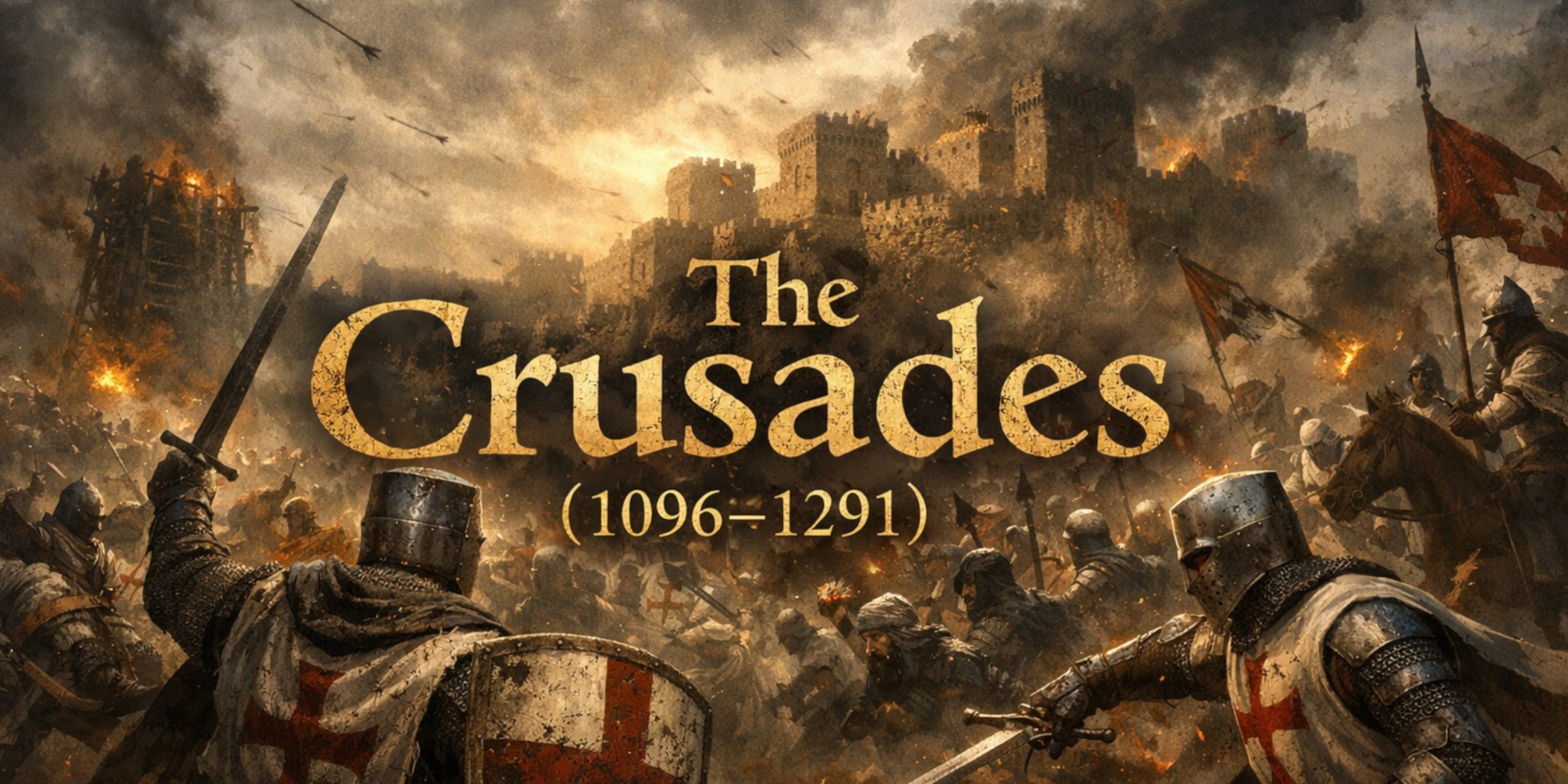
The Crusades remain one of the most argued-over chapters in medieval history. They have been called acts of faith, wars of conquest, armed pilgrimages and, by some rather exhausted chroniclers, an excellent way of turning perfectly good farmland into a battlefield.
Between 1096 and 1291, armies from western Europe marched east to fight for Jerusalem and the wider Holy Land. Along the way they founded kingdoms, lost them, made unlikely alliances, sacked cities, quarrelled endlessly and occasionally remembered why they had come in the first place.
At their heart, the Crusades were driven by religion. Yet faith was only part of the story. Land, prestige, political advantage, trade and simple greed all rode east with the armies.
What Were the Crusades?
The Crusades were a series of military campaigns launched mainly by western European Christians against Muslim powers in the eastern Mediterranean. Most were aimed at controlling Jerusalem and other sacred sites.
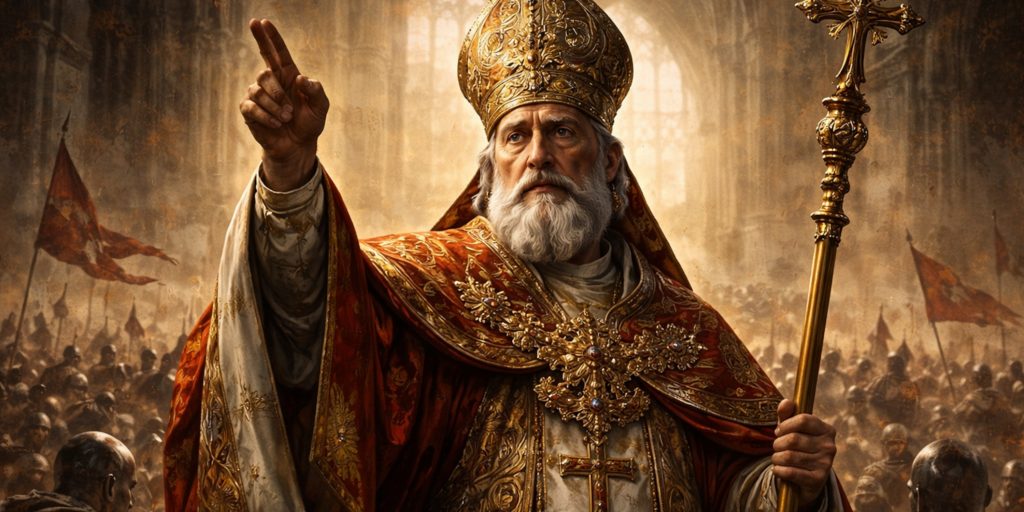
The movement began after Pope Urban II called for a holy expedition in 1095 at the Council of Clermont. He urged knights and nobles to travel east to aid the Byzantine Empire and recover Jerusalem.
According to several chroniclers, Urban declared:
“God wills it!”
That cry became the rallying call of the First Crusade. It was also rather useful for silencing awkward questions about cost, logistics and the fact that most of the men involved had only the vaguest idea where Jerusalem actually was.
The Crusades traditionally lasted from 1096 to 1291, ending with the fall of Acre, the last major Crusader stronghold in the Holy Land.
Why Did the Crusades Begin?
Several causes came together.
- The Byzantine Empire requested military aid against the Seljuk Turks.
- Pilgrims travelling to Jerusalem increasingly faced danger and political instability.
- The papacy wished to strengthen its authority and unite Christian Europe.
- Knights and nobles saw opportunities for land, wealth and status.
- Religious belief and the promise of forgiveness of sins motivated many participants.
Pope Urban II offered spiritual rewards to those who took part. Crusaders were promised remission of sins if they completed the journey. For many medieval Christians this was an extraordinary offer. It was the spiritual equivalent of being handed a clean slate and told that, for once, your neighbours could not bring up that unfortunate incident involving the sheep and the boundary wall.
The Major Crusades
The First Crusade (1096–1099)
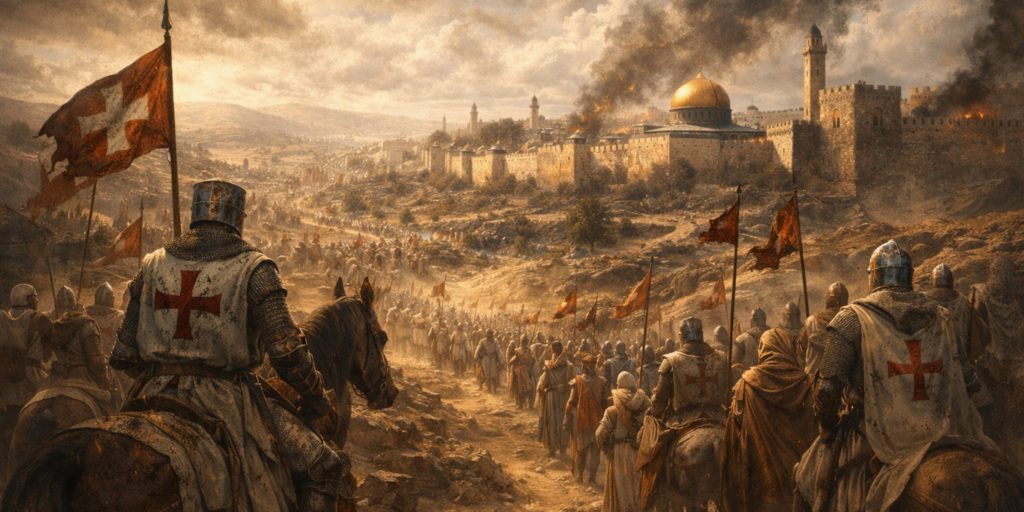
The First Crusade was the most successful. After a difficult journey through Anatolia and Syria, the Crusaders captured Jerusalem in July 1099.
Key events included:
- Siege of Nicaea, 1097
- Battle of Dorylaeum, 1097
- Siege of Antioch, 1097–1098
- Siege of Jerusalem, 1099
The capture of Jerusalem was followed by a massacre of many of the city’s Muslim and Jewish inhabitants. Contemporary accounts are grim and, frankly, impossible to soften.
The Crusaders established several states:
- The Kingdom of Jerusalem
- The County of Edessa
- The Principality of Antioch
- The County of Tripoli
The Second Crusade (1147–1149)
The Second Crusade was launched after the fall of Edessa in 1144. It was led by Louis VII of France and Conrad III of Germany.
It achieved very little. The campaign collapsed after the failed siege of Damascus in 1148. Medieval chroniclers tried hard to explain the failure. Some blamed poor leadership. Others blamed sin. A few quietly blamed the fact that the Crusaders could barely agree on where to camp, let alone how to conduct a siege.
The Third Crusade (1189–1192)
The Third Crusade followed the dramatic Muslim victory at Hattin and the capture of Jerusalem by Saladin in 1187.
The leading figures were:
Richard the Lionheart won victories along the coast, particularly at Arsuf, but failed to retake Jerusalem.
The crusade ended with a treaty allowing Christian pilgrims to visit the city.
Richard and Saladin became legendary rivals, though they never met in person. Medieval writers on both sides admired their opponent. That was rare. Most crusading chronicles read rather like long arguments written by people who had not slept properly for six months.
The Fourth Crusade (1202–1204)
The Fourth Crusade never reached the Holy Land. Instead, Crusaders turned against Constantinople and captured the greatest Christian city in the eastern Mediterranean in 1204.
The sack of Constantinople shocked Europe. Churches were looted, relics stolen and the Byzantine Empire badly weakened.
Few moments better reveal the contradictions of the Crusades. A campaign intended to defend Christianity ended with Christian knights stripping silver from church altars while insisting they were acting in a noble cause.
Later Crusades
Later expeditions included:
- The Fifth Crusade, aimed at Egypt
- The Sixth Crusade, in which Emperor Frederick II regained Jerusalem through diplomacy in 1229
- The Seventh and Eighth Crusades, led by Louis IX of France
By the late thirteenth century, Crusader power had shrunk to a few coastal cities.
Key Figures of the Crusades
Pope Urban II
Urban II launched the movement. Without his speech at Clermont, there would have been no Crusades in their familiar form.
Saladin
Saladin united Egypt and Syria and defeated the Crusaders at Hattin. He recaptured Jerusalem in 1187 and became one of the most respected rulers of the age.
Richard the Lionheart
Richard I was a formidable commander and perhaps the best battlefield leader of the Third Crusade. He was also expensive, stubborn and entirely capable of quarrelling with allies while in the middle of a war.
Godfrey of Bouillon
Godfrey became ruler of Jerusalem after the First Crusade. He refused the title of king and instead styled himself Defender of the Holy Sepulchre.
Frederick II
Frederick II recovered Jerusalem without major fighting. He was excommunicated at the time, which makes him one of the few men in medieval history to conduct a crusade while technically being on very poor terms with the Church.
Baldwin IV, the Leper King
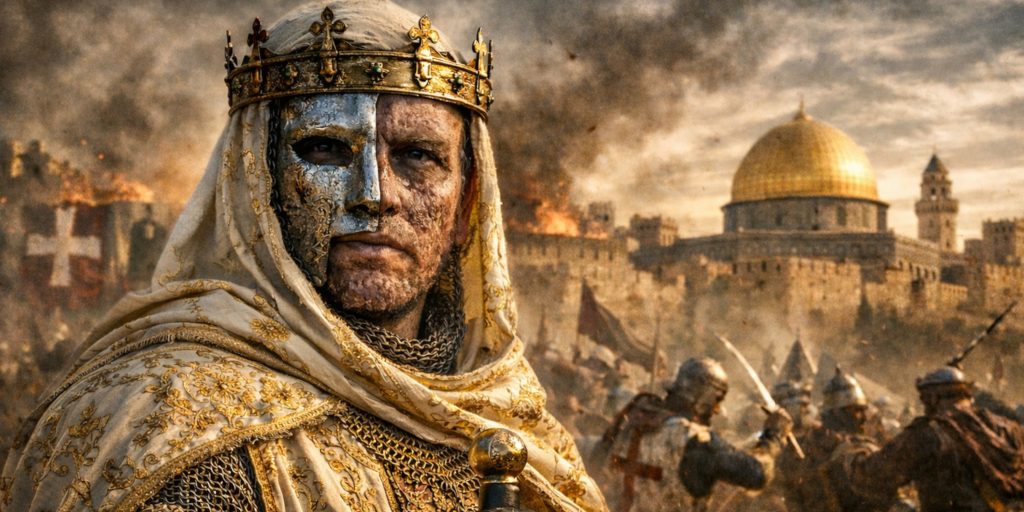
Baldwin IV of Jerusalem remains one of the most remarkable figures of the Crusades. He became king in 1174 while still a boy and was soon diagnosed with leprosy. In most medieval kingdoms that would have ended any hope of rule. Baldwin instead spent much of his short life governing a fragile kingdom while trying to stop it from collapsing under the pressure of Saladin’s growing power.
Despite his illness, Baldwin proved an intelligent and determined ruler. Contemporary writers often described him as courageous, though one suspects they were occasionally understating matters. Ruling the Kingdom of Jerusalem in the 1170s was rather like being handed a leaking ship, a mutinous crew and a storm on the horizon, then being told to do your best.
Baldwin IV and the Battle of Montgisard
Baldwin’s greatest achievement came at the Battle of Montgisard in 1177.
Outnumbered and only sixteen years old, Baldwin led the Crusader army against Saladin near Ramla. The Crusaders launched a sudden attack and won a dramatic victory.
Many historians regard Montgisard as one of the most surprising Crusader victories of the age. Saladin escaped, but much of his army was destroyed.
“The king, though suffering greatly from his illness, fought bravely and encouraged his men.”
William of Tyre
Baldwin IV’s Rule and Decline
Baldwin spent much of his reign balancing rival nobles, ambitious relatives and the constant threat of invasion. He relied heavily on trusted supporters such as Raymond III of Tripoli and the military orders.
As his illness worsened, Baldwin knew the kingdom’s future was uncertain. He attempted to secure the succession through his nephew, Baldwin V, but political divisions deepened.
Baldwin died in 1185 at about the age of twenty-four. Within two years the Kingdom of Jerusalem suffered disaster at Hattin and Jerusalem itself fell to Saladin.
His death marked the end of the last period in which the Crusader kingdom still possessed a ruler capable of holding its factions together.
Baldwin IV in Memory
Baldwin IV has become one of the most famous Crusader kings. Modern interest in him has grown because of his extraordinary story: a young king, gravely ill, still leading armies and trying to preserve his kingdom.
He appears in modern books, documentaries and films, though these often exaggerate or simplify his life. The reality is more impressive. Baldwin was not just tragic or heroic. He was politically skilled, stubborn and, by all accounts, capable of keeping far more experienced men in line.
Major Battles of the Crusades
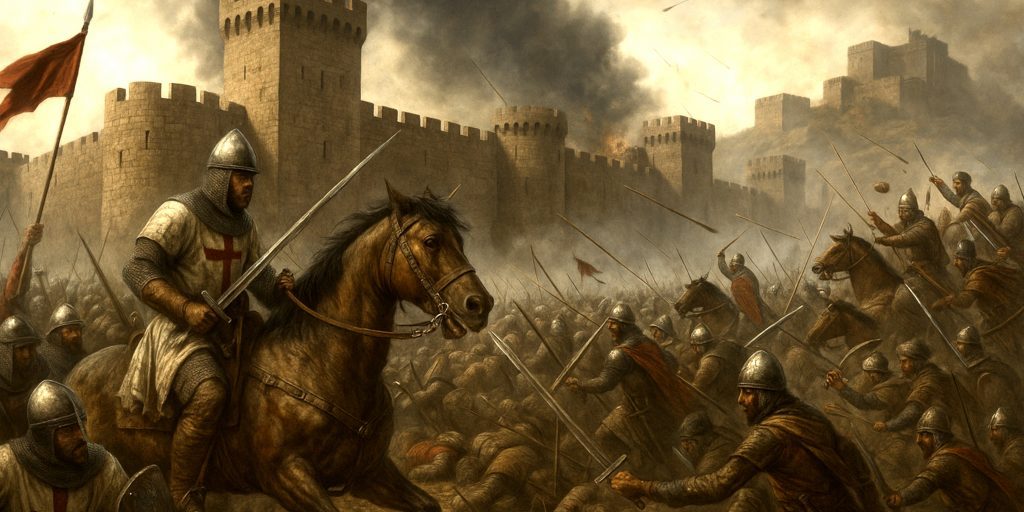
Battle of Dorylaeum (1097)
The First Crusade narrowly survived after Seljuk forces attacked the Crusader column in Anatolia. Reinforcements arrived just in time and the Crusaders won.
Siege of Antioch (1097–1098)
One of the longest and harshest sieges of the Crusades. The Crusaders captured Antioch, then immediately found themselves besieged inside it.
Battle of Hattin (1187)
Perhaps the decisive battle of the Crusades. Saladin destroyed the Crusader army near the Horns of Hattin.
The True Cross was captured and Jerusalem soon fell.
Battle of Arsuf (1191)
Richard the Lionheart defeated Saladin’s forces near the coast. The battle restored Crusader morale and secured the route to Jaffa.
Siege of Acre (1189–1191)
Acre was besieged for almost two years. It became one of the bloodiest and most famous sieges of the age.
Fall of Acre (1291)
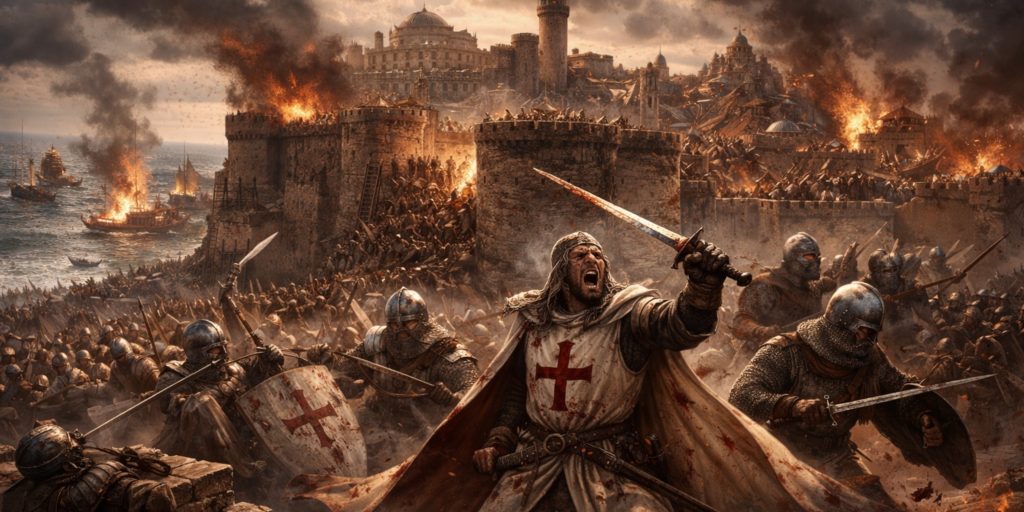
The Mamluks captured Acre in 1291, ending the Crusader presence in the Holy Land.
Many chroniclers treated the loss of Acre as the true end of the Crusading era. One can understand why. After two centuries of war, treasure and endless speeches about divine favour, the Crusaders had very little left but memories, relics and some very disappointed descendants.
Arms, Armour and Warfare
Crusader warfare changed over the two centuries of campaigning.
Early Crusaders usually fought as heavily armed knights supported by infantry and crossbowmen.
Typical Crusader equipment included:
- Mail hauberk
- Conical helmet with nasal guard
- Kite shield
- Spear or lance
- Arming sword
Later Crusaders adopted more advanced armour:
- Great helms
- Surcoats
- Plate reinforcements
- Crossbows and siege engines
Common sword types included:
- Early medieval knightly swords, similar to Oakeshott Type X and XI forms
- Broad crusading swords suited to mounted combat
- Later arming swords with narrower points for fighting through improved armour
Muslim armies often relied on speed, mounted archery and mobility.
Their weapons included:
- Composite bows
- Curved sabres
- Spears and maces
- Lamellar and scale armour
The contrast between the two styles of warfare is striking. Crusader armies often fought like a hammer. Muslim armies often fought like a knife. One depended on weight and shock, the other on movement and patience.
Life in the Crusader States
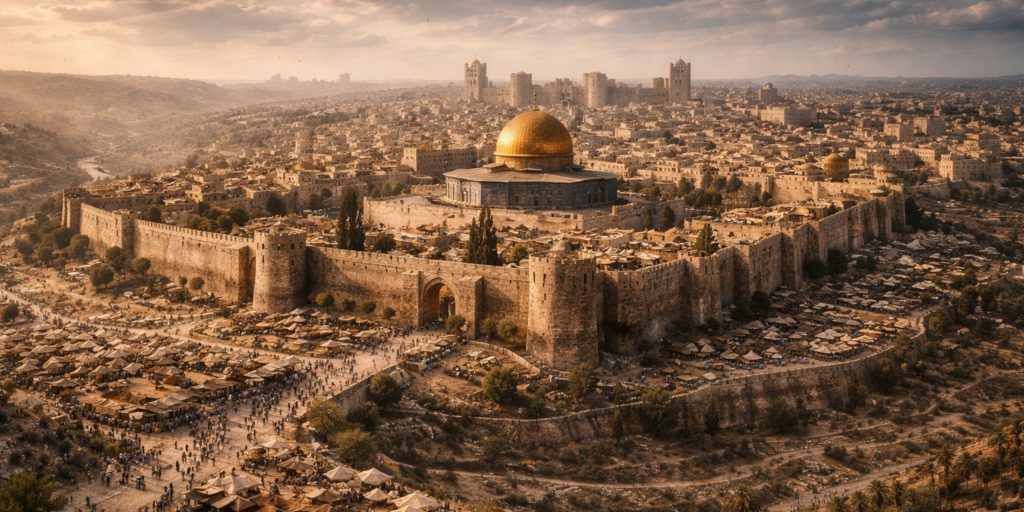
The Crusader kingdoms were more complex than many imagine.
Western Europeans lived alongside local Christians, Muslims and Jews. Trade flourished in places such as Acre and Antioch. Italian merchants from Venice, Genoa and Pisa became wealthy from eastern commerce.
Crusader castles dominated the landscape. Famous examples included:
- Krak des Chevaliers
- Belvoir Castle
- Kerak
These fortresses were impressive but expensive. Medieval rulers built them because they needed them. They also built them because, like every ambitious lord in history, they wanted a castle large enough to impress their enemies and irritate their neighbours.
Archaeology of the Crusades
Archaeology has transformed our understanding of the Crusades.
Excavations in the Holy Land have uncovered:
- Crusader fortifications and castles
- Arrowheads, sword fragments and armour
- Coins and pottery
- Mass graves from battles and sieges
At Acre, archaeologists have uncovered tunnels, fortifications and remains of the medieval port.
At Jerusalem, excavations have revealed evidence of Crusader rebuilding around the Church of the Holy Sepulchre.
Recent excavations at sites such as Montfort Castle and Arsuf have uncovered:
- Crossbow bolts
- Frankish and Islamic pottery
- Evidence of siege damage
- Remains of military orders such as the Templars and Hospitallers
Archaeology has also corrected some myths. The Crusaders were not always a small band of armoured westerners surrounded by a hostile world. In reality they depended heavily on local allies, local craftsmen and local knowledge.
Contemporary Quotes
The Crusades produced some remarkable contemporary writing.
“Jerusalem is the navel of the world.”
Fulcher of Chartres
“Our men rode in blood up to their ankles and bridle reins.”
Raymond of Aguilers, describing the capture of Jerusalem
“What shall I say of the dead? We were surrounded by corpses and blood.”
Ibn al-Athir
“The Franks are brave and strong, but they know nothing of prudence.”
Usama ibn Munqidh
That last remark is one of the sharpest summaries of the Crusaders ever written. Usama admired their courage while quietly despairing at their behaviour. One suspects many Crusader commanders would have agreed.
The Legacy of the Crusades
The Crusades left a deep mark on Europe and the Middle East.
Their legacy includes:
- Greater contact between Europe and the eastern Mediterranean
- Increased trade and cultural exchange
- Long-lasting hostility between religious communities
- The growth of powerful military orders such as the Templars
- Changes in warfare, architecture and kingship
The Crusades also shaped later memory. Victorian writers romanticised them. Modern historians are generally more cautious.
The Crusades were neither a simple clash between Christianity and Islam nor a straightforward story of heroism. They were complicated, violent and often contradictory. They contained acts of bravery and cruelty in almost equal measure.
As a historian, that is perhaps what makes them so fascinating. The Crusades reveal people at their most ambitious, devout, fearful and destructive. They remind us that medieval history was not a world of simple villains and heroes. It was a world of very human people, trying to make sense of faith, power and survival, usually while wearing too much armour in an unforgiving climate.
Takeaway
From the speech at Clermont in 1095 to the fall of Acre in 1291, the Crusades reshaped the medieval world.
They created kingdoms, destroyed empires and filled chronicles with some of the most dramatic scenes in history. Yet they also left behind a more uncomfortable truth. The Crusades promised certainty and salvation, but more often they produced chaos, suffering and arguments that lasted for centuries.
For all their fame, the Crusades remain difficult to pin down neatly. Perhaps that is why they still matter.