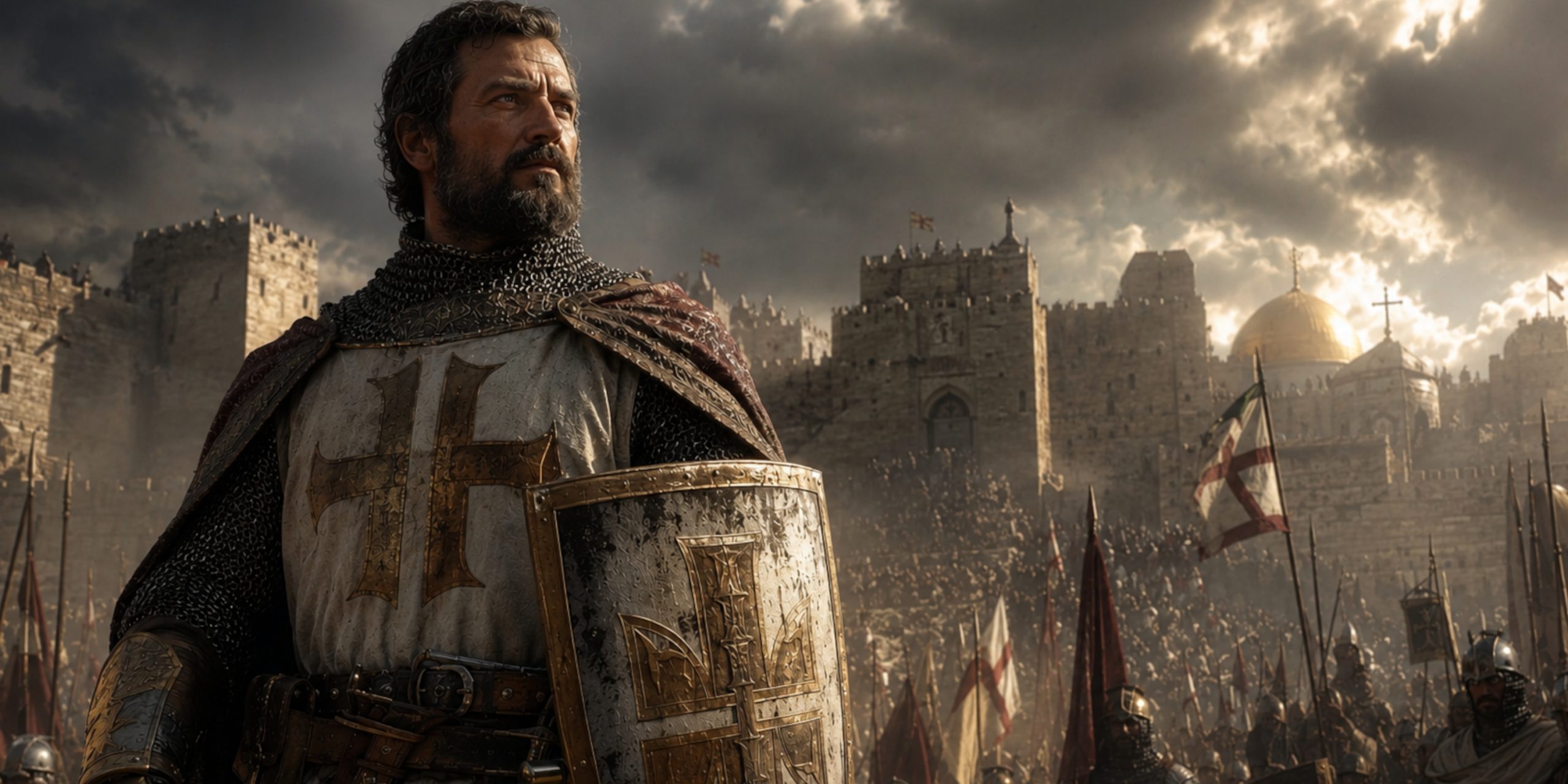
Godfrey of Bouillon remains one of the most recognisable figures of the First Crusade, yet separating the man from the medieval legend is not always simple. Later writers transformed him into a perfect Christian knight, one of the Nine Worthies, a warrior without flaws. The historical Godfrey was more complicated and far more interesting.
Born around 1060, probably in the region of Baisy in Lower Lorraine, Godfrey came from a powerful noble family connected to the Carolingian legacy. As Duke of Lower Lorraine, he was already an experienced political and military figure before he took the cross in 1095.
His fame rests largely on one extraordinary achievement: becoming one of the principal commanders who captured Jerusalem in 1099. After victory, he refused the title of king, reportedly unwilling to wear a golden crown where Christ had worn a crown of thorns. Instead, he accepted the title Advocate of the Holy Sepulchre.
Whether this refusal happened exactly as later chroniclers described is debated, but it reveals how medieval writers wanted Godfrey remembered: not simply as a conqueror, but as the ideal Christian warrior.
Early Life And Rise To Power
Godfrey was the second son of Eustace II, Count of Boulogne, and Ida of Lorraine. His family connections placed him close to some of the most influential houses of Western Europe.
His inheritance came through his maternal uncle, Godfrey the Hunchback, Duke of Lower Lorraine. The title was not immediately granted to him, and Godfrey spent years proving his loyalty to Emperor Henry IV during the conflicts between the Holy Roman Empire and the Papacy.
Before the Crusade, Godfrey had already experienced:
- Siege warfare
- Feudal conflicts
- Cavalry campaigning
- Political negotiations
- Managing armies and territories
This background mattered. The First Crusade was not a simple charge east by enthusiastic knights. It was an exhausting logistical nightmare across thousands of miles. Commanders needed patience as much as courage.
Medieval armies had plenty of men willing to swing swords. They had fewer who could keep thousands of hungry, tired soldiers moving in the same direction.
The First Crusade

When Pope Urban II called for an expedition to the Holy Land in 1095, Godfrey became one of the most important nobles to join.
To finance the campaign, he sold and mortgaged lands, gathering a substantial army from Lorraine and surrounding territories. Alongside his brothers Baldwin and Eustace, he travelled through Europe and into Byzantine territory.
Major stages of his crusading career included:
| Event | Date | Godfrey’s Role |
|---|---|---|
| Departure for the Crusade | 1096 | Led forces from Lorraine |
| Arrival at Constantinople | 1096 to 1097 | Negotiated with Byzantine Emperor Alexios I Komnenos |
| Siege of Nicaea | 1097 | Senior crusader commander |
| Battle of Dorylaeum | 1097 | Helped secure crusader survival in Anatolia |
| Siege of Antioch | 1097 to 1098 | Participated in one of the Crusade’s hardest campaigns |
| Capture of Jerusalem | 1099 | One of the leading commanders |
| Battle of Ascalon | 1099 | Helped defeat a Fatimid relief army |
Battles And Military Acumen
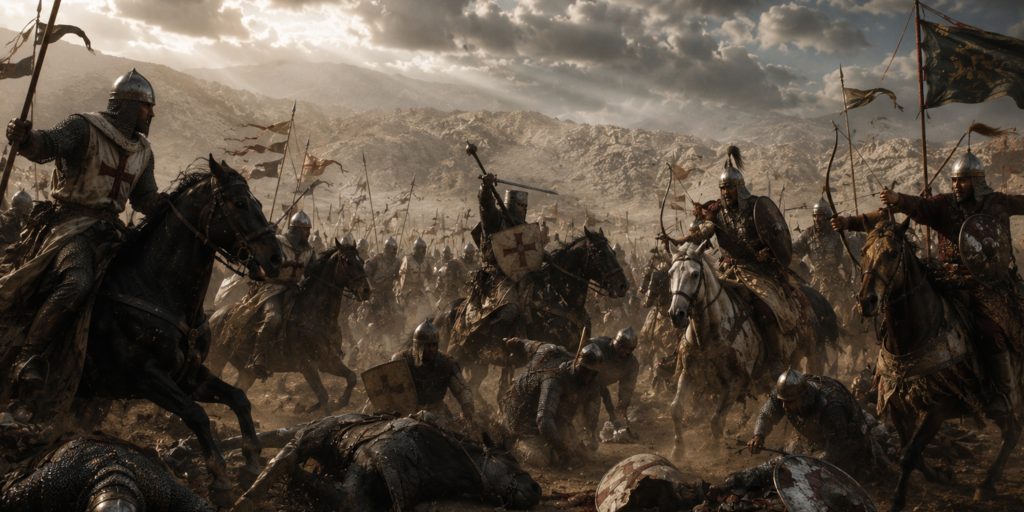
Godfrey was not necessarily the most tactically brilliant commander of the First Crusade. Figures such as Bohemond of Taranto often displayed greater battlefield creativity. Godfrey’s strengths were steadiness, endurance and authority.
Siege Of Nicaea, 1097
The crusaders faced a heavily defended Seljuk city. Godfrey’s forces contributed to the siege operations, though the eventual surrender of the city to Byzantine representatives frustrated many crusaders who expected plunder.
The campaign demonstrated an early lesson: victory in the east depended on diplomacy as much as swordsmanship.
Battle Of Dorylaeum, 1097
The crusaders were ambushed by the forces of Kilij Arslan. Godfrey helped reinforce the battle after the initial crusader contingent came under heavy attack.
The victory showed the effectiveness of heavily armoured western cavalry when coordinated properly, although the crusaders also learned how dangerous mobile Turkish horse archers could be.
Siege Of Antioch, 1097 To 1098
Antioch was perhaps the true test of the First Crusade. Starvation, disease and desertion nearly destroyed the army.
Godfrey survived a campaign that broke many others. Sometimes medieval leadership was not about dramatic speeches before battle. It was about still being there when everyone else wanted to leave.
Siege Of Jerusalem, 1099
Godfrey played a central role in the final assault on Jerusalem. His troops attacked from a siege tower positioned against the northern defences.
According to crusader accounts, his men were among the first to breach the walls.
The aftermath was brutal. Contemporary Christian sources celebrated the victory, while Muslim accounts remembered the devastation and killing that followed. Both perspectives are essential to understanding the event beyond later romantic images.
Battle Of Ascalon, 1099
Shortly after Jerusalem fell, a Fatimid Egyptian army advanced north. Godfrey helped lead the crusader response, achieving a major victory that secured the fragile new crusader presence.
Arms And Armour Of Godfrey Of Bouillon
No confirmed surviving sword or armour belonging personally to Godfrey exists. However, contemporary evidence allows historians to reconstruct what a knight of his rank likely carried.
Helmet
Godfrey would probably have worn:
- Conical nasal helmet
- Iron construction
- Protective nose guard
- Mail coif beneath
The great helm often associated with crusader knights belongs to a later period and would not have been used by Godfrey.
Body Armour
His protection likely included:
- Mail hauberk reaching to the knees
- Long mail sleeves
- Padded gambeson underneath
- Mail chausses for leg protection
- Kite shield
High quality mail was expensive and represented elite status. A duke’s armour would have been among the finest available.
Weapons
Likely weapons included:
Typical examples:
- Oakeshott Type X sword
- Broad double edged blade
- Single handed use
- Designed for powerful cutting strikes
- Straight crossguard
Lance
The defining weapon of western heavy cavalry.
Features:
- Wooden shaft
- Iron spearhead
- Used increasingly with couched techniques
Dagger Or Knife
A practical secondary weapon carried for close fighting and everyday use.
Godfrey’s battlefield image should not be imagined as a lone swordsman cutting through armies. Medieval commanders fought within a network of retainers, cavalry formations and household warriors.
Personality And Leadership
Godfrey’s reputation for humility, discipline and religious devotion grew rapidly after his death.
Contemporary writers such as Albert of Aachen praised his character, though medieval chroniclers often shaped leaders into moral examples rather than writing neutral biographies.
William of Tyre later described him as:
“A religious man, mild, virtuous and fearing God.”
The challenge for historians is finding the real commander beneath the polished medieval portrait.
My own impression is that Godfrey’s greatness was not built on being the most aggressive general of the Crusade. His talent was reliability. In a campaign filled with rival personalities, political arguments and impossible conditions, being the person others trusted was its own form of power.
Death And Succession
Godfrey ruled Jerusalem for only a short time.
He died in July 1100, possibly from illness. Medieval accounts differ, with theories including fever or poisoning, though firm evidence is lacking.
His brother Baldwin succeeded him and accepted the title King of Jerusalem, creating the formal Kingdom of Jerusalem.
Godfrey became something different: a symbol.
Later generations transformed him into the perfect knight, appearing among the Nine Worthies alongside figures such as Julius Caesar, Alexander the Great and King Arthur.
A rather impressive fictional dinner party, although the arguments over leadership would probably have been unbearable.
Artefacts From Godfrey’s Reign And Where To See Them
Although no personal equipment belonging to Godfrey can be securely identified, several museums and sites preserve material connected to his world.
Church Of The Holy Sepulchre, Jerusalem
Traditionally associated with Godfrey’s burial.
Visitors can see:
- Crusader period architecture
- Medieval modifications
- Remains connected with the Latin Kingdom period
His tomb was destroyed after a fire and later rebuilding work, so the original monument no longer survives.
Tower Of David Museum, Jerusalem
Contains material relating to:
- Medieval Jerusalem
- Crusader fortifications
- Changing control of the city
Israel Museum, Jerusalem
Important collections include:
- Medieval artefacts from the region
- Archaeological discoveries from crusader controlled territories
- Military and domestic objects
Royal Armouries, Leeds
Useful for understanding Godfrey’s military world through:
- Medieval swords
- Mail armour
- Knightly equipment
- Comparative weapons
Archaeology And Latest Research
Modern archaeology has changed how historians view the Crusader states.
Important areas of research include:
Crusader Jerusalem
Excavations continue to reveal information about:
- Fortifications
- Urban rebuilding
- Religious structures
- Daily life after 1099
The evidence shows a complex city shaped by many cultures rather than the simplified medieval narratives of conquest alone.
Crusader Castles
Research into castles such as Belvoir and other fortifications demonstrates how quickly western military traditions adapted to Middle Eastern conditions.
Changes included:
- Improved defensive planning
- Stronger stone construction
- Adaptation to regional warfare
Battlefield Studies
Archaeology has also improved understanding of crusader warfare through:
- Weapon finds
- Fortification analysis
- Settlement archaeology
- Environmental studies
The image of endless knightly charges has gradually been replaced by something more realistic: logistics, engineering, diplomacy and survival.
Legacy
Godfrey of Bouillon occupies an unusual place in history. The legendary version became almost too perfect, a flawless knight created by centuries of storytelling. The real man is more compelling.
He was a nobleman shaped by ambition, faith and the violent realities of the 11th century. He helped lead one of history’s most controversial military expeditions and briefly governed one of the most contested cities on earth.
His reputation survived because medieval Europe wanted heroes carved from marble. History usually gives us something more interesting: human beings.
Godfrey was not a mythical knight. He was a commander who endured one of the most difficult campaigns of the Middle Ages and left a legacy that lasted nearly a thousand years.