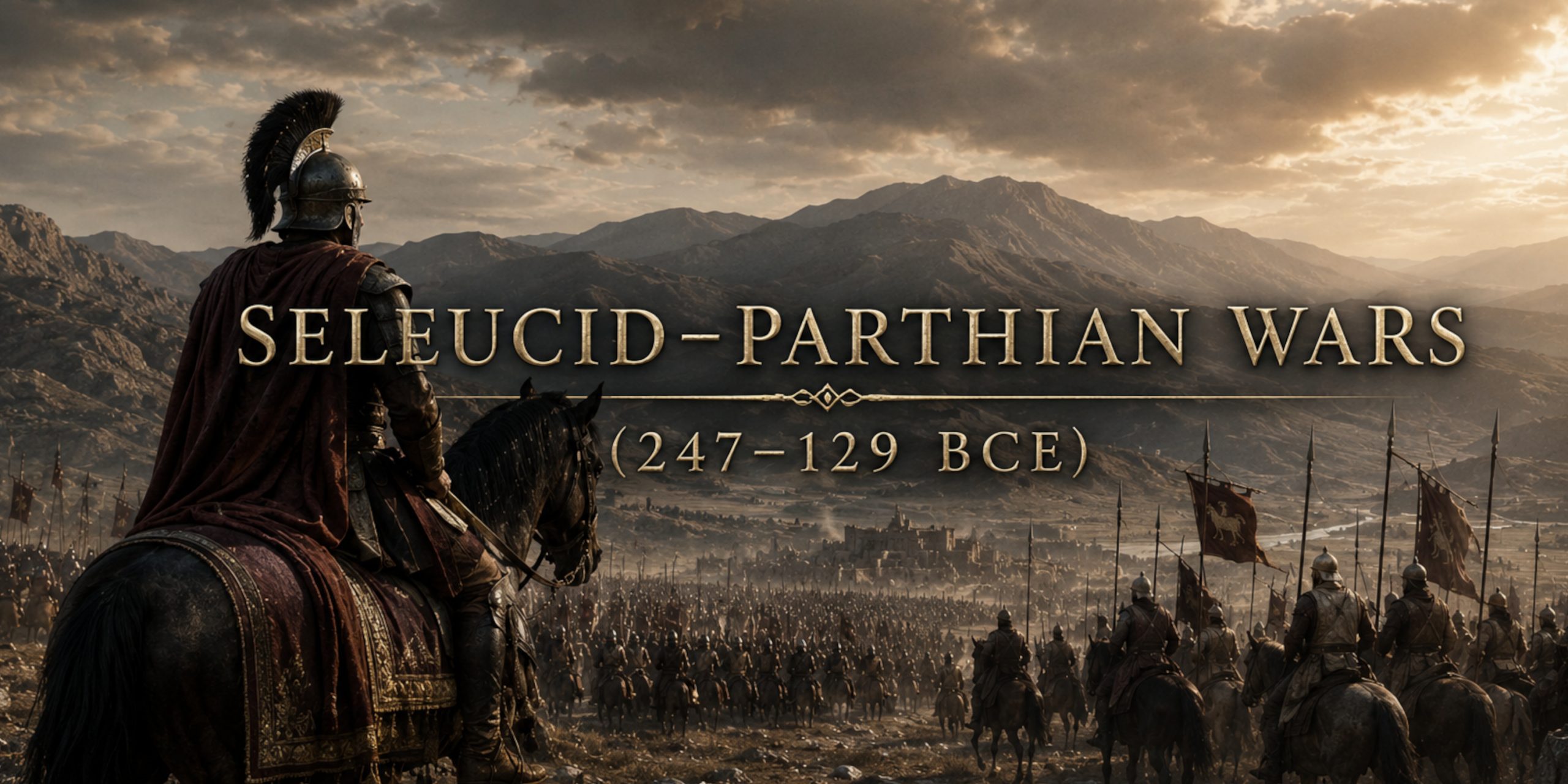
The Seleucid-Parthian Wars were not a single conflict but a long series of campaigns, invasions, rebellions, and shifting frontiers that stretched across more than a century. They transformed the political map of the ancient Near East and marked the gradual collapse of one of Alexander the Great’s successor kingdoms.
At their beginning, the Seleucid Empire still appeared formidable. It ruled vast territories from Syria to Iran and claimed the legacy of Alexander himself. By the end, much of the eastern empire had been lost to the rising Parthians, a people whom earlier Seleucid rulers had scarcely considered a serious threat.
The story has a certain irony. The Seleucids spent generations fighting ambitious rivals, rebellious satraps, and Roman intervention in the west. While they were distracted, a relatively obscure tribal kingdom in northeastern Iran quietly built an empire of its own.
Origins of the Conflict
The roots of the war lay in the fragmentation of Seleucid authority during the third century BCE.
Following the death of Seleucus I Nicator, the empire remained enormous but increasingly difficult to govern. Vast distances separated Antioch from the eastern provinces. Local governors accumulated power, and central authority weakened.
Around 247 BCE, the Parni tribe under Arsaces seized Parthia, a region south-east of the Caspian Sea. This event established what would become the Arsacid, or Parthian, dynasty.
Initially, the Seleucids regarded the revolt as one of many provincial disturbances. In reality, it would become one of the most consequential rebellions in ancient history.
The Rise of the Parthians
The early Parthian kingdom was small, vulnerable, and surrounded by stronger powers.
Under Arsaces I and his successors, however, the Parthians combined steppe cavalry traditions with Iranian political culture. They proved remarkably resilient.
Their strengths included:
- Highly mobile cavalry forces
- Skilled horse archers
- Strong regional support in eastern Iran
- Leadership capable of exploiting Seleucid weakness
Unlike many nomadic groups, the Parthians did not simply raid. They occupied territory, established administration, and built a durable state.
This distinction would prove decisive.
Why the Seleucids Struggled
The Seleucid Empire faced challenges on multiple fronts.
Among the most significant were:
- Wars against Ptolemaic Egypt
- Rebellions by local governors
- Internal dynastic disputes
- Pressure from emerging powers in Anatolia
- Growing Roman involvement in eastern Mediterranean affairs
Maintaining authority over territories thousands of miles apart required resources the Seleucid kings increasingly lacked.
The eastern provinces often became secondary concerns until they were already slipping away.
Major Battles and Campaigns
The Campaign of Seleucus II (c. 230 BCE)
King Seleucus II Callinicus launched one of the first major attempts to recover Parthia.
Ancient sources are fragmentary, but the campaign appears to have achieved little lasting success.
The Parthians avoided decisive destruction and retained control of their core territories.
This established a pattern that would repeat throughout the wars. The Seleucids could often win battles or recover cities, yet struggled to maintain permanent control.
Antiochus III’s Eastern Campaign (209-205 BCE)
The greatest Seleucid recovery came under Antiochus III, often called “the Great.”
Marching east with a substantial army, Antiochus campaigned against Parthian ruler Arsaces II.
After military pressure and negotiations, the Parthians accepted a form of Seleucid overlordship.
For a brief moment, it seemed possible that Seleucid authority might be restored.
Yet the victory proved temporary.
Once Antiochus became occupied elsewhere, Parthian autonomy quickly returned.
The Expansion of Mithridates I (c. 171-132 BCE)
The true turning point came during the reign of Mithridates I.
An exceptionally capable ruler, Mithridates transformed Parthia from a regional kingdom into a major imperial power.
His conquests included:
- Media
- Elymais
- Babylonia
- Mesopotamia
These territories had long formed the economic heart of the Seleucid Empire.
Their loss was catastrophic.
Ancient kings could survive losing distant deserts. Losing Mesopotamia was another matter entirely.
The Campaign of Demetrius II (139-138 BCE)
Determined to recover lost lands, Demetrius II Nicator launched an ambitious eastern expedition.
Initially successful, the campaign soon unravelled.
Parthian forces employed manoeuvre warfare, avoided unnecessary engagements, and gradually isolated the Seleucid army.
Demetrius was captured alive.
His treatment was unusual. Rather than executing him, the Parthians kept him as a royal prisoner and eventually married him into the Arsacid family.
It was an effective demonstration of confidence.
Nothing says “we have won” quite like adopting your enemy into the family.
Antiochus VII’s Final Offensive (130-129 BCE)
The last serious Seleucid attempt to reverse the situation came under Antiochus VII Sidetes.
Gathering a large army, he achieved several impressive victories against Parthian forces.
Ancient writers describe significant successes throughout Mesopotamia and Iran.
For a short period, it appeared that the Seleucid Empire might recover its eastern provinces.
Then disaster struck.
Parthian ruler Phraates II regrouped and launched a counter-offensive.
In 129 BCE Antiochus VII was defeated and killed.
The exact location remains debated, but the consequences are clear.
The defeat effectively ended Seleucid hopes of restoring their eastern empire.
Arms and Warfare
The two powers represented very different military traditions.
Seleucid Forces
Seleucid armies reflected the Hellenistic military model.
They typically included:
- Macedonian-style phalanxes
- Heavy cavalry
- Mercenary infantry
- Archers and slingers
- War elephants
Common weapons included:
- Xiphos swords
- Kopis swords
- Sarissas
- Javelins
- Composite bows
Parthian Forces
Parthian armies relied heavily on cavalry.
Their forces featured:
- Horse archers
- Cataphracts
- Noble cavalry retainers
- Light mounted scouts
Weapons included:
- Long cavalry spears
- Composite bows
- Iranian swords and daggers
- Scale armour
- Lamellar protection
The famous “Parthian shot”, firing arrows while retreating, became one of antiquity’s most feared battlefield tactics.
Archaeology and Material Evidence
Archaeological discoveries have significantly expanded our understanding of the conflict.
Nisa
The ancient Parthian capital at Nisa has produced:
- Fortifications
- Administrative records
- Sculptures
- Ceremonial objects
These discoveries reveal a sophisticated kingdom rather than a simple tribal confederation.
Hecatompylos
Although not fully excavated, evidence from the region points to substantial urban development under Parthian rule.
Seleucia-on-the-Tigris
Excavations at Seleucia have revealed changing patterns of administration and culture during the transition from Seleucid to Parthian control.
Coins, inscriptions, and architecture demonstrate continuity alongside political change.
Numismatic Evidence
Coins remain among the most valuable sources.
They provide:
- Royal portraits
- Titles
- Dates
- Evidence of territorial control
In many cases, coins offer clearer evidence than surviving literary texts.
Ancient historians occasionally disagreed with one another. Coins, thankfully, do not argue back.
Contemporary Sources and Quotes
The wars are known primarily through later historians, though some preserve earlier traditions.
The Greek historian Polybius described Antiochus III’s eastern expedition:
“He crossed the desert and advanced into Parthia.”
Though brief, the passage confirms the importance of the campaign.
The geographer Strabo wrote of the Parthians:
“The Parthians have become masters of the country beyond the Euphrates.”
This succinctly captures the transformation of power in the Near East.
The Roman historian Justin, summarising earlier works, observed:
“The Parthians rose from obscurity to great power.”
Few statements better summarise the century-long conflict.
The End of the Wars
By 129 BCE the outcome was largely settled.
The Parthians controlled:
- Iran
- Mesopotamia
- Babylonia
- Media
The Seleucid Empire survived, but only as a diminished state centred on Syria.
It would continue for several decades before being absorbed by other regional powers.
The eastern empire created by Seleucus I was gone forever.
Legacy
The Seleucid-Parthian Wars reshaped the ancient world.
Their consequences included:
- The emergence of Parthia as a superpower
- The permanent fragmentation of Alexander’s eastern empire
- The decline of Seleucid influence
- The creation of a major eastern rival to Rome
Parthia would remain one of Rome’s greatest opponents for centuries.
Many later Roman generals, from Crassus to Trajan, would discover that defeating Parthian cavalry was considerably harder than drawing arrows on a campaign map.
The wars also marked a broader historical shift. The age of the Hellenistic successor kingdoms was gradually giving way to a new era dominated by Rome in the west and Parthia in the east.
For historians, that makes these conflicts far more than a border war. They were one of the great turning points of the ancient Near East, a slow but relentless transfer of power that changed the course of regional history for centuries.
Key Dates
| Date | Event |
|---|---|
| 247 BCE | Arsaces establishes Parthian independence |
| c. 230 BCE | Campaign of Seleucus II |
| 209-205 BCE | Antiochus III’s eastern expedition |
| c. 171-132 BCE | Expansion under Mithridates I |
| 139-138 BCE | Capture of Demetrius II |
| 130-129 BCE | Antiochus VII’s final campaign |
| 129 BCE | Death of Antiochus VII and effective end of Seleucid eastern ambitions |
Takeaway
The Seleucid-Parthian Wars began as a provincial rebellion and ended with the destruction of a great empire’s eastern half. Across more than a century of campaigning, the Parthians demonstrated patience, adaptability, and strategic vision. The Seleucids, despite moments of brilliance, could never fully overcome the pressures pulling their empire apart.
When the dust settled, Parthia stood as the dominant power of the Iranian world, while the Seleucid Empire entered its final decline. It remains one of antiquity’s most fascinating struggles, not because of a single decisive battle, but because of how steadily and relentlessly the balance of power shifted from one civilisation to another.