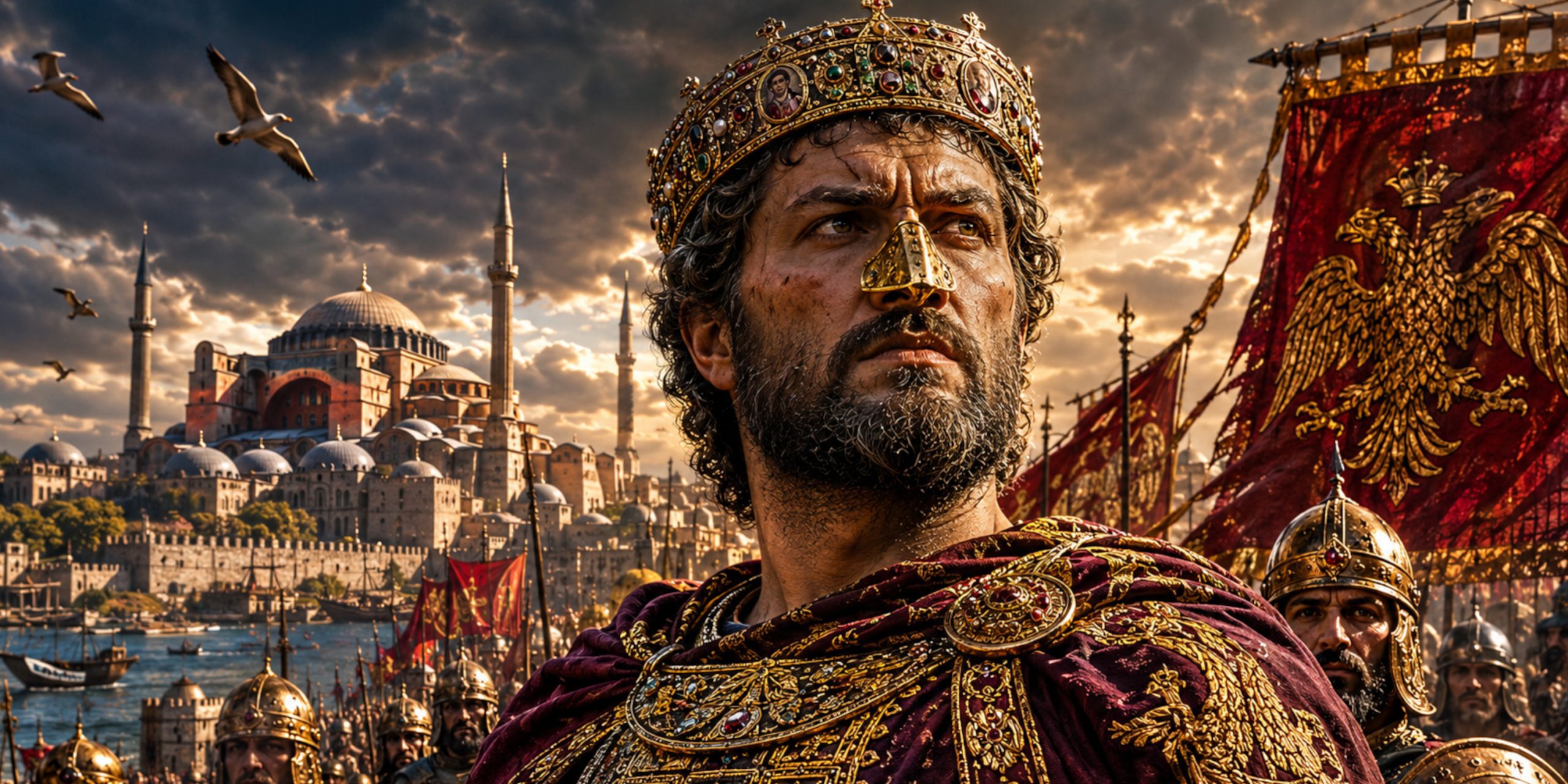
Few rulers in Byzantine history inspire quite as much fascination as Justinian II. His reign reads less like a conventional imperial biography and more like an epic historical drama. He was crowned as a teenager, overthrown by his own subjects, mutilated in an attempt to prevent his return, exiled to the edge of the known world, and then somehow reclaimed the throne.
The Byzantines had seen ambitious emperors before. They had also seen cruel emperors, unlucky emperors, and incompetent emperors. Justinian II managed to be all four at different moments.
As a historian, I often find myself returning to his story because it demonstrates something fundamental about the Byzantine Empire. Political survival often mattered more than military victory, and reputation could be as deadly as any sword.
Early Life and Accession
Justinian II was born around 669 and was the son of Emperor Constantine IV.
In 685, at roughly sixteen years of age, he succeeded his father as emperor of the Eastern Roman Empire. The empire he inherited remained powerful but faced considerable challenges.
These included:
- Ongoing conflict with the Umayyad Caliphate
- Pressure from Slavic groups in the Balkans
- Internal political rivalries
- Economic strains caused by warfare
Initially, Justinian appeared energetic and capable. Contemporary sources describe an ambitious ruler determined to strengthen imperial authority.
Unfortunately, ambition and tact do not always travel together.
The First Reign (685-695)
During his first reign, Justinian sought to restore imperial power both militarily and administratively.
He negotiated favourable arrangements with the Umayyad Caliphate and attempted to increase state revenues through taxation and reforms.
His government also sponsored major building projects and strengthened imperial control over provinces.
Yet these achievements came at a cost.
The emperor developed a reputation for harsh taxation and severe punishments. Several contemporary chroniclers portray him as increasingly authoritarian. While Byzantine writers often exaggerated the faults of fallen rulers, the consistency of these accounts suggests genuine discontent among both elites and ordinary citizens.
By 695, opposition had reached a breaking point.
Overthrow and Mutilation
In 695, a revolt led by Leontios successfully removed Justinian from power.
Rather than execute him, the conspirators chose a punishment with deep symbolic meaning.
His nose was cut off.
The Byzantines generally believed physical mutilation made a man unsuitable to rule. A disfigured emperor was thought incapable of representing divine authority.
The logic appeared sound.
Unfortunately for everyone involved, Justinian refused to cooperate with the plan.
He was exiled to Cherson in Crimea, where he began plotting his return almost immediately.
Exile, Escape and Return
Justinian spent years in exile, first in Crimea and later among the Khazars.
At one point, political circumstances forced him to flee for his life across the Black Sea. Accounts of storms, secret escapes, and narrow survival have become some of the most dramatic episodes in Byzantine history.
Eventually he secured support from the Bulgar ruler Tervel.
In 705, Justinian and his allies marched on Constantinople.
According to Byzantine sources, he entered the city through an unused aqueduct and seized power in a remarkably daring operation.
Against all expectations, the mutilated emperor had returned.
To conceal his injury, later traditions suggest he wore a prosthetic nose made from gold. Whether entirely accurate or somewhat embellished, the image became one of the most enduring symbols of Byzantine resilience and stubbornness.
The Second Reign (705-711)
Justinian’s restoration remains one of the most extraordinary political comebacks in medieval history.
Unfortunately, his second reign quickly became defined by revenge.
Many of those involved in his overthrow faced execution or brutal punishment. Political opponents were pursued relentlessly.
The emperor’s determination to settle old scores created widespread fear and instability.
Rather than reconciling factions, he deepened divisions throughout the empire.
By 711, another rebellion emerged.
This time Justinian’s luck finally ran out.
Captured while attempting to resist the revolt, he was executed. His young son Tiberios was also killed, ending his dynasty.
Battles and Military Acumen
Strengths as a Military Ruler
Justinian was not an incompetent military leader.
His strengths included:
- Strategic persistence
- Diplomatic flexibility
- Effective use of allied forces
- Strong understanding of imperial logistics
His greatest achievement was undoubtedly the recovery of the throne in 705.
Few rulers in world history have successfully reclaimed an empire after exile and mutilation.
Major Military Campaigns
| Campaign | Date | Result |
|---|---|---|
| Operations against Slavic groups in the Balkans | 688-689 | Byzantine victory |
| Campaigns involving the Umayyad Caliphate | 680s-690s | Mixed results |
| Recovery of Constantinople | 705 | Decisive success |
| Suppression of internal revolts | Various | Temporary successes |
Assessment of Military Ability
As a battlefield commander, Justinian appears competent rather than brilliant.
His real weakness was political judgement.
Many Byzantine emperors lost battles and survived politically. Justinian often won military successes while steadily creating new enemies.
That is rarely a sustainable strategy.
Arms and Armour During Justinian II’s Reign
The Byzantine military of Justinian’s era retained strong Roman traditions while incorporating influences from Persia, the steppe, and neighbouring cultures.
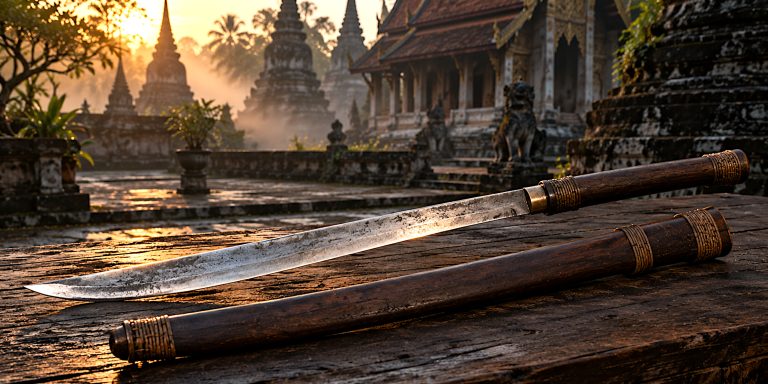
Swords
Common sword types included:
- Spathion: The standard Byzantine straight sword used by cavalry and infantry.
- Paramerion prototypes: Early curved cavalry weapons may have appeared in limited forms.
- Long cavalry blades influenced by eastern designs.
Other Weapons
- Spears and kontaria lances
- Composite bows
- Javelins
- Maces
- Axes
Armour
Byzantine soldiers commonly wore:
- Lamellar armour
- Scale armour
- Mail shirts
- Padded protection beneath metal armour
Elite cavalry units often possessed extensive body protection that rivalled contemporary Persian forces.
Helmets and Shields
Helmets frequently featured:
- Iron bowl construction
- Nasal guards
- Decorative crests for officers
Shield designs varied considerably but typically included oval and round forms.
The Byzantine army remained one of the most sophisticated military organisations of the early medieval world.
Government and Religious Policies
Justinian II actively involved himself in religious affairs.
He supported decisions emerging from important church councils and sought greater imperial influence over ecclesiastical matters.
His reign also witnessed tensions between Constantinople and Rome.
Relations between emperors and popes had rarely been simple. Justinian’s approach ensured they remained complicated.
Administrative reforms attempted to strengthen central authority, though their effectiveness remains debated.
Contemporary Views of Justinian II
The Byzantine chronicler Theophanes preserved one of the most influential portrayals of Justinian:
“He became harsh and merciless toward all.”
Many later writers adopted similar views.
Yet modern historians tend to be somewhat more cautious.
The surviving sources were largely written after his downfall, often by individuals hostile to his memory. While Justinian undoubtedly ruled harshly, the full extent of his alleged cruelty remains difficult to verify.
Artefacts from the Reign of Justinian II
Several important artefacts survive from his reign.
Gold Coinage
Perhaps the most significant are his gold solidi.
These coins are particularly notable because they prominently feature images of Christ. This represented a remarkable innovation in Byzantine imperial coinage.
Examples can be found in:
- The British Museum, London
- The Dumbarton Oaks Collection, Washington
- The Bibliothèque nationale de France, Paris
- The State Hermitage Museum, St Petersburg
Seals and Administrative Objects
Lead seals from officials serving under Justinian have been discovered throughout former Byzantine territories.
These provide valuable evidence for government administration and regional authority.
Architectural Remains
While many structures from his reign have been altered or destroyed, archaeological work in Constantinople and other Byzantine centres continues to reveal material dating to his period.
Latest Archaeology and New Discoveries
Research connected to Justinian II increasingly benefits from archaeological work across the eastern Mediterranean and Black Sea region.
Recent areas of interest include:
Cherson in Crimea
Excavations continue to improve understanding of the city where Justinian spent part of his exile.
Archaeologists have uncovered fortifications, churches, housing complexes, and trade evidence that illuminate conditions during his residence.
Byzantine Coin Hoards
New coin finds across the Balkans and Anatolia continue to refine our understanding of imperial finances and trade networks during the late seventh and early eighth centuries.
Constantinople
Ongoing work in modern Istanbul regularly uncovers material connected to the broader period of Justinian’s reign, including infrastructure, harbour installations, and military facilities.
These discoveries help historians place his dramatic political career within a richer social and economic context.
Legacy
Justinian II occupies a unique place in Byzantine history.
He was the last emperor of the Heraclian dynasty and one of the most controversial rulers ever to sit on the throne in Constantinople.
His story contains military campaigns, palace intrigue, exile, revenge, assassination, and an almost unbelievable restoration to power.
Most rulers would consider one of those achievements sufficient for a lifetime.
Justinian somehow managed all of them.
His reign also highlights a central truth of Byzantine politics. Military strength and personal determination could achieve extraordinary things, but an emperor who alienated too many powerful interests rarely enjoyed lasting security.
More than thirteen centuries later, Justinian II remains one of Byzantium’s most memorable figures. Not because he was its greatest emperor, but because his life was so astonishingly improbable.