The Parthian horse archer has a reputation that borders on myth, and in this case, the reputation is largely deserved. These riders turned mobility into a weapon, patience into a strategy, and retreat into a trap. For centuries, they frustrated armies that were built around discipline and formation, particularly those of Roman Empire, who discovered rather quickly that fighting an enemy who refuses to stand still is deeply inconvenient.
They were not heavily armoured knights thundering into a charge. They were something far more elusive. Skilled riders, calm under pressure, and deadly at range, they created a style of warfare that relied on control of distance rather than brute force.
Origins and Historical Context
The Parthians emerged from the eastern fringes of the Iranian world, originally linked to nomadic traditions that valued horsemanship above almost everything else. By the 3rd century BC, under the Arsacid dynasty, they had carved out a powerful state that stretched across much of the Near East.
Their geography shaped their warfare. Open plains and steppe terrain encouraged speed and flexibility. Infantry-heavy armies, so effective in Mediterranean environments, struggled here.
Key points in their rise:
- Expansion into former Seleucid territories during the 2nd century BC
- Consolidation under rulers such as Mithridates I
- Long-standing rivalry with Rome, culminating in repeated clashes along the Euphrates frontier
Their military system reflected this world. Cavalry was not a supplement. It was the army.
The Parthian Way of War
The defining feature of Parthian warfare was control of engagement. They chose when to fight, how to fight, and when to leave.
Core tactical elements:
- Continuous movement, rarely allowing the enemy to close
- Massed arrow fire to wear down formations
- Feigned retreats that lured opponents into disarray
- Encirclement once cohesion broke
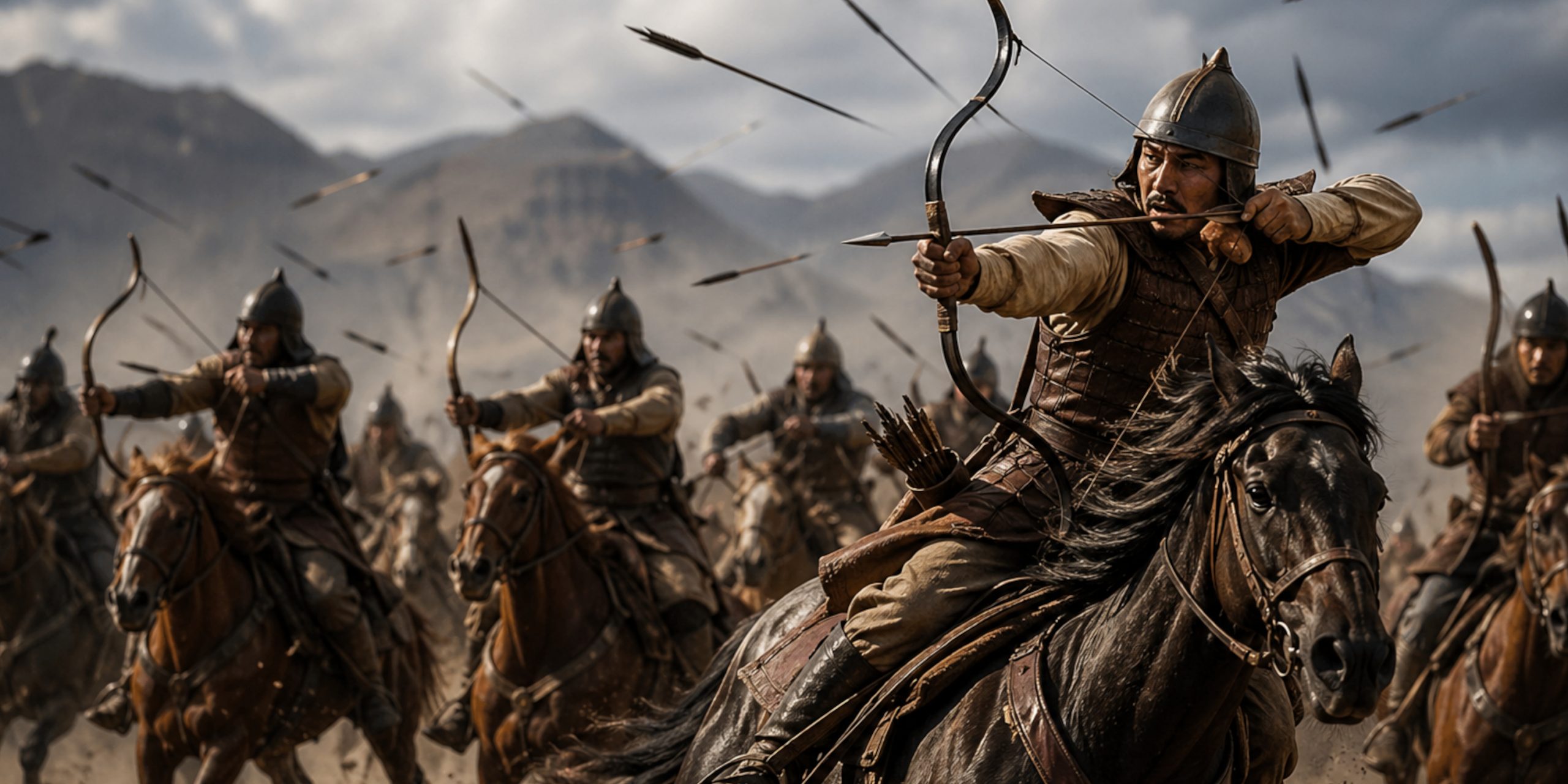
The famous “Parthian shot” sits at the centre of this approach. A rider would turn in the saddle and fire backwards while retreating, maintaining pressure while appearing to flee. It sounds theatrical, but it worked, repeatedly.
The disaster of Battle of Carrhae remains the clearest example. Roman legions, confident in their discipline, found themselves harassed, exhausted, and eventually surrounded. The result was not just defeat but humiliation, a rare experience for Rome at the time.
Arms and Armour
Parthian horse archers were lightly equipped compared to their heavily armoured cataphract counterparts, but this was a deliberate choice. Speed mattered more than protection.
Core Equipment
Composite Bow
- Made from wood, horn, and sinew
- Short enough for mounted use
- High draw weight and strong penetration
Arrows
- Stored in a combined bow case and quiver known as a gorytos
- Often bodkin-tipped for armour penetration
Swords
- Common sidearms included early forms of the Akinakes
- Longer blades began to appear later, foreshadowing the Spatha style
- Used primarily as a backup when close combat became unavoidable
Armour
- Typically light or minimal for horse archers
- Leather or scale elements in some cases
- Helmets were simple, often conical
Horse Equipment
- Saddles designed for stability rather than shock combat
- No stirrups in this period, which makes their shooting accuracy more impressive than most people expect
There is a quiet irony here. Roman authors sometimes dismissed Parthians as lacking discipline, yet hitting a moving target from a moving horse without stirrups requires a level of control that most infantry would struggle to imagine.
Organisation and Composition
The Parthian army revolved around two main cavalry types:
- Horse archers, the majority, fast and flexible
- Cataphracts, heavily armoured shock cavalry for decisive moments
This combination allowed them to weaken an enemy at range before delivering a crushing blow.
Command structures were less rigid than Roman systems. Noble families often provided contingents, which could make coordination uneven, but it also meant a constant supply of skilled riders raised in a martial culture.
Archaeology and Evidence
Material evidence for Parthian warfare is scattered but informative.
Key Archaeological Insights
- Reliefs and sculptures from sites like Hatra show mounted archers with distinctive equipment
- Arrowheads recovered from battle sites indicate large-scale missile use
- Parthian coins frequently depict rulers with bows, reinforcing the cultural importance of archery
Excavations suggest a society deeply invested in cavalry warfare. Horse gear, weapon fragments, and iconography all point in the same direction.
Still, much of what we know comes through the eyes of their enemies, which introduces a certain bias. Roman writers admired Parthian effectiveness while quietly resenting it.
Contemporary Accounts
Ancient sources, particularly Roman ones, offer vivid if occasionally frustrated descriptions.
Plutarch, writing on Carrhae, observed:
“Before they came to close quarters, they were overwhelmed by a storm of arrows.”
Cassius Dio noted the difficulty of engaging them directly:
“They did not charge, nor did they stand their ground, but attacked and retreated at once.”
These are not just complaints. They are admissions that traditional methods were failing.
Strengths and Weaknesses
Strengths
- Exceptional mobility across open terrain
- Ability to dictate the pace of battle
- Psychological pressure through constant harassment
- Effective combination with heavy cavalry
Weaknesses
- Less effective in confined or rough terrain
- Limited staying power in prolonged close combat
- Reliance on coordination between units that were not always centrally controlled
In other words, brilliant when the battlefield suited them, less comfortable when it did not.
Legacy
The Parthian model of mounted archery did not disappear with their empire. It influenced later powers, including the Sasanian Empire, and echoed across the steppe for centuries.
The concept of mobile missile cavalry would reach its peak with later groups such as the Huns and Mongols, but the Parthians refined it into a system that could challenge one of the most formidable empires in history.
Even the Romans adapted. Over time, they incorporated more cavalry and missile troops into their own forces, a quiet acknowledgement that the Parthians had exposed a weakness.
Seven Swords Takeaway
There is something almost modern about the Parthian approach. Avoid unnecessary risk, control distance, exploit mobility, and never fight on the enemy’s terms.
It is easy to imagine Roman commanders watching their formations dissolve under arrow fire, wondering when exactly the battle had slipped out of their hands.
The answer, more often than not, was the moment the Parthians decided to leave.