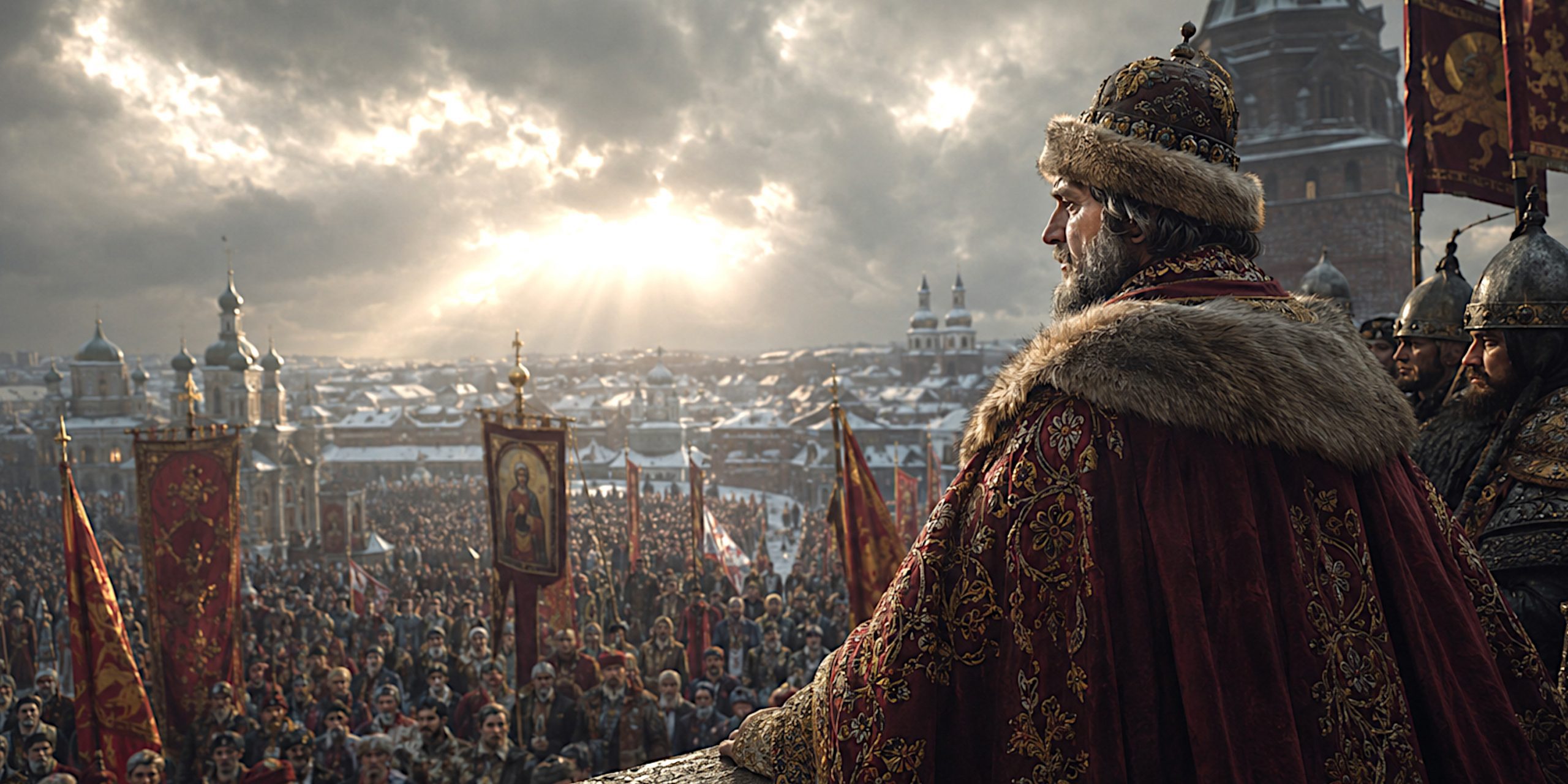
Few rulers have reshaped their country as completely as Ivan III. Better known as Ivan the Great, he inherited a respectable principality and left behind a state that had become the dominant power in northeastern Europe. He did not merely expand Muscovy. He transformed its identity.
His reign marked the end of centuries of Mongol supremacy, the absorption of rival Russian principalities, the birth of a more centralised government, and the emergence of Moscow as the political heart of Russia. Many of the symbols associated with later Tsarist Russia, from the double-headed eagle to the notion of Moscow as the “Third Rome”, have their roots in his era.
As a historian, I often find Ivan III strangely overshadowed by his grandson, Ivan IV, otherwise known as Ivan the Terrible. The irony is difficult to ignore. Ivan IV inherited an empire that largely existed because of his grandfather’s patience, diplomacy, and occasionally ruthless determination. Ivan III rarely receives the dramatic film treatment, perhaps because careful administration makes for less exciting cinema than uncontrolled paranoia.
Still, history is rarely built by spectacle alone.
Early Life
Ivan III Vasilyevich was born on 22 January 1440.
He was the son of Vasily II, known as Vasily the Blind, whose reign was dominated by a devastating civil war between rival branches of the ruling family. Young Ivan therefore grew up surrounded by political intrigue, shifting loyalties and military conflict.
Unlike many medieval princes raised in relative comfort, Ivan witnessed first-hand how fragile power could be. Those experiences appear to have shaped his cautious and calculating personality throughout adulthood.
In 1462, following his father’s death, Ivan became Grand Prince of Moscow.
At that point, Muscovy remained only one of several competing Russian states, while still formally paying tribute to the Mongol Golden Horde.
A Russia Divided
When Ivan inherited power, the political map of Russia looked very different from today.
Several important principalities remained independent, including:
| Principality | Status |
|---|---|
| Novgorod | Wealthy merchant republic |
| Tver | Independent rival |
| Ryazan | Semi-independent ally |
| Pskov | Republic with considerable autonomy |
| Various smaller principalities | Ruled by local princes |
This fragmentation weakened collective resistance against outside powers including Lithuania and the remnants of the Mongol successor states.
Ivan understood something many rulers struggled to accept.
A divided Russia could never become a great power.
Expansion of Muscovy
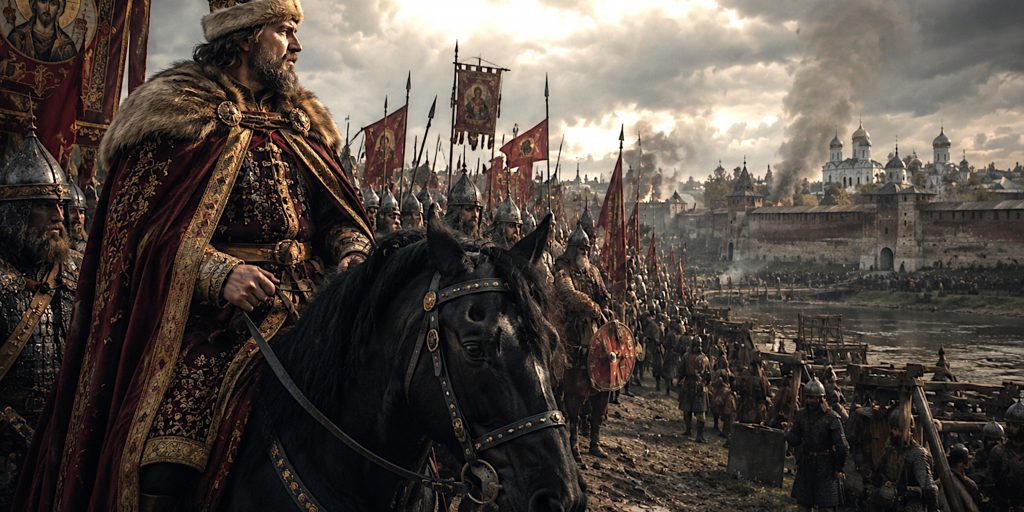
Ivan rarely relied on conquest alone.
Marriage alliances, political pressure, purchases of territory, diplomacy and selective military campaigns all became tools of expansion.
His greatest victories included:
| Territory | Date | Importance |
|---|---|---|
| Yaroslavl | 1463 | Early territorial gain |
| Rostov | 1474 | Expanded central control |
| Novgorod | 1478 | Destroyed independent republic |
| Tver | 1485 | Removed major rival |
The conquest of Novgorod proved particularly significant.
Novgorod had long maintained close commercial ties with northern Europe through the Hanseatic League. It possessed a republican political tradition unlike much of medieval Europe.
Ivan regarded its independence as unacceptable.
Following military victory, thousands of influential families were relocated while Novgorod’s famous assembly bell, the symbol of its political independence, was removed to Moscow.
It was an unmistakable message.
Regional autonomy had ended.
The End of Mongol Domination
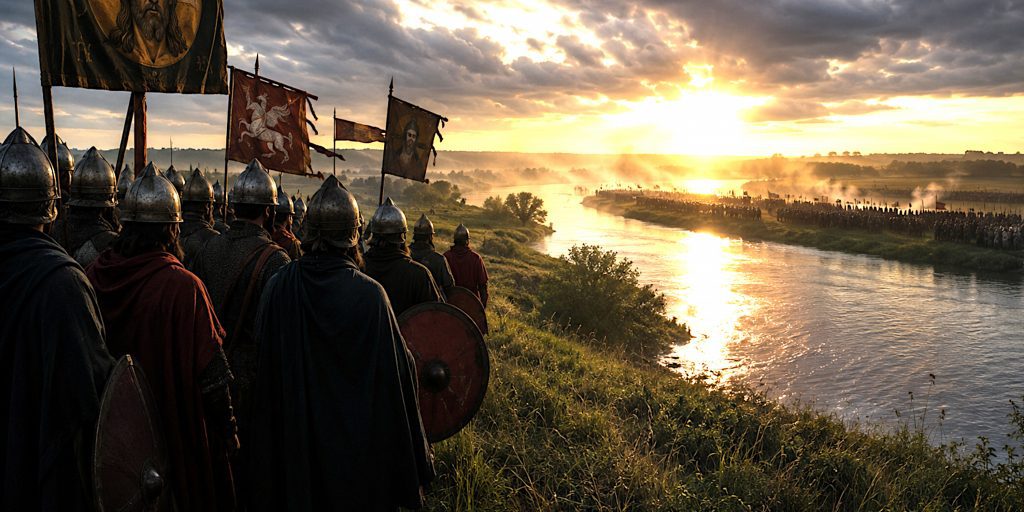
Perhaps Ivan’s greatest achievement came in 1480 during the famous Great Stand on the Ugra River.
For over two centuries, Russian rulers had acknowledged the authority of the Mongol khans.
When Akhmat Khan attempted to reassert control, Ivan refused to submit.
Rather than launching an immediate battle, both armies faced one another across the River Ugra for weeks.
Eventually the Mongol forces withdrew.
No dramatic cavalry charge.
No heroic last stand.
Just two exhausted armies deciding that fighting looked increasingly unattractive.
History occasionally changes with astonishing restraint.
The withdrawal effectively ended Mongol political dominance over Muscovy.
Although historians continue debating the precise significance of the event, contemporaries increasingly viewed it as the moment Russian independence had finally been secured.
Marriage to Sophia Palaiologina
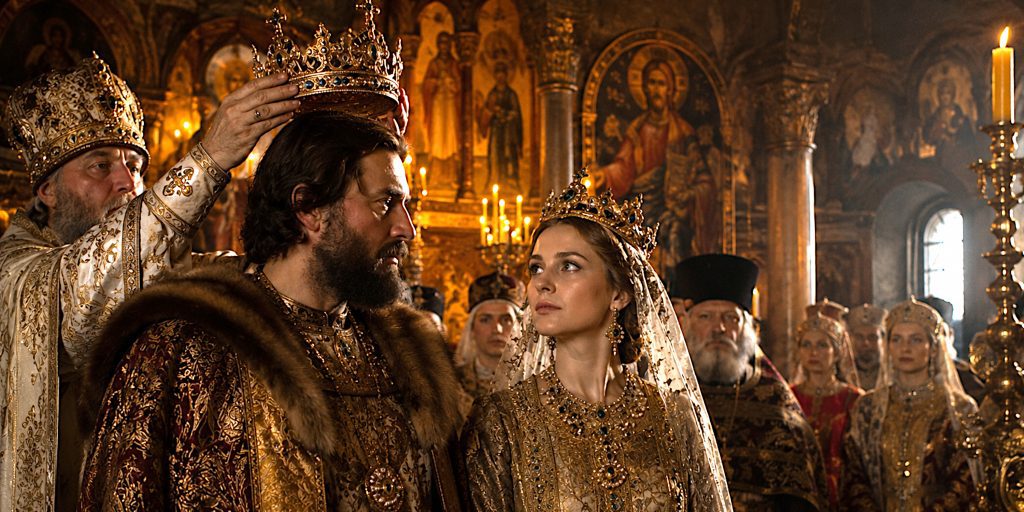
One of Ivan’s most influential decisions was marrying Sophia Palaiologina in 1472.
Sophia was the niece of the last Byzantine Emperor, Constantine XI.
After the fall of Constantinople in 1453, she represented one of Europe’s most prestigious dynastic connections.
The marriage transformed Moscow’s international standing.
Byzantine court traditions entered Muscovy.
Imperial ceremonial expanded considerably.
The famous double-headed eagle, associated with Byzantium, gradually became one of Moscow’s principal symbols.
This marriage also encouraged the belief that Moscow had inherited the spiritual mission of Constantinople.
From these ideas emerged the famous concept of Moscow as the Third Rome.
Whether Ivan personally embraced every aspect of that ideology remains uncertain, but later generations certainly did.
Government and Reform
Ivan steadily centralised authority.
Local princes increasingly became servants of the Grand Prince rather than semi-independent rulers.
His administration expanded through:
- Centralised taxation
- Greater control over noble landholding
- Professional government offices
- Unified legal administration
- Stronger military obligations
Perhaps his greatest administrative achievement was the Sudebnik of 1497.
This legal code standardised judicial procedures across much of Muscovy.
It also restricted the movement of peasants between landowners.
Although not full serfdom, it represented one of the important steps towards the system that later developed.
Administrative paperwork rarely inspires excitement, yet kingdoms are far more often held together by tax records than heroic speeches.
The Moscow Kremlin
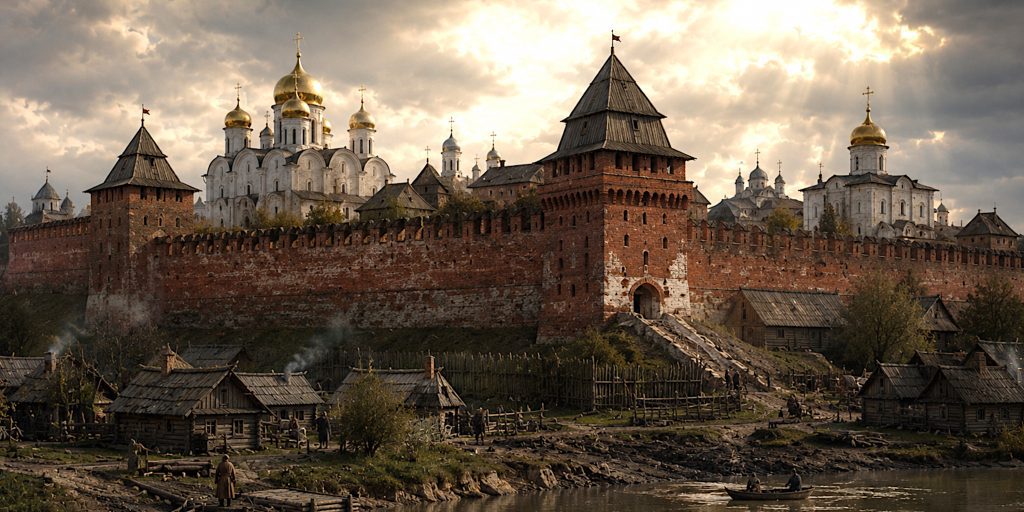
Ivan invested heavily in rebuilding Moscow.
Italian architects were invited to modernise the Kremlin using advanced Renaissance engineering techniques.
Notable achievements included:
- New red brick defensive walls
- Stronger towers
- The Cathedral of the Dormition
- Expanded royal residences
- Improved fortifications
These projects turned Moscow into one of eastern Europe’s most impressive capitals.
The influence of Italian military engineering remained visible for centuries.
Military Power
Ivan expanded military organisation alongside territorial growth.
His armies relied upon:
- Noble cavalry
- Infantry levies
- Crossbowmen
- Early firearms
- Siege artillery
Firearms had begun appearing across Europe, although traditional cavalry remained decisive.
Rather than seeking spectacular victories, Ivan generally preferred campaigns that produced lasting political results.
His approach feels remarkably modern.
Winning battles mattered.
Winning the peace mattered rather more.
Foreign Relations
Ivan balanced relationships with several major powers.
These included:
| State | Relationship |
|---|---|
| Grand Duchy of Lithuania | Principal rival |
| Poland | Frequent diplomatic competition |
| Crimean Khanate | Periodic alliance |
| Holy Roman Empire | Diplomatic contact |
| Papacy | Limited engagement through Sophia |
His diplomacy demonstrated considerable flexibility.
Alliances shifted according to political necessity rather than permanent friendship.
A habit many rulers still seem unable to resist.
Family
Ivan married twice.
Maria of Tver
His first wife strengthened relations with the neighbouring principality of Tver.
Their son was Ivan the Young, originally intended as heir.
Sophia Palaiologina
Sophia became enormously influential at court.
Their son, Vasily III, eventually inherited the throne after complicated succession disputes.
Vasily later became the father of Ivan IV.
Personality
Contemporary sources present Ivan as cautious, reserved and intensely determined.
Unlike rulers driven by battlefield glory, Ivan preferred calculated decision making.
He could be patient for years before acting.
He could also be ruthless when required.
His suppression of Novgorod demonstrated that mercy was not always among his preferred political tools.
Still, compared with many European rulers of the fifteenth century, his methods were hardly exceptional.
History has an unfortunate habit of making brutality appear almost ordinary.
Death
Ivan III died on 27 October 1505.
He had ruled for forty-three years.
His son Vasily III inherited a far larger and considerably stronger state than Ivan himself had received.
Peaceful succession was never guaranteed during this period, making the transfer of power another success in itself.
Legacy
Ivan III deserves recognition as one of Russia’s greatest state builders.
His achievements included:
- Ending Mongol political dominance
- Unifying much of Russia
- Defeating major rivals
- Establishing Moscow as the political centre
- Introducing significant legal reforms
- Strengthening royal authority
- Transforming the Kremlin
- Laying foundations for the Russian Tsardom
Without Ivan III, there is unlikely to have been an Ivan the Terrible in anything like the form history remembers.
More importantly, there may never have been a unified Russian state emerging when it did.
He rarely dominates popular imagination because he lacked the theatrical excesses of later rulers. Yet steady builders often leave deeper foundations than flamboyant conquerors. Ivan did not simply enlarge Muscovy. He quietly altered the course of Eastern European history, replacing a patchwork of competing principalities with a state capable of standing alongside Europe’s great powers. That achievement deserves rather more attention than it usually receives.