Olaf Guthfrithson, also known in the sources as Amlaíb mac Gofraid or Anlaf Guthfrithson, remains one of the most formidable and frustratingly elusive rulers of the Viking Age. He appears suddenly in the chronicles, wins kingdoms, gathers coalitions, loses one of the most famous battles in British history, then returns almost immediately to seize power again.
He was the sort of figure medieval chroniclers admired and feared in equal measure. A king of Dublin, ruler of Viking Northumbria and perhaps, for a brief moment, the most dangerous man in Britain.
What makes Olaf especially interesting is that he stood at the meeting point of several worlds. He was part Norse, part Irish, deeply tied to the Viking kingdom of Dublin, yet ambitious enough to claim York and challenge the kings of England. If he had won at Brunanburh in 937, the history of Britain may have looked very different.
Who Was Olaf Guthfrithson?
Olaf was the son of Gofraid ua Ímair, king of Dublin and briefly ruler of York. Through his family he belonged to the Uí Ímair dynasty, the most powerful Norse-Gaelic ruling house in the Irish Sea world.
The dynasty traced itself back to Ímar, often identified with the famous Viking leader Ivar the Boneless. Whether that connection is entirely true is another matter. Medieval royal families had a healthy appetite for convenient ancestors.
Olaf first appears in the Irish annals in the early 930s. By 934, after the death of his father, he became king of Dublin. His rule there was not secure at first. Viking Ireland was deeply divided, with rival Norse groups in Limerick and elsewhere competing for dominance.
Olaf moved quickly. In 937 he captured Amlaíb Cenncairech, ruler of the Vikings of Limerick, effectively making himself the strongest Norse ruler in Ireland.
With Ireland largely under control, he turned his attention across the Irish Sea.
Olaf and the Road to Brunanburh
Olaf’s greatest ambition was to recover Northumbria, especially York, which his father had briefly ruled before being driven out by King Æthelstan.
To do this he built an extraordinary alliance. He married a daughter of Constantine II of Scotland and secured the support of Constantine himself, along with Owain of Strathclyde. Together they launched a massive invasion of England in 937.
The campaign ended at the Battle of Brunanburh.
Few battles in early medieval Britain have attracted more debate. Historians still argue over where it was fought, how many men took part and exactly what happened. What is beyond doubt is that Olaf commanded the largest anti-English coalition of the age.
According to later traditions, his fleet may have contained more than a hundred ships. That number is probably exaggerated, though even half that would have been an enormous force by tenth-century standards.
The battle ended in disaster. Æthelstan and his younger brother Edmund crushed the coalition after what the Anglo-Saxon Chronicle described as a terrible slaughter.
Olaf escaped by ship and returned to Dublin.
As a historian, I find Brunanburh fascinating because Olaf did not behave like a defeated man afterwards. Many rulers would have disappeared into the shadows after such a defeat. Olaf simply regrouped, waited for Æthelstan to die and tried again. There is something grimly impressive in that. He had the stubbornness of a man who believed history owed him another chance.
Battles and Military Acumen
Battle of Brunanburh, 937
This was Olaf’s defining battle.
Opponents
- King Æthelstan of England
- Edmund, future king of England
Olaf’s Allies
- Constantine II of Scotland
- Owain of Strathclyde
- Norse warriors from Dublin and the Irish Sea
Olaf’s Strengths as a Commander
- He excelled at building alliances across different kingdoms.
- He coordinated Viking, Scottish and Brittonic forces into a single campaign.
- He appears to have been an aggressive commander who preferred decisive action.
- His use of naval power allowed him to move quickly and strike where opponents were weakest.
Weaknesses
- Olaf struggled to hold together coalitions over long periods.
- His army may have lacked the unity and discipline of Æthelstan’s English force.
- He seems to have relied heavily on shock and momentum. Once the battle turned against him, there was little room to recover.
Although Olaf lost, Brunanburh should not be seen simply as a failure. The fact that he came close enough to force Æthelstan into one of the largest battles of the age says a great deal about his ability.
The Reconquest of Northumbria, 939
When Æthelstan died in 939, Olaf moved with remarkable speed. He crossed from Dublin to York and was accepted as king of Northumbria.
This was no small achievement. York was wealthy, strategically vital and difficult to control. Olaf’s return suggests he retained strong support among the Norse population of northern England.
He then pushed south into Mercia and forced King Edmund to negotiate. At Leicester the two rulers agreed to divide England between them.
For a brief period Olaf controlled:
- Northumbria
- York
- The Five Boroughs of the Danelaw
- Much of the north and east of England
That settlement did not last long, but it shows how close Olaf came to reversing the political map created by Æthelstan.
In military terms, this was arguably Olaf’s finest moment. He recognised political weakness, acted before his enemies could organise and seized territory with speed rather than attritional warfare. It was clever, opportunistic and brutally effective.
Arms and Armour
Because no contemporary portrait of Olaf survives, we must reconstruct his appearance from archaeology, surviving equipment and the wider military culture of Viking Dublin and Northumbria.
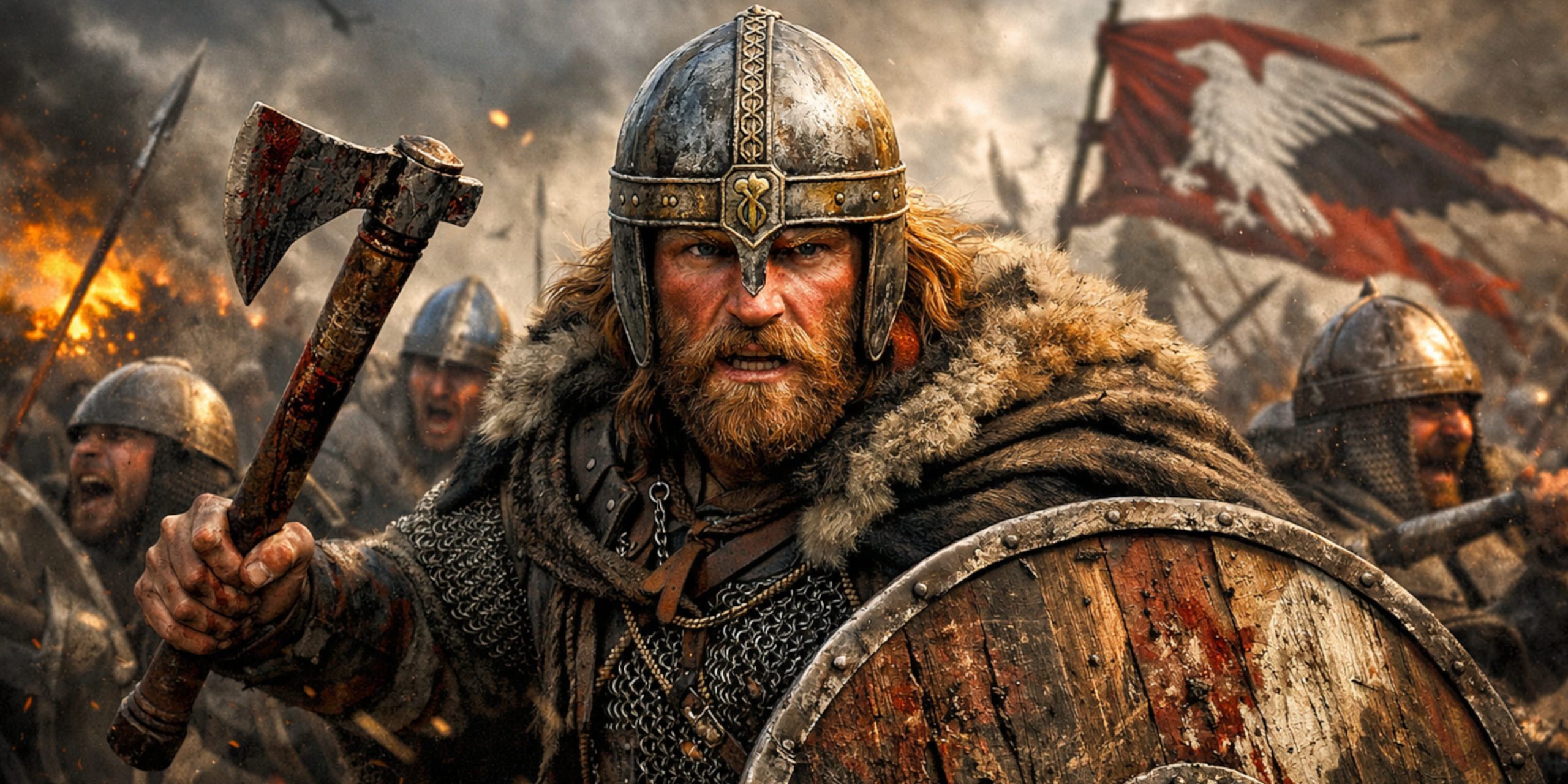
Olaf probably looked less like the fur-clad fantasy Viking of television and more like a wealthy warlord of the Irish Sea world.
Typical Equipment of Olaf and His Household Warriors
| Item | Description |
|---|---|
| Helmet | Likely an iron helmet with a nasal guard, possibly decorated with silver or bronze fittings. Richer leaders may have used spectacle-style helmets influenced by Scandinavian designs. |
| Mail Shirt | A long mail byrnie was probably worn by Olaf and his elite retainers. Mail was expensive and a sign of high status. |
| Shield | Round wooden shield, usually around 80 to 90 cm wide, reinforced with an iron boss. |
| Sword | A high-status pattern-welded Viking sword, probably of Petersen Type S or Type D. These were prized weapons, often richly decorated. |
| Spear | The most common battlefield weapon. Olaf likely carried a heavier spear for mounted or close combat use. |
| Axe | Danish-style axes were increasingly common. Elite warriors may have used broad-bladed axes in battle. |
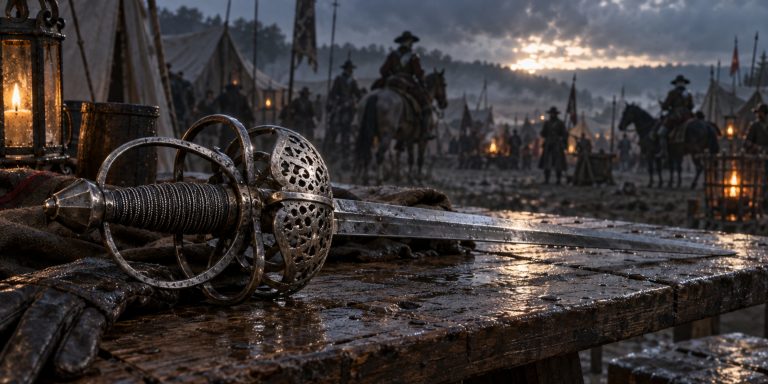
The sword most likely associated with Olaf’s world would have been a fine Viking blade imported from the Rhineland and mounted locally with richly decorated fittings. Some surviving examples from Dublin and northern England have silver wire grips and elaborate pommels.
One should resist the temptation to imagine Olaf striding into battle waving an axe the size of a small tree. Viking leaders generally valued expensive swords because they projected authority. A sword announced that its owner was not merely a raider but a king.
Olaf as a Ruler
Olaf’s kingship rested on more than warfare. He governed two of the richest Viking centres in the British Isles: Dublin and York.
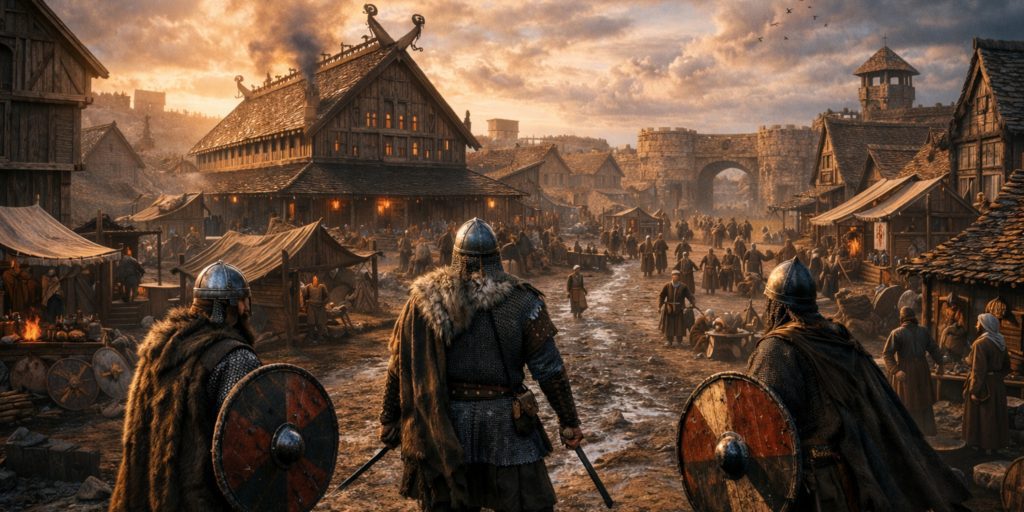
Both cities were major trading hubs linking Scandinavia, Ireland, England and the wider European world. Under Olaf, trade in silver, cloth, slaves, amber and luxury goods continued to flourish.
His reign in York is especially notable because he issued coinage there. Some coins bear the Old Norse title “Anlaf Cununc”, meaning “King Olaf”.
That matters because it was unusual. Most rulers of the period used Latin. Olaf’s decision to use Norse on his coinage was almost certainly deliberate. It proclaimed his identity as a Viking ruler and reminded his subjects exactly who was in charge.
Coins and Artefacts From Olaf’s Reign
Several artefacts connected to Olaf and his dynasty survive.
Coins of York
The most important surviving objects from Olaf’s reign are silver pennies minted at York between 939 and 941.
These often feature:
- The inscription “ANLAF CVNVNGI”
- A raven or bird motif, possibly linked to Odin
- Crosses or Christian imagery on the reverse
The combination is wonderfully revealing. Olaf ruled in a world where Christianity and older Norse traditions existed side by side. His coins look as though they cannot quite decide whether to attend church or raid one.
Where to See Artefacts From Olaf’s Reign
- The Yorkshire Museum, York, holds Viking-age finds from York and Northumbria.
- The Jorvik Viking Centre in York displays objects from the Norse kingdom of York, including weapons, coins and everyday items from Olaf’s era.
- The National Museum of Ireland in Dublin contains Viking swords, jewellery and artefacts from tenth-century Dublin.
- The National Museum of Scotland in Edinburgh holds material linked to Viking settlement in Scotland and Northumbria.
- The British Museum has examples of Viking-age coinage from York, including coins struck by Olaf and related rulers.
Latest Archaeological Findings
The most intriguing discovery linked to Olaf emerged in East Lothian in Scotland.
In 2005 archaeologists excavated a high-status Viking burial at Auldhame, near Tyninghame. The grave contained the skeleton of a man buried with an ornate belt and other objects associated with elite Viking burials.
The date of the burial fits remarkably closely with Olaf’s death in 941.
Some historians, particularly Alex Woolf, have suggested that the body may actually be Olaf Guthfrithson himself. Olaf is known to have raided churches in the area shortly before his death, and later sources place his death near Tyninghame.
No one can prove the identification. Archaeology is rarely so kind. Yet the possibility is tantalising. Somewhere beneath the grass of East Lothian there may lie the man who fought at Brunanburh and nearly overturned the balance of power in Britain.
Recent work at York has also revealed more about the world Olaf ruled. Excavations in Coppergate and elsewhere continue to uncover:
- Viking workshops
- Imported goods from Scandinavia and the Continent
- Weapons and armour fragments
- Evidence of wealthy Norse households
These discoveries show that Olaf’s kingdom was not merely a land of raiders and warriors. It was an urban, commercial and surprisingly sophisticated society.
Death and Legacy
Olaf died in 941, probably while campaigning in Scotland or northern England.
His death was sudden and badly timed for the Viking cause. Without him, the Norse hold on Northumbria weakened. Within a few years the English kings had reasserted control.
He was succeeded by his cousin Olaf Cuaran, but the moment of greatest Viking power in England had already begun to pass.
Olaf’s importance lies in how close he came to success. He nearly restored a powerful Norse kingdom stretching from Dublin to York. He nearly broke the authority of the early English monarchy. He nearly won.
History tends to remember the victors, which is why Æthelstan is far better known today. Yet Olaf was every bit as remarkable. He was bold, politically astute and relentless.
If Brunanburh had ended differently, schoolchildren might be learning about Olaf Guthfrithson as the founder of a Viking Britain.
Seven Swords Takeaway
Olaf Guthfrithson remains one of the great almost-men of British history.
He was not merely a Viking raider with a fleet and a talent for setting monasteries on fire. Britain had quite enough of those already. Olaf was a king, strategist and dynast who understood power in a sophisticated way.
He forged alliances, ruled major cities, issued coinage and came within touching distance of reshaping the British Isles.
That he ultimately failed makes him more interesting, not less. The defeated often reveal more about an age than the winners do. Olaf’s life shows just how uncertain the tenth century really was, when England, Scotland and the Viking world were still struggling to decide what they were going to become.