The American Civil War was fought across an enormous geographical area between 1861 and 1865. Armies collided in Virginia farmland, Tennessee woodland, along the Mississippi and outside cities whose names would become shorthand for catastrophe: Antietam, Gettysburg, Vicksburg, Chickamauga, Cold Harbor.
There was no single moment when the Confederacy lost the war, nor one battle in which the Union inevitably won it. The conflict was a succession of campaigns in which manpower, logistics, political resolve, command decisions and increasingly sophisticated fortifications all mattered.
What makes the military history particularly interesting is how quickly expectations collapsed. In 1861, plenty of people imagined a short contest settled by one or two decisive encounters. Four years later, soldiers were living in trenches outside Petersburg while armies numbering tens of thousands marched through the Confederate interior.
This chronological guide covers the major battles and campaigns that shaped the war, from the bombardment of Fort Sumter to Lee’s surrender at Appomattox Court House.
American Civil War Battles at a Glance
| Battle | Date | Theatre | Result |
|---|---|---|---|
| Fort Sumter | 12–13 April 1861 | South Carolina | Confederate victory |
| First Bull Run | 21 July 1861 | Virginia | Confederate victory |
| Fort Donelson | 11–16 February 1862 | Tennessee | Union victory |
| Shiloh | 6–7 April 1862 | Tennessee | Union victory |
| Seven Days Battles | 25 June–1 July 1862 | Virginia | Confederate strategic victory |
| Second Bull Run | 28–30 August 1862 | Virginia | Confederate victory |
| Antietam | 17 September 1862 | Maryland | Union strategic victory |
| Fredericksburg | 11–15 December 1862 | Virginia | Confederate victory |
| Chancellorsville | 30 April–6 May 1863 | Virginia | Confederate victory |
| Vicksburg | 18 May–4 July 1863 | Mississippi | Union victory |
| Gettysburg | 1–3 July 1863 | Pennsylvania | Union victory |
| Chickamauga | 18–20 September 1863 | Georgia | Confederate victory |
| Chattanooga | 23–25 November 1863 | Tennessee | Union victory |
| Wilderness | 5–7 May 1864 | Virginia | Inconclusive |
| Spotsylvania | 8–21 May 1864 | Virginia | Inconclusive |
| Cold Harbor | 31 May–12 June 1864 | Virginia | Confederate victory |
| Atlanta | 22 July 1864 | Georgia | Union victory |
| Franklin | 30 November 1864 | Tennessee | Union victory |
| Nashville | 15–16 December 1864 | Tennessee | Union victory |
| Bentonville | 19–21 March 1865 | North Carolina | Union strategic victory |
| Five Forks | 1 April 1865 | Virginia | Union victory |
| Appomattox Court House | 9 April 1865 | Virginia | Union victory |
The table makes the war look remarkably tidy. It was anything but.
Fort Sumter: 12–13 April 1861
Location: Charleston Harbor, South Carolina
Union commander: Major Robert Anderson
Confederate commander: Brigadier General P. G. T. Beauregard
Result: Confederate victory
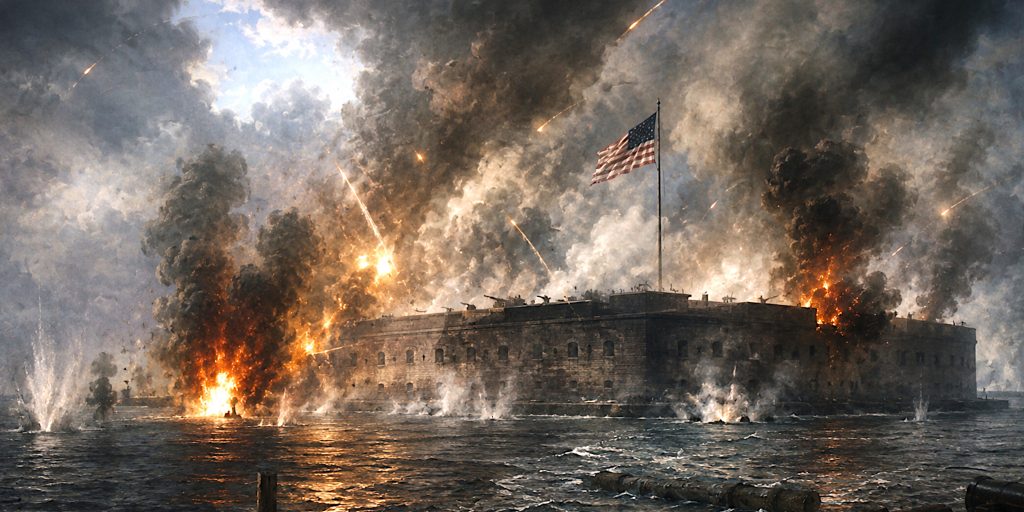
The shooting war began in Charleston Harbor when Confederate batteries opened fire on the Federal garrison at Fort Sumter.
Militarily, the encounter was tiny compared with what followed. Politically, it was enormous. Anderson surrendered after prolonged bombardment, and the attack transformed secession from a constitutional and political crisis into open warfare.
Lincoln responded by calling for 75,000 volunteers. Virginia, Arkansas, Tennessee and North Carolina subsequently joined the Confederacy.
The strange thing about Fort Sumter is how restrained it appears in retrospect. The battle that ignited America’s bloodiest internal conflict produced none of the battlefield slaughter later associated with Antietam or Gettysburg.
That restraint did not last.
First Battle of Bull Run: 21 July 1861
Location: Manassas, Virginia
Union commander: Brigadier General Irvin McDowell
Confederate commanders: P. G. T. Beauregard and Joseph E. Johnston
Result: Confederate victory
First Bull Run, known in the South as First Manassas, demolished the idea that enthusiasm could substitute for experience.
McDowell advanced towards the Confederate position near Manassas Junction with an inexperienced army. Early Union success gave way to confusion as Confederate resistance hardened around Thomas J. Jackson’s brigade.
Jackson acquired the nickname “Stonewall” during the fighting, although exactly what Brigadier General Barnard Bee intended when he compared Jackson to a stone wall remains debated.
Confederate reinforcements helped turn the battle. Union troops eventually retreated towards Washington.
The military importance was considerable, but its psychological impact was greater. Both governments now had evidence that the war might be longer and considerably nastier than the optimistic crowds of 1861 had imagined.
Fort Donelson: 11–16 February 1862
Location: Tennessee
Union commander: Brigadier General Ulysses S. Grant
Confederate commanders: John B. Floyd, Gideon J. Pillow and Simon Bolivar Buckner
Result: Union victory
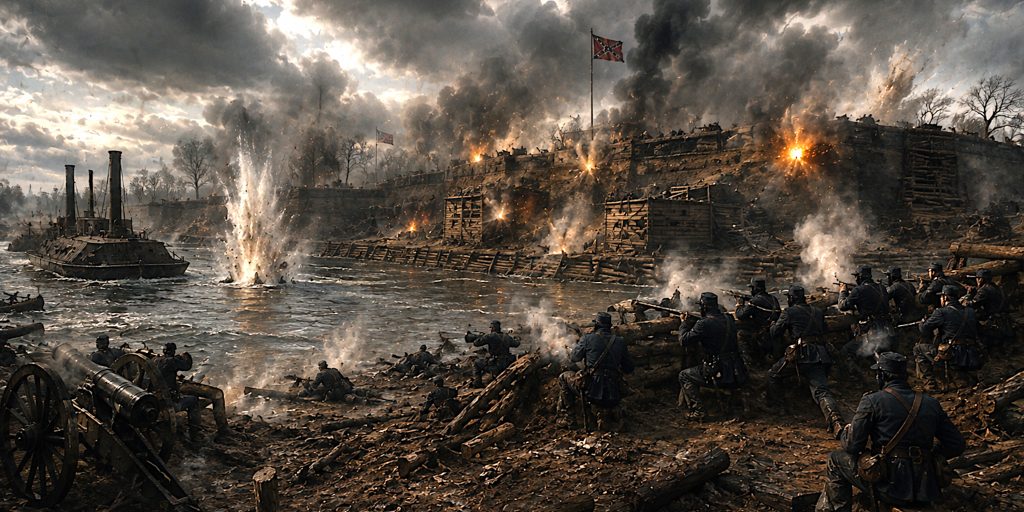
Fort Donelson was where Ulysses S. Grant began becoming Ulysses S. Grant.
Following the capture of Fort Henry, Union forces surrounded Fort Donelson on the Cumberland River. A Confederate attempt to break out initially succeeded in opening an escape route, only for confused command decisions to squander the opportunity.
When Simon Bolivar Buckner requested terms, Grant demanded:
“No terms except an unconditional and immediate surrender can be accepted.”
The phrase made excellent newspaper copy and gave Grant the convenient nickname “Unconditional Surrender” Grant.
More importantly, the victory opened important routes into Tennessee and demonstrated the strategic importance of combined army and naval operations on the western rivers.
Battle of Shiloh: 6–7 April 1862
Location: Tennessee
Union commanders: Ulysses S. Grant and Don Carlos Buell
Confederate commanders: Albert Sidney Johnston and P. G. T. Beauregard
Result: Union victory
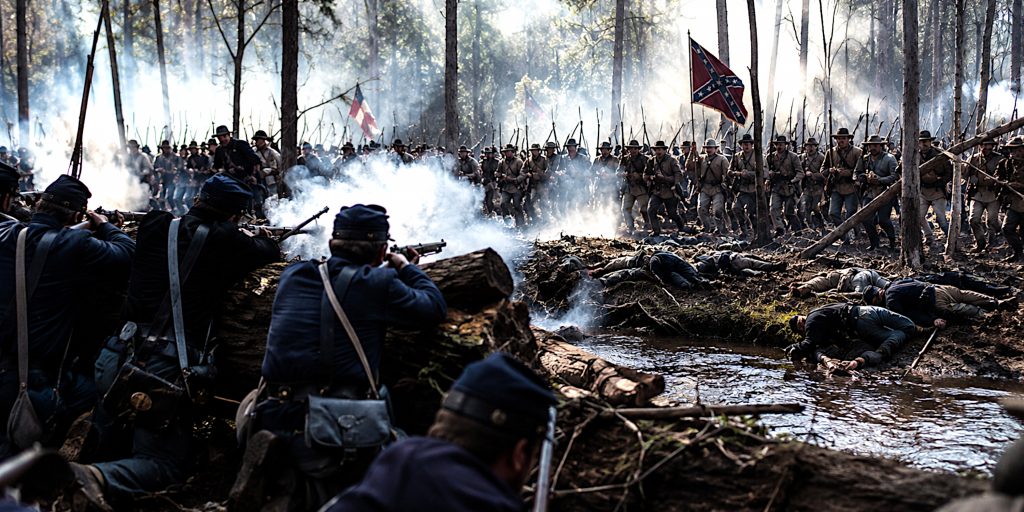
Shiloh was one of the first battles to show Americans what an industrial-age civil war was going to cost.
Confederate forces struck Grant’s army near Pittsburg Landing on 6 April and drove Union formations backwards through bitter fighting. General Albert Sidney Johnston was mortally wounded, leaving Beauregard in command.
Union reinforcements arrived during the night. Grant counter-attacked on 7 April and forced the Confederates to withdraw.
Roughly 23,000 men were killed, wounded or missing across the two armies.
Shiloh mattered because it wrecked remaining illusions about a relatively bloodless conflict. Armies equipped with rifled small arms and supported by increasingly effective artillery could inflict appalling losses in remarkably short periods.
Seven Days Battles: 25 June–1 July 1862
Location: Around Richmond, Virginia
Union commander: George B. McClellan
Confederate commander: Robert E. Lee
Result: Confederate strategic victory
The Seven Days Battles were really a sequence of engagements rather than one battle, including Beaver Dam Creek, Gaines’ Mill, Savage’s Station, Glendale and Malvern Hill.
They also marked Robert E. Lee’s emergence as the dominant Confederate commander in Virginia.
McClellan had brought the Army of the Potomac dangerously close to Richmond during the Peninsula Campaign. Lee responded aggressively.
The Confederate attacks were often poorly coordinated and extremely costly. At Malvern Hill in particular, Confederate infantry suffered heavily attacking a formidable Union position.
Yet strategically Lee succeeded. McClellan withdrew from the immediate approaches to Richmond.
It was a recurring Civil War lesson: tactical casualty figures and strategic outcomes did not always point in the same direction.
Second Battle of Bull Run: 28–30 August 1862
Location: Manassas, Virginia
Union commander: John Pope
Confederate commander: Robert E. Lee
Result: Confederate victory
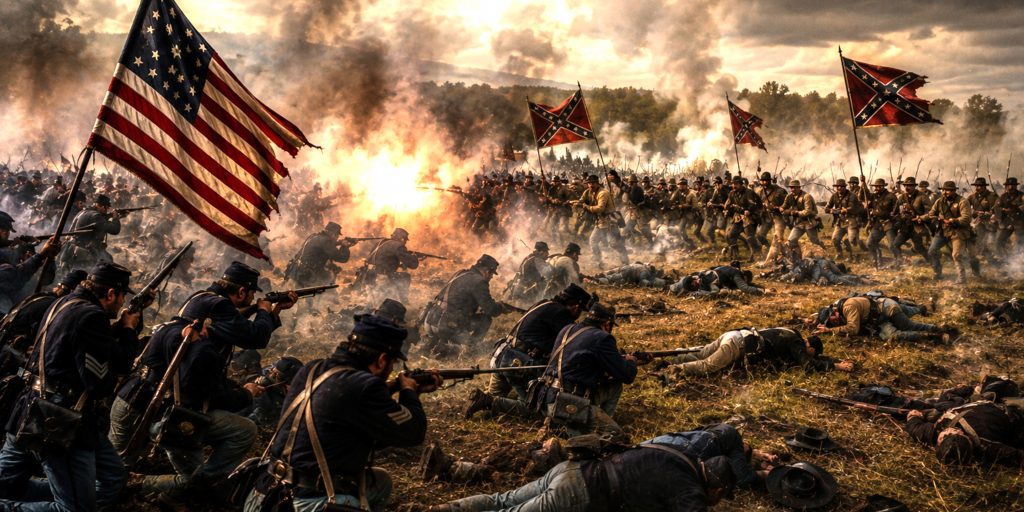
The armies returned to the ground around Manassas thirteen months after their first major encounter there.
This time they were considerably more experienced and far more dangerous.
Stonewall Jackson drew John Pope’s Army of Virginia into battle while James Longstreet’s wing moved into position. On 30 August, Longstreet launched a massive counter-attack against the Union left.
Pope’s army was defeated and withdrew towards Washington.
The victory gave Lee the confidence and strategic opportunity to take the war north into Maryland.
Battle of Antietam: 17 September 1862
Location: Sharpsburg, Maryland
Union commander: George B. McClellan
Confederate commander: Robert E. Lee
Result: Strategic Union victory
Antietam remains the bloodiest single day in American military history.
Around 23,000 soldiers were killed, wounded or missing after roughly twelve hours of combat.
The battle developed through several savage phases around locations that became infamous: the Cornfield, Dunker Church, the Sunken Road and Burnside Bridge.
McClellan possessed numerical superiority but committed much of his army piecemeal. Lee survived the attacks and withdrew across the Potomac the following day.
One Confederate soldier offered a wonderfully unsentimental assessment:
“The Yankees say they routed and demoralized our Army. This is false.”
He added that Confederate claims of victory would be false too, describing the engagement as close to a drawn battle.
That is a useful corrective to tidy retrospective labels.
Strategically, however, Lee’s invasion had been stopped. Lincoln used the opportunity to announce the preliminary Emancipation Proclamation, fundamentally changing the political character of the war.
Battle of Fredericksburg: 11–15 December 1862
Location: Fredericksburg, Virginia
Union commander: Ambrose Burnside
Confederate commander: Robert E. Lee
Result: Confederate victory
Fredericksburg is remembered primarily for the repeated Union attacks against Confederate positions behind the stone wall at Marye’s Heights.
There is good reason for that.
Burnside’s army crossed the Rappahannock but encountered Lee in strong defensive positions. Union attacks across exposed ground were repeatedly repulsed.
The result was a humiliating Union defeat.
Fredericksburg also demonstrated something increasingly obvious about Civil War combat. Frontal attacks against prepared infantry supported by artillery were becoming ruinously expensive. Unfortunately for the soldiers, recognising that fact and persuading generals to stop attempting them were two separate matters.
Battle of Chancellorsville: 30 April–6 May 1863
Location: Virginia
Union commander: Joseph Hooker
Confederate commander: Robert E. Lee
Result: Confederate victory
Chancellorsville is often described as Lee’s greatest victory, and there is a strong case for it.
Facing a larger Union army, Lee divided his forces in the presence of the enemy. Stonewall Jackson then conducted a long flank march and struck the exposed Union XI Corps on 2 May.
The manoeuvre was extraordinarily successful.
It also carried a terrible price for the Confederacy. Jackson was accidentally shot by his own men that evening and died on 10 May.
Lee had won a remarkable tactical victory while losing one of the few commanders capable of independently handling a large Confederate corps.
Siege of Vicksburg: 18 May–4 July 1863
Location: Mississippi
Union commander: Ulysses S. Grant
Confederate commander: John C. Pemberton
Result: Union victory
Vicksburg deserves to stand beside Gettysburg when discussing the decisive campaigns of 1863.
Grant crossed the Mississippi, moved inland, defeated Confederate forces in a sequence of engagements and eventually trapped Pemberton’s army inside Vicksburg.
After direct assaults failed, Grant settled into siege operations.
The city surrendered on 4 July 1863.
Union control of Vicksburg, followed by the fall of Port Hudson, gave the North command of the Mississippi and effectively divided the Confederacy.
Lincoln later admitted to Grant that he had doubted aspects of the campaign:
“I now wish to make the personal acknowledgment that you were right, and I was wrong.”
Presidents admitting that to generals has never exactly been an overcrowded historical genre.
Grant’s reputation soared.
Battle of Gettysburg: 1–3 July 1863
Location: Pennsylvania
Union commander: George G. Meade
Confederate commander: Robert E. Lee
Result: Union victory
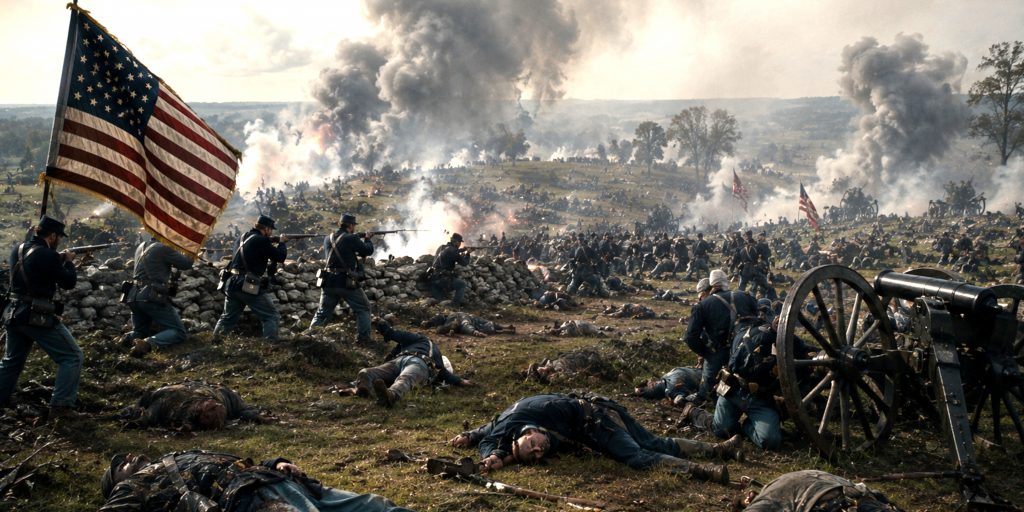
Gettysburg has become the most famous battle of the American Civil War, partly because it contained almost everything later generations looked for in a decisive historical drama.
Lee invaded Pennsylvania in the summer of 1863. The opposing armies collided unexpectedly around Gettysburg on 1 July.
Union troops were initially driven through the town but established formidable defensive positions along Cemetery Hill, Cemetery Ridge and the surrounding heights.
The second day saw brutal fighting at Little Round Top, the Wheatfield, Peach Orchard and elsewhere.
On 3 July came Pickett’s Charge, a huge Confederate assault against the Union centre on Cemetery Ridge. It failed with severe losses.
Lee retreated towards Virginia.
More than 50,000 casualties were sustained during the three-day battle, making Gettysburg the bloodiest battle of the war by total losses.
A contemporary Washington newspaper described the fighting with grim economy:
“The slaughter was perfectly unparalleled.”
Four months later Lincoln travelled to Gettysburg to dedicate the new military cemetery. His speech lasted only a few minutes but transformed the battlefield into part of a larger argument about democracy, sacrifice and emancipation.
“The brave men, living and dead, who struggled here, have hallowed it.”
Gettysburg ended Lee’s second invasion of the North. Combined with the surrender of Vicksburg on 4 July, it made the summer of 1863 a profound strategic turning point.
Battle of Chickamauga: 18–20 September 1863
Location: Georgia
Union commander: William Rosecrans
Confederate commander: Braxton Bragg
Result: Confederate victory
Chickamauga was one of the bloodiest battles fought in the western theatre and a rare major Confederate victory there during the latter half of the war.
A mistaken Union movement created a gap in Rosecrans’s line at exactly the wrong moment. Longstreet’s Confederate troops attacked through it and shattered much of the Union army.
George H. Thomas organised a stubborn defence that helped prevent complete disaster, earning him the nickname “Rock of Chickamauga”.
Union troops withdrew into Chattanooga, where they were effectively besieged.
The Confederacy had won a major battlefield victory but failed to turn it into lasting strategic advantage.
Battles for Chattanooga: 23–25 November 1863
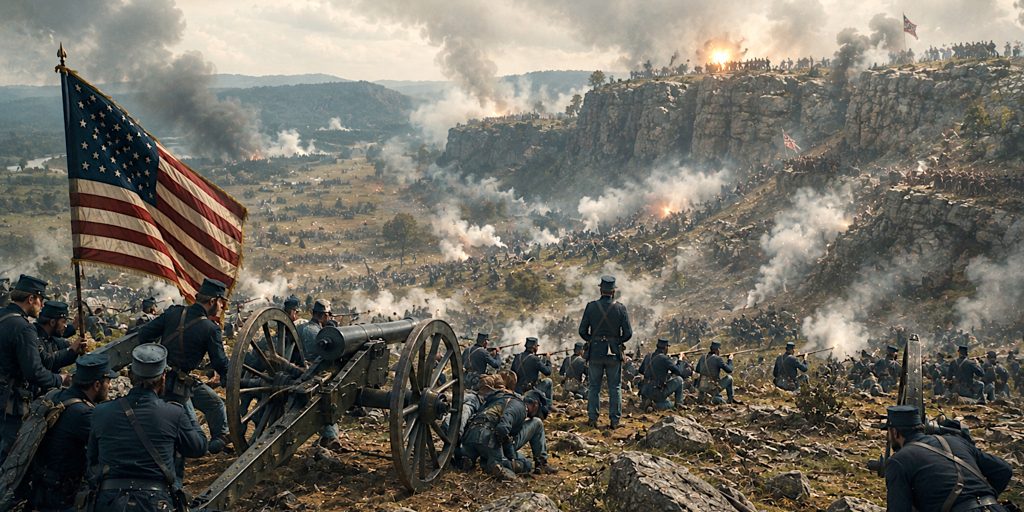
Location: Tennessee
Union commander: Ulysses S. Grant
Confederate commander: Braxton Bragg
Result: Union victory
Grant arrived at Chattanooga and reorganised the Union position.
The resulting battles at Lookout Mountain and Missionary Ridge broke the Confederate hold around the city.
The assault on Missionary Ridge became particularly famous because Union troops continued beyond their initial objectives and stormed the heights.
Bragg’s army retreated into Georgia.
Chattanooga opened a strategic gateway into the Deep South. The following year, William T. Sherman would use it as the starting point for his campaign against Atlanta.
Battle of the Wilderness: 5–7 May 1864
Location: Virginia
Union commander: Ulysses S. Grant
Confederate commander: Robert E. Lee
Result: Tactically inconclusive
The Wilderness was Grant’s first major encounter with Lee after taking overall command of Union armies.
The terrain was atrocious for controlling a nineteenth-century army. Dense woodland reduced visibility, disrupted formations and limited artillery.
Fires swept through parts of the battlefield, sometimes killing wounded soldiers unable to escape.
Neither side achieved a decisive tactical victory.
What happened afterwards was more important.
Previous Union commanders had tended to withdraw after bloody encounters with Lee. Grant moved south.
The Army of the Potomac reportedly cheered when soldiers realised what was happening. The campaign would continue.
Battle of Spotsylvania Court House: 8–21 May 1864
Location: Virginia
Union commander: Ulysses S. Grant
Confederate commander: Robert E. Lee
Result: Inconclusive
Grant and Lee collided again around Spotsylvania.
Confederate troops constructed extensive earthworks, including a vulnerable salient known as the Mule Shoe.
On 12 May Union troops launched a huge attack against it. Fighting around the Bloody Angle continued for hours, sometimes at extraordinarily close range.
The battle demonstrated how rapidly field fortification was becoming central to the war.
Grant eventually disengaged and again moved south rather than retreating.
Lee was being forced into a campaign he could ill afford. Even when Grant failed to destroy the Army of Northern Virginia, the Confederacy found replacing its losses increasingly difficult.
Battle of Cold Harbor: 31 May–12 June 1864
Location: Virginia
Union commander: Ulysses S. Grant
Confederate commander: Robert E. Lee
Result: Confederate victory
Cold Harbor has become synonymous with the cost of Grant’s Overland Campaign.
Union forces attacked heavily fortified Confederate positions on 3 June and suffered severe casualties.
Grant later wrote:
“I have always regretted that the last assault at Cold Harbor was ever made.”
The comment has shaped the battle’s reputation ever since.
Yet Cold Harbor did not end Grant’s campaign. Rather than withdraw northwards, he crossed the James River and moved against Petersburg.
The strategic pressure continued.
Siege of Petersburg: June 1864–April 1865
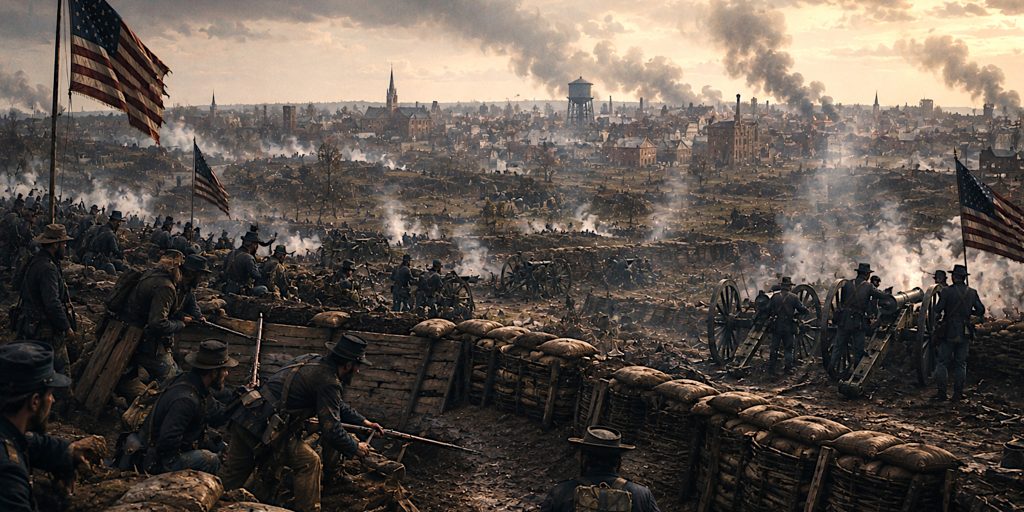
Location: Virginia
Union commander: Ulysses S. Grant
Confederate commander: Robert E. Lee
Result: Union victory
Petersburg was less a conventional siege than a vast, grinding campaign around an expanding network of trenches and fortifications.
The city was crucial because railway lines passing through Petersburg supplied Richmond and Lee’s army.
After failed attempts to seize the city quickly, Union and Confederate forces dug in.
The resulting landscape can look surprisingly modern to anyone accustomed to photographs of the Western Front fifty years later: trenches, dugouts, artillery positions and elaborate earthworks stretching across miles of countryside.
The Battle of the Crater on 30 July 1864 was perhaps the most extraordinary episode. Union miners detonated explosives beneath Confederate lines, creating a huge crater. The subsequent assault was disastrously managed and repulsed.
Petersburg slowly became a war of logistics that the Confederacy was increasingly incapable of winning.
Battle of Atlanta: 22 July 1864
Location: Georgia
Union commander: William T. Sherman
Confederate commander: John Bell Hood
Result: Union victory
John Bell Hood attempted to halt Sherman’s advance with aggressive attacks around Atlanta.
They failed.
The battle itself did not immediately capture the city, but Confederate attempts to drive Sherman away were unsuccessful. Atlanta eventually fell to Union forces on 2 September.
Its capture had political consequences far beyond Georgia.
Lincoln’s prospects in the 1864 presidential election had appeared uncertain during the grim summer campaigning. The fall of Atlanta provided the Union with tangible evidence that the war was being won.
Military events and democratic politics were deeply intertwined.
Battle of Franklin: 30 November 1864
Location: Tennessee
Union commander: John Schofield
Confederate commander: John Bell Hood
Result: Union victory
Franklin was a catastrophe for the Confederate Army of Tennessee.
Hood ordered large-scale frontal attacks against entrenched Union positions.
Confederate troops briefly penetrated sections of the Union line, but repeated assaults resulted in devastating casualties, particularly among senior officers.
Six Confederate generals were killed or mortally wounded.
Schofield withdrew after the battle, but Hood had inflicted crippling damage on his own army for little strategic gain.
It is difficult to find a better demonstration of the difference between occupying a battlefield and actually benefiting from a battle.
Battle of Nashville: 15–16 December 1864
Location: Tennessee
Union commander: George H. Thomas
Confederate commander: John Bell Hood
Result: Decisive Union victory
At Nashville, George H. Thomas finished what Franklin had begun.
Thomas carefully prepared his forces despite pressure from Washington to attack. When he finally moved, the result justified the delay.
Union troops struck Hood’s positions on 15 December and launched another major attack the following day.
The Confederate line collapsed.
The Army of Tennessee ceased to function as an effective major field army. Hood resigned his command in January 1865.
Battle of Bentonville: 19–21 March 1865
Location: North Carolina
Union commander: William T. Sherman
Confederate commander: Joseph E. Johnston
Result: Union strategic victory
Bentonville was the largest battle fought in North Carolina and the Confederacy’s final serious attempt to defeat Sherman’s army.
Johnston concentrated available Confederate forces and attacked part of Sherman’s advancing army before the Union columns could fully unite.
The attack achieved some initial success but could not produce a decisive victory.
As additional Union forces arrived, Johnston withdrew.
The Confederacy was now running out of almost everything: soldiers, horses, supplies, territory and plausible routes to victory.
Battle of Five Forks: 1 April 1865
Location: Virginia
Union commander: Philip Sheridan
Confederate commander: George Pickett
Result: Union victory
Five Forks broke the increasingly fragile Confederate position around Petersburg.
Sheridan’s cavalry and Union infantry attacked Pickett’s forces and overwhelmed them.
The defeat threatened the South Side Railroad, one of Lee’s final supply routes.
Grant ordered attacks along the Petersburg front the following day. Lee informed Jefferson Davis that Richmond and Petersburg would have to be evacuated.
The end was suddenly measured in days rather than months.
Appomattox Court House: 9 April 1865
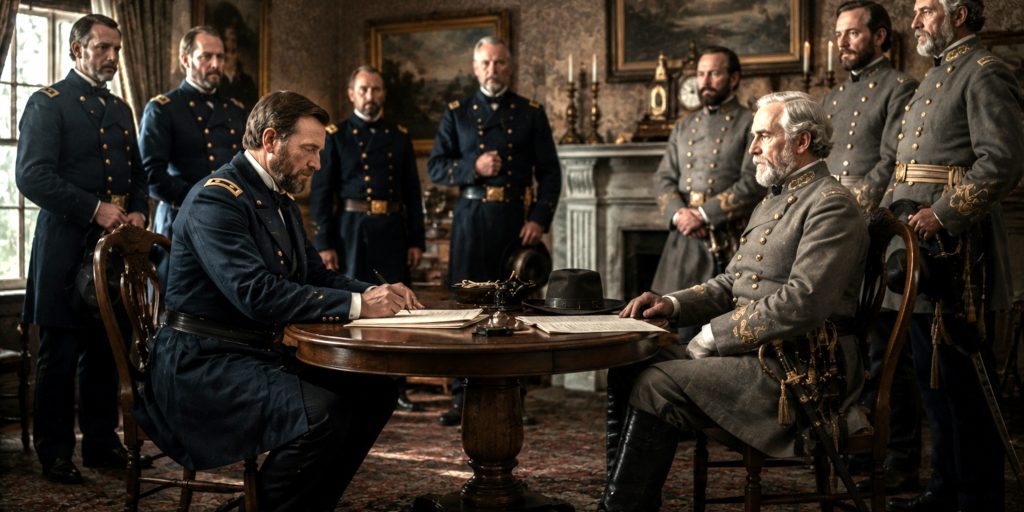
Location: Virginia
Union commander: Ulysses S. Grant
Confederate commander: Robert E. Lee
Result: Union victory and surrender of the Army of Northern Virginia
Lee’s retreat from Petersburg became a desperate race westwards.
His army hoped to obtain supplies and perhaps join Joseph E. Johnston in North Carolina. Union forces moved faster and blocked the escape routes.
On 9 April, Confederate troops made one final attempt to break through near Appomattox Court House.
They discovered substantial Union forces in their path.
Lee concluded that further resistance by the Army of Northern Virginia was pointless.
He met Grant at the home of Wilmer McLean and surrendered his army.
The coincidence is irresistible. McLean had previously lived near the battlefield of First Bull Run and had moved partly to escape the war. Four years later, Lee surrendered in his parlour.
History occasionally has a rather dry sense of humour.
Grant offered generous terms. Confederate soldiers were paroled and permitted to return home, while officers could retain their sidearms. Men who owned horses or mules were allowed to take them for spring planting.
Lee’s surrender did not technically end the entire Civil War. Other Confederate armies remained in the field.
But politically and militarily, Appomattox made the outcome unmistakable.
Weapons That Defined Civil War Battlefields
The Civil War occurred during a transitional period in military technology.
The standard infantry weapon was increasingly the rifled musket, particularly weapons such as the Springfield Model 1861 and British Pattern 1853 Enfield.
The Minié-style expanding bullet allowed soldiers to combine rifled accuracy with relatively rapid muzzle-loading.
Artillery remained equally important. Common weapons included:
- 12-pounder Napoleon smoothbore guns
- 3-inch Ordnance Rifles
- Parrott rifles
- Field howitzers
- Heavy siege artillery
- Mortars
Repeating firearms appeared in growing numbers later in the conflict. Spencer rifles and carbines were particularly valuable to Union cavalry.
Sabres were carried extensively by cavalry, although popular culture tends to exaggerate the frequency of enormous mounted sword fights. The Model 1860 Light Cavalry Saber became one of the characteristic edged weapons of Union cavalry.
Officers commonly carried swords as badges of rank as well as practical weapons. Infantry officers’ swords, cavalry sabres and artillery swords therefore remained visible parts of military equipment even as firearms increasingly dominated combat.
The Civil War battlefield was a rather uncomfortable meeting point between older military traditions and increasingly modern firepower.
How Civil War Fighting Changed Between 1861 and 1865
Compare First Bull Run with Petersburg and the transformation is extraordinary.
The armies of 1861 were inexperienced, colourful and frequently chaotic. Formations manoeuvred with limited battlefield experience and commanders were still learning how to handle forces that would eventually number in the tens of thousands.
By 1864, veterans routinely constructed field fortifications whenever they stopped.
Earthworks became increasingly elaborate because soldiers understood exactly what rifled muskets and artillery could do to exposed troops.
Cavalry changed too. Mounted troops increasingly operated as mobile infantry, particularly when equipped with breech-loading or repeating carbines.
Railways transported troops and supplies. Telegraph networks allowed governments and senior commanders to communicate at unprecedented speed. Steam-powered warships transformed river operations.
The Civil War was not fully modern warfare, but it contained a disturbing number of previews.
Which Was the Bloodiest Battle of the American Civil War?
Gettysburg produced the largest overall number of casualties of any battle of the war, with more than 50,000 men killed, wounded, captured or missing across three days.
Antietam holds a different and particularly grim distinction.
On 17 September 1862, approximately 23,000 soldiers became casualties in a single day, making Antietam the bloodiest single day in American military history.
Shiloh, Chickamauga, Spotsylvania and the Wilderness also produced enormous losses.
Raw casualty numbers only tell part of the story. Confederate losses were particularly damaging because the South possessed a much smaller pool of military manpower from which to replace them.
What Were the Most Important Battles of the Civil War?
Historians will continue arguing about this because historians regard agreement as a suspicious activity.
If forced to choose the battles with the greatest strategic consequences, I would put Antietam, Gettysburg, Vicksburg, Chattanooga, Atlanta and the Petersburg Campaign near the top.
Antietam stopped Lee’s first northern invasion and provided Lincoln with the opportunity to announce preliminary emancipation.
Gettysburg ended Lee’s second invasion.
Vicksburg secured Union control of the Mississippi.
Chattanooga opened the route into the Confederate heartland.
Atlanta helped demonstrate that Union strategy was succeeding during a crucial presidential election year.
Petersburg slowly strangled Lee’s ability to defend Richmond and maintain the Army of Northern Virginia.
No single battle won the Civil War. Together, these campaigns steadily removed the Confederacy’s military options.
Why the Union Eventually Won
Union victory rested on considerably more than simply having a larger population.
The North possessed major advantages in industrial capacity, railway infrastructure, financial resources, naval strength and manpower. Those advantages still had to be converted into military success.
For the first half of the war, that conversion was anything but smooth.
By 1864, however, Union strategy had become increasingly coordinated. Grant applied pressure against Lee in Virginia while Sherman advanced through Georgia and other Union forces operated elsewhere.
The Confederacy faced a problem for which battlefield brilliance offered no permanent solution. Every lost soldier, railway, industrial centre and supply route became increasingly difficult to replace.
Emancipation also transformed the conflict. Nearly 180,000 African American soldiers served in the Union Army by the end of the war, adding military manpower while connecting Union victory directly with the destruction of slavery.
The Confederacy had begun the war principally to preserve a slaveholding political and social order. By 1865, military defeat had destroyed both Confederate independence and the legal institution at its centre.
The Human Cost
Statistics have a habit of making nineteenth-century warfare seem strangely clean.
It was not.
Men died from bullets, shell fragments and bayonet wounds, but disease killed on a vast scale. Dysentery, typhoid, pneumonia and infections moved readily through crowded camps.
Medical practice improved during the conflict, yet surgeons worked without antibiotics and with limited understanding of infection.
Amputation was common because shattered limbs caused by heavy lead projectiles could be almost impossible to reconstruct safely.
Then there were civilians.
Communities across the South suffered displacement, food shortages and destruction. Enslaved people escaped towards Union lines in enormous numbers, turning military movement into a process of self-emancipation long before the conflict formally ended.
The war cannot be understood solely through generals moving coloured blocks across campaign maps. Those blocks contained human beings.
Legacy of the Civil War’s Battlefields
The major battlefields of the American Civil War tell a story considerably more complicated than a simple procession from Fort Sumter to Appomattox.
The Confederacy won some extraordinary tactical victories. Lee’s performance at Chancellorsville remains a fascinating study in command and calculated risk. Yet battlefield success could not overcome the Confederacy’s growing strategic disadvantages.
Union commanders, meanwhile, learned through expensive experience.
Grant’s great strength was not that he never suffered setbacks. He did. His importance lay partly in understanding that a battle did not exist in isolation. Armies, railways, rivers, factories, political will and manpower belonged to the same strategic equation.
The war also changed what Union victory meant.
In 1861, Lincoln’s stated objective was preservation of the Union. By 1863, emancipation had become formally tied to the Union war effort. By December 1865, ratification of the Thirteenth Amendment had abolished slavery throughout the United States.
Lincoln’s words at Gettysburg captured that transformation better than any later historian is likely to improve upon:
“That this nation… shall have a new birth of freedom.”
He also predicted that the world would “little note, nor long remember” what was said at Gettysburg.
On that particular point, he was spectacularly wrong.