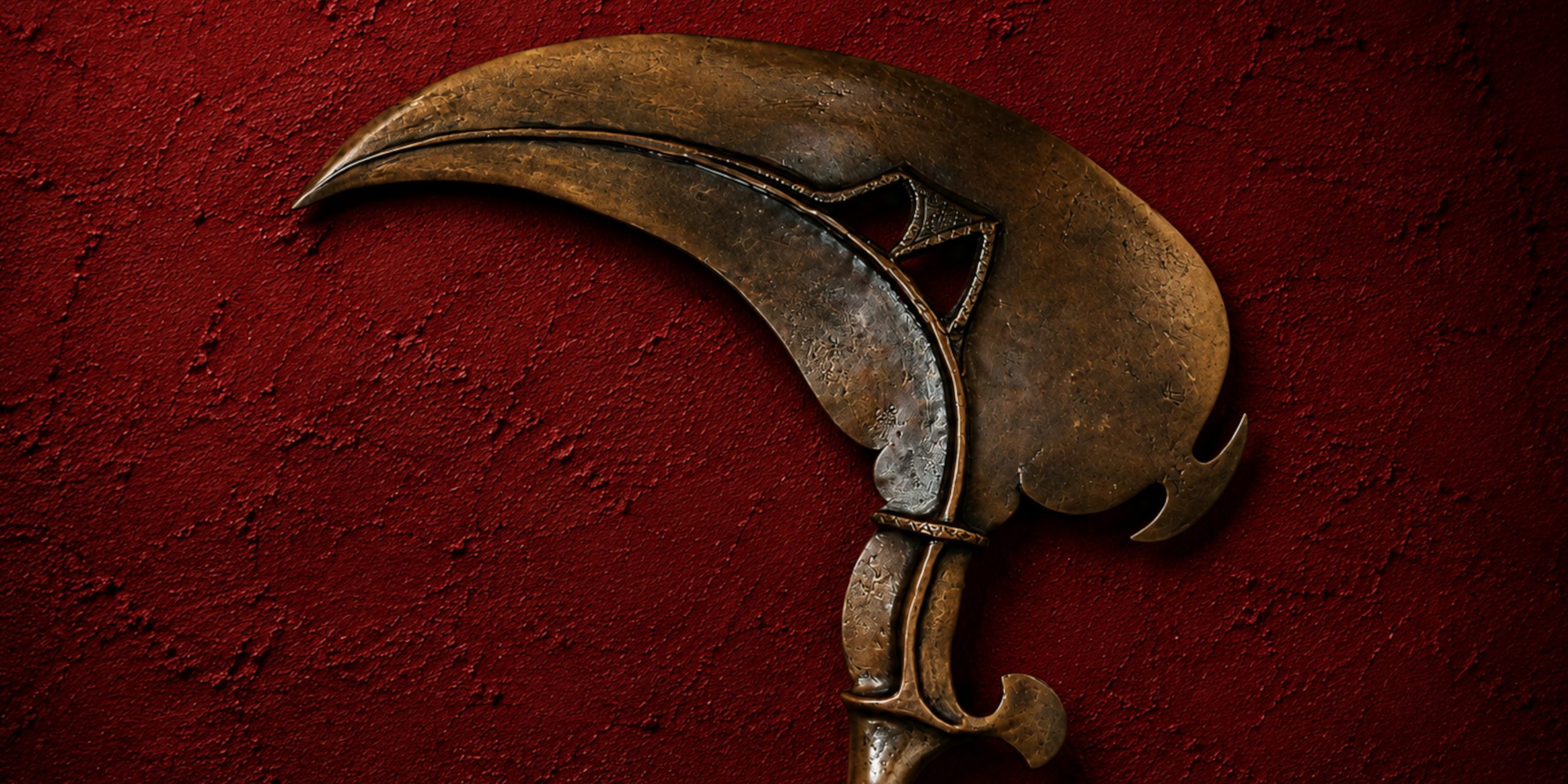
The Mambele is one of the most visually striking weapons ever produced in Central Africa. At first glance it looks almost impractical, more like a piece of ceremonial metalwork than a battlefield weapon. Yet the Mambele was very real, very dangerous, and deeply tied to the warrior traditions of the northeastern Congo region.
Part sword, part throwing knife, and part status symbol, the Mambele belonged to a wider family of multi bladed African weapons developed by groups such as the Azande, Mangbetu and neighbouring peoples. European explorers often struggled to categorise it because it ignored familiar weapon conventions. It was neither a conventional sword nor a simple axe. Instead, it was a carefully balanced hybrid weapon designed for slashing, hooking and throwing.
There is also something wonderfully intimidating about it. A straight blade says “I may cut you.” A Mambele says “I have absolutely no intention of fighting fairly.”
Specifications
| Feature | Details |
|---|---|
| Weapon Type | Throwing knife / short sword hybrid |
| Origin | Central Africa, particularly northeastern Congo |
| Associated Peoples | Azande, Mangbetu and related groups |
| Blade Material | Iron or forged steel |
| Handle Material | Wood, leather, fibre or wrapped metal |
| Average Length | 40 to 70 cm |
| Weight | Approximately 0.8 to 2 kg |
| Primary Uses | Throwing, slashing, prestige weapon |
| Blade Shape | Multiple protruding hooked blades |
| Era of Prominence | 18th to early 20th century |
Design Characteristics
The Mambele’s defining feature is its asymmetrical blade profile. Unlike European swords designed around a central edge, the Mambele incorporated:
- Curved cutting hooks
- Forward projecting spikes
- Weighted throwing surfaces
- Reinforced central spine
- Multiple sharpened edges
Many examples feature three or more distinct cutting points. Some were optimised for throwing, while others leaned more heavily toward ceremonial or status functions.
The balance point was crucial. Skilled warriors could rotate the weapon through the air with surprising accuracy. The hooked protrusions increased the chance of causing severe wounds regardless of how the weapon struck the target.
History and Evolution
Origins in Central Africa
The Mambele emerged within the broader tradition of African throwing weapons that stretched across Sudan, Chad and the Congo Basin. These weapons developed in societies where versatility mattered enormously. Warriors often needed a weapon capable of both ranged and close combat use.
The Azande are most commonly associated with the Mambele. During the 18th and 19th centuries, Azande warriors built a formidable military culture across parts of modern Congo, South Sudan and the Central African Republic.
European visitors recorded extensive use of elaborate throwing knives among elite warriors. Some accounts described them as highly valued possessions carried by experienced fighters and nobles.
Influence of Ironworking
Central African blacksmiths possessed highly sophisticated forging traditions long before European colonial involvement. The Mambele demonstrates remarkable metalworking skill:
- Complex heat shaping
- Fine edge grinding
- Decorative ironwork
- Balance optimisation
- Multi directional blade forging
Each weapon was often individually crafted rather than mass produced. This means surviving examples vary enormously in shape and detail.
Some Mambele blades became increasingly ornate over time, especially during the late 19th century when ceremonial prestige became more important in some regions than battlefield practicality.
Colonial Era Decline
The spread of firearms and colonial military campaigns gradually reduced the battlefield usefulness of traditional throwing weapons.
By the early 20th century:
- Firearms dominated warfare
- Colonial authorities suppressed indigenous arms
- Traditional warrior classes weakened
- Ceremonial use became more common
Many Mambele weapons were collected by Europeans during this period and taken into museums or private collections.
Unfortunately, a considerable number were also stripped of cultural context and displayed merely as “exotic curiosities,” which says rather more about colonial attitudes than about the weapon itself.
Advantages and Disadvantages
Advantages
| Advantage | Explanation |
|---|---|
| Multi directional cutting ability | Dangerous impact from several angles |
| Psychological intimidation | Unusual appearance created fear and uncertainty |
| Versatile combat role | Effective in both melee and throwing combat |
| Strong cutting power | Hooked blades inflicted severe wounds |
| Symbolic prestige | Associated with elite warrior status |
Combat Flexibility
A skilled fighter could use the Mambele in close combat similarly to a hatchet or short sword, then throw it during pursuit or retreat.
Unpredictable Wounding
The multiple blades increased the likelihood of tearing injuries. Even glancing impacts could prove devastating.
Disadvantages
| Disadvantage | Explanation |
|---|---|
| Difficult to forge | Complex shape required skilled smiths |
| Harder to carry | Irregular shape less practical than straight blades |
| Limited armour penetration | Less effective against heavy armour |
| Requires training | Throwing accuracy demanded practice |
| Poor standardisation | Wide variation between weapons |
Logistical Problems
Unlike a simple spear or straight sword, the Mambele was awkward to store and transport. One suspects more than a few warriors discovered this after accidentally snagging clothing, shields or nearby companions.
Arms and Combat Use
How the Mambele Was Used
The Mambele was designed for several battlefield functions:
- Mid range throwing attacks
- Close combat slashing
- Hooking shields or limbs
- Displaying status and rank
- Ceremonial use during gatherings
Some warriors reportedly carried multiple throwing blades before engaging with spears or melee weapons.
Throwing Technique
The weapon rotated in flight, allowing its hooked blades to strike unpredictably. The unusual design increased the likelihood of some part of the weapon making damaging contact.
Unlike modern throwing knives, the Mambele prioritised injury creation over precision penetration.
Comparison With Similar Weapons
Mambele vs Hunga Munga
| Feature | Mambele | Hunga Munga |
|---|---|---|
| Region | Congo Basin | Sudan and Central Africa |
| Shape | More curved and hooked | Often broader with crescent shapes |
| Combat Role | Throwing and melee | Primarily throwing |
| Complexity | Highly asymmetrical | Slightly more standardised |
The terms Mambele and Hunga Munga are sometimes confused in Western literature. In reality, they belong to a broad family of related African throwing weapons rather than a single unified weapon type.
Mambele vs Shotel
| Feature | Mambele | Shotel |
|---|---|---|
| Origin | Central Africa | Ethiopia |
| Blade Type | Multi hooked | Curved sabre |
| Intended Use | Throwing and slashing | Melee combat |
| Length | Short to medium | Longer sword |
The Ethiopian Shotel focused on bypassing shields in hand to hand combat, while the Mambele prioritised versatility and rotational throwing attacks.
Mambele vs European Axe
| Feature | Mambele | European Axe |
|---|---|---|
| Throwing Use | Common | Occasional |
| Blade Structure | Multiple edges | Single head |
| Cultural Role | Warrior prestige | Utility and warfare |
| Forging Complexity | High | Moderate |
Cultural Importance and Legacy
Symbol of Warrior Status
In many Central African societies, elaborate weapons reflected prestige, leadership and military achievement.
The Mambele was often:
- Carried by elite warriors
- Displayed during ceremonies
- Passed through families
- Used as diplomatic gifts
Its appearance alone conveyed authority.
Influence on Modern Interest
Today the Mambele fascinates historians, collectors and arms enthusiasts because it challenges conventional assumptions about weapon design.
It also highlights the sophistication of African metallurgy and martial traditions, fields that were historically underrepresented in older European scholarship.
Modern museum exhibitions increasingly present these weapons within their proper cultural context rather than treating them as oddities.
Where to See Mambele Weapons
Several museums hold important examples.
| Museum | Location |
|---|---|
| British Museum | London |
| Musée du quai Branly | Paris |
| Royal Museum for Central Africa | Belgium |
| Metropolitan Museum of Art | New York |
Some collections include ceremonial examples with engraved blades and decorative handles.
Archaeology and Surviving Examples
Archaeological evidence for Mambele weapons is relatively limited compared with European swords because tropical environments are harsh on iron preservation.
Most surviving examples come from:
- Colonial era collections
- Ethnographic acquisitions
- Royal or noble holdings
- Missionary collections
Even so, surviving pieces reveal significant regional variation in shape and craftsmanship.
Some examples appear almost aerodynamic, while others resemble brutal clusters of sharpened hooks. Both are deeply memorable.
Collector’s Guide
What Collectors Look For
Important factors include:
- Provenance
- Blade condition
- Original handle wrapping
- Regional style
- Decorative ironwork
- Signs of authentic age
Weapons with documented collection histories are particularly desirable.
Reproduction vs Authentic Pieces
Modern reproductions exist, though they are less common than reproductions of European swords.
Authentic antique examples typically show:
- Hand forged irregularities
- Age consistent oxidation
- Traditional handle materials
- Asymmetrical craftsmanship
- Period wear patterns
Machine perfect symmetry is usually a warning sign.
Auction Prices
| Type | Estimated Value |
|---|---|
| Small damaged example | £300 to £700 |
| Standard authentic example | £900 to £2,500 |
| High quality ceremonial piece | £3,000 to £7,000 |
| Museum quality provenance example | £10,000+ |
Prices vary substantially depending on documentation and rarity.
Weapons linked to specific ethnic groups or historic collections command stronger prices at specialist arms and ethnographic auctions.
Takeaway
The Mambele remains one of the most unusual edged weapons ever developed. It combined warfare, symbolism and craftsmanship into a form that still looks startlingly modern centuries later.
For historians, it is a reminder that sophisticated military design existed far beyond the familiar armouries of Europe and the Middle East. For collectors, it offers rarity and extraordinary visual character. For anyone seeing one for the first time, it tends to produce the same reaction:
“Surely that cannot possibly work.”
Then one studies the edges more closely and decides not to test the theory personally.