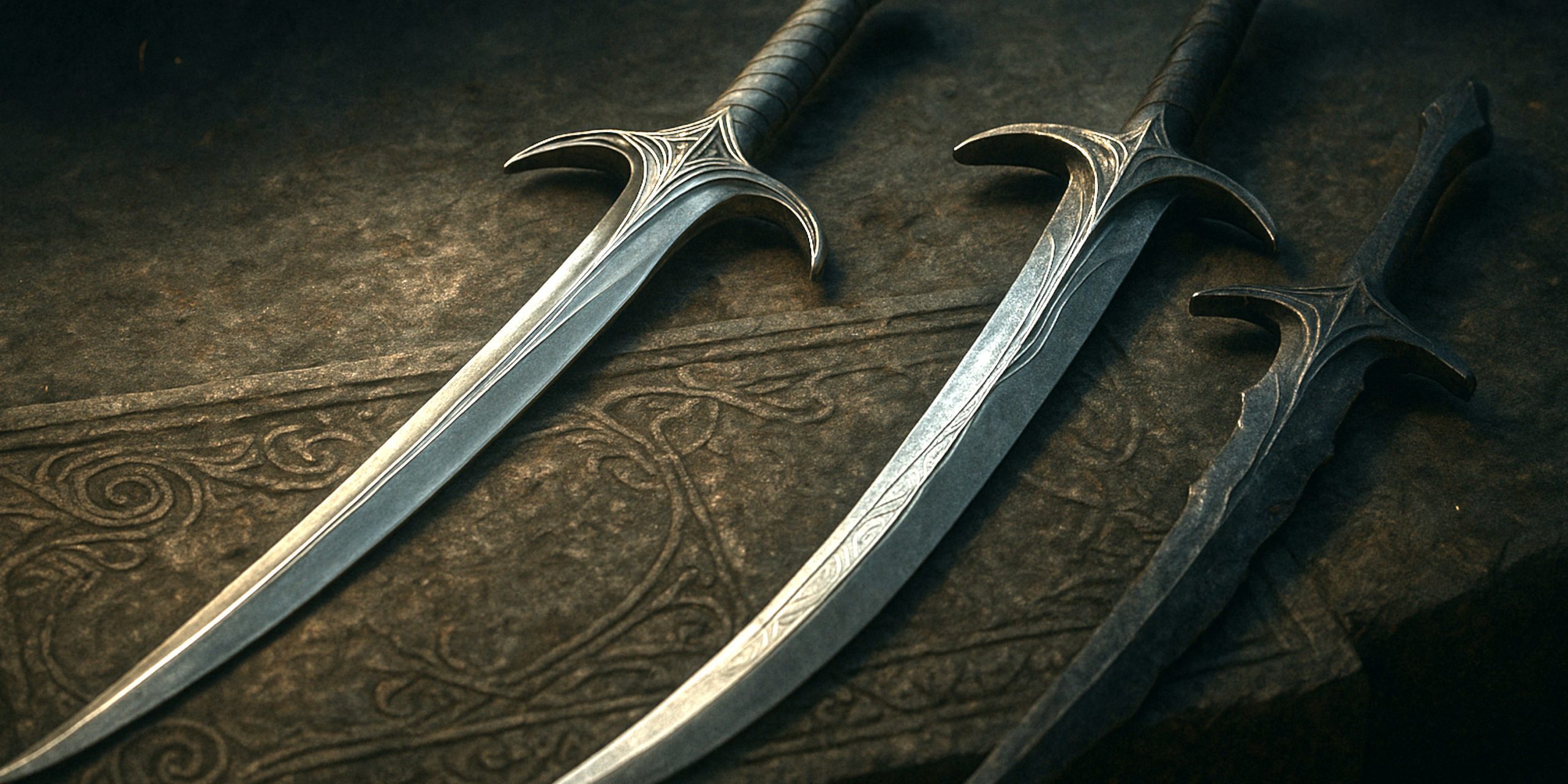
The Rings of Power absolutely understands how incredible Elven weapons should be, they make every Elven weapon look like a museum piece you could never afford to touch. From Galadriel’s razor-sharp grace to the shadowy relics unearthed in the Southlands, these swords carry centuries of pride, grief, and perfectly balanced metallurgy. Let’s be honest, Elves don’t just forge weapons, they create poetry that happens to be able to decapitate an Orc.
The Philosophy Behind Elven Blades
Elven swords aren’t just steel with an attitude. They’re bound up in Elven identity. These weapons are:
- Elegant yet deadly, designed for precision rather than brute force.
- Forged with symbolism, often reflecting light and purity.
- Timeless, with craftsmanship meant to endure millennia.
In The Rings of Power, every Elven weapon mirrors the state of its wielder’s soul. When Galadriel swings her blade, it’s less about anger and more about centuries of bottled-up frustration with everyone not listening to her about Sauron.
Galadriel’s Sword – The Blade of Relentless Will
Galadriel’s sword in The Rings of Power is the closest thing Middle-earth has to a laser-guided moral compass. Sleek, silver, and impossibly light, it reflects her obsessive pursuit of justice. Its design blends the curved elegance of the First Age with the practicality of later eras, hinting at her transformation from warrior to stateswoman.
The craftsmanship is pure Elven minimalism. No gaudy runes. No ostentatious jewels. Just lethal precision. It’s not about dominance, it’s about balance, discipline, and centuries of very pointed disappointment in Men.
Arondir’s Sword – A Soldier’s Relic
Arondir’s weapon has a different kind of beauty. It’s functional, slightly worn, and clearly used in real combat, not just ceremonial duels. It’s shorter than Galadriel’s, with a curved edge better suited to close-quarters fighting.
There’s a subtle melancholy in its simplicity. It feels like something an Elf would cling to while stationed in a human backwater, half-forgetting the forests of Valinor. When Arondir draws it, it’s not to show off, it’s because he’s the only one left who remembers what the Elves used to stand for.
The Dark Blade – Morgoth’s Lingering Shadow
No discussion of Elven swords in The Rings of Power would be complete without the dark relic that Theo discovers. At first glance, it’s the anti-Elven weapon, crude, corrupted, and dripping with malice. But it serves as a direct contrast, a mirror showing what happens when craft turns to obsession.
This blade might not be Elven in origin, but its twisted design echoes their style, almost as if Morgoth’s followers tried to imitate their perfection and ended up with a horror instead. Its presence in the series is a literal infection, a cursed fragment of a bygone age that still whispers to mortals.
How They Reflect Elven Culture
Each sword in The Rings of Power tells you something about Elves as a species:
- Perfectionism is a lifestyle.
- Beauty and war are inseparable.
- Every weapon carries a memory.
The contrast between Galadriel’s light-forged sword and the dark relic of Morgoth shows the two extremes of their legacy: creation versus corruption. For the Elves, forging a blade is an act of art, but also a declaration that even beauty can cut.
Craftsmanship: Forged Beyond Mortal Hands
Elven metallurgy in Tolkien’s world was legendary even before The Rings of Power dramatized it. Their smiths worked with materials like mithril, rumoured to be lighter than silk yet harder than any mortal metal. In the show, you can see the echo of this tradition: curved lines, mirror-polished steel, and designs that seem to channel light itself.
Unlike the rough, utilitarian weapons of Men or the brutal tools of Orcs, Elven swords are made to last ages. Their blades are an argument for eternity, and for the Elves, eternity is both blessing and curse.
Legacy and Symbolism
Elven swords have always symbolised more than warfare, they represent identity, memory, and the ache of immortality. In The Rings of Power, these weapons quietly track the decline of Elven influence. Galadriel’s blade is still sharp, but her world is fraying.
The series uses swords the way Tolkien used language: to remind us that beauty fades, even if the craftsmanship doesn’t.
The Seven Swords Takeaway
There’s a reason the Elves never mass-produced anything. Every sword is unique, a relic of pride and pain. The Rings of Power captures that duality beautifully, making each Elven weapon feel like it belongs in both a battlefield and an art gallery.
And honestly, if I ever had to pick between wielding one or hanging it on my wall, I’d probably hang it, then brag about how I “forged it myself under the light of the Two Trees.”