There comes a moment in every historian’s life when someone asks the unforgiving question. Which sword was the best. It is impossible to answer without offending several cultures at once, yet here we are. What follows is a tier list shaped by battlefield performance, historical influence and the sort of instinct that grows after too many hours spent squinting at museum glass.expanded global ranking with dates and battlefield context
S Tier. Blades that shaped entire military systems
Longsword, Europe, c. 13th to 16th centuries
The longsword reached maturity in the late medieval era when full plate armour demanded more complex fighting methods. Manuals by Liechtenauer, Fiore and Talhoffer show a weapon capable of wrestling, thrusting, binding and armoured half swording.
Prominent battles: Poitiers 1356, the Swiss Burgundian Wars (1470s), and numerous duels and judicial combats throughout the Holy Roman Empire. Its versatility made it the knightly weapon of choice in the late medieval period.
Katana, Japan, c. 14th century onward
Emerging from earlier tachi forms, the katana took its recognisable shape during the Muromachi period. Its differential hardening and curved geometry allowed swift cutting and quick drawing techniques.
Prominent battles: The Onin War (1467 to 1477), Sekigahara 1600, and widespread Sengoku period clan warfare. Samurai used it as both sidearm and status symbol.
Jian, China, c. 7th century BCE onward
Bronze jian appear in the Spring and Autumn period and develop into refined steel versions by the Han dynasty. The jian became the officer’s blade, symbolising scholarship and disciplined technique.
Prominent battles: Han campaigns against the Xiongnu (c. 2nd century BCE), the Chu Han Contention (206 to 202 BCE), and numerous palace guard engagements.
Roman Gladius, Mediterranean world, c. 3rd century BCE to 3rd century CE
The gladius Hispaniensis evolved from Iberian prototypes. Compact and lethal, it proved ideal for close formation thrusting within the Roman manipular and cohort systems.
Prominent battles: Cannae 216 BCE, Zama 202 BCE, Alesia 52 BCE, Masada 73 CE, plus nearly every Roman expansion campaign. Its pairing with Roman discipline makes it one of history’s most consequential weapons.
Talwar, Indian subcontinent, c. 16th century onward
Refined under the Mughals and fiercely embraced by Rajput and Sikh warriors. Its curved edge and disc pommel created a slicing weapon ideal for cavalry and duelling.
Prominent battles: First Battle of Panipat 1526, Battle of Khanwa 1527, Sikh battles such as Anandpur and Chamkaur (1690s to 1700s).
Shamshir, Persia, c. 15th century onward
Persian smiths perfected the deep curve and shimmering wootz steel. The shamshir excelled in mounted warfare with sweeping cuts.
Prominent battles: Chaldiran 1514, Persian Ottoman frontier conflicts, and Safavid cavalry manoeuvres throughout the 16th and 17th centuries.
Arming Sword, Europe, c. 10th to 14th centuries
The core knightly weapon before the rise of the longsword. Well balanced and adaptable for shield and mail based combat.
Prominent battles: Hastings 1066, Bouvines 1214, the Crusades including Hattin 1187 and Arsuf 1191. It defined Europe’s medieval battlefield long before the longsword arrived.
A Tier. Excellent, influential, and widely used
Viking Sword, Scandinavia, c. 8th to 11th centuries
Pattern welded cores, wide fullers and surprisingly refined balance. Not the primary weapon for shield wall fighting, yet decisive when drawn.
Prominent battles: Stamford Bridge 1066, Clontarf 1014, and raids across the North Sea and Rus’ river routes.
Spatha, Roman and early medieval Europe, c. 1st to 7th centuries
Longer than the gladius and ideal for cavalry. It gradually became the default sword of early medieval Europe.
Prominent battles: Adrianople 378, various Roman frontier engagements, and early Frankish and Visigothic campaigns.
Kilij, Ottoman Empire, c. 15th to 19th centuries
Recognisable by its yelman flare. Used by elite Sipahis and Janissaries.
Prominent battles: Mohacs 1526, Vienna 1683, numerous Balkan campaigns. It excelled in mounted charges.
Dao (especially willow leaf dao), China, c. 2nd century BCE onward
The infantry workhorse of China. The dao’s single edge made it durable, simple to train and devastating at close range.
Prominent battles: Battle of Poyang Lake 1363, the Imjin War 1592 to 1598, and Qing frontier campaigns.
Kris, Maritime Southeast Asia, c. 10th century onward
A culturally symbolic and often spiritually charged blade. Effective in close quarters thanks to its forward balance.
Prominent battles: Javanese Majapahit expansion (13th to 15th centuries), Malacca conflicts against the Portuguese (1511).
Estoc, Europe, c. 14th to 16th centuries
A stiff, edgeless thrusting weapon designed for piercing armour gaps.
Prominent battles: Castillon 1453, Burgundian Wars, and late Hundred Years War engagements where heavily armoured fighting dominated.
Shashka, Caucasus and Russia, c. 17th to 20th centuries
Guardless, incredibly fast and favoured by Cossack cavalry.
Prominent battles: Russian Caucasus campaigns (19th century), Russo Turkish War 1877 to 1878, and cavalry charges during the Russian Civil War.
B Tier. Effective within the right context or style of warfare
Kopesh, Egypt, c. 2000 to 1200 BCE
Bronze sickle sword used by Egyptian elite troops.
Prominent battles: Megiddo 1457 BCE, Kadesh 1274 BCE. Ideal for hooking shields and armour, though limited by bronze technology.
Khanda, India, c. 3rd century BCE onward
Straight, broad bladed with a reinforced spine. Delivers powerful chops.
Prominent battles: Rajput wars, the rise of the Maratha Empire, and Khalsa conflicts in the 17th century.
Falchion, Europe, c. 13th to 16th centuries
Forward weighted and brutally effective in unarmoured or lightly armoured fighting.
Prominent battles: Poitiers 1356, various mercenary actions where infantry sought reliable cutters.
Barong, Philippines, pre 16th century onward
Used by Moro warriors and admired for its chopping force.
Prominent battles: Spanish Moro conflicts, including Jolo and Bud Dajo. Excellent in dense terrain.
Kukri, Nepal, ancient to modern
Sidearm rather than sword, but devastating in close combat.
Prominent battles: Anglo Nepalese War (1814 to 1816), both World Wars with Gurkha regiments.
Yatagan, Ottoman Empire, c. 16th to 19th centuries
A short, inward curved blade used by Janissaries.
Prominent battles: Russo Turkish Wars, Balkan campaigns and extensive service across Ottoman garrisons.
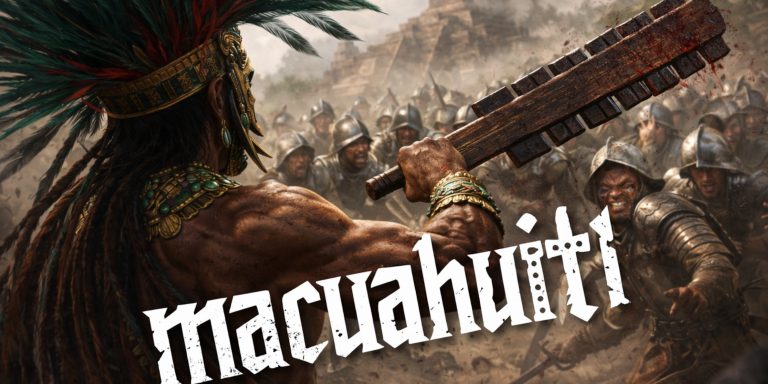
Macuahuitl, Mesoamerica, c. 14th to 16th centuries
Wooden body set with obsidian blades. Capable of astonishing trauma.
Prominent battles: Otumba 1520 during the Spanish conquest, ritual warfare among the Triple Alliance states.
Cinqueda, Italy, c. 15th century
Short, heavy and designed for brutal close work in city skirmishes.
Prominent battles: Urban clashes of Renaissance Italy rather than open field warfare. It thrived where armour was light and grudges were plentiful.
Spadroon, Europe, c. 18th century
Light infantry officer’s sword combining cut and thrust.
Prominent battles: American War of Independence, early Napoleonic officer engagements. Decent enough in emergencies, never adored.
C Tier. Culturally significant, technically limited or highly specialised
Rapier, Europe, c. 16th to 17th centuries
The chosen weapon of duelists. Exceptional for civilian defence but poor in battlefield melee.
Prominent battles: Appears mostly in officer duels rather than formal engagements.
Shotel, Ethiopia, c. 10th century onward
Curved inward to bypass shields.
Prominent battles: Adwa 1896, where traditional Ethiopian weapons still played a role despite firearms.
Kampilan, Philippines, pre 1500 onward
Associated with the Visayan peoples.
Prominent battles: Mactan 1521, linked in tradition to the death of Ferdinand Magellan.
Wakizashi, Japan, c. 15th century onward
Used indoors or as a secondary blade.
Prominent battles: Mostly duelling, castle fighting and samurai household defence. Not a battlefield star.
Xiphos, Greece, c. 8th to 4th centuries BCE
Secondary to the spear for hoplites.
Prominent battles: Marathon 490 BCE, Thermopylae 480 BCE, Plataea 479 BCE. A finisher rather than a primary weapon.
Seax, Northern Europe, c. 6th to 11th centuries
Long knife used by Anglo Saxons and Norse.
Prominent battles: Appears at Hastings 1066 among English troops. More tool than sword, though still lethal.
Daab Thai Sabre, Thailand, c. 16th to 19th centuries
Used by Siamese infantry and duelists.
Prominent battles: Burmese Siamese Wars including the fall of Ayutthaya 1767. Effective in quick strikes but overshadowed by more advanced sabres.
D Tier. Glorious, oversized or limited by metallurgy
Zweihander, Europe, c. 16th century
Two handed spectacle weapon of the Landsknechts.
Prominent battles: Mühlberg 1547, pike line disruptions in Italian Wars. Effective only in niche roles.
Scottish Great Claymore, c. 15th to early 17th centuries
Large, imposing and often unwieldy.
Prominent battles: Flodden 1513, Pinkie 1547. Inspiring, yet impractical in prolonged combat.
Bronze Age Leaf Blades, Europe, c. 1500 to 800 BCE
Elegant early metal swords limited by brittleness.
Prominent battles: Tollense Valley conflict c. 1200 BCE, one of the earliest large scale battles in Europe. Hard hitting but fragile.
Falcata, Iberia, c. 5th to 1st century BCE
Curved chopping sword used by Celtiberians.
Prominent battles: Hannibal’s Iberian campaigns, battles of the Numantine War (153 to 133 BCE). Devastating in single combat but hampered by inconsistent iron quality.
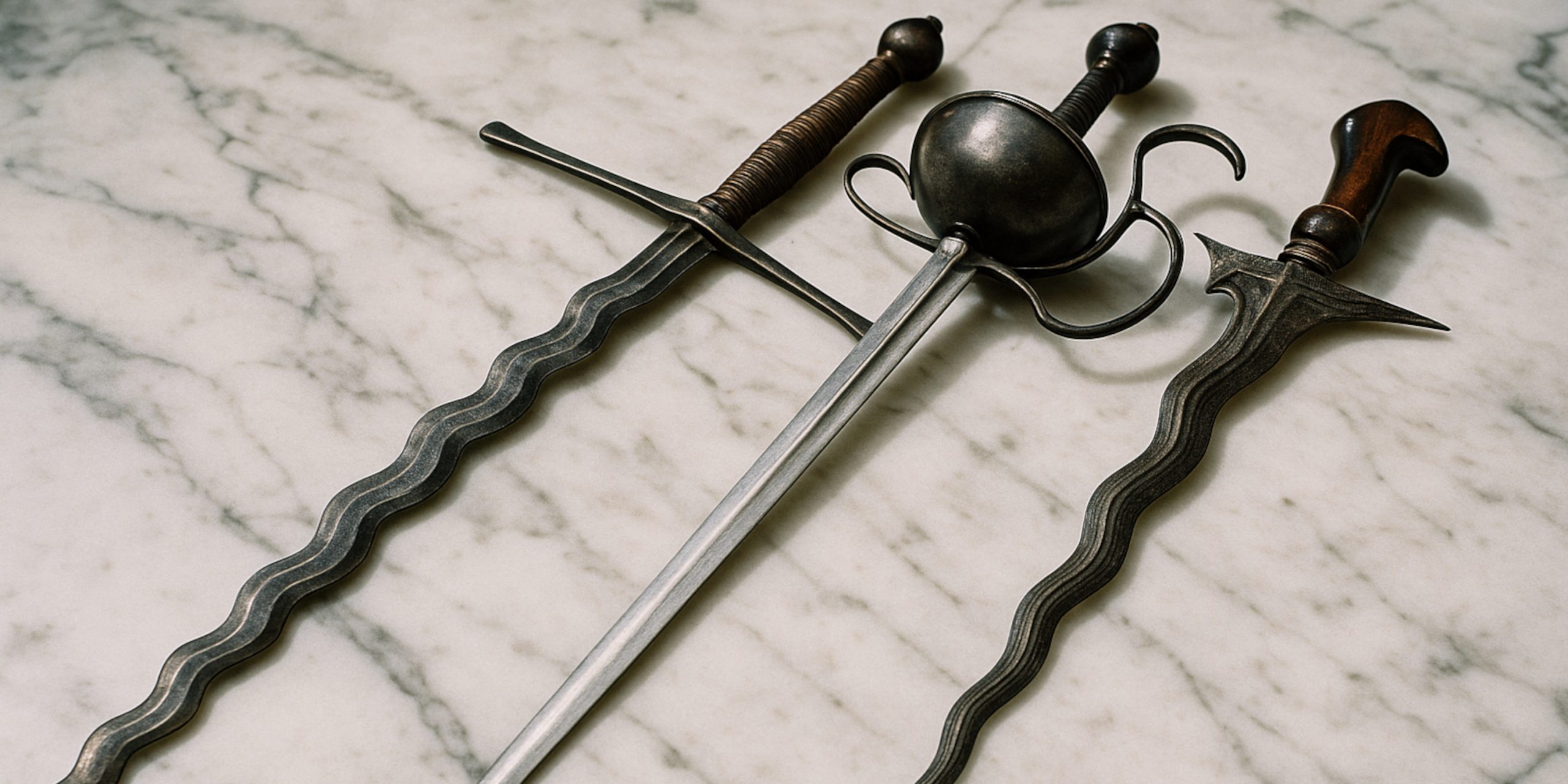
Flamberge Two Handed Sword, Europe, 16th century
The wavy blade gained fame for its intimidating look rather than measurable advantage.
Prominent battles: Ceremonial use and occasional Landsknecht deployment. Beauty over practicality.
The Seven Swords Takeaway
With dates, cultural placement and real battlefield associations, the hierarchy becomes clearer. Some blades changed the course of empires. Some ruled regional styles of combat. Others simply looked dramatic on parade days.